Paying to pass a prop firm challenge — what the money actually buys
What paying to pass actually buys in 2026: the three payment models, published prices, who absorbs a failed attempt, and eight questions to ask first.
Read guide →
Reviewed · how we check firm rules
Guides library
Long-form articles on passing evaluations: drawdown mechanics, consistency arithmetic, firm-by-firm breakdowns and the payout process. Written to be useful whether you pass your own evaluation or pay someone to pass it.
Most traders arrive with one of four questions, and the guide they need depends on which one it is. If you are choosing a firm, start with the comparison and the rules matrix — they answer structural questions faster than any article can. If you have already bought an evaluation and failed it, the guides on drawdown mechanics and position sizing are where the answers are, because almost every failure comes from one of those two. If you have passed and cannot withdraw, the consistency rule and payout process articles cover the arithmetic that firms apply. And if you are deciding whether to use a passing service at all, the honest answer is in the sections below about when it is a bad idea.
Three conventions are used consistently across the library. Percentages are paired with currency wherever a limit is described, because a 5% daily loss limit means $1,250 on a $25,000 account and $10,000 on a $200,000 one, and only the second number makes clear how much room there actually is. Trailing behaviour is always specified as intraday or end-of-day, never as just "trailing", because the two produce very different outcomes on the same equity curve. And timelines are given in trading days rather than calendar days, since firms count the days they count and weekends are not among them. If an article is missing one of those three details, it is a gap worth reporting.
Everything here is written to be useful without a purchase. Several readers use these guides to pass their own evaluation and never contact us, which is a perfectly good outcome — the material exists because understating evaluation mechanics is how traders lose money.
These six pages cover the questions that arrive most often in enquiries: how to run an evaluation step by step, how to keep it inside a risk budget, how the day count is measured, which firms leave the best day uncapped, how a stop loss is actually held by the broker, and which contracts suit a small account.
Newest first. Firm-specific guides cover the exact ruleset a trader is evaluating under, mechanics guides cover the rules that apply everywhere, and the payout section covers what happens after a pass. Every entry lists its review date and approximate length, so it is clear before clicking whether an article is a quick explanation of one rule or a full walkthrough of a firm's entire evaluation structure. Each article states the month it was reviewed, because firms change targets and drawdown behaviour more often than most traders expect.
What paying to pass actually buys in 2026: the three payment models, published prices, who absorbs a failed attempt, and eight questions to ask first.
Read guide →Is a propfirm passing service legit or a scam? What the $220 fee really buys, the terms clause that voids an account, and how to verify a pass you are shown.
Read guide →How to pass a FXIFY challenge: the six programs compared, trailing versus static floors, the 0.5% day rule, the $4,000 cap and the sizing that survives.
Read guide →FundedNext review 2026: one-step versus two-step arithmetic, real price per attempt, the Quick Strike gate, add-on economics and the traders each model fits.
Read guide →A compliance-first playbook for passing a prop firm challenge: the seven rule categories, the behaviours behind breaches, a checklist and a recovery plan.
Read guide →How to pass a Tradify evaluation: the trailing floor with a session stop, contract sizing, qualifying days, a 24-session plan and the payout conditions.
Read guide →Topstep vs Tradify compared: two futures trails with daily stops, the Combine structure against a direct evaluation, contract sizing and payout qualification.
Read guide →The5ers review for 2026: the static loss floor, one-off per programme billing, payout rhythm, strengths, cautions and the traders the rulebook actually fits.
Read guide →An independent TFT review: the two account models, how its trailing drawdown and consistency gate work, the true cost per attempt, and who the rulebook suits.
Read guide →Prop firms without a consistency rule, compared on how they treat the best day, the payout test and the evaluation. Worked arithmetic and ten plans reviewed.
Read guide →Prop firm taxes explained: why most payouts are income rather than capital gains, what records to keep per payout, and the questions to ask a local adviser.
Read guide →How prop firm scaling plans work: the three scaling models, the requirements that block traders, the math of each stage, and when a second account beats a scale-up.
Read guide →A practical risk framework for prop firm challenges: the three budgets, position sizing math, stop placement, correlation, drawdown phases and a daily protocol.
Read guide →Prop firm payout times measured stage by stage: qualification window, review, payment rail, first-payout seasoning and the four conditions that hold a request.
Read guide →How a propfirm passing service works: the rule audit, the risk plan, who holds the login, the retry policy and the funded-account handover.
Read guide →Prop firm news trading rules decoded: how the affected window is defined, why gap risk is priced, which events are usually covered and how to trade an exemption.
Read guide →MT4, MT5 and cTrader compared on the mechanics that decide evaluations: hedging, server-side stops, order types, EA support and execution transparency.
Read guide →Prop firm minimum trading days explained: what counts as a day, how the count resets, why a fast pass waits and how to plan the count without padding risk.
Read guide →Prop firm minimum deposits explained: how a deposit differs from the evaluation fee, what is refundable, and how withdrawal terms change the real cost.
Read guide →Prop firm EA rules decoded: the three permission tiers, why high-frequency and latency strategies are banned, how VPS and copy trading interact and what to disclose.
Read guide →A clause-by-clause guide to prop firm challenge rules: targets, drawdowns, daily loss, consistency, time limits and the wording traps that decide a pass.
Read guide →The twenty-two prop firm challenge mistakes that end most attempts, grouped by preparation, sizing, execution and payout, with the specific fix for each one.
Read guide →A prop firm beginner FAQ covering how evaluations work, choosing a firm, drawdown rules, fees, passing services, funded accounts, payouts and common scams.
Read guide →What it means to have your FTMO challenge passed for you: the two-phase structure, the terms position, the daily loss rule and what to verify at funding.
Read guide →A long-form essay on prop firm challenge economics: why execution beats strategy advice, how the rulebook decides outcomes and what a reviewable process looks like.
Read guide →How to pass a Lucid Trading evaluation: trailing threshold maths, contract sizing, the daily stop, a session plan and the payout conditions.
Read guide →Lot size on a $100,000 prop account calculated properly: pip values, stop distance, risk per trade, gold and index contracts, and the margin check most traders skip.
Read guide →Set a stop loss in MT5 so the broker holds it: order-ticket stops, modifying after entry, checking it survived a disconnect, and the errors that block placement.
Read guide →The honest routes to passing a prop firm challenge without trading it yourself, the shortcuts that void accounts, and what to verify before you pay anyone.
Read guide →A 2026 prop firm challenge plan built around five phases and weekly gates: preparation, phase one, phase two, verification and first payout, with a 30-day calendar.
Read guide →Passing an FTMO challenge quickly is a pacing problem, not a size problem: the setup maths, a 10-day schedule, the daily limit constraint and the consistency trap.
Read guide →Why funded accounts are lost after the pass: what changes between evaluation and funded rules, buffer sizing, conduct rules and the monthly review routine.
Read guide →How to build multiple funded accounts: the four scaling routes, per-person caps, correlation across accounts, and the arithmetic of whether a second account pays.
Read guide →How much prop firm traders make, modelled honestly: account size, return, profit split, payout frequency and costs, with worked examples and net-income tables.
Read guide →The hardest prop firm challenges scored on six rule mechanics, with the maths of trailing floors, daily stops and consistency clauses and who each one defeats.
Read guide →How to pass a Funding Pips evaluation: static floor maths, lot sizing, the percentage daily stop, cTrader workflow and a twelve-week, two-phase plan.
Read guide →FundedNext vs The5ers compared on structure: one-step versus two-step targets, consistency rules at payout, scaling programmes and which trader each fits.
Read guide →FundedNext vs Funding Pips compared: two forex evaluations that look almost identical, the model and floor differences that decide an attempt, and lot sizing.
Read guide →FundedNext vs Earn2Trade compared on floor type, daily stop, trailing behaviour, contract sizing, education bundle and payout gating rather than headline targets.
Read guide →FundedNext vs E8 Markets compared: two forex firms with model menus, the floor variants behind them, Match-Trader, lot sizing and payout gating.
Read guide →How to pass a FundedNext evaluation: the two model shapes, daily versus maximum drawdown, target pacing, the consistency gate and the sizing that survives.
Read guide →FundedNext one-step versus two-step compared on drawdown room, target math, calendar, cost and the traders each structure suits. Includes a decision framework.
Read guide →FTMO vs Trade The Pool compared on market structure, capital type, floor mechanics, share sizing, settlement, platform stack and payout gating in 2026.
Read guide →FTMO versus The5ers compared by mechanism: drawdown basis, target percentages, time limits, payout gates and the cost per funded account at each.
Read guide →FTMO vs Take Profit Trader compared: a static forex path against a futures trail, contract and lot sizing, daily stops and the two payout calendars.
Read guide →FTMO, FundedNext and My Funded Futures compared as three different products: floor mechanic, plan menu, billing rhythm, platform stack and payout gating.
Read guide →FTMO versus FundedNext in 2026, compared on drawdown mechanics, daily loss, targets, calendar, consistency and payout. Includes a worked example and a fit guide.
Read guide →FTMO's two-phase static evaluation against FTUK's pay-after-pass and instant funding model, compared on targets, fees, payout access and platform fit.
Read guide →FTMO vs Earn2Trade compared on mechanics rather than headline targets: floor type, daily stop, session rules, contract sizing and how each payout is gated.
Read guide →FTMO vs Audacity Capital compared: a two-phase evaluation against a capital allocation programme, seasoning against a minimum trading period, and lot sizing.
Read guide →FTMO review for 2026: static floor arithmetic, equity-based daily stops, the verification stage, one-off billing, payout rhythm and the traders it fits.
Read guide →A phase-by-phase FTMO strategy: separate risk budgets, targets that repeat, a verification plan and the sizing that keeps all three stages alive.
Read guide →FTMO challenge rules explained: the static loss floor, the 5% daily stop, both phase targets, the minimum trading day count and what the payout review checks.
Read guide →How to pass an E8 Markets evaluation in 2026: the One, Pro and Signature one-step products, their drawdowns, daily rules and payout gates, and the maths for each.
Read guide →How to find the cheapest propfirm passing service without buying a cheap failure: quote archetypes, the cheap-evaluation trap and what not to cut.
Read guide →Cheap prop firm challenges compared by fee per dollar of drawdown, by phase and by account size, with ten plans priced and the add-ons that change the total.
Read guide →Challenge Passing Service Review: A passing service trades an evaluation on your behalf for a flat fee and returns a funded account in your name. Worked…
Read guide →Challenge fees versus a passing service on expected cost: retake rates, subscription creep, funding odds and the break-even number most traders skip.
Read guide →How to pass a BluSky evaluation: Propel's 34% consistency rule, Launch's 50%, the EOD trailing minimum balance, monthly fees and the payout gates.
Read guide →The best trading platforms for prop firms, compared: MT4, MT5, cTrader, TradingView, Tradovate and NinjaTrader, plus the features that protect an account.
Read guide →Best Prop Firms for Scalping: Scalping depends on tight spreads, fast execution and a high trade count. Worked examples plus the terms to confirm before buying.
Read guide →Choosing a prop firm for XAUUSD trading in 2026: gold's volatility, stop distance, sizing math, the rules that break gold strategies, and a firm scorecard.
Read guide →How to choose the best prop firm as a beginner in 2026: a weighted scoring framework, the rule shapes that suit new traders, red flags and a worked comparison.
Read guide →The best micro futures for small accounts, with contract specs, tick values, margin math and worked position-sizing examples for $2,000 to $10,000 accounts.
Read guide →Instant funding skips the evaluation and sells the account directly. Ten firms compared on fee per dollar of drawdown, payout thresholds and the maths.
Read guide →How to pass an Audacity Capital allocation programme: fixed loss allowance maths, the minimum trading period, lot sizing and the profit-share billing model.
Read guide →AquaFunded review for 2026: the plan-specific loss floor, one-off per attempt billing, payout rhythm, strengths, cautions and the traders the rulebook actually fits.
Read guide →Apex vs Trade The Pool compared: futures against equity day trading, contract and share sizing, the daily stop difference and what each session demands.
Read guide →Apex vs The5ers compared: futures against forex, a live trail against a static floor, the programme ladder, lot and contract sizing, and the payout path.
Read guide →Apex Trader Funding versus GOAT Funded Trader compared on trailing thresholds, daily stops, targets, consistency, payouts and platform fit, with a scoring method.
Read guide →Apex vs Earn2Trade: a one-time 30-day Apex evaluation against Earn2Trade's monthly Gauntlet Mini, and how their 50% and 30% rules change a payout.
Read guide →Apex vs E8 Markets: a one-time 30-day futures evaluation against E8's flat-fee One and Pro, compared on drawdown, daily rules and payout gates.
Read guide →Apex vs Bulenox: two one-time-fee futures evaluations, the EOD and intraday models at each firm, where daily stops apply and what each floor does to $50,000.
Read guide →Apex first payout timeline: the 7-day activation window, the 5 qualifying trading days, the 50% consistency rule, the safety net and the review.
Read guide →What happens after you pass an Apex evaluation: the funded threshold, the payout cycle, the consistency cap, scaling and the 90-day plan that reaches income.
Read guide →Prop firm account sharing rules explained: third-party trading, family and team accounts, written authority and why a managed pass can be reversed at payout.
Read guide →The pass changes the contract, not just the dashboard. What arrives next, which rules tighten, and how to trade the first thirty funded days safely.
Read guide →How to pass a The5ers staged evaluation with no time limit: static drawdown maths, target pacing, payout gating and the discipline a deadline provides.
Read guide →Why a Friday position can fail an account before Monday even opens. How weekend rules, swap costs and gap risk interact with trailing and static drawdown limits.
Read guide →How to reach a prop firm profit target without breaching the limits: pace arithmetic, sizing from two constraints, de-risking near the target and the final stretch.
Read guide →A failed evaluation is diagnostic data. How to identify which limit broke, audit your own records, decide whether to reset, and what must change before the next fee.
Read guide →How a My Funded Futures evaluation is won: contract sizing from the dollar drawdown, daily limit arithmetic, and the funded conditions that gate payouts.
Read guide →A procedural walkthrough of an FTMO evaluation: the pre-purchase audit, the risk line, a twenty-day calendar and the decision gates that keep an account alive.
Read guide →The account size a micro futures strategy actually needs: stop distance, tick value, drawdown tolerance and the fixed costs that eat a small account.
Read guide →How to pass a GOAT Funded Trader evaluation: the futures rulebook, contract sizing from the dollar drawdown, and the failure patterns that end most attempts.
Read guide →FundedNext and Topstep evaluate different markets. Compare the percentage and dollar rulebooks, session demands, cost shapes and payouts before you buy.
Read guide →FTMO and Apex are not competing brands so much as different sports: percentage rules with fractional lots against dollar rules with whole contracts. How to choose.
Read guide →Easier does not mean smaller target. How two forex evaluations compare on drawdown mechanism, daily limits, consistency rules and the sizing method that decides fit.
Read guide →The four rules that end beginner accounts, why the biggest payout is the wrong thing to chase, how to size a first evaluation, and a 90-day path to a funded account.
Read guide →What a passing service sells, the four pricing models, the seven tests that separate a real provider from a scam and the terms trap buyers miss.
Read guide →Futures evaluations are sized in contracts and the account fails on dollars, not percentages. The criteria that actually separate one futures firm from another.
Read guide →Safety on a futures evaluation means one thing: the probability of breaching before the target. How two rulebooks compare on floor mechanism, loss rules and payouts.
Read guide →A trailing drawdown can close an account that was never losing. The arithmetic of a floor that follows peak equity, plus exit rules that keep a funded account alive.
Read guide →An independent read of Alpha Capital Group's evaluation mechanics: drawdown type, daily limits, payout gating and the trader profile the rulebook actually suits.
Read guide →How to pass the Topstep Combine: the trailing loss limit, the optional daily limit, the 55% best-day target and the pacing that funds an account.
Read guide →The prop firm consistency rule explained: how to calculate it, which firms enforce it and when, worked examples, and the prop firms with no consistency rule.
Read guide →How to pass a MyFundedFutures evaluation: plan structures, end-of-day trailing options, targets, consistency at payout and the pacing that funds an account.
Read guide →A complete, practical guide to passing a prop firm challenge: drawdown types, daily loss limits, consistency rules, position sizing and payout mechanics.
Read guide →How to pass a Take Profit Trader evaluation: trailing threshold mechanics, target sizing, the payout path and the risk plan that keeps the account alive.
Read guide →Prop firm instant funding explained: how the model works, what early payout restrictions really cost, and when passing an evaluation is the better choice.
Read guide →The funded account payout process step by step: minimum trading days, profit thresholds, consistency checks, KYC and the delays that block first payouts.
Read guide →Practical FTMO passing tips: sizing arithmetic, daily loss discipline, pacing, news handling and the routines that stop a good attempt failing late.
Read guide →How to pass an FTMO challenge and verification: the 5% daily loss limit on equity, the static 10% maximum loss, pacing and the mistakes that end attempts.
Read guide →How to pass an Apex evaluation: the EOD and intraday drawdown models, dollar targets, the 50% payout consistency rule and how to pace each account.
Read guide →How prop firm challenges are passed in 2026: the four numbers that decide every account, firm selection, pacing, the rules that end attempts and the payout path.
Read guide →What a MyFxbook-verified track record proves about a propfirm passing service, what it cannot prove, and the four checks to run before trusting one.
Read guide →How to compare propfirm passing services in 2026: the four criteria that matter, what a flat fee should cover, and the questions that expose weak providers.
Read guide →What reviews of propfirm passing services show in 2026: recurring praise, recurring complaints, five patterns to read for, and how to test a provider yourself.
Read guide →How to choose the best prop firm in 2026 for your style: the drawdown mechanics, payout terms and consistency rules that decide difficulty, at any account size.
Read guide →How to spot prop firm scams in 2026: the eight patterns that repeat, how to test a firm before paying, and what to do if you have already been caught.
Read guide →How leverage works on a prop firm evaluation: why 1:100 does not mean more risk, how margin and stop distance set risk, and what high leverage changes in practice.
Read guide →How a prop firm daily loss limit works: equity versus closed-balance measurement, when it resets, how floating losses count, and how to size so it is never hit.
Read guide →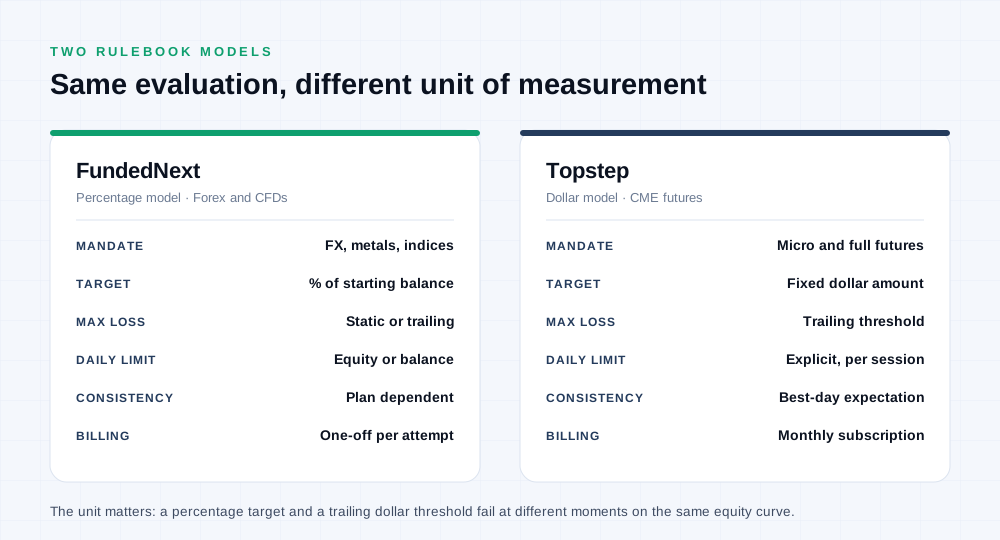
Every article in this library eventually connects back to the same four constraints, and understanding them in advance makes the firm-specific guides much easier to apply.
The maximum loss permitted in a single day, usually around 5% on forex evaluations and enforced through a dollar threshold on futures ones. The detail that matters is the measurement basis: a limit calculated on equity including floating positions is considerably stricter than one calculated on closed balance, because an open trade that is temporarily deep in the red consumes budget even if it later recovers. Traders comparing firms on headline percentages are comparing two different products.
Static floors never move. End-of-day trailing floors follow your closed profit upward at the end of each session. Intraday trailing floors follow your unrealised equity, which means a retracement can end an account while the day is still net positive. This is the single most consequential difference between firms, and it is invisible in most comparison tables — a firm advertising a "10% maximum drawdown" may be describing any of the three.
A cap on how much of your total profit may come from a single day, typically 30%. Enforced at payout by most firms and during the evaluation by a few, it is the main reason an account that looks finished cannot withdraw. The arithmetic is unsentimental: a 30% rule means your largest day must be no more than a third of your total profit, so a $6,000 best day requires $20,000 overall.
Usually four to ten days before an evaluation can be verified and, on funded accounts, before a first payout can be requested. This rule rarely ends an account, but it routinely delays one — and trying to reach the target quickly to finish sooner is what creates the consistency problem above.
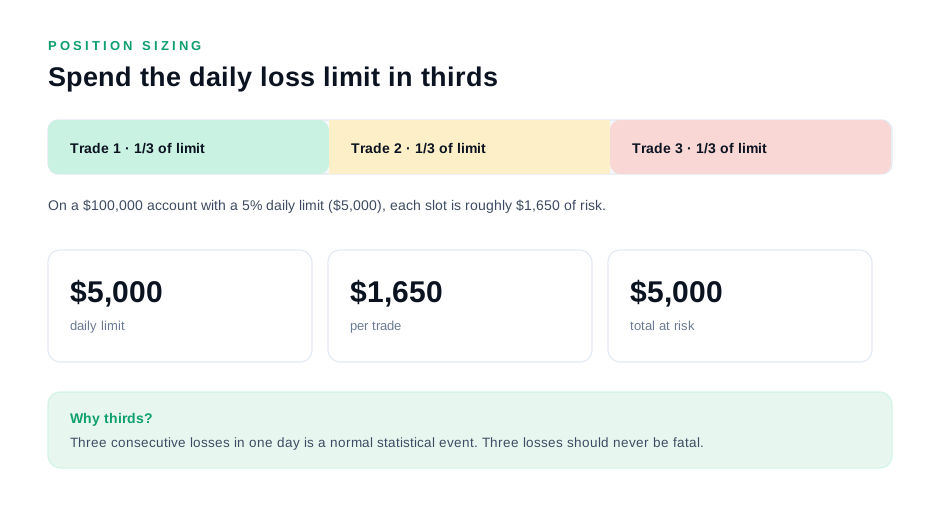
If you read nothing else: size every trade against the daily loss limit rather than against the profit target, and read the drawdown type before the target percentage. Those two habits prevent the majority of failed evaluations.
This site sells a service, so it is worth stating plainly when you should not buy it.
For everyone else — traders who can manage risk but keep breaching one specific rule — the flat $220 fee with retries covered is a straightforward trade of money for execution. The passed challenges page shows what that looks like in documented results, and the contact page explains what to include in a first message.
Four editorial rules apply across the library.
Numbers are attributed or omitted. Where a firm publishes a target, a daily limit or a trailing rule, the figure appears with the plan it applies to. Where a firm operates several products with different rules, that is stated rather than averaged away. Where a figure cannot be verified, it is left out instead of estimated.
Nothing is presented as advice. These articles describe how evaluation mechanics work and what follows from them arithmetically. They do not tell anyone what to trade, and no position, entry or market call appears anywhere in the library.
Failures are documented. Where an article covers a process — a payout timeline, a reset, a consistency calculation — the parts that go wrong are described with the same detail as the parts that go right. A guide that only describes success is a brochure.
Figures are dated. Prop firm rules change frequently, sometimes quarterly. Articles carry the month they were reviewed, and anything that depends on a firm's current terms should be checked against the firm's own documentation before it is relied on.
If a number in an article contradicts your firm's current published terms, send it with a screenshot and it will be corrected. Rules data is more useful accurate than flattering.
One final note on scope: these guides describe mechanics, not outcomes. No article can tell you what a market will do next week, and none of them tries. What they can do is remove the guesswork from the parts of prop trading that are fully determined by a rulebook — sizing, pacing, consistency arithmetic and payout sequencing — which is where the majority of avoidable failures originate.
Everything in this library reduces to a sequence. Followed in order, it removes most of the ways an evaluation ends early.
Steps five, six and ten do most of the work. Almost every failed evaluation in our own records breached either the daily budget or the trailing floor in a single session — and almost all of those sessions were a plan failure rather than a market failure.
Thirty terms that appear in rulebooks and forum threads, defined the way they are used rather than the way they are marketed.
One caution on abbreviations: firms share initials, and "max DD" means the failure threshold in one rulebook and the cushion above it in another. Where a term matters, use the firm's own definition.
Related reading: the ultimate guide covers each failure mode in depth, and the rules matrix shows which firms enforce which constraints and when.
A challenge fee is a small amount of money and a large amount of time. Answering these questions first takes twenty minutes and prevents the most common purchases that were never going to work.
1. Which market will I trade on the funded account? Forex evaluations are percentage-based with static or end-of-day trailing drawdowns; futures evaluations are dollar-based with intraday trailing thresholds and payout-stage consistency rules. Buying an evaluation in a market you do not intend to trade adds a variable you cannot control.
2. Is the drawdown static or trailing? This is the single most consequential difference between firms and the one most often glossed over. If the answer is not immediately clear from the firm's documentation, that ambiguity is itself a warning.
3. Is the daily limit measured on equity or on closed balance? The difference roughly doubles the required discipline at the same headline percentage.
4. Is there a consistency rule, and when does it apply? At payout is more manageable than during the evaluation, and none at all is the easiest to plan around.
5. Are there minimum trading days? And what counts as a qualifying day — a closed trade, an order fill, or a held position.
6. Is there an overall time limit? A window compresses the required profit per session and removes the option of waiting out a bad week.
7. Which instruments are permitted, and at what maximum size? Instrument lists are usually published; lot and contract caps sometimes are not.
8. What are the news and weekend holding rules? And how strictly are they enforced relative to the published definition.
9. What are the payout conditions on the funded account? Minimum days, profit threshold, consistency window, processing time and withdrawal methods.
10. What does a reset cost? Free within a window, a reduced fee, or a full new challenge purchase — this changes the true cost of an evaluation substantially.
11. What does the firm's client agreement say about third-party trading? If it prohibits it and enforces the policy, the funded account can be voided after the fact. That risk is worth knowing before paying anyone.
12. If I fail twice on this rulebook, what will I change? If the answer is "try harder", the plan is not a plan. A useful answer names a specific change: a different firm, a smaller size, a lower profit target per session.
Traders who answer all twelve before buying rarely end up surprised. The questions that produce the most consequential answers are two, three, eleven and twelve — and they are the four that no marketing page volunteers.
Three topics are absent from this library, and the reason is worth stating rather than leaving as an unexplained gap.
Market predictions and trade ideas. Nothing here tells you where a market is going. Prop trading content that mixes evaluation mechanics with directional calls makes the useful part harder to find, and the directional part is not something that can be written accurately in advance.
Strategy development. Whether to trade breakouts, mean reversion or anything else is a separate discipline. These guides assume a trader already has an approach and address how to fit it inside a firm's constraints — which is where most failures actually happen.
How to circumvent firm rules. Anything about hiding trades, evading detection, or exploiting a rule's letter while breaking its intent is out of scope, and requests for it are declined. The purpose of the material is to trade inside a rulebook rather than to beat it, and the firmware that a service relies on — a clean account at payout — depends on exactly that orientation.
What remains is the part of prop trading that can be described factually: how each rule behaves, what the arithmetic implies for risk per trade, what happens at payout, and which firms enforce which rules when. That is the subject of every article in the library.
No. They are written so that a trader can pass their own evaluation using them, and several readers do exactly that. Nothing in the library is gated.
Whenever a firm's published rules change materially or a recurring question produces a better explanation. Each article carries a reviewed date so you can judge how current it is.
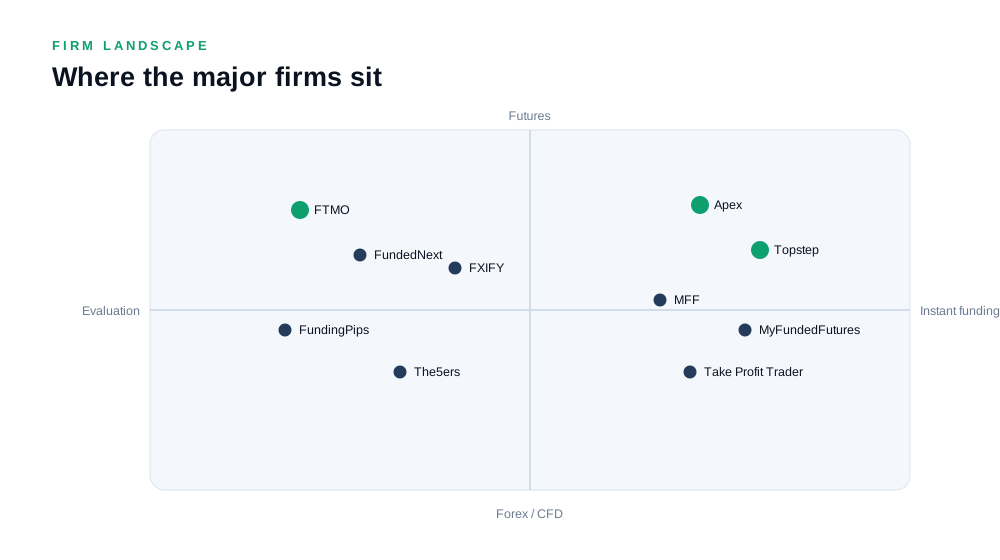
Coverage focuses on the firms most traders evaluate with — FTMO, FundedNext, The5ers, FXIFY, Alpha Capital Group, Apex Trader Funding, Topstep, MyFundedFutures, Take Profit Trader, TradeDay and MFF — and expands as new evaluation structures appear.
No, and that is deliberate. The material here is about evaluation mechanics, firm rules and payout arithmetic — the parts of prop trading that can be described factually rather than predicted.
Yes — email support@elitepropx.com. Questions that come up repeatedly in enquiries usually become articles, because answering the same question well once is more efficient than answering it individually.
With the ultimate guide, then the comparison when choosing a firm. Between them they cover the mechanics and the structural differences that decide most outcomes.
The articles here answer different questions, and reading them in publication order is the least useful way to use them. Three paths cover most situations: you are choosing a firm, you are mid-evaluation and something has gone wrong, or you are trying to get paid after a pass.
Start with the rules matrix, which reduces each firm to the four numbers that decide difficulty: how the daily limit is measured, whether the maximum loss trails, the minimum trading days, and any consistency rule at payout. Then read the comparison article for the reasoning behind the table, and the firm-specific guides only for the two or three firms you are actually considering. Reading eleven firm reviews before you know which three matter is how a week disappears.
If you are approaching a limit rather than a target, the sequence is different. Read the guide to the consistency rule first, because a rule that applies at payout can invalidate an otherwise clean pass and it is the most commonly misread constraint. Then the drawdown explainers — daily, trailing, and the arithmetic of a trailing floor — since those decide how much room actually remains. The firm-specific guides are useful here for pacing rather than rules: what a realistic pass looks like on that particular rulebook.
The payout process article covers the sequence from target to funded login to first withdrawal, including the waiting periods that surprise people. Read it before you reach the target, not after, because the profit threshold and the minimum day count usually have to be planned together — a trader who reaches a target on day six and requests a withdrawal that needs twenty days has not lost anything, but they have lost the ability to plan.
Long pages exist because short pages cannot explain a rule that has exceptions. But they are not meant to be read linearly when a specific question is pressing. Every article opens with a key-takeaways box that states the conclusion, then a contents list. If the takeaways answer your question, you can stop; if they raise a second question, jump to that section.
The worked examples are the part worth slowing down for. A table of rules tells you what a constraint is; a worked example tells you whether it applies to your account size, your instrument and your style of trading. Where an article contains arithmetic — the multiple of a best day required by a consistency rule, the distance from a trailing floor, the trade count needed to reach a target in R terms — that arithmetic is the content, and the prose around it is the explanation.
Every page carries a review date in its header. Rules change, and a page that was accurate in the spring may describe a challenge that no longer exists. If a figure matters to a decision you are about to make, check it against the firm's own rulebook on the day, and treat the article as the explanation rather than the source of record.
One last note on how to use the library when two articles appear to disagree. They usually are not disagreeing; they are describing different account types at the same firm, or the same rule before and after a revision. The review date resolves most of it, and where it does not, the firm's own terms resolve the rest.
One flat $220 for any prop firm, any account size. Retries covered, no profit split, funded login in your name. We work with any firm; before you pay we tell you in writing what its third-party trading clause says and where the enforcement risk sits.