
Complete guide · reviewed October 2026
Prop firm passing: the complete guide for 2026
Every prop firm challenge, whatever the brand, is decided by four numbers and one behaviour. This guide sets out the numbers, explains how they interact, and describes the routine that gets an account funded — including what a flat-fee passing service does and does not change.
Key takeaways
- Four numbers decide every evaluation: daily loss budget, distance to the failure level, target in R, and any payout constraint.
- Most attempts fail through a budgeting error in one session, not through a lack of analysis.
- Slower paths to target pass more often, because a failed attempt costs the fee and the elapsed weeks.
- A flat $220 covers any prop firm and any account size — the rulebook, not the brand, decides the difficulty.
Contents
What passing actually requires
Passing a prop firm challenge requires two things, and only one of them is trading skill. The first is a process that produces a modest positive return over a few weeks without a drawdown large enough to breach a limit. The second is compliance with a rulebook that was written by someone who expects most traders to fail it. Traders over-invest in the first and under-invest in the second, which is why the market is full of capable traders with a drawer of failed evaluations.
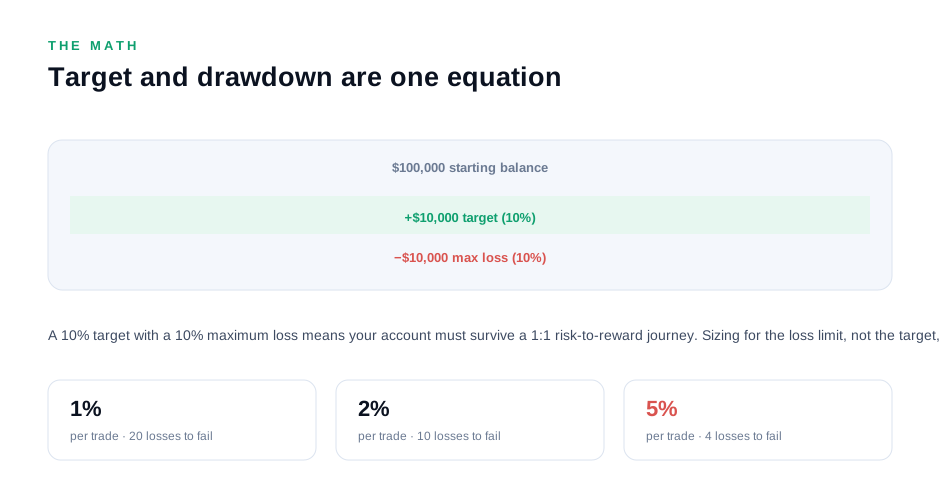
The scale of the second problem is easy to see from the arithmetic. A target of 10% with a 5% daily loss limit and a 10% maximum loss is not a hard return to generate over an unlimited calendar — it is roughly seven full-risk wins at 1.5% risk. What makes it hard is that the same account can be ended by two careless sessions, and careless sessions are what a three-week deadline produces.
So the useful frame for an evaluation is not "can I make 10%" but "can I make 10% without ever losing 5% in a day or 10% in total, while keeping my per-trade risk constant". That is a budgeting question, and budgeting questions have answers that can be written down before the first trade. The rest of this guide is that answer, generalised across firms.
Why the target is usually not the problem
Traders who fail almost never fail by being unable to reach the target. They fail by reaching it slowly and then giving it back, or by reaching it quickly and having no margin left for verification, or by reaching it and discovering a payout rule that the profit distribution does not satisfy. In all three cases the target was met; something else was not.
That is the single most valuable reframing available. It moves the work from the entry to the structure: how much is risked per trade, how many trades a session allows, how large a day is permitted to be, and how the account behaves near the finish. Those are decisions a trader can make calmly on a Sunday, rather than urgently on a Wednesday afternoon.
What the firms are actually selecting for
Firms are not selecting for the highest return; they are selecting for traders whose results can be paid out without the account collapsing. That means they favour consistency over brilliance, and the rules reflect it: daily limits, consistency checks on the best day, minimum trading days, and payout thresholds that force a trader to keep the account alive after passing it.
Once that is understood, the rulebook stops looking arbitrary. A consistency rule is a filter for traders whose profit depends on rare large days. A minimum day count is a filter for traders who cannot sustain a routine. A trailing drawdown is a filter for traders who give back unrealised gains. None of those is an unreasonable thing to filter for in someone you are about to fund.
The four numbers on one card
Whatever the firm, an evaluation reduces to four numbers. Write them down, date them, and rewrite them each morning, because three of the four move as equity moves.
| Number | Where it comes from | What it controls |
|---|---|---|
| Daily loss budget | Firm's daily limit, in dollars | Maximum exposure in a session |
| Distance to failure level | Max loss mechanic, static or trailing | Size, once equity has moved |
| Target in R | Target ÷ per-trade risk | Trade count and pacing |
| Payout constraint | Consistency, day count, threshold | What happens after a pass |
Converting percentages into dollars and trades
On a $100,000 account with a 5% daily limit and 1.5% risk per trade, the daily budget is $5,000 and each trade risks $1,500. Three losses end the day, four would breach, and the working stop is $4,000 — eighty percent of the limit, which leaves room for the float on the last position. The 10% target is $10,000, or roughly seven full-risk wins.
Those five figures — $5,000, $1,500, three, $4,000, seven — are the entire plan for that account. Everything else is execution. A trader who can recite them has a plan; a trader who knows the percentages has a brochure.
The number traders forget
The payout constraint is the fourth number and it is the one that turns a pass into income. A firm requiring no single day to exceed 30% of total profit is asking for a distribution, not just a total. A trader with a $3,000 best day needs $10,000 of total profit before a withdrawal, which means the evaluation target and the payout requirement are different thresholds and the second is the binding one.
Planning for that from the first session costs nothing. Planning for it at the payout request costs weeks.
Choosing the firm before the strategy
Firm choice is a difficulty setting, and it is set before a single trade. Two firms with the same target and the same headline drawdown can be materially different assignments once the measurement mechanics are applied, and the difference is usually invisible on a pricing page.
| Mechanic | Forgiving version | Strict version |
|---|---|---|
| Maximum loss | Static, from starting balance | Trailing from peak equity, intraday |
| Daily loss | Measured on closed balance | Measured on equity incl. floating |
| Consistency | None at evaluation | Best day capped during evaluation |
| Minimum days | Four, or none | Ten or more, enforced strictly |
| Payout | On request, low threshold | Monthly window, high threshold |
For a first attempt, the left-hand column is the correct column to pick, even at a higher fee. A forgiving rulebook bought twice is cheaper than a strict one bought three times, and the elapsed weeks are the real cost — a trader who spends nine weeks on two failed strict attempts has lost more than the fee difference by a wide margin.
What the brand does not tell you
Brand reputation is mostly a proxy for payout reliability, which matters enormously and says almost nothing about difficulty. A firm can be excellent at paying and brutal at evaluating, or vice versa. Treat the two questions separately: read the rulebook for difficulty, and read the payout record for reliability.
The practical test for reliability is whether the firm publishes clear payout terms and honours the ones it publishes. Firms with vague payout language and a long list of conditions are telling you something about how a request will be handled when the money is due.
The plan: risk, pacing and session limits
The plan is three decisions and one habit. The decisions are risk per trade, pace, and the session limit; the habit is recalculating the four numbers every morning.
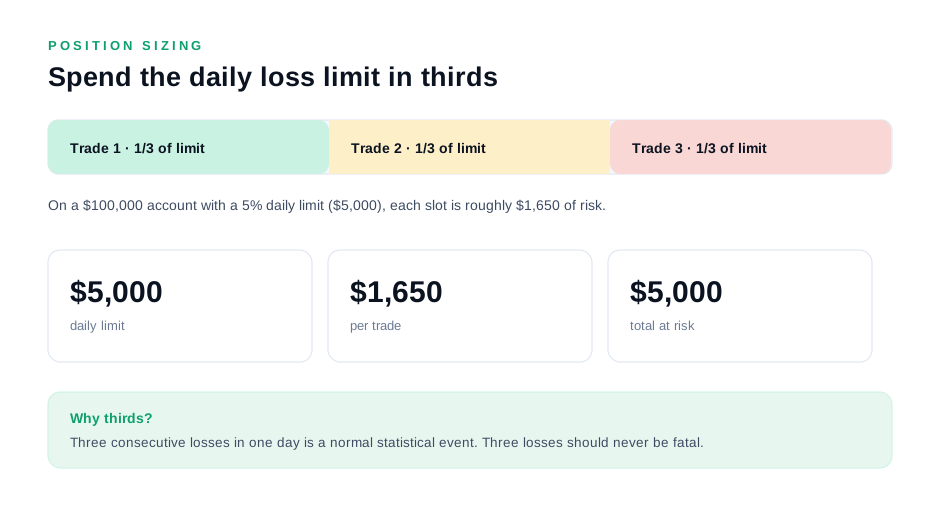
Risk per trade: one third of the daily budget
Half the daily budget means two losses end the day, and two consecutive losses are ordinary. A third means three losses are needed, which converts a bad session into a bad session rather than a failed account. The cost is that the target takes slightly longer; the benefit is that the account survives the variance it is certain to meet.
Pace: sixteen to twenty-two days, not six
There is no prize for speed and no penalty for patience, because most firms either impose no overall deadline or set one long enough that a deliberate pace fits comfortably. A target reached in six days at aggressive size means the risk was high enough that a second attempt would have been likely; a target reached in eighteen days at 1.5% risk means the process was repeatable.
| Pace | Risk per trade | Days to a 10% target | Main risk |
|---|---|---|---|
| Aggressive | 3–4% | 4–6 | One bad session ends the attempt |
| Standard | 2% | 10–14 | Sensitive to two-loss days |
| Patient | 1.5% | 16–22 | Discipline over a longer period |
Session limit: define the end before the start
A session needs three closing conditions: a profit level at which you stop, a loss level at which you stop, and a time at which you stop regardless. The third is the one traders omit, and it is the one that prevents a drifting afternoon from spending the last of the daily budget on an entry nobody planned.
The habit: rewrite the card each morning
Ninety seconds, four numbers, before the first trade. Equity, distance to the failure level, today's budget in dollars, and today's maximum position size. The numbers change as the account moves, and the day they matter most is the day a trader feels most confident and therefore least likely to check.
The rules that end attempts
Failures cluster so tightly that seven patterns cover almost every case. Six of them are budgeting failures, which is why the fix is arithmetic rather than analysis.
- The oversized position. Three or four times normal risk, usually after a good week, consuming the whole daily budget in one trade.
- The third trade. Two losses followed by a recovery trade, which breaches the daily limit rather than recovering the day.
- The give-back. A profitable position held until it reverses through entry and stop, converting a good day into a bad one.
- The deadline sprint. Size increasing in the final week because an invented finish date is approaching.
- The news gap. A stop filling beyond its level during a release, turning a planned loss into a large one.
- The rule misread. Positions held overnight or over a weekend on an account type that does not permit it.
- The abandonment. A drawdown followed by a fortnight of inactivity, then a return with a size chosen to recover in one trade.
All seven share a signature: the trader knew the rule and did not apply it under pressure. That is why written numbers beat remembered ones, and why the eighty-percent stop exists — it is the only defence that works when judgement is compromised.
Passing yourself or with a service
Everything above can be done by a disciplined trader working alone, and many are. A service adds three specific things: the rulebook translation that identifies which constraint binds today, the daily recalculation and enforcement of the budget, and the discipline to cap a winning session and reduce size near the target — sustained for two or three weeks without drift.
ElitePropX charges one flat $220 for any prop firm and any account size. Retries on rule breaches at the same firm and size are covered, there is no profit split, and the funded account is issued in the client's own name so payouts are paid directly. The flat fee is deliberate: a split model rewards large accounts and long retention, while a flat fee rewards a clean pass.
What to check before paying any service
Ask four questions and insist on written answers. What happens when an evaluation fails? What do the retry terms actually cover? Does the firm permit third-party trading, and is enforcement credible? What evidence exists beyond a testimonial? A provider that answers all four plainly is worth shortlisting; one that answers none has answered the most important question.
The third question is the one that decides whether a service is safe to use at all. Where a firm prohibits third-party trading and enforces the prohibition after funding, the client carries the entire downside: the account can be closed at exactly the point where the work would have paid. Any service that works around that has transferred its own risk to the person least able to absorb it.
From funded login to first payout
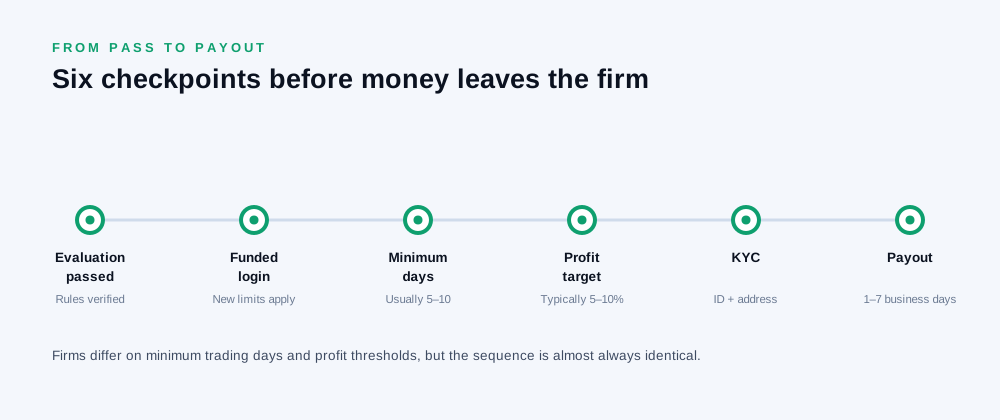
Passing is the second-hardest part of the process. The hardest is the first payout cycle, where the trailing floor or static limit applies from day one, the payout conditions are live, and there is no target to organise the trading around.
The three conditions that arrive together
Most funded accounts require a profit threshold, a minimum number of trading days, and a consistency ratio on the best day before the first withdrawal. They have different deadlines, and the efficient plan lands them on the same date rather than treating the day count as a formality to wait out.
The consistency condition is the one that blocks most first requests. Required total profit equals best day divided by the threshold percentage, so a $2,400 best day under a 30% rule needs $8,000 of total profit. An account showing $5,500 needs $2,500 of ordinary profit, added without creating a new dominant day.
Trade smaller after the pass, not larger
The instinct after funding is to make the first payout worth having. That instinct is the most common reason a funded account never pays. The first payout's purpose is to prove the pipe works; the size of it is a by-product of the account size, not of the risk taken in week one.
The one-page checklist
- Rulebook read twice — numbers, then exceptions — and dated.
- Four numbers written on a card: budget, distance, target in R, payout constraint.
- Risk per trade at one third of the daily budget, constant within 10%.
- Session closing conditions written: profit, loss, and time.
- Working stop at eighty percent of the daily limit, not one hundred.
- Pacing set at sixteen to twenty-two days; no invented deadline.
- Risk halved above seventy percent of the target.
- Journal with five fields, reviewed every week for risk drift.
- Payout conditions checked before the request, not after a refusal.
- Third-party trading policy confirmed in writing before any fee is paid.
Ten lines, one page, and every one of them is a defence against a specific failure that recurs across firms and account sizes. Traders who pass on the first attempt are rarely better analysts; they are the ones who did this arithmetic before the market asked them a question.
Forex and futures are different sports
The rules of a prop firm evaluation look similar across markets and behave very differently in practice, and traders who move between them without adjusting tend to fail on mechanics rather than on analysis.
Forex and CFD challenges
Forex firms usually measure the maximum loss statically, impose a daily loss limit on equity, and apply no consistency rule during the evaluation. Position sizing is continuous — lot sizes can be halved or doubled freely — which makes the risk arithmetic simple and precise. Targets are typically 8% to 10% with a verification phase at half that, and there is often no overall time limit.
The forgiving part is the static drawdown: a good week cannot make the account more fragile, so a trader can hold size constant throughout. The unforgiving part is the daily limit measured on equity, because a floating loss counts in real time and leaves no room for a position to breathe through noise.
Futures challenges
Futures firms more often use dollar-denominated targets and trailing drawdowns, and consistency rules at payout are common rather than exceptional. Position sizing is discrete — one contract is a large jump in risk relative to a small account — which makes precise risk budgeting harder than in forex.
The trailing floor is the defining feature, and it changes which strategies are viable: a plan that relies on holding a winner through a pullback is charged twice on a trailing account, once in the profit given back and once in the room that disappears. Futures evaluations reward exit discipline and punish patience in a way forex challenges do not.
| Feature | Typical forex firm | Typical futures firm |
|---|---|---|
| Maximum loss | Static percentage | Trailing dollars, often intraday |
| Consistency at payout | Sometimes none | Common, 30% best day |
| Sizing granularity | Continuous (lots) | Discrete (contracts) |
| Time limit | Often none | Often none, sometimes 20–30 days |
| Hardest habit | Managing floating loss | Taking profit before the floor moves |
What transfers between them
The budgeting method transfers completely: daily budget, per-trade risk at a third of it, a hard stop at eighty percent, and a written session limit. The instrument knowledge does not transfer, and neither does the exit style — a trader who scalps forex successfully will find the same approach viable on a futures account, while a trader who holds position trades will find it expensive on a trailing floor.
That is the practical reason a firm's rulebook matters more than its market. A trader with a swing style is better served by a static-drawdown forex evaluation than by an aggressively trailing futures one, even if they believe futures suit them better as a market.
Budgeting the money and the weeks
An evaluation has two costs and traders usually count only one. The fee is visible and the elapsed time is not, yet the time is the scarcer resource for anyone building a track record.
At a realistic 50% pass probability, the expected number of attempts is two, so a $540 challenge has an expected fee cost of about $1,080 and an expected time cost of about six weeks. Raising the probability to 70% by halving risk brings the expected fee to roughly $770 and the expected time to four weeks — a saving in both currencies from a change that feels like going slower.
This is also the arithmetic that makes a flat service fee interesting. Where one fee covers retries at the same firm and size, the expected cost of reaching a funded account is fixed at the price of the service, and the comparison between firms becomes a comparison of difficulty and payout terms rather than of headline challenge prices.
The weeks matter for a second reason: firms change terms, and an attempt that stretches over two months may finish under a different rulebook than the one it started with. Shorter, better-planned attempts are less exposed to that risk, which is another argument for the patient approach — it is slower per attempt but it fails less often, so it finishes sooner in expectation.
There is one further line worth adding to the budget: the cost of the funded account's first payout cycle, in time. Most programs require a minimum number of trading days and a profit threshold before a withdrawal, so the real horizon from purchase to cash is typically six to ten weeks even after a clean pass. Traders who plan for three are the ones who press, and pressing is what the plan exists to prevent.
Written down as a calendar rather than a hope, the whole sequence becomes checkable: purchase date, expected pass date, earliest payout date. A trader who can see all three stops treating the middle one as a deadline and starts treating it as an estimate, which is what it is.
A worked example end to end
Numbers generalise badly when they stay abstract, so here is one account taken from purchase to first withdrawal at every step. A $50,000 futures evaluation with a $2,500 maximum loss, a $1,100 daily loss limit, a $3,000 profit target and a minimum of five trading days.
Day zero: the four numbers
Daily budget $1,100. Distance to failure $2,500. Target in R at 0.75% risk — $375 per trade — is eight wins. Payout constraint: a 30% best-day rule at withdrawal, which means the best day must stay under roughly $1,000 while profit accumulates. The card reads: 1100 / 2500 / 8 / 30%.
Two things are immediately visible from those numbers and would not have been visible from the marketing page. First, the daily limit is only 44% of the maximum loss, so two bad days is all the account can absorb. Second, the target is eight wins at a risk level that permits three losses a day, which is a patient profile rather than a fast one.
Week one: three trades a day, flat by the close
Four days, nine trades, five wins and four losses, roughly $1,050 net. The daily budget was never threatened because the worst day lost $375 twice — two trades at full risk, then stopped. The consistency ratio is already healthy because no day exceeded $525, well under the $1,000 ceiling that a 30% rule will imply once profit reaches $3,000.
Week two: the first warning sign
A strong Tuesday makes $1,150, which is the best outcome of the evaluation and the worst piece of news. If the account were at target, that day would be 38% of profit and the payout would be blocked. At $2,300 total profit it is 50% of profit, which means the next $1,000 of profit has to arrive without making another day of that size. The correct response is not to stop — the account is working — but to reduce size to 0.5% for the remainder so that a repeat session cannot dominate the distribution.
Week three: reaching target without pressing
The remaining $700 arrives over three sessions at reduced size. The account finishes at $3,080 with a best day of $1,150, which is 37% of profit — above a 30% threshold. The evaluation is complete and the payout is not yet available, and knowing that on day fifteen is the difference between a plan and a surprise.
Two options exist. Wait for the funded account and add ordinary profit until the ratio falls under 30% (another $750 at any pace), or, if the firm permits, continue on the evaluation to build a better distribution before requesting. The first is usually correct, because the funded account's profit counts toward the same ratio and the floor there is more forgiving than a fresh evaluation.
Week four: the first payout request
On the funded account, three sessions of small trades add $820, bringing total profit to $3,900 against a $1,150 best day — 29%, just inside the threshold. The minimum day count is already satisfied, so the request goes in on a Tuesday with a flat book and verified payment details. Processing takes three business days.
The lesson from the sequence is that the evaluation was never the binding constraint. The payout condition was, and it was visible on day zero to anyone who had written down the fourth number.
What to do when an attempt fails
Failure is normal and it is also information, but only if the cause is identified rather than felt. A useful post-mortem takes twenty minutes and answers four questions in order.
- How many sessions did the attempt last? Very short attempts indicate sizing; long attempts that end suddenly indicate a discipline break.
- On how many sessions was risk outside 10% of the plan? Any number above zero explains most of the variance in the outcome.
- Which session came closest to the daily limit, and what was different about it? The answer is usually time of day, a news event, or a trade taken after a loss.
- If the attempt had ended one day earlier, would it have passed? Most failures answer yes, which is the most useful sentence an attempt can produce.
Then change exactly one thing before the next purchase. Changing three things at once makes the second attempt unreadable, and a trader who cannot read their own attempts is buying lottery tickets with extra steps.
Whether to reset, change size, or change firm
Reset at the same size if the failure was a single identifiable discipline break and the rulebook suits the strategy. Move down a size if the failure was caused by the pressure of the fee rather than by the rules — a cheaper account makes the same process easier to follow. Change firm if the failure came from a mechanic the strategy cannot accommodate, such as a trailing floor against a strategy that needs to hold through pullbacks; in that case a second attempt on the same rulebook is a second purchase of the same problem.
Frequently asked about passing a prop firm challenge
How hard is a prop firm challenge really?
In return terms it is modest — roughly seven full-risk wins at 1.5% risk for a 10% target. In rule terms it is hard, because two careless sessions can end the account regardless of the return. The difficulty is budgeting, not analysis.
How long should an evaluation take?
Sixteen to twenty-two trading days at 1.5% risk is the realistic range for a 10% target. Faster passes are possible and usually mean the risk was high enough that a second attempt would have been needed.
What risk per trade should I use?
One third of the daily loss budget. On a 5% daily limit that is about 1.65% per trade, which allows three losses in a session and keeps a normal losing sequence survivable.
Does it matter which firm I choose?
Enormously. The same target and headline drawdown can be forgiving or brutal depending on whether the maximum loss trails, whether the daily limit is measured on equity, and whether a consistency rule applies at payout.
What does a passing service cost?
At ElitePropX, one flat $220 for any prop firm and any account size, with retries on rule breaches covered and no profit split. The firm's own challenge fee is separate and is paid to the firm.
Is third-party trading allowed?
It depends on the firm, and the answer must be checked in writing before paying anyone. Some firms prohibit it and enforce the prohibition after funding, which is the most expensive possible outcome for a client.
Why is a payout sometimes refused after a clean pass?
Almost always the consistency ratio. The best day is measured against total profit at the moment of the request, so a profitable account can still be blocked until enough ordinary profit is added to bring the ratio inside the threshold.
What is the most common mistake?
Continuing to trade after a strong session. The daily budget is smallest relative to the remaining target, and the trade taken to press an advantage is the one that gives it back.