Prop Firm Rules Matrix 2026: Every Firm Compared
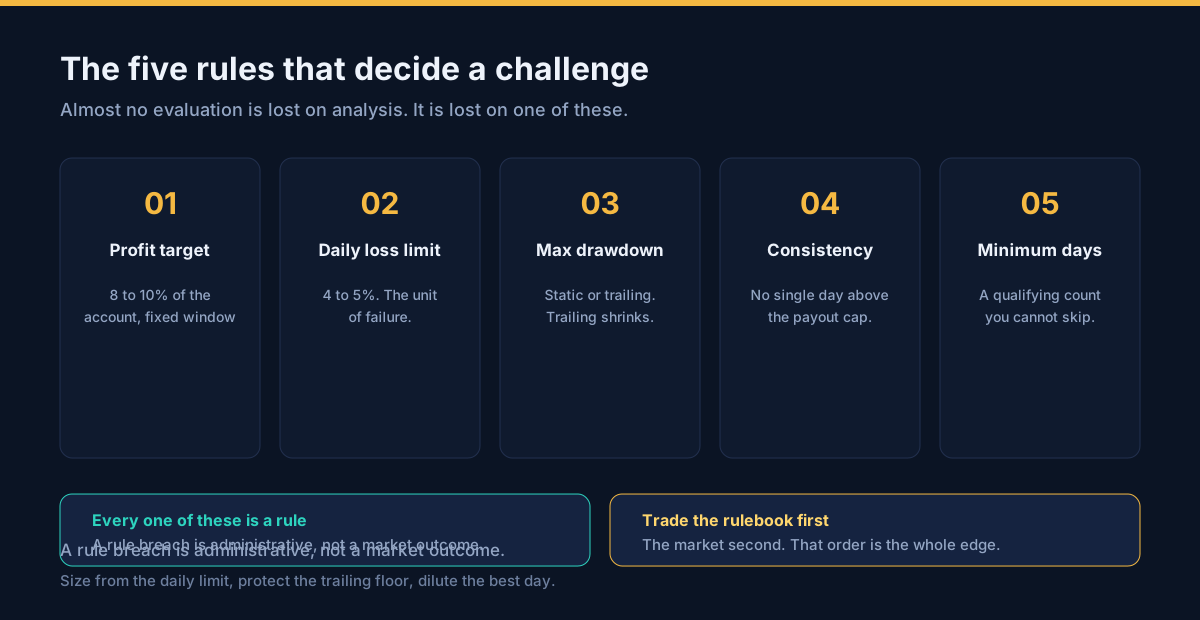
Every prop firm comparison eventually shows you the same trap: the rules that decide whether you pass are buried three clicks deep in a help centre, and the numbers move while the comparison page stays still. This page is the opposite approach — one matrix of the numbers that actually decide outcomes, with the source we read each one from and an honest confidence label on every row.
Read the caveat before the table, because it is the most important line here. Prop firms revise targets, drawdown mechanics and consistency thresholds without warning, sometimes between one evaluation and the next. The matrix below reflects what we could verify on 2026-10-01. Where a value came from a firm's own site it is labelled as such; where we could only find it in third-party write-ups it is labelled accordingly; and where we could not confirm it at all, it is marked as unconfirmed rather than guessed. When this page and your firm's live dashboard disagree, the dashboard is right.
The 2026 prop firm rules matrix
| Firm / model | Market | Profit target | Daily loss limit | Max loss | Drawdown type | Min trading days | Consistency |
|---|---|---|---|---|---|---|---|
| FTMO 1-Step Challenge |
Forex / CFD | 10% | 3% | 10% (end-of-day trailing) | Trailing (EOD) | 4 | Best Day Rule: best day ≤ 50% of positive days' profit |
| FTMO 2-Step Challenge |
Forex / CFD | 10% then 5% | 5% | 10% (static) | Static | 4 per phase | None |
| FundedNext Stellar 1-Step |
Forex / CFD | 10% | 3% | 6% (static) | Static | 2 | None during the challenge |
| FundedNext Stellar 2-Step |
Forex / CFD | 8% then 5% | 5% | 10% (static) | Static | 5 per phase | None during the challenge |
| Topstep Trading Combine |
Futures | Per account size | Per account size | End-of-day trailing | Trailing (EOD) | 2 (fastest possible pass) | Consistency Target: best day must stay below 55% of the profit target |
| Apex Trader Funding Evaluation (EOD and Intraday) |
Futures | Per account size | Per account size | Trailing - end-of-day or intraday, chosen per account | Trailing (EOD or Intraday) | None published | None during the evaluation; a consistency rule applies to PA/funded accounts |
| FundingPips 2 Step Standard |
Forex / CFD | 8% (Phase 1) | Per model | Per model | Static | 3 per phase | None during the challenge |
| E8 Markets E8 One |
Forex / CFD | Per account | Per account | Dynamic (trailing) | Trailing (dynamic) | None | None during the challenge; a 40% Best Day rule applies on the Performance account |
| Take Profit Trader Evaluation |
Futures | $1,500 to $9,000 by account size | None (removed) | End-of-day trailing during the evaluation | Trailing (EOD eval, intraday funded) | 3 | 50% |
The drawdown type column deserves more attention than it usually gets. A static limit sits below your starting balance and never moves, so profit does not shrink your remaining room. A trailing limit follows your equity high-water mark upward, which means a strong week quietly reduces the buffer you have left — and a normal pullback can breach a limit you believed was safely behind you. Two firms can advertise the same “10% maximum loss” with completely different difficulty.
Confidence, not certainty
Rows labelled third-party only or unconfirmed have not been read on the firm's own site. They are directionally useful and should never be the basis of a purchase decision. Check the specific account you intend to buy, because many firms sell several drawdown models under one brand.
What actually changed in 2026
The reason this page exists in its current form is that a surprising number of rulebooks moved this year, and the most-linked comparison pages still describe the previous version. These are the shifts worth knowing about.
- FTMO — 1-Step Challenge. FTMO's 1-Step product, with a 3% daily loss limit and a published Best Day Rule, is the significant 2026 change - most comparison pages still describe only the classic 2-step structure.
- FundedNext — Stellar 1-Step. The 3% daily / 6% static structure and the 2-day minimum are current; older write-ups quote a 5% daily limit.
- FundedNext — Stellar 2-Step. FundedNext now publishes every model on one page, which makes the Lite (8%/4%, 4% daily, 8% max) and Instant (6% trailing, no target) variants easy to confuse with the standard 2-Step.
- Topstep — Trading Combine. The 55% Consistency Target and the 5/10/15-contract caps for $50K/$100K/$150K are the numbers to quote. Traders also report that payout eligibility now requires five winning days of at least $150 each - third-party reports only, confirm on the dashboard.
- Apex Trader Funding — Evaluation (EOD and Intraday). Apex now sells two drawdown models side by side - end-of-day trailing and real-time intraday trailing - over a 30-day assessment. Most comparisons were written when only one model existed.
- FundingPips — 2 Step Standard. Minimum trading days moved: accounts opened before 26 August 2026 keep a 1-day minimum, while resets and new accounts need 2 days. A 2 Step Flex model (12% maximum drawdown, no consistency rule, no time limit) launched in June 2026.
- E8 Markets — E8 One. E8 Zero launched in July 2026 and drops both the consistency rule and the trailing drawdown, so the E8 line now spans trailing and non-trailing one-step models.
- Take Profit Trader — Evaluation. The evaluation was cut from 5 trading days to 3 in August 2026, and the drawdown type now differs between the evaluation (end-of-day) and the PRO funded account (intraday).
The pattern across most of those changes is a drift toward simpler rulebooks: fewer minimum days, no consistency rule during the challenge, and static drawdown where it used to trail. That is genuinely good news for traders, but it also means advice written eighteen months ago is now not just stale but actively misleading — a plan built around a 5-day minimum and a trailing limit is wasted work if the current account asks for three days and no consistency rule.
How to use the matrix
Find your model, not your brand
Almost every firm here sells more than one structure. Identify the exact product name — Stellar 2-Step, Trading Combine, E8 One — before reading across the row.
Compare target against drawdown, not target alone
The number that predicts difficulty is the gap between the profit target and the maximum loss. A smaller target against a tighter drawdown is harder than a larger target against a generous one.
Check when the consistency rule bites
Some firms apply it during the evaluation, some only at payout. The second kind is the one that leaves a profitable account temporarily unpayable, which is why it is worth knowing before your first trade rather than your first withdrawal.
Confirm on the dashboard before buying
Treat this page as the map, not the territory. Open the live rulebook for the account in front of you and reconcile it against the row here.
Sources we read
Each row above is traceable to one of the following. Where a row is labelled third-party only, the firm's own page could not be read at the time of writing, so it is cited honestly rather than upgraded to official on optimism.
- FTMO (Firm's own site): ftmo.oanda.com/trading-objectives/
- FundedNext (Firm's own site): fundednext.com/usa/cfds/stellar-1-step
- FundedNext (Firm's own site): fundednext.com/usa/cfds/stellar-2-step
- Topstep (Firm's own site): help.topstep.com/en/articles/8284197-trading-combine-parameters
- Apex Trader Funding (Third-party only): apextraderfunding.com/help-center/evaluation-accounts-ea/intraday-trailing-drawdown-evaluations/
- FundingPips (Firm's own site): help.fundingpips.com/hc/en-us/articles/34501809112081-2-Step-Standard
- E8 Markets (Firm's own site): help.e8markets.com/en/articles/11775980-e8-one
- Take Profit Trader (Third-party only): takeprofittrader.com/blog/3-day-evals
Frequently asked questions
The FAQ block below covers which rules matter most, how drawdown type changes difficulty, whether consistency rules apply during the evaluation or at payout, and how often these numbers change.
Which prop firm rule fails the most traders?
Is a trailing drawdown harder than a static drawdown?
Does the consistency rule apply during the evaluation or only at payout?
How often do prop firm rules change?
Can I trust the numbers on this page?
Does a passing service need to know the current rules?
Have a question before you commit?
Ask us anything about your firm, your account size or whether a passing service suits you. We answer directly on Telegram — no forms, no queues.
Ready to pass your prop firm challenge?
Flat $220 per evaluation — we trade it for you and hand over a funded account. No hidden cuts, no monthly fees. Message us on Telegram and we will answer in minutes.