How Much Money to Trade Micro Futures
“How much money do I need to trade micro futures?” has two completely different answers depending on who is carrying the contract, and most people reading about it end up budgeting for the wrong one. If you are trading your own broker account, the number is margin. If you are trading a prop firm evaluation, the number is a one-off fee and you never post margin at all. This is both answers, with the figures, and then the number that actually decides whether you survive — which is neither of them.
The four micro contracts, and what a point is worth
Everything that follows depends on per-point value, so start there. Micro contracts are one tenth the size of their full-size equivalents, which is the entire reason they exist.
| Contract | Tracks | Minimum tick | Value per tick | Value per point |
|---|---|---|---|---|
| MES | Micro E-mini S&P 500 | 0.25 pts | $1.25 | $5.00 |
| MNQ | Micro E-mini Nasdaq-100 | 0.25 pts | $0.50 | $2.00 |
| MYM | Micro E-mini Dow | 1 pt | $0.50 | $0.50 |
| M2K | Micro E-mini Russell 2000 | 0.10 pts | $0.50 | $5.00 |
| MGC | Micro Gold (10 oz) | 0.10 | $1.00 | $10 per $1 move |
| MCL | Micro WTI Crude (100 bbl) | 0.01 | $1.00 | $100 per $1 move |
That table is the whole game. When someone asks how much money they need, what they are really asking is how many of these they can afford to be wrong on, and for how long.
The first answer: what micros cost on your own account
Trading your own account means posting margin. Two different margin numbers apply, and confusing them is a common and expensive error.
- Initial margin is what the exchange requires you to hold overnight, published by the CME and revised periodically. For MES this has recently sat in the region of $1,300 to $1,900 per contract.
- Intraday margin is what your broker requires to hold a position during the session only. It is dramatically lower — commonly somewhere between $50 and $500 per MES contract.
Both numbers change, and neither is a risk budget
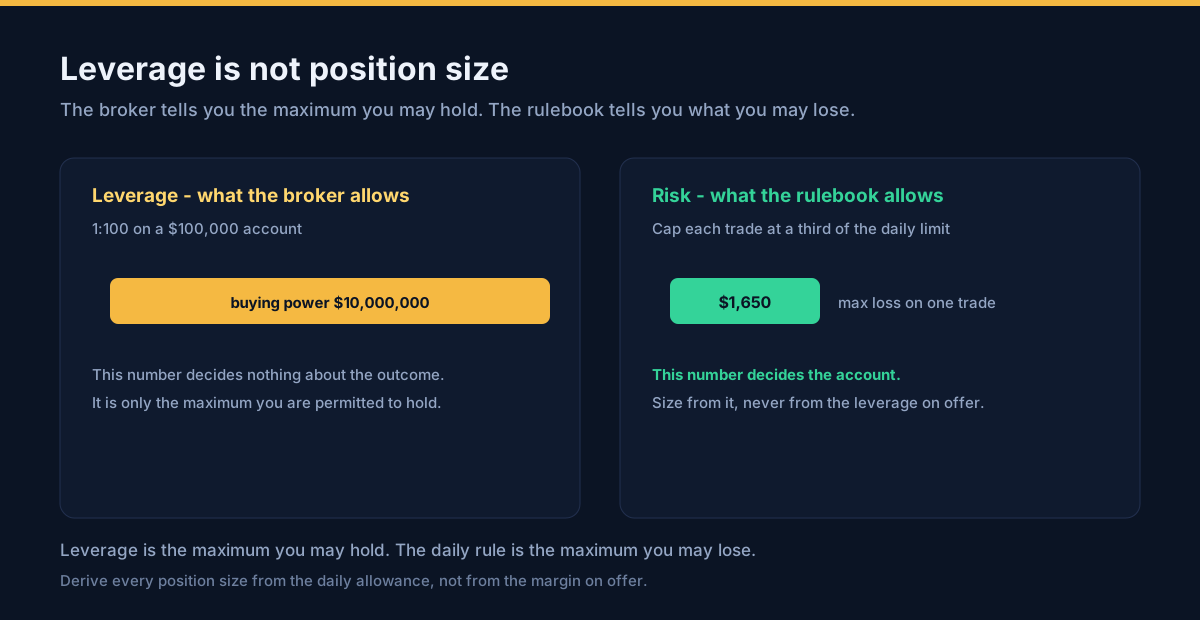
Exchanges and brokers revise margin periodically and without warning, often around volatility spikes. Check the current figure rather than trusting anything written down, including this. More importantly, the margin requirement is the minimum your broker will permit you to hold. It has nothing to do with the amount you should risk. A trader who sizes to their margin limit is leveraged to the maximum available, which is precisely how a small losing streak becomes a wiped account.
So for a practical own-account budget: one or two micro contracts, plus enough working capital to absorb a normal losing run without being forced to stop. In practice that means a few thousand dollars rather than the few hundred it looks like from the margin figure alone.
The second answer: what it costs at a prop firm
At a futures prop firm you are not buying margin. The firm holds the contract; you buy an evaluation and then trade under its rules. So the capital question collapses into a much simpler one: what is the fee?
| Account size | Typical evaluation fee | What you are actually buying |
|---|---|---|
| $25,000 | roughly $50–$160 | Access to a contract size you could not fund yourself |
| $50,000 | roughly $150–$350 | The same, with more room per trade |
| $100,000 | roughly $300–$600 | The same again, at a size where micros are the sensible default |
| $150,000+ | roughly $500–$900 | Scale, but the drawdown rules tighten in practice |
Two caveats worth more than the table. First, firms run promotions constantly, so the published price is often 40–70% off, and the fee you actually pay changes month to month. Second, and more important: the fee is not the expected cost. If you reset or re-buy an evaluation twice before passing, your real outlay is three fees. That is the number to budget against, and it is the single most common budgeting error in this market. The full breakdown of challenge pricing is in our challenge fees versus passing service comparison, and the cheapest available options are ranked in cheapest prop firm challenges.
The number that actually decides your risk
Neither margin nor the fee determines whether your account survives. The drawdown limit does. Size from that, and the capital question becomes almost irrelevant.
The method is the same one we use for forex lots in our lot size guide, with per-point values instead of pip values:
Contracts = risk budget ÷ (stop distance in points × value per point)
Take a $50,000 account with a $2,000 trailing drawdown, and the discipline of risking no more than a third of the allowance on any single trade:
| Contract | Risk budget | Stop | Risk per contract | Max contracts |
|---|---|---|---|---|
| MES | $660 | 10 pts | $50 | ~13 |
| MES | $660 | 20 pts | $100 | ~6 |
| MNQ | $660 | 20 pts | $40 | ~16 |
| MNQ | $660 | 40 pts | $80 | ~8 |
| M2K | $660 | 15 pts | $75 | ~8 |
Read those numbers as ceilings, not targets. The honest observation from watching these accounts is that traders who pass are usually holding well below the maximum, and traders who breach are usually at or above it. A smaller position costs you speed. A larger one costs you the account, and only one of those is recoverable.
Why micros matter more at trailing-drawdown firms
Most futures firms use a trailing drawdown rather than a static one. The floor follows your equity high-water mark upward, which means that as you profit, the distance between your current equity and your failure point does not grow — and at some firms the floor keeps climbing until it reaches your starting balance.
This produces a specific failure mode that has nothing to do with analysis. You build profit, the floor rises under you, you take one larger position on a high-conviction setup, it goes against you, and the account ends while you are still net profitable overall. Micros are the direct counter-measure: they let you hold absolute per-trade risk roughly constant while the account grows, so progress does not increase your exposure. Full-size contracts make that calculation impossible on a modest account, because one contract's point value is too large a step.
The mechanics of both rule types are set out in the daily drawdown explainer, and the firms themselves are compared in our best futures prop firms guide.
Worked example: a $50,000 evaluation
Suppose a $50,000 evaluation with a $2,000 trailing drawdown, a $6,000 profit target and no minimum day requirement, traded in MNQ.
Set the per-trade ceiling
A third of $2,000 is $660. With a 20-point stop at $2 per point, that is up to 16 contracts. We would open with 6 to 8 and treat 16 as a hard ceiling that is never reached.
Convert the target into daily arithmetic
A $6,000 target over 15 sessions is $400 a day. At 8 MNQ contracts, $400 is 25 points. That is a modest daily session, which is the point — the target is never supposed to require a big day.
Check the floor before adding size
Once the account is $3,000 up, the trailing floor has moved up to $1,000 below the starting balance. Recalculate the ceiling against the remaining room, not the original $2,000, and keep the risk fraction constant.
Stop rather than recover
Two losing trades close the session. A third is how a bad morning becomes a breach, and the drawdown is a percentage of the account — the recovery attempt is where the account actually dies.
What people get wrong
- Reading the margin figure as a budget. It is a permission, not a constraint.
- Budgeting one evaluation fee. Plan for the retries; they are close to normal, not exceptional.
- Sizing from the account balance. The drawdown is the binding constraint, and it is often a tenth of the balance.
- Assuming micros are a beginner's crutch. Micros are a risk-precision tool. Plenty of funded traders stay on them permanently for exactly that reason.
- Trading full-size on a small account to pass faster. Speed is not the objective. Not breaching is the objective.
- Ignoring commission. On micros, per-contract fees are a larger share of a winning trade than on full-size contracts, and they are charged on every round turn.
If the arithmetic above is the part you are comfortable with but the execution is not, that is a different problem from a capital one — see how our passing service works and what it costs. Either way, run your own numbers first with the prop firm profit calculator.
Frequently asked questions
The FAQ block below covers how much money you need to start, MES margin, micros versus a prop firm evaluation on cost, contract counts for a $50,000 account, why micros suit trailing drawdowns and whether trading smaller hurts your chances of passing.
How much money do I need to start trading micro futures?
What is the margin on one MES contract?
Is it cheaper to trade micro futures or a prop firm evaluation?
How many micro contracts should I trade on a $50,000 account?
Why do micro futures suit prop firm challenges so well?
Does trading micros instead of full-size contracts hurt my chances of passing?
Have a question before you commit?
Ask us anything about your firm, your account size or whether a passing service suits you. We answer directly on Telegram — no forms, no queues.
Ready to pass your prop firm challenge?
Flat $220 per evaluation — we trade it for you and hand over a funded account. No hidden cuts, no monthly fees. Message us on Telegram and we will answer in minutes.