Flat pricing, every account size
The work does not change with account size, so the fee should not either. A provider quoting by size is charging you for your balance, not their effort.
Everyone wants the cheapest prop firm passing service, and that instinct is reasonable — until you look at what "cheap" means in this market. The lowest advertised fee is often attached to the most expensive pricing model in the industry. Here is how to find genuine low-cost value rather than a low number with a long tail.
Two services can both advertise passing your challenge, and one can charge $99 while the other charges $220. On the surface the $99 option is obviously cheaper. In practice it is frequently the more expensive one by an order of magnitude, because of how it recovers its margin.
| Service | Fee | After funding | Cost after $10k withdrawn |
|---|---|---|---|
| "Cheap" provider | $99 | 30% of every payout | $3,099 |
| Flat-fee provider | $220 | Nothing | $220 |
The $99 service costs fourteen times more. This is the single most important thing to understand about pricing in this category: a profit split converts a one-time fee into a permanent claim on your trading. The cheaper the headline, the more likely a split is hiding behind it.
$50–$600. Identical on every route, so it does not differentiate providers — but it is real and it repeats on every failed attempt.
$100–$500 flat, or a low number attached to a split. This is the only line that genuinely varies.
Zero if the provider covers failures, hundreds more if they do not. A provider that charges again after a failed attempt has effectively priced their service as a lottery ticket.
Zero with a flat-fee provider. Potentially thousands per year with a split provider. This single line usually decides which service is actually cheapest.
The work does not change with account size, so the fee should not either. A provider quoting by size is charging you for your balance, not their effort.
The defining feature of an actually cheap service. If the provider takes a percentage after funding, the up-front fee is irrelevant.
This removes the biggest variable cost in the whole exercise — the cost of attempts that fail. It converts an open-ended expense into a fixed one.
Monthly retainers bill you whether or not you make progress. A one-off fee only exists once.
There is a genuinely free option, and it deserves to be stated plainly. If you can pass your own challenge, the only cost is the evaluation fee itself — no service fee, no split, and no third-party trading risk. For traders with a solid pass rate and enough screen time, self-passing is not just the cheapest route, it is the best one.
We publish full, free guides for exactly that: the ultimate guide to passing a prop firm challenge, the consistency rule breakdown, and firm-specific walkthroughs for FTMO, Apex and Topstep. If those solve your problem, you do not need to spend anything.
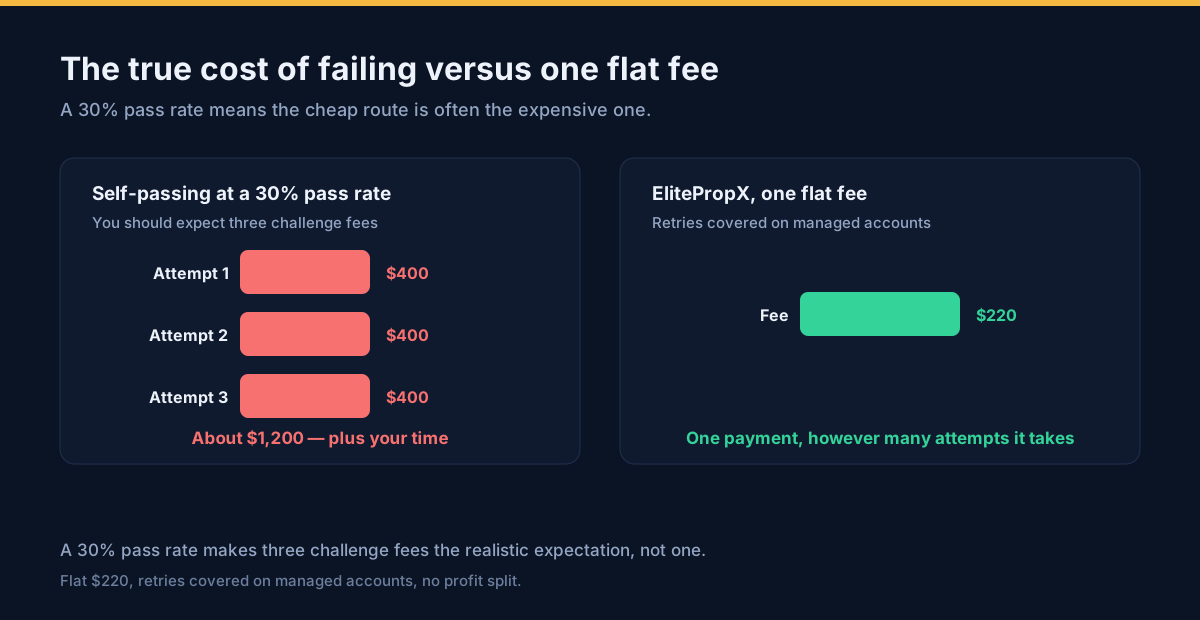
The flat fee only becomes the cheaper option when your realistic pass rate is low. At a 30% pass rate on a $400 challenge, self-passing costs roughly $1,330 in evaluation fees before a single success. That is where a $220 flat fee stops being a cost and starts being a saving.
Since this page is about cost, here is ours without ambiguity: a flat $220 per evaluation, any account size from $10,000 to $400,000. No profit split — the funded account is 100% yours. Retries covered on managed accounts. No subscription, no recurring charge, no upsell tier. The prop firm's own evaluation fee is separate and paid to the firm. Full details on the flat-fee prop firm passing service page.
The FAQ block below covers which services are cheapest on total cost, why some appear cheap, whether low fees are risky, total cost of ownership and the free self-passing route. Related: prop firm passing service cost and no profit split passing services.
Ask us anything about your firm, your account size or whether a passing service suits you. We answer directly on Telegram — no forms, no queues.
Flat $220 per evaluation — we trade it for you and hand over a funded account. No hidden cuts, no monthly fees. Message us on Telegram and we will answer in minutes.