Apex vs Topstep: Which Is Safer?
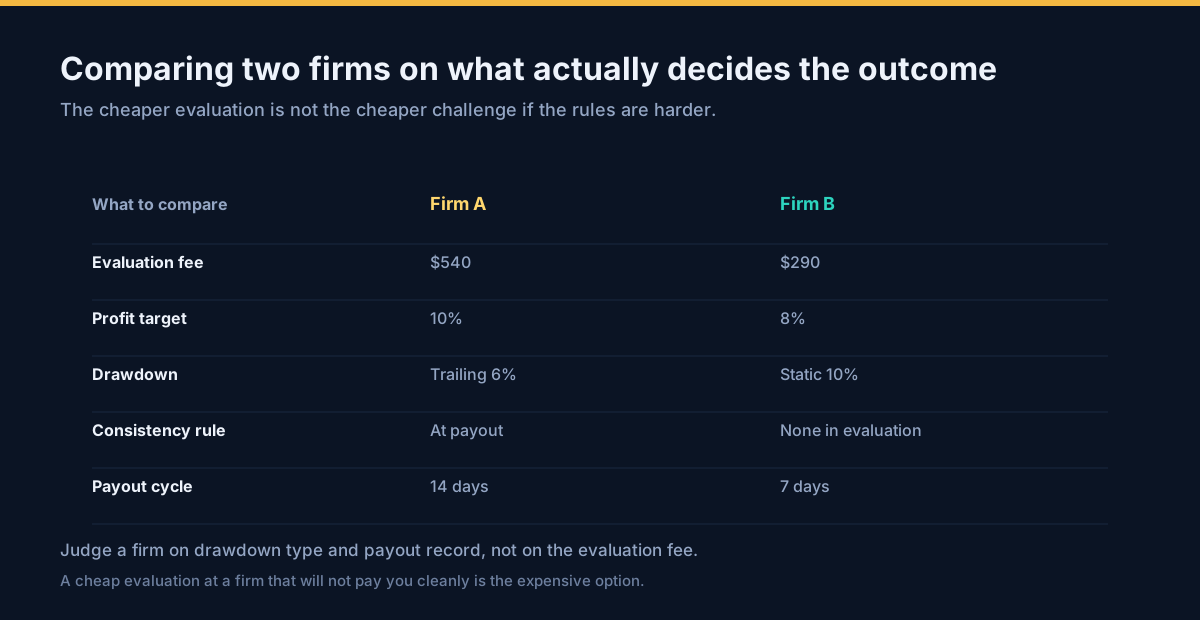
Apex Trader Funding and Topstep are the two names most futures traders compare, and the comparison is usually framed as "which is easier". That is the wrong question. The right question is which one is safer for your specific failure mode — because the two firms fail traders in different ways, and the one that protects you depends on how you break.
The structural comparison
| Factor | Apex Trader Funding | Topstep |
|---|---|---|
| Account sizes | $25k – $300k | $50k – $150k |
| Drawdown | Trailing, locks at a defined profit | Trailing, plus a daily loss limit |
| Daily loss limit | No hard daily limit in the same form | Yes — tight, hard stop |
| Consistency rule | Applied at payout | Applied at payout |
| Platforms | Tradovate, Rithmic, TradingView | TopstepX, Tradovate, TradingView |
| Standout | Widest account range in futures | Longest payout track record |
Both firms use a trailing drawdown. Both apply a consistency rule at payout. Both fund simulated futures accounts and pay real withdrawals. The behavioural differences come almost entirely from the daily loss limit and the shape of the trailing mechanic.
The trailing drawdown, at both firms
The floor follows your highest balance upward, keeping a roughly constant gap between peak and floor. The consequence is the same at both firms and remains the single most misunderstood mechanic in futures prop trading.
The mistake that ends accounts at both firms
On a $50,000 account with a $2,500 trailing threshold, take a trade that runs $1,000 into profit and the floor rises to $48,500. You are still $2,500 from the peak but only $1,500 from your starting balance. Traders who believe they have $3,500 of room — the starting buffer plus the profit — are wrong, and they discover it by losing the account.
At both firms the relief is the lock point: at a defined profit level the threshold stops trailing and the floor becomes fixed. Reaching that point safely converts a difficult account into a normal one, and it should be the explicit objective of the early phase.
Where the two firms differ behaviourally
Topstep's daily loss limit is the tighter constraint
Topstep imposes a hard daily loss limit that ends the session and, at minimum, the evaluation if breached. That makes Topstep genuinely more dangerous for traders who revenge-trade within a day — the behaviour most likely to consume a daily allowance quickly.
If your pattern is "small morning loss, larger lunchtime position to recover, second loss, doubled position into the close", Topstep will end you faster than Apex.
Apex's trailing floor is the harder concept
Apex's constraint is conceptual rather than daily. There is no tight daily stop in the same form, but the trailing floor punishes exactly one behaviour: holding a winner that reverses. Traders who let profits run without banking them — correct on a personal account — lose Apex accounts in the middle of trades they believe are break-even.
If your pattern is "position goes into profit, I hold for more, it comes back, I exit near flat and the account is gone", Apex is the harder firm for you.
| Your failure pattern | Harder firm | Safer firm |
|---|---|---|
| Revenge trading within a session | Topstep (daily limit) | Apex |
| Holding winners until they reverse | Apex (trailing floor) | Topstep |
| Oversizing with full contracts early | Both equally | Neither — use micros |
| Taking one outsized profitable day | Both (consistency rule) | Neither — pace profit |
| Holding through news | Topstep (daily limit first) | Apex, marginally |
Account size and target ratio
Apex offers a wider range, from $25,000 to $300,000, which means more opportunity to select a favourable target-to-drawdown ratio. Smaller tiers at either firm generally present a better ratio than the largest tiers, because profit targets and drawdowns do not always scale proportionally.
The practical guidance is the same at both: read the ratio, not the dollar figure. A firm where the target is 1.2× the drawdown is materially easier than one where it is 2×, because the second requires roughly double the profit per unit of risk budget.
Costs
Both firms price competitively and both run promotions that reduce the effective fee substantially. Two points matter more than the headline price.
- Retry cost is the real cost. At a 30% pass rate you should expect to buy roughly three evaluations before one succeeds, whichever firm you choose. That is the number to compare against a flat-fee service, not the sticker price.
- Topstep's subscription framing. Where Topstep structures access on a recurring basis, a slow pass costs more in elapsed months. That is a genuine argument for pacing efficiently rather than retrying casually.
Our passing service cost breakdown works through the expected-attempt arithmetic in detail.
Platforms
Both firms support Tradovate and TradingView, so a trader migrating between them keeps most of their workflow. Topstep additionally offers TopstepX, which integrates the firm's own rule engine — a genuine advantage, because drawdown and daily-limit tracking is accurate and live rather than estimated.
If you use a fully customisable setup with EAs or advanced charting, note that both firms restrict certain automation patterns. See our EA and automated trading guide.
The consistency rule at both firms
Both apply a consistency requirement as a payout condition, commonly capping any single day at around 30% of total profit. Because both firms fund futures accounts where targets are reached in fewer, larger days, this rule bites harder than it does at forex firms — and it is the most common reason a completed evaluation cannot immediately be withdrawn from.
Reaching the target is not the finish line
At either firm, a pass achieved with one dominant day requires additional trading before the payout is released. The fix is to pace profit from the start. See the consistency rule guide.
Payouts — the decisive factor
Everything above is secondary to payout reliability. A cheap evaluation at a firm that stalls withdrawals is the most expensive option in the market, and a slightly harder evaluation at a firm with a documented payment history is far better value.
Both Apex and Topstep have established records, which is precisely why they dominate the futures conversation. When comparing them, check the current minimum qualifying days, the minimum payout amount, the consistency threshold and the processing cadence — and weight independent withdrawal reports above marketing claims.
The practical answer
Diagnose your failure mode first
Look at your last two failed attempts. Was it a daily breach from oversizing after a loss, or a trailing-floor breach from holding a winner? That answer selects the firm.
Pick the account tier by ratio, not size
Compute target ÷ drawdown and choose the most favourable ratio you can trade calmly.
Trade micros until the threshold locks
At both firms, micros are the correct instrument in the pre-lock phase. This is not a beginner concession; it is the mathematically sound choice.
Pace profit for payout eligibility
Both firms apply a consistency rule. Distribute gains from day one so reaching the target also means being able to withdraw.
Consider running both
Futures accounts at multiple firms diversify single-firm risk and multiply payout streams. It is a legitimate scaling strategy.
Frequently asked questions
The FAQ block below covers which firm is safer, trailing drawdowns, which evaluation is easier, payout speed, whether we can pass both and whether to run accounts at both firms. Related: the Apex complete guide, Topstep challenge passing and what a passing service costs.
Is Apex or Topstep safer?
Do Apex and Topstep both use trailing drawdowns?
Which firm has the easier evaluation?
Which pays faster, Apex or Topstep?
Can you pass both Apex and Topstep for me?
Should I run both Apex and Topstep accounts?
Have a question before you commit?
Ask us anything about your firm, your account size or whether a passing service suits you. We answer directly on Telegram — no forms, no queues.
Ready to pass your prop firm challenge?
Flat $220 per evaluation — we trade it for you and hand over a funded account. No hidden cuts, no monthly fees. Message us on Telegram and we will answer in minutes.