Prop Firm Scams to Avoid
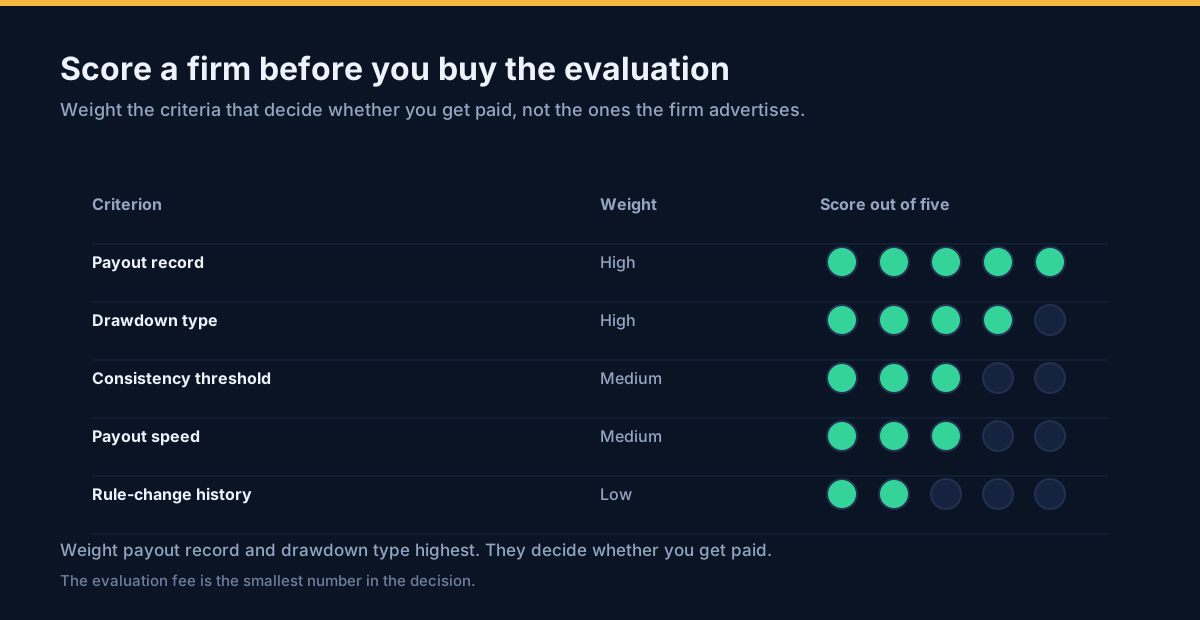
Most writing about "prop firm scams" focuses on outright fraud, which is rarer than the industry's reputation suggests. The more common and more costly problem is a firm that is technically legitimate but structurally designed to make payouts difficult. This is a guide to spotting both, with the warning signs that actually predict trouble.
The distinction that matters
There are two separate categories, and conflating them makes the problem harder to navigate.
| Outright fraud | Evaluation farm | |
|---|---|---|
| What it is | A firm that never intended to pay | A legitimate firm optimised around evaluation revenue |
| How common | Rare, but damaging | Common, and the bigger industry-wide issue |
| Warning sign | Payments stop entirely, support disappears | Payouts are possible but procedurally difficult |
| Your protection | Operating history and verification | Reading the payout terms before buying |
The second category is the one that costs most traders money, precisely because it is not illegal. A firm can publish rules that are genuinely hard to satisfy, apply them consistently, and never be accused of fraud — while still taking far more in fees than it pays out.
The twelve warning signs
No verifiable payout history
The single most important factor, and the hardest to fake over time. A firm operating for years with documented withdrawals is a fundamentally different risk from one launched recently with screenshot marketing.
Payout screenshots as the primary evidence
Screenshots are trivial to fabricate. If marketing leans on images rather than on a track record, discount them entirely.
Vague or shifting rulebooks
Rules should be specific and stable. If the published terms are ambiguous, or if they change between your evaluation and your payout, that ambiguity will be resolved against you.
Payout conditions buried in the terms
Consistency rules, minimum qualifying-day definitions and payout thresholds hidden deep in legal text are the most common cause of surprise blocks. A transparent firm surfaces them.
Pressure to buy more before your first payout
Upsells to additional accounts, add-ons or resets before you have been paid once are a warning. A healthy model earns after your success, not before it.
Retroactive rule application
Applying a rule change to activity that occurred before the change is a serious red flag, and one that is difficult to remedy once your payout is at stake.
Open-ended payout processing
"Payouts are processed within 14–30 business days" with no cadence is a structure that can extend indefinitely. Prefer firms that state a defined cycle.
Support that disappears when money is involved
A firm's character shows most clearly during a contested payout. Slow or evasive responses at that moment are more informative than any amount of fast pre-sale chat.
Unrealistic marketing claims
"Instant funding", "100% pass rate", "guaranteed profit". Claims that cannot be true signal that accuracy is not the priority.
Fees that escalate unexpectedly
Activation fees, reset fees or platform fees that appear after purchase change the economics you agreed to. Read the full fee schedule, not the headline price.
No clear company identity
A firm with no verifiable legal entity, address or long-standing web presence offers no recourse. This is rare among established firms and common among short-lived ones.
No independent trader community
If nobody outside the firm's own channels discusses it — positively or negatively — that absence of a track record is itself information.
What to check before you buy
| Check | What good looks like |
|---|---|
| Operating history | Several years of activity with a documented presence |
| Payout evidence | Independent reports, not just screenshots |
| Rule clarity | Specific, published, stable terms |
| Payout cycle | A defined cadence with stated processing times |
| Total fees | A complete schedule with no post-purchase surprises |
| Support | Responsive, and specifically responsive about payouts |
| Consistency rule | Published, ideally with the threshold and when it applies |
The structural protection: diversify
No amount of due diligence eliminates firm risk entirely — rule changes, ownership changes and payout policy shifts happen at firms with good records. The most practical protection is therefore structural: do not concentrate your entire operation in one firm.
- Spread funded accounts across two or three reputable firms.
- Mix rule types — a static-drawdown forex account and a trailing-drawdown futures account fail in different ways.
- Stagger payout cycles so your income does not depend on one firm's processing week.
- Keep records of every payout you receive, including dates and amounts, which is valuable if a dispute ever arises.
This is the same logic that makes multiple funded accounts attractive in general — see how to get multiple funded accounts.
Applying the same scepticism to passing services
The passing-service category has its own version of these problems, and the checks are similar: published pricing, no hidden profit split, a stated retry policy, honest risk disclosure and verifiable results. Our how to find a legit passing service guide applies the same framework to providers, and the category review explains where we sit against it.
The uncomfortable symmetry
We sell a passing service, and we recommend you apply strict scepticism to passing services — including ours. Published pricing, a written retry policy, no profit split, firm-specific results and an explicit warning about third-party trading terms are the standards we hold ourselves to, and the ones you should demand.
Frequently asked questions
The FAQ block below covers how to identify a scam firm, whether prop firm payouts are real, what an evaluation farm is, fabricated screenshots, upsell pressure and how to protect yourself. Related: best futures prop firms and best prop firms for beginners.
How do I know if a prop firm is a scam?
Are prop firm payouts real?
What is an evaluation farm?
Are fake payout screenshots common?
What upsells should I watch for?
How can I protect myself?
Have a question before you commit?
Ask us anything about your firm, your account size or whether a passing service suits you. We answer directly on Telegram — no forms, no queues.
Ready to pass your prop firm challenge?
Flat $220 per evaluation — we trade it for you and hand over a funded account. No hidden cuts, no monthly fees. Message us on Telegram and we will answer in minutes.