The Ultimate Guide to Passing a Prop Firm Challenge
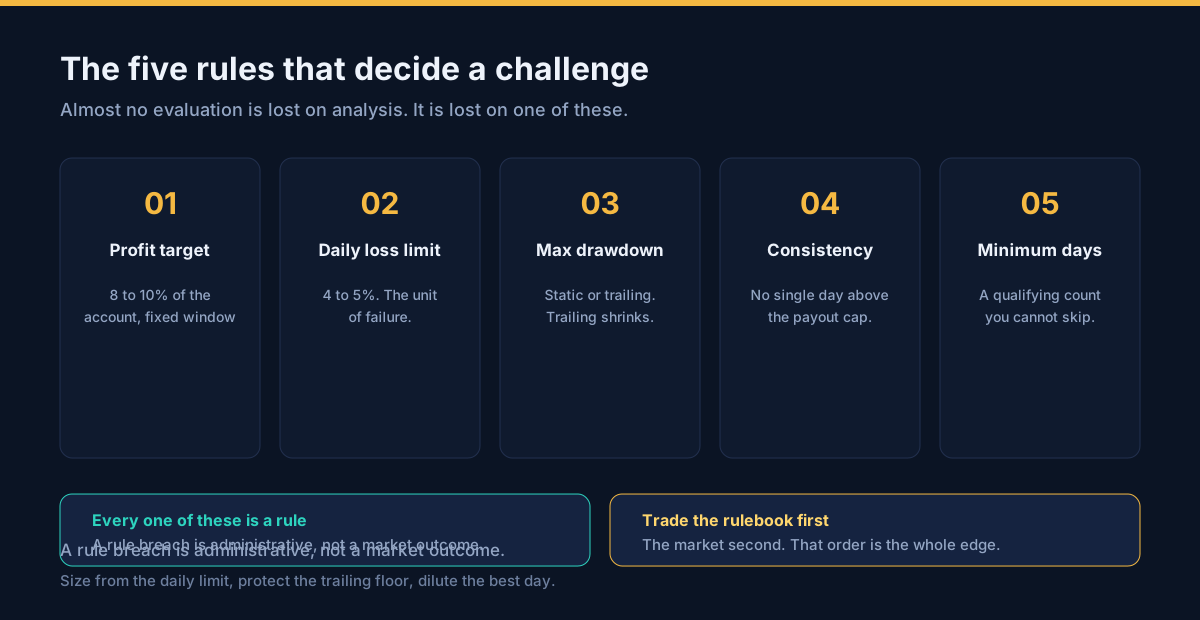
This is the guide we would give a friend: everything that actually determines whether you pass a prop firm challenge, in the order it matters. It is written for traders who can read a chart and manage risk, and who keep losing evaluations anyway — usually to a rule rather than to the market.
The one insight that changes everything
Almost every failed evaluation is a rule breach, not a bad trade. Run that statement against your own history and see whether it holds. When you lost a challenge, was it because your analysis was wrong, or because you gave back too much in a single day, or held a winner until the drawdown floor caught up with you, or hit a target and could not withdraw?
If the answer is a rule, then the solution is not a better indicator. It is treating the rulebook as the primary constraint of the exercise and the market as the secondary one. That inversion is the whole method. Everything below is a consequence of it.
Before the first trade
Write down five numbers and keep them beside your screen: the profit target, the daily loss limit, the drawdown type and size, the minimum trading days, and the consistency percentage. If you cannot state all five from memory, you are not ready to trade the account.
Step 1: Understand the three drawdown types
Drawdown is the distance your account can fall before the evaluation ends. Firms express it in three ways, and confusing them is the most expensive mistake you can make.
| Drawdown type | How it behaves | Difficulty |
|---|---|---|
| Static | Fixed floor below your starting balance; never moves | Easiest |
| Trailing | Floor follows your peak upward; shrinks your buffer as you win | Hardest |
| Intraday / end-of-day | Measured on live equity, or only on closed positions | Moderate |
Why trailing drawdown is so punishing
On a trailing account, opening a winner and giving it back is doubly expensive. The floor rose while the position was open; when the trade reverses, you are not just giving back profit, you are giving back the buffer that profit created. Traders who do not understand this lose accounts in the middle of trades they think are break-even.
The relief is that trailing thresholds usually stop trailing at a defined profit level. Find that lock point and reach it as safely as possible — after it locks, the account behaves far more normally. Until then, treat every winner as a liability to be banked rather than a position to be held.
Step 2: Respect the daily loss limit above all
If trailing drawdown is the long-term threat, the daily loss limit is the immediate one, and it is the tightest constraint on most evaluations. Usually expressed as 4–5% of the account, it is a hard stop: once you are down that much in a session, the evaluation ends regardless of how much overall room you had.
The single most common failure pattern
A small morning loss. An attempt to recover it with a larger position at lunch. A second loss. A doubled position into the close to "get back to flat". The daily limit is breached, the evaluation is over, and the fee is gone. This pattern accounts for a very large share of all failed challenges, and it is entirely preventable with a rule: when the day's plan is done, close the platform.
Practical defence: set a personal daily stop well inside the firm's limit — half of it, if you are prone to this — and treat it as absolute. Also set a daily profit target. Most traders never plan a maximum win, which is how consistency problems are born.
Step 3: Map the consistency rule before you trade
Many firms cap how much of your total profit can come from a single day — commonly 30% or 40%. Miss this and you will pass the evaluation, hit the target, and discover you cannot withdraw.
| Best day | Total profit | Best day share | Payout? |
|---|---|---|---|
| $6,000 | $10,000 | 60% | Blocked — keep trading |
| $6,000 | $24,000 | 25% | Approved |
| $1,800 | $9,000 | 20% | Approved |
The counter-intuitive lesson: a huge day delays your payout, and only additional ordinary days unlock it. Trade for even, repeatable gains rather than a heroic session. Full maths in the consistency rule guide.
Step 4: Size against the drawdown, not the account
This is the practical heart of the method. Most traders size by account size — "it is a $100k account, so I can trade five contracts." Wrong. Size by the distance to your failure point.
Calculate your remaining buffer
Distance from current equity to the drawdown floor, and distance to the daily limit. Take the smaller. That is your true risk capacity for the day.
Risk a small fraction per trade
Cap any single trade's loss at a fraction of the daily allowance — one third or less. Three consecutive losses should still leave you inside the limit.
Use micros or minis until the threshold locks
MES, MNQ, MCL, MGC or 0.01 lots. Smaller size means more decisions survive, and the evaluation only ends on a breach, not on a drawdown.
Scale up only after the lock point
Once a trailing threshold stops trailing, add size. Before that, every extra contract is borrowed risk against a shrinking buffer.
Step 5: A realistic day-by-day plan
Here is how a disciplined pass typically unfolds on a two-step challenge with a 10% target and a 5% daily limit.
| Phase | Days | Objective | Size |
|---|---|---|---|
| Establish | 1–3 | Small, consistent gains; learn the platform and spreads | Minimum |
| Build | 4–10 | Steady progress, evenly spread; never risk the daily limit | Small |
| Close | 11–15 | Reach target while keeping best day under the consistency cap | Small, patient |
| Verify | After pass | Complete verification without breaking fresh limits | Minimum |
Notice there is no "big day" in this plan. That is deliberate. The plan is designed so that reaching the target also satisfies the payout conditions, which is what separates a pass from a withdrawal.
The twelve most common failure causes
- Misreading a trailing drawdown as static.
- Letting a winner reverse into the trailing floor.
- Revenge trading within one session and breaching the daily limit.
- Oversizing with full-size contracts before the threshold locks.
- Ignoring the consistency rule until the payout stage.
- Holding through CPI, NFP or FOMC and getting gapped through stops.
- Not counting minimum trading days correctly (a one-trade day may not qualify).
- Breaking a news-trading or weekend-holding rule you had forgotten applied.
- Trading a firm's rules you assumed rather than read.
- Chasing the target in the final days and blowing the daily limit.
- Skipping the verification phase's fresh drawdown rules.
- Passing quickly but with an unpayable profit distribution.
When to consider a passing service
If you have read this far and recognised your own pattern — profitable analysis, rule-based failure, no time to grind — a passing service is a legitimate answer rather than a shortcut. Ours is a flat $220 per evaluation with no profit split and retries covered, and it trades accounts in a deliberately payout-ready way rather than merely hitting the target. Read what a flat-fee prop firm passing service includes, or the honest breakdown in our service review. If you would rather do it yourself, you now have the framework — and the rules that matter guide goes deeper on the constraints that decide the outcome.
Frequently asked questions
The FAQ block below covers the hardest part of a challenge, timelines, drawdown types, position sizing, the consistency rule and whether to pass it yourself. Firm-specific guides: FTMO rules 2026, Apex, Topstep.
What is the hardest part of passing a prop firm challenge?
How many trading days does it take to pass a prop firm challenge?
What is the difference between static and trailing drawdown?
How should I size positions on a challenge?
What is the consistency rule and why does it matter?
Can I pass a prop firm challenge without trading?
Is it better to pass the challenge myself or use a service?
Have a question before you commit?
Ask us anything about your firm, your account size or whether a passing service suits you. We answer directly on Telegram — no forms, no queues.
Ready to pass your prop firm challenge?
Flat $220 per evaluation — we trade it for you and hand over a funded account. No hidden cuts, no monthly fees. Message us on Telegram and we will answer in minutes.