How to Pass Apex Trailing Drawdown: The Math Behind Most Failures
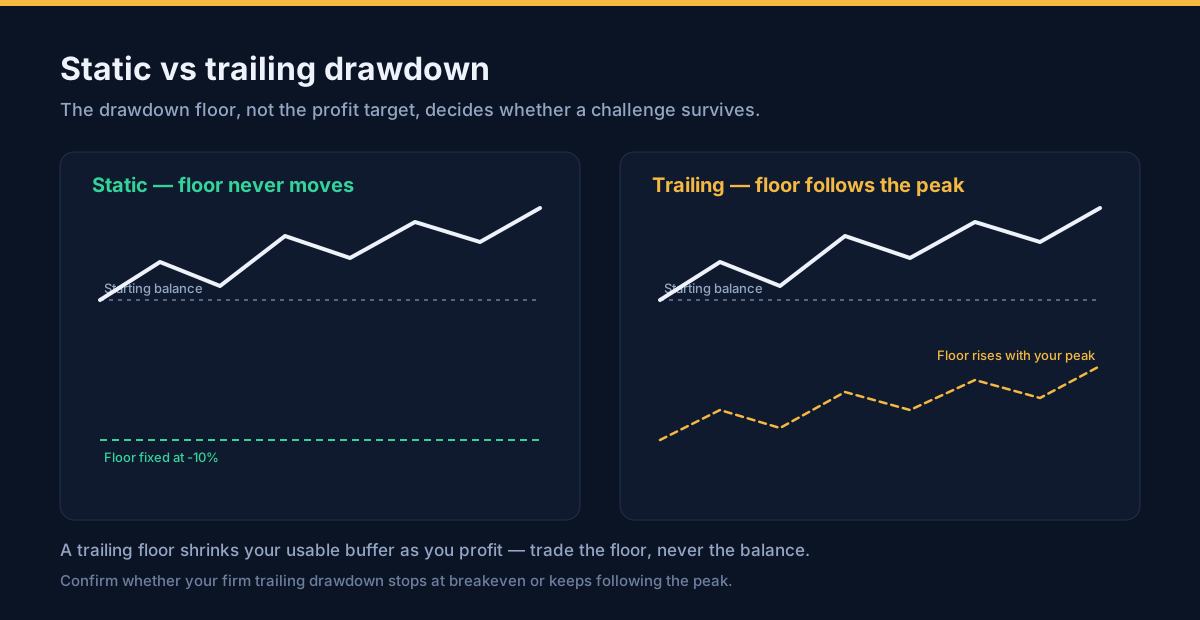
Apex's trailing drawdown is not a loss limit. It is a moving floor that follows your peak upward and never comes back down, which makes it a subtraction problem rather than a stop-loss. Most Apex evaluations do not end on a bad market call. They end in the first few days of profit, when a trader believes the account is winning while the buffer underneath it is quietly shrinking. This is the arithmetic that decides the outcome.
Verify on your dashboard before trading
Account parameters change and differ by model. The mechanics and formulas below are structural and stable; the exact threshold, target and lock point for your account are not. Confirm them inside your own Apex account, and never size a position from any article — including this one.
The math behind why 95% of traders fail this rule
Start with an honesty note: treat "95%" as an industry approximation, not a measurement. Firms do not publish audited pass rates, and the figures quoted by different sources range widely. What is not approximate is the mechanism, and the mechanism is what produces those headline numbers.
A static drawdown fixes a floor below your starting balance and leaves it there. You can spend that buffer down, and as long as you stay above the line you are safe. A trailing drawdown does the opposite. It defines the floor relative to your highest equity, and it only ratchets upward:
floor = peak_equity − trailing_threshold
Your remaining room is therefore never the threshold itself. It is the threshold minus whatever drawdown you have already taken from your peak:
room = trailing_threshold − (peak_equity − current_equity)
Read that second line carefully. The whole failure mode is in it. Room does not depend on whether the account is up or down against the starting balance. It depends only on your distance below your peak. An account that is up $1,000 overall, having peaked $2,000 higher, has $1,000 of buffer gone — permanently. Giving back profit does not merely cost you the profit. It costs you the safety margin the profit created, and the margin never returns.
The subtraction most traders get wrong
On a $50,000 account with a $2,500 trailing threshold, run a trade $1,000 into open profit and the floor rises to $48,500. You are still $2,500 from your peak but only $1,500 from your starting balance. A trader who believes they have $2,500 of room has already lost the evaluation in their head; the account will confirm it later.
Why the danger is concentrated at the start
Here is the part that makes the rule survivable. The threshold stops trailing at a defined profit level, the lock point. Once your peak reaches it, the floor is fixed and the account behaves like an ordinary static-drawdown account. That means the entire risk window is the profit you accumulate before the lock.
For a $50,000 Apex account with a $2,500 threshold and a $3,000 target, the trailing behaviour is live for roughly the first $2,500 of profit. After that, the floor has effectively stopped moving and the remaining $500 to target is comparatively harmless. Reaching the lock safely is therefore the objective itself, not a milestone on the way to the target; the profit target is the easy part that follows.
The tick maths that converts a threshold into a position size
"Size small" is not advice a trader can execute. Futures sizing is exact, and it starts with the tick value of the contract you are trading. For the CME index products Apex funds:
| Contract | Underlying | Tick size | Value per tick | Value per point |
|---|---|---|---|---|
| ES | E-mini S&P 500 | 0.25 pt | $12.50 | $50.00 |
| MES | Micro E-mini S&P 500 | 0.25 pt | $1.25 | $5.00 |
| NQ | E-mini Nasdaq-100 | 0.25 pt | $5.00 | $20.00 |
| MNQ | Micro E-mini Nasdaq-100 | 0.25 pt | $0.50 | $2.00 |
| CL | Crude Oil | 0.01 | $10.00 | — |
| MCL | Micro Crude Oil | 0.01 | $1.00 | — |
Now size the trade the way the account demands. Decide what fraction of the threshold you are willing to risk on a single idea, 10% is a sensible starting point, and solve for contracts:
contracts = (risk_fraction × trailing_threshold) ÷ (stop_distance_in_ticks × tick_value)
Worked on the $50,000 account: a 10% risk budget is $250. A 10-point stop on MES is 40 ticks at $1.25, or $50 per contract, which allows five MES contracts. The same $250 budget with the same 10-point stop on ES is $500 per contract, which allows half a contract, meaning none in practice. That single calculation is why micros are not a beginner's concession on a trailing-drawdown account; they are the only instrument that lets a $250 risk budget exist in the first place.
The floor moves between your entry and your exit
A position that goes into profit has already raised the floor before you close it. If the account uses intraday (real-time) trailing rather than end-of-day, an open winner is shrinking your buffer while you hold it. Bank profit deliberately and re-derive your size as the floor rises. The right number of contracts at the open is not the right number after a good hour.
The traditional way vs. the ElitePropX way
The conventional approach to a trailing drawdown is behavioural: keep size small, take profit early, hope the floor does not catch you. It works for disciplined traders and fails for almost everyone at some point, because the rule punishes a natural human behaviour — holding a winner — rather than a market error. The professional approach treats the threshold as an arithmetic constraint that is solved before the first trade rather than after the damage.
| Dimension | The traditional way | The ElitePropX way |
|---|---|---|
| Position size | Chosen from confidence or a fixed contract maximum | Derived from the trailing threshold and the stop distance, per the tick formula above |
| The floor | Assumed static until a breach proves otherwise | Recomputed after every peak; treated as a live number, not a setting |
| Open profit | Left running because "the trade is working" | Scaled out deliberately, because open profit has already moved the floor |
| Lock point | Discovered at the end, if at all | Made the explicit first objective of the evaluation |
| Consistency rule | Discovered when the withdrawal is blocked | Paced from day one so the account is payout-ready, not just passed |
| Failure mode | Account lost mid-trade to a floor that moved | Threshold never approached by an amount the plan had not already allowed for |
| Who it suits | Experienced traders with the screen time to manage it live | Traders repeatedly beaten by this one rule, or short on screen time |
This is not a skill difference. A profitable discretionary trader has spent years learning to let winners run, and a trailing floor punishes that instinct directly. The professional advantage is narrower and more mundane: someone who trades nothing but rulebooks has no habit to unlearn, and treats the threshold as the first constraint rather than the last thing to check.
How our $220 passing service automates this risk
ElitePropX is a flat-fee challenge-passing service. We trade your Apex evaluation to a payout-ready finish for a flat $220, whatever the account size from $25k to $300k, with 0% profit split taken from the funded account you receive and retries funded at our own cost if an account we manage fails.
What that means specifically for a trailing-drawdown account:
We map the numbers before a single trade
Exact threshold, target, lock point, drawdown model (intraday or end-of-day), contract limits and consistency requirement, read from your live dashboard rather than from a generic article. Every position is then sized against that threshold using the formula above.
We make the lock point the first objective
Until the floor stops following your peak, every position carries more risk than it appears to. We treat getting the threshold locked as phase one and the profit target as phase two, because that is the order the maths requires.
We trade a distribution, not a headline
Reaching the target is not a pass if the payouts are blocked by the consistency rule. We pace profit across sessions from the beginning so the account you receive can actually withdraw, rather than requiring weeks of repair trading first.
You keep the account, entirely
When Apex verifies the pass, the funded account is yours. We take no monthly fee, no cut of your payouts, and no ongoing relationship is required. The flat $220 is the entire cost; nothing recurring is charged.
You can test us first at no cost. A free trial run is available on request, and we answer directly on Telegram @voraspas. If you would rather trade the evaluation yourself, the maths above is the whole game, and the Apex complete guide walks the process end to end at no cost.
One caveat we repeat on every page: many firms restrict third-party trading, and Apex is no exception. Using any passing service can conflict with your agreement and risks a denied payout. We state that plainly so the decision is yours and fully informed. The prop firm rules matrix and the Apex challenge passing guide cover the adjacent detail.
Frequently asked questions
The FAQ block below covers intraday versus end-of-day measurement, the lock point, contract sizing, relative versus absolute drawdown and whether we can pass Apex for you. Related reading: the complete Apex guide, the consistency rule explained and the Topstep guide for the same trailing mechanic at a different firm.
What is the difference between Apex's intraday and end-of-day trailing drawdown?
At what point does Apex's trailing drawdown stop trailing?
How many contracts can I trade on a $50,000 Apex account?
Why is a trailing drawdown described as relative rather than absolute?
Can you pass an Apex evaluation for me?
Have a question before you commit?
Ask us anything about your firm, your account size or whether a passing service suits you. We answer directly on Telegram — no forms, no queues.
Ready to pass your prop firm challenge?
Flat $220 per evaluation — we trade it for you and hand over a funded account. No hidden cuts, no monthly fees. Message us on Telegram and we will answer in minutes.