
Buyer's guide · reviewed October 2026
The best futures prop firms in 2026, judged on what fails accounts
Futures evaluations look simpler than forex challenges and are considerably harder to compare, because the two products do not measure risk the same way. A futures account is sized in contracts, its drawdown is often a dollar figure that trails a peak, and the daily loss limit rather than the profit target is what ends most attempts. This guide sets out the criteria that actually separate one futures firm from another, the arithmetic behind each one, and the questions to ask before paying a fee.
Key takeaways
- A futures evaluation is measured in contracts and dollars, so position size is quantised — you cannot halve a two-contract position without going to one.
- The drawdown mechanism matters more than the headline number: a trailing threshold that follows intraday equity is far tighter than the same figure measured at end of day.
- The daily loss limit ends more attempts than the profit target does, because it fires on normal variance rather than on a bad plan.
- Total cost is fee plus platform and market-data subscriptions plus any activation charge — a cheap evaluation on an expensive data feed is not cheap.
- Payout terms on the funded account, not the evaluation rules, decide whether a pass becomes income.
Contents
- Why futures firms are not forex firms in a different wrapper
- Sizing: contracts, ticks and dollars
- Trailing, end-of-day and static thresholds
- The daily loss limit as the binding rule
- Targets, minimum days and consistency
- What an evaluation actually costs
- Seven criteria that survive marketing
- Platforms, routing and data
- Payout mechanics and cadence
- The sizing arithmetic that keeps accounts alive
- Where futures attempts fail
- Scaling, combining and copying
- A thirty-day evaluation plan
- Frequently asked questions
The two product categories have converged in marketing language and diverged in mechanics. A forex evaluation usually states a percentage profit target, a percentage maximum loss, and a leverage cap on currency pairs. A futures evaluation states a dollar target, a dollar drawdown, and a contract limit per instrument. The first is scale-free; the second is not.
That difference has consequences that reach every decision a trader makes. On a percentage-based account, doubling the balance doubles both the target and the room, and the plan is unchanged. On a contract-based account, doubling the balance doubles the number of contracts permitted but does not double the number of contracts the market will tolerate at a given stop distance — a point that matters most on the index futures that dominate the category, where the contract's tick value is fixed and large.
There is also a structural difference in what the firm is selling. Futures evaluations are generally cheaper to buy and shorter to complete than forex evaluations, and they typically carry a monthly or one-off fee rather than a subscription with an unlimited-tries clause. That changes the economics of failure: a reset on a cheap evaluation is a small purchase, which encourages a second attempt rather than a rethink. The traders who do well in this category are the ones who treat the first attempt as the only one, and size accordingly.
The instruments themselves impose a session. Most futures contracts trade nearly around the clock but have a thin overnight book and a defined settlement. A plan built on the New York cash session behaves differently from a plan that holds through the Asian session, and the drawdown mechanism will price that difference whether or not the trader has noticed it.
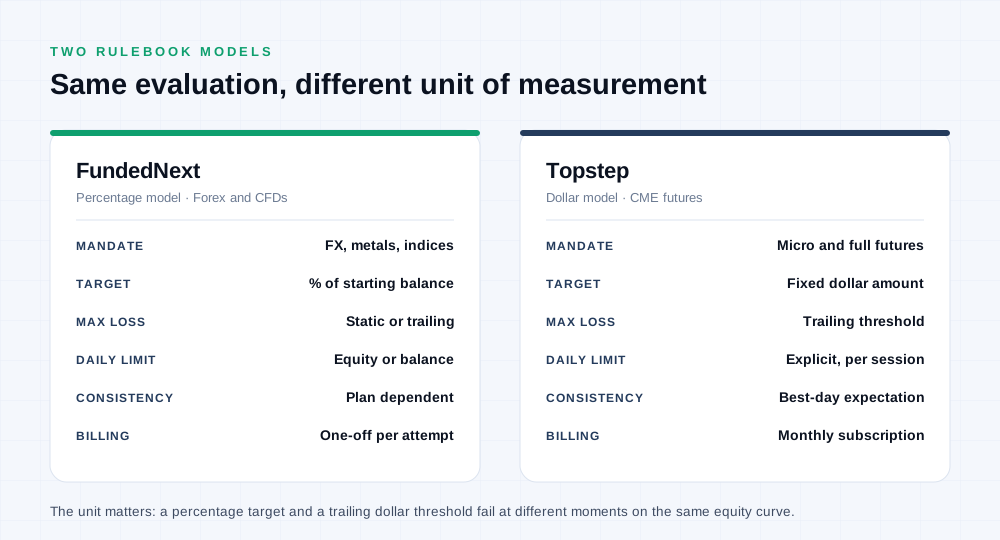
None of that makes one category better. It makes them non-substitutable. A trader with a currency strategy and a part-time schedule is usually better served by a percentage evaluation with a static drawdown. A trader who already reads order flow on an index future, and who wants a fast, cheap evaluation with a clear dollar stop, is usually better served here.
Sizing: contracts, ticks and dollars
The single most useful thing to understand before comparing futures firms is that a position is a whole number of contracts, and each contract has a fixed dollar value per tick. That makes risk per trade a multiplication problem rather than a percentage decision.
Take a contract whose tick is worth a fixed dollar amount and whose stop is a fixed number of ticks. Risk per trade is contracts multiplied by ticks multiplied by tick value. If the plan permits a maximum loss per trade, the number of contracts is that maximum divided by the tick cost of the stop. The result is rarely a round number, and it must be rounded down — always down, because rounding up converts a plan that fits the drawdown into one that does not.
Three consequences follow. First, small accounts are effectively forced into one-contract positions on the larger index contracts, which means the stop distance, not the account size, determines risk. A one-contract position with a wide stop can risk more than a three-contract position with a tight one, so "one contract" is not a proxy for "small risk".
Second, micro contracts change the arithmetic without changing the strategy. A micro version of the same instrument carries a fraction of the tick value, which allows a trader to take a stop of the same tick distance at a tenth of the dollar risk. For an evaluation, that is the difference between a plan that fits and a plan that does not — and it is the reason many experienced futures traders run micros during the evaluation and full-size contracts only after funding.
Third, the contract limit in the rules is a ceiling, not a target. A firm that permits a large number of contracts is not inviting that size; it is setting the point at which the account is closed for breaching. The correct contract count is derived from the drawdown and the stop, and it is usually far below the ceiling.
Write the number down before the first trade of the evaluation: instrument, tick value, stop in ticks, dollars at risk at one contract, and the maximum contracts the drawdown permits. That single line of arithmetic governs the entire attempt, and it does not change because the account is up or down.
Trailing, end-of-day and static thresholds
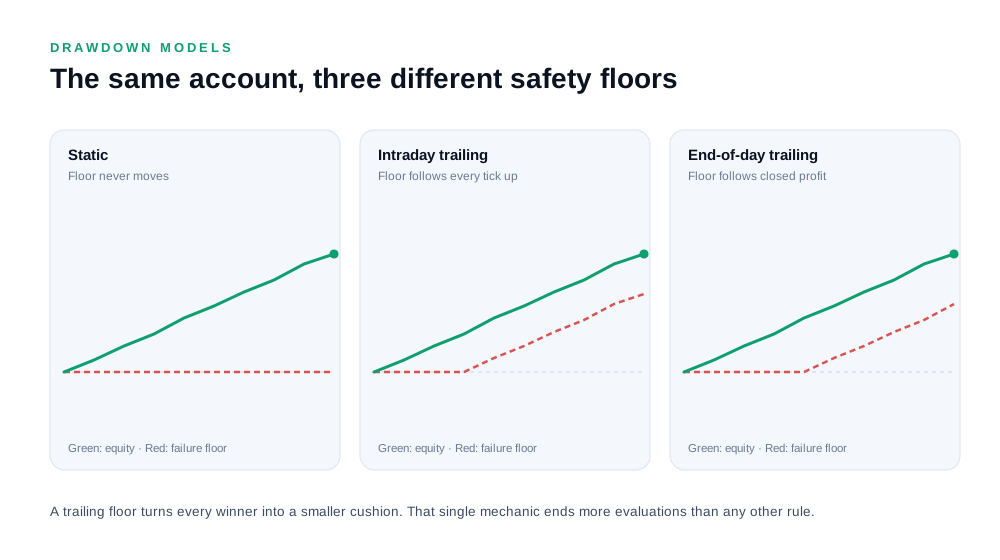
Drawdown is where futures firms differ most, and where the marketing is least informative. Three mechanisms are in common use, and the same headline figure produces very different accounts under each.
| Mechanism | How the floor moves | What it means for a trader |
|---|---|---|
| Intraday trailing | Follows peak unrealised equity tick by tick | Open profit tightens the account immediately; a fast reversal can breach from a winning position |
| End-of-day trailing | Resets to the day's closing balance | Intraday spikes do not move the floor, so winners can breathe within a session |
| Static | Fixed at the starting balance | Progress never reduces room; the most forgiving of the three |
An intraday trailing threshold is the harshest of the three because it converts unrealised profit into a liability. A trader who is up on the day and gives it back is not merely flat — the floor has risen behind them, and the retracement is measured against a peak that no longer exists. This is the mechanism that produces the familiar complaint about being stopped out of a profitable account.
End-of-day trailing is meaningfully gentler without being generous. The floor locks in at settlement, so a spike that reverses within the session costs the profit but not the account. The trader still cannot give back a completed day's gain, which imposes a real constraint on holding through the close.
A static threshold is the most forgiving and the least common in this category. The floor never moves, so the account's fragility is fixed at the start and profit cannot make it worse. The trade-off is that the initial buffer is usually smaller as a percentage, because the firm is carrying more risk on a structure that never tightens.
Comparing two firms on the headline drawdown number alone is therefore meaningless. A large number attached to an intraday trailing mechanism can be tighter in practice than a smaller number attached to a static one, particularly for a strategy that holds winners through retracements. Read the mechanism first, then the number, then the interaction with the daily limit.
There is one more clause worth locating in the terms: whether the threshold applies to realised or unrealised profit, and whether it applies during the overnight session. A mechanism described as end-of-day trailing but calculated on the highest unrealised equity of the day is, in practice, intraday trailing with a delay.
The daily loss limit as the binding rule
Most attempts do not fail on the maximum loss. They fail on the daily limit, because the daily limit is calibrated to a normal bad day rather than to a catastrophic one, and normal bad days are common.
The arithmetic is unforgiving in a specific way. Suppose the daily limit is a fraction of the maximum loss — the usual arrangement. That fraction defines how many losing trades a session can absorb at the plan's risk per trade. If risk per trade is a fifth of the daily limit, five consecutive losses close the session; if it is half, two do. Both numbers sound survivable until the trader remembers that a 45% win rate produces five-loss runs regularly over a few hundred trades.
Two design decisions follow. The first is that risk per trade should be derived from the daily limit as well as from the maximum loss, and the smaller of the two answers should govern. The second is that the session should have a hard trade cap independent of the dollar limit, because the dollar limit is measured by the firm's server and the trade cap is measured by the trader's discipline — and only one of those is under the trader's control.
There is also a definitional trap. Daily loss limits are usually calculated from the day's starting balance or equity, and the day's start is defined by the firm's server time, not the trader's. A position opened late in the trader's evening may belong to the next trading day for the purposes of the limit. Traders who trade the overnight session discover this the expensive way: two positions that feel like one day's risk are counted against two days' limits, and the second day starts with a deficit the trader did not know they had created.
The remedy is to establish the server's day boundary before the first trade and to build the trading day around it. If the boundary falls in the middle of the trader's session, the session should be split or shortened rather than run through it. This is not a detail; it is the difference between a limit that protects the account and a limit that surprises it.
A final point on the interaction with trailing drawdown: on an intraday trailing account, a day that begins after a strong previous day starts with a higher floor, so the same dollar loss is a larger fraction of the remaining room. The daily limit is static, the floor is not, and the two should be recomputed together each morning rather than assumed to be constants.
Targets, minimum days and consistency
The profit target on a futures evaluation is usually expressed in dollars and is often modest relative to the drawdown — a ratio that looks generous until the contract arithmetic is applied.
Take a target and a maximum loss where the target is a fraction of the loss limit. To reach the target at a given risk per trade, the trader needs a certain number of trades at positive expectation. If risk per trade is set by the drawdown survivability rule, that number of trades is large, and the calendar is long. If risk per trade is set by the target, the number is small and the account's survival probability falls sharply. The tension between those two calculations is the entire discipline of an evaluation.
Minimum trading days are a separate constraint and usually a mild one. Where they exist, they prevent a single-day pass, which is a sensible protection for the firm and a useful discipline for the trader. Where they do not, a trader can pass in two sessions and then discover that the funded account's payout conditions assume a longer record — the minimum-day requirement has not disappeared, it has moved to the payout stage.
Consistency rules appear in this category in two forms: a cap on the best day's share of total profit, and a cap on a single day's profit in absolute terms. The first is a ratio and constrains the shape of the profit; the second is a ceiling and constrains the size of any one day. A ratio of around a third means total profit must reach roughly three times the largest day before a full withdrawal is allowed, which is straightforward arithmetic and easy to violate with one good session.
The practical response is a daily profit cap set well below the consistency threshold, applied from the first day of the evaluation rather than at the payout request. A trader who reaches the target in one dominant day has passed the evaluation and created a payout problem at the same time, and the payout problem is the one that costs money.
Where a firm publishes no consistency rule at all, the absence is worth verifying rather than celebrating. It sometimes means the rule lives in the funded terms rather than the evaluation terms, which is precisely where a trader is least likely to look before paying.
What an evaluation actually costs
The headline fee is the smallest part of the cost of a futures evaluation, and comparing firms on that number alone produces reliably bad decisions.
| Cost line | When it is charged | How it changes the decision |
|---|---|---|
| Evaluation fee | Up front, sometimes monthly | Small relative to the total; a monthly fee punishes a slow attempt |
| Platform subscription | Monthly, per platform | Often unavoidable and identical across firms for the same platform |
| Market data | Monthly, per exchange | Can exceed the evaluation fee over a multi-month attempt |
| Activation fee | On funding | Converts a cheap pass into a paid one; ask before starting |
| Reset or retry | Per attempt | Determines whether a failed attempt is a lesson or a subscription |
| Commission per contract | Per round turn | Scales with activity; a high-frequency plan is far more sensitive to it |
The pattern that matters is the ratio of recurring cost to expected time. A monthly fee on an evaluation that takes four months costs four times the advertised figure, and a plan that takes four months is usually a plan that is being traded too conservatively for the target. The correct comparison is total cost to funding, not fee at signup.
Commission per contract deserves separate attention because it is the one cost that scales with the strategy rather than the calendar. A plan that takes six trades a day at two contracts pays twelve round-turn commissions daily, and over sixty sessions that is 720 commissions — a number that can dwarf the evaluation fee. Traders arriving from spot forex, where spreads are the only transaction cost, routinely underestimate this line.
Data subscriptions are the quiet cost. Exchange fees for real-time depth are usually passed through, and a trader who needs depth on two exchanges is paying for two feeds whether or not the evaluation is going well. Before paying anything, establish which feeds the platform requires, whether the firm offers a bundled feed, and whether delayed data is sufficient for the strategy — for a swing plan it often is.
Finally, price the retry. A firm with a generous retry policy is selling an option, and the option has value only if the second attempt is genuinely different from the first. A trader who resets with the same size and the same stop distance has bought the same outcome at a higher price. The retry should be budgeted as part of the plan, and the plan should change with it.
Seven criteria that survive marketing
Most published comparisons rank firms on account size and fee. Those are the two numbers that matter least once an account is live. The following seven criteria are the ones that change outcomes, roughly in order of importance.
One: the drawdown mechanism, read precisely. Intraday trailing, end-of-day trailing or static, measured on equity or balance, and applied during which sessions. This single clause dominates everything else, because it determines whether the plan's winners are permitted to breathe.
Two: the daily limit relative to the maximum loss. A daily limit that is a small fraction of the total forces a low risk per trade and a long calendar. A large fraction permits more trades per session but raises the cost of one bad day. Neither is wrong; the trader's plan has to match.
Three: the funded account's drawdown. It is frequently tighter than the evaluation's, and it is the account where real money is at stake. A firm whose funded rules cannot accommodate the plan that passed the evaluation is selling a pass that cannot be used.
Four: payout conditions and speed. Minimum profitable days, profit threshold, consistency check, verification, and the interval between request and payment. A generous split paid in ninety days is worth less than a smaller split paid in five.
Five: the third-party and automation clause. Whether assistance is permitted on the evaluation and on the funded account are separate questions, and the funded answer is the one with money attached. Where the terms are ambiguous, a written answer from support is the only reliable source.
Six: platform and data routing. Which platforms are supported, which exchanges are bundled, what a feed costs, and whether the trader's existing setup transfers without a new subscription. A firm that requires a platform the trader does not use has an unadvertised switching cost.
Seven: the reproducibility of the terms. Whether the current rules are published as a versioned document rather than a marketing page, and whether changes apply to existing accounts. A firm that revises terms mid-evaluation has transferred risk to the trader in a way the fee did not price.
Ranking on those seven will usually produce a shorter list than ranking on fee and account size, and a list that is far more likely to survive contact with a funded account. The rules matrix lays out the comparison across firms, and the 2026 comparison covers the wider market including forex-side structures.
Platforms, routing and data
Futures trading is platform-mediated in a way that spot forex is not, and the platform decision is effectively part of the firm decision.
The common arrangements are a dedicated futures platform with its own order engine, a retail multi-asset platform with a futures add-on, and a bridge into a charting and execution environment that many discretionary traders already use. Each has a different cost structure and a different set of available order types, and the differences matter most for the stops.
Order handling is where evaluations are quietly lost. A stop that is held on the platform's server behaves differently from a stop that is held locally on the trader's machine. If the connection drops — and it will — a local stop is not a stop. For an evaluation with a hard daily limit, that distinction is the difference between a planned loss and a breach, so the first question to ask about any platform is whether the protective orders sit on the server.
Routing and fill quality are the second question. A firm that routes to a single liquidity provider during a thin session produces fills that a demonstration account on a different feed will not reproduce. A trader who has calibrated a stop distance on one feed and executes on another has calibrated against the wrong number, and the error appears as slippage on exactly the trades that matter.
The third question is the data. Real-time exchange data usually carries a monthly fee, and the feed determines what the trader can see at the moments that count: the depth at the open, the book during a news release, the settlement print. A delayed feed is adequate for a plan with wide stops and inadequate for one that trades the first minutes of a session.
Before paying for an evaluation, run the platform for a week on a demonstration account with the same feed and the same order types. Measure the spread at the hours the plan trades, the average slippage on entry and exit, and whether the protective orders survive a deliberate disconnect. Those three measurements are worth more than any comparison table, because they are the only ones taken on the trader's own setup.
One practical note: the platform subscription is often the same across firms, which means it is a constant rather than a differentiator. The differentiators are the feed bundle, the order handling, and whether the firm permits the platform's full order set during an evaluation. Firms occasionally restrict bracket orders or automated exits on evaluation accounts, and a plan that depends on them should establish that before paying.
Payout mechanics and cadence
Everything before funding is a qualifying round. The funded account is the product, and its payout mechanics are the specification.
The standard sequence is a minimum number of profitable trading days, a profit threshold before the first withdrawal, a consistency check on the profit being withdrawn, identity verification, and then a payment on a stated schedule. Each step has a failure mode that has nothing to do with trading skill.
Minimum profitable days are the most commonly missed condition, because they are satisfied by activity rather than by profit. A trader who reaches the threshold in nine sessions and needs fifteen has six sessions of obligation, and the temptation in those six is to trade for the sake of the count. The correct approach is to trade the plan at reduced size, accept whichever sessions produce a small profit, and treat the count as a calendar problem rather than a trading one.

The profit threshold before the first withdrawal is where the funded account's drawdown becomes relevant. Profit that is not withdrawn sits in the account and can be given back, and on a trailing structure it also raises the floor behind the trader. A trader who builds a large unwithdrawn profit on an intraday trailing funded account has made the account more fragile, not less. The disciplined approach is to withdraw on the earliest permitted schedule at a size that keeps the account above its floor with room to spare.
Cadence matters as much as size. A monthly cycle with a modest threshold produces a predictable income stream and a stable account; a quarterly cycle with a large threshold produces a larger single payment and a longer period of exposure. For a first funding, the monthly cycle is usually the better choice even where the split is less favourable, because the information gained from a completed payout cycle is worth more than the difference in percentage.
Verification is administrative and should be finished before the first request rather than after it. Identity documents, address confirmation, and any payment-method checks are routinely the cause of a delay that has nothing to do with the trading record. Completing them in the first week of funding removes the only step in the sequence that the trader cannot influence later.
The sizing arithmetic that keeps accounts alive
The arithmetic of a futures evaluation fits on one line, and it is worth deriving rather than copying from a table.
Start from the drawdown. Decide how many consecutive losses the plan should survive — for a discretionary plan with a win rate in the forties, eight to ten is a reasonable design target, because runs of that length occur within a few hundred trades. Divide the available drawdown by that number to get the maximum dollar loss per trade.
Then convert to contracts. Divide the maximum dollar loss by the tick value of the stop distance. Round down to a whole number, and if the answer is zero, the plan does not fit the contract at that account size — which is information worth having before paying a fee, not after.
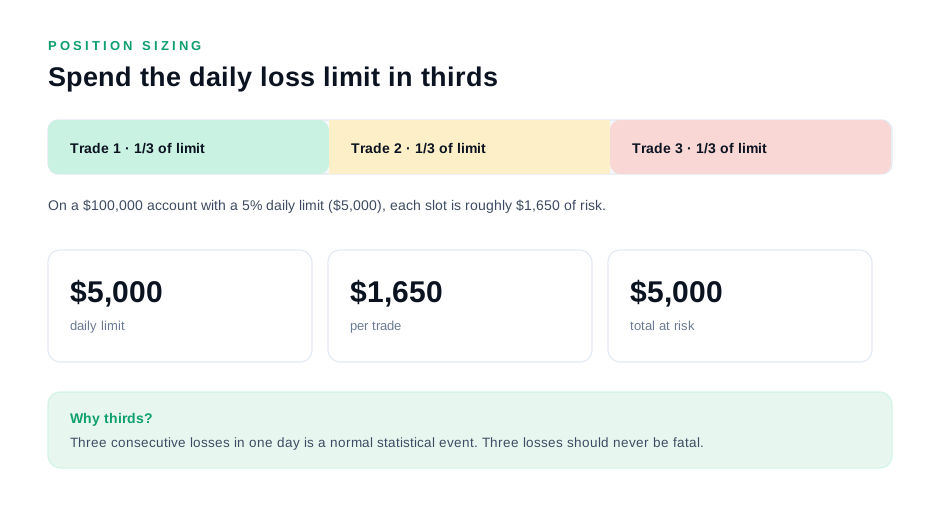
Then check the daily limit. Multiply the dollar loss per trade by the number of losses the session should absorb, and compare it to the daily limit. If the session budget exceeds the limit, reduce the trade count or the size. If it is far below the limit, the plan is probably too conservative to finish inside a reasonable calendar, and the trader should consider a micro contract and a slightly larger size rather than a smaller one with the same stop.
Then check the target against the arithmetic. If risk per trade is fixed by survivability and the reward-to-risk ratio is known, expected value per trade follows, and the number of trades to reach the target follows from that. Divide by the planned trades per week to get the calendar. If the calendar is longer than the trader is willing to fund — remembering the monthly data and platform costs — the plan needs a better ratio, not a bigger size.
The reserve is the part most plans omit. Keeping a quarter of the drawdown untouched means the account can survive a sequence longer than the design case, which is exactly what a trailing mechanism punishes. It also means the trader has something to do after a bad week other than stop, which is a behavioural benefit as much as a financial one.
Recalculate the whole line once a week, using the floor as it stands rather than the floor at the start. On a trailing account the floor moves, so the number of contracts that fitted at the beginning may not fit now. This is the single most common cause of a breach in the final third of an evaluation: a size chosen when the account had room, kept after the room had gone.
Where futures attempts fail
Failures in this category cluster into five patterns, and each has a signature that can be recognised in advance.
Breaching the daily limit on a normal day. The trader's risk per trade was set against the maximum loss and never checked against the daily limit, so a three-loss morning ends the attempt. The signature is a plan whose per-trade risk is a large fraction of the daily limit.
Being stopped by a trailing floor after a good day. On an intraday trailing account, a winning session raises the floor and a normal retracement breaches it. The signature is a plan that holds positions through the afternoon after a strong morning.
Oversizing after a drawdown. The trader is behind, the calendar is short, and the size goes up to recover. This converts a recoverable evaluation into a closed account, and it is the most reliably fatal of the five because it happens exactly when the account is least able to absorb it.
Passing and then losing the funded account in the first fortnight. The evaluation's size is carried into a funded account with a tighter drawdown, and the first normal losing sequence ends it. The signature is no reduction in size at funding.
Failing the payout conditions rather than the rules. The target was reached, but the minimum-day count, the consistency ratio or the verification step was not satisfied, so the profit cannot be withdrawn. The signature is a trader who read the evaluation page and not the funded terms.
All five share a common cause: a rule that was understood in principle and not converted into a number. The remedy is a written plan with the numbers filled in — contracts, stop in ticks, dollars at risk, session cap, weekly recalc — checked against the firm's actual terms rather than against a comparable firm's.
Scaling, combining and copying
Futures firms offer three routes to a larger position, and they are not equivalent.
The first is the scaling plan: the firm increases the account or the contract limit after a defined record of profitable payouts. This is the slowest and the most reliable, because it is judged on behaviour the firm can verify. It rewards a boring record of on-time withdrawals over a spectacular month, which is worth understanding before optimising for a single large result.
The second is combining accounts. Many firms allow several evaluations to be run in parallel and their allocations to be combined for the purposes of size. This multiplies the fee and the data cost along with the size, and it multiplies the daily limit too, which is the part traders notice. What it does not multiply is the trader's attention, and a plan that requires monitoring four accounts at once is a different plan from the one that passed a single evaluation.
The third is copy trading between accounts, either across the trader's own accounts or through a third-party system. Where the firm permits it, copying is an efficient way to apply one decision to several allocations. Where the terms are silent, it is a compliance risk: a firm that later classifies copied positions as account management can void a payout, and the trader will have no route to appeal.
The prudent sequence is one account, one payout cycle, then a decision. A first funding that produces a completed withdrawal is worth more than three parallel evaluations, because it establishes the entire chain — trading, rules, verification, payment — rather than only the first link. Traders who combine before completing a cycle are scaling an unverified process.
One structural note on scaling plans: they usually reward consistency of profit rather than size of profit, so the fastest route to a larger allocation is a smaller, steadier result repeated. A trader who produces one month at triple the threshold and then a breach has produced nothing the firm can scale, and has probably also broken a consistency ratio in the process.
A thirty-day evaluation plan
Thirty days is a realistic horizon for a futures evaluation at survivable size, and it divides into four weeks with different jobs.
Week one: calibrate, do not perform. Trade the plan at half the eventual size, cap the session at two trades, and record three numbers per trade: planned risk, realised risk including slippage, and the time in the trade. The purpose is to establish whether the stop distance the plan assumes is the stop distance the market delivers at the hours being traded. Most plans are wrong about this by a meaningful margin, and week one is the cheapest place to find out.
Week two: full size, tight session cap. If week one's realised risk matched the plan, move to the full contract count and keep the trade cap. If it did not, adjust the tick distance rather than the size, because the slippage is a property of the instrument and the session, not of the account.
Week three: protect the buffer. By now the account is either ahead or behind. Ahead, reduce size by a quarter and keep the target in sight; the risk of the final third is giving back a good evaluation, not failing to finish. Behind, keep the size and move the calendar, and do not touch the daily limit to catch up.
Week four: finish or extend deliberately. Review the four numbers — trades, expectation per trade, worst drawdown, distance to target — and decide. A plan on pace continues. A plan behind on pace with a healthy expectation extends. A plan with negative expectation stops, because another fortnight of the same process produces the same result at a higher cost.
Two rules make the plan robust across all four weeks. The first is that size is recalculated from the current floor every Monday, not inherited from the start. The second is that no position is opened in the final hour of the trading day defined by the firm's server, because that is where the day-boundary and trailing-floor traps live.
If the evaluation is being traded on the trader's behalf by a passing service, the same four weeks apply with one addition: confirm in writing that the firm's terms permit third-party trading on both the evaluation and the funded account. ElitePropX charges a flat $220 per evaluation at any stage and size, covers retries, and works with any firm, telling you in writing what that firm’s third-party trading clause says before you pay — the passing services guide explains what to check, and the scam guide covers the failure modes on the other side of that market.
Frequently asked questions
What are the top futures prop firms in 2026?
There is no single answer, because the best firm is the one whose drawdown mechanism and funded terms match the plan being traded. A static or end-of-day structure suits a plan that holds winners; an intraday trailing structure does not. Rank candidates on the drawdown mechanism, the daily limit relative to the maximum loss, and the funded account's conditions before comparing fees.
Is a trailing drawdown worse than a static one?
It is tighter, not automatically worse. A trailing floor follows peak equity, so open profit raises the failure point and a retracement can breach from a winning position. A static floor never moves, which is more forgiving but usually comes with a smaller starting buffer as a percentage of the account.
How many contracts should I trade on an evaluation?
Derive it: divide the maximum dollar loss per trade by the tick value of the stop distance, then round down. Check the result against the daily limit and against the firm's contract ceiling. If the answer is zero, the plan does not fit that contract at that account size — use a micro contract or a smaller account.
Why do most futures evaluations fail on the daily limit?
Because the daily limit is calibrated to a normal bad day and normal bad days are common. If risk per trade is a large fraction of the daily limit, three ordinary losses close the session. Setting risk per trade from the daily limit as well as the maximum loss, and capping trades per session, removes most of that failure mode.
What does a futures evaluation really cost?
Fee plus platform subscription plus market data plus commission per round turn, plus any activation charge on funding. A monthly fee on a four-month attempt costs four times the headline figure, and commission on an active plan can exceed the fee entirely. Compare total cost to funding rather than cost at signup.
Do futures firms allow holding overnight?
Most permit it, with conditions: reduced size over the settlement window, no holding through certain news events, and a daily limit that resets on the firm's server time rather than the trader's. The weekend holding guide covers the gap arithmetic for positions held across a close.
What is a consistency rule on a futures account?
A cap on how much of the total profit can come from one day, usually expressed as a share of around a third. It means total profit must reach roughly three times the largest day before a full withdrawal. Cap daily profit well below the threshold from day one rather than discovering the ratio at the payout request.
Should I use a micro contract during the evaluation?
Often yes. A micro carries a fraction of the tick value, which lets a trader keep the stop distance the strategy needs while risking a fraction of the dollars. Many experienced futures traders run micros during evaluation and full-size contracts only after funding.
Can I run several evaluations at once?
Usually permitted, and usually a mistake before the first payout cycle is complete. Parallel accounts multiply the fee, the data cost and the daily limit, but not the trader's attention. Complete one funding and one withdrawal before combining allocations.
What happens if I pass and then breach the funded account?
The allocation is typically closed and the fee is not refunded. Funded drawdowns are frequently tighter than evaluation drawdowns, so the correct response at funding is to halve the evaluation's size for the first fortnight, complete verification, and only then scale back toward the evaluation plan.
Does a passing service work on futures firms?
Only where the firm's terms permit third-party trading, and that must be checked separately for the evaluation and the funded account. ElitePropX charges a flat $220 per evaluation regardless of stage or size, covers retries, and tells you in writing what the firm’s third-party trading clause says before you pay.
How long should a futures evaluation take?
Four to eight weeks at survivable size is realistic for most plans. Faster passes are possible with larger size and a correspondingly lower survival probability. On a monthly-fee structure, the calendar is a real cost, so a plan that needs four months is usually a plan that needs a better reward-to-risk ratio rather than more time.
Where these rules come from
Firm figures on this page are read from the rulebooks below rather than from other comparison sites. Every link was opened and checked on . Firms revise targets and drawdown rules without notice, so confirm the figures on the plan you are buying before paying. How we check firm rules sets out what a checked date means, what we publish when a figure cannot be confirmed, and how corrections are handled.
- Apex Trader Funding — EOD evaluation parameters, intraday trailing drawdown, 50% consistency requirement
- Topstep — maximum loss limit, daily loss limit, consistency targets
- MyFundedFutures — help centre — evaluation rules and parameters
Want the evaluation traded for you?
Related reading
- FundedNext vs Topstep: the two rulebook models
- Passing a Topstep challenge
- A funded futures pass, documented
- Daily drawdown explained
- Consistency rule guide
- Best firms for beginners
- Prop firm rules matrix
- Prop firm comparison 2026
- Take Profit Trader
- Micro futures for small accounts
Firm names are used for identification only. ElitePropX is an independent service and is not affiliated with, endorsed by or sponsored by any proprietary trading firm. Contract specifications, drawdown mechanisms and payout terms change; verify them against the firm's current documentation. Trading futures involves substantial risk of loss.