
Reviewed · how we check firm rules
What clients actually said
Reviews of the ElitePropX passing service
Feedback from traders who paid for an evaluation, including the parts that are unflattering. Names are withheld where clients asked for privacy; where a review was posted publicly, the thread is linked so you can read it in its original context rather than in ours.
The short version
- Most positive feedback is about communication during the evaluation and the single flat fee.
- Most negative feedback is about timelines — specifically, expecting a pass faster than the firm's rules allow.
- Public threads on Forex Peace Army, BabyPips and Myfxbook exist and are linked below.
- We do not publish star ratings, because a self-collected rating is not a review.
Why reviews in this niche are mostly noise
Prop firm challenge-passing is a young, lightly regulated niche, and its review culture reflects that. Travel a few pages into any search for a passing service and you will find the same patterns: unbroken five-star walls, testimonials with stock-photo avatars, and "verified" badges issued by the site that is being reviewed. A trader trying to make a $220 decision has almost no way to tell a real service from a well-built funnel.
The reasons are structural. Reviews are cheap to fabricate and expensive to verify. The outcome being reviewed — a passed evaluation — happens on a third party's platform, so a reviewer's claim cannot be checked by the platform hosting the review. And the incentive to leave a review is asymmetric: people who are happy move on to trade their funded account, while people who are unhappy are motivated to write.
Our approach is the opposite of a star widget. We publish summaries of the feedback we receive, link to threads written by clients in public forums, and describe the negative themes with the same specificity as the positive ones. If that makes the page less flattering, it also makes it more useful.
How to read this page: the case notes below are summaries of feedback from paying clients, edited for length and to remove identifying details. They are not commissioned testimonials and no client was paid or given a discount for their feedback.
Public threads you can read yourself
Independent discussion of ElitePropX exists outside this site. Reading it is a better use of ten minutes than reading the rest of this page, because nobody here controls it.
- Forex Peace Army — "Got my FTMO account funded in 16 days". A trader describes using the free trial first, then paying for an FTMO evaluation, and the point at which the funded credentials arrived. The thread includes follow-up questions from other members about the fee structure and the firm's position on third-party trading.
- BabyPips — "Used ElitePropX for an FTMO challenge — funded in 16 days". A longer thread with replies from traders who had used other passing services, comparing communication and timelines. Worth reading for the scepticism in the replies as much as the original post.
- Myfxbook — posts by user chidozie. A shorter account of the same process, focused on the free trial and what it showed before any payment.
None of those threads is a controlled study, and a single positive forum post proves only that one trader had that experience. Treat them as data points rather than verdicts — which is the correct way to read any review in this space, including the ones below.
Recurring positive themes
Communication during the evaluation
The most common positive comment is not about profit or speed. It is that clients knew what was happening. Session logs with closing equity, distance from the failure floor and percentage of target completed come up repeatedly, especially from traders who had previously used services that went silent for two weeks and then announced a result.
One client put it plainly: after two failed attempts of their own, the value was not that someone else could trade better, but that someone else would follow the rulebook without the emotional noise that made them breach it. That is the entire thesis of the service, so it is unsurprising that it is what satisfied clients notice.
The flat fee and the absence of a profit split
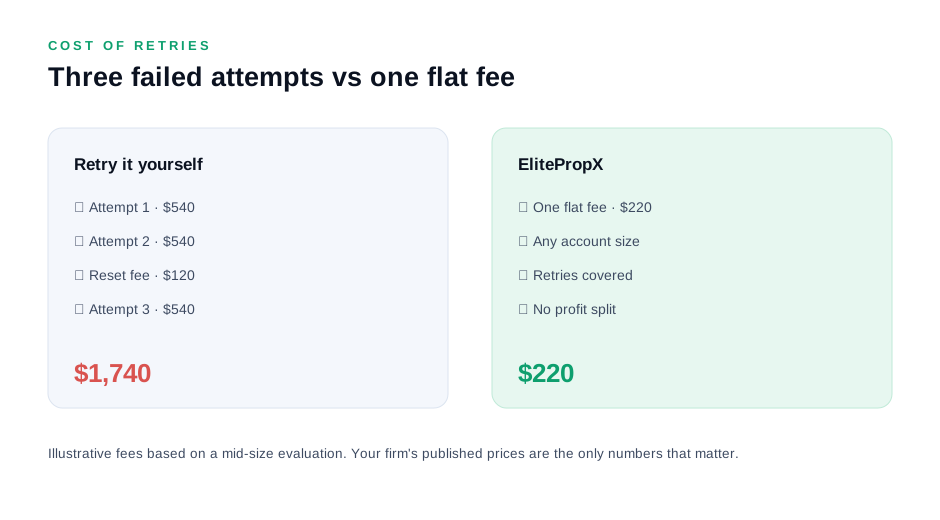
The second recurring theme is cost structure. Traders who had looked at percentage-based services or copy-trading arrangements often mention that a one-time fee with no claim on payouts was the deciding factor. The comparison they draw is concrete: a funded account generating $40,000 over a year would surrender $8,000 to $12,000 under a typical profit-share arrangement, against $220 once with ElitePropX.
Retries without an argument
Several reviews describe a first attempt that was reset — usually because of a firm-specific rule interaction — and note that the reset happened without a second payment or a negotiation. This is the practical value of a flat fee: the client does not have to argue about who bears the cost of a rule that was applied differently than published.
The free trial
The trial evaluation is mentioned frequently, and usually in the same way: it converted a sceptic. Being able to watch the reporting on a small account before paying $220 removed the main objection, which was not the price but the fear of paying for silence.
Recurring negative themes
Timelines were slower than expected
This is the most common complaint and it is entirely fair. Many traders arrive with an expectation set by marketing elsewhere — "pass in seven days" — and a two-phase forex evaluation with a 5% daily limit and a 10% target cannot be passed in seven days without gambling. When a client is told fourteen to eighteen trading days and it takes nineteen, the frustration is real even though the outcome is correct.
What changed in response: timelines are now quoted in trading days rather than calendar days, with the arithmetic shown, so the expectation is set by the rulebook rather than by an average.
The firm's fee is separate
Some clients expected the $220 to include the prop firm's challenge fee. It does not, and the reviews that mention it are right to flag the confusion — the cost of an evaluation is the firm's fee plus ours, and the two serve different purposes. The pricing section of the FAQ now states this in the first answer rather than the fourth.
No contact during flat weeks
A handful of reviews note that quiet weeks felt like silence. The log continued to update, but there was no narrative explaining why the week was flat. That is a legitimate criticism of a reporting cadence that prioritises numbers over interpretation, and the response has been to add a short weekly note when a week produces less than 2% of target.
The funded phase is not covered
Several reviewers expected ongoing support after funding and found that the engagement ended at handover. That is by design — we do not trade funded accounts and do not want a continuing claim on one — but the expectation gap is real. The handover now includes a funded-phase rules summary so the client is not starting from zero.
One review disputes a rule interpretation
A client whose first attempt was reset believes the firm applied a news-window restriction inconsistently with its published schedule. We agree that the firm's published schedule was ambiguous, which is why the retry was covered, but the client's view that the reset should have been avoidable is reasonable and is left here rather than argued away.
Case notes from paying clients
Eight summaries, chosen to represent the spread rather than the best results. All describe evaluations that were paid for; none was compensated.
“I had failed the same FTMO challenge twice.”
A trader with six years of forex experience had failed two $100,000 FTMO attempts, both by breaching the daily loss limit on a single oversized position after a losing morning. They used the free trial first, then paid for a full evaluation, which was passed in sixteen trading days. Their comment: the useful part was not the entries but seeing a log where the daily budget was never more than a third consumed. They now run the funded account with a fixed 1% risk per trade.
“Slower than I wanted, but it passed.”
A client expected a ten-day pass on a two-phase evaluation with a minimum trading day requirement and received the account on day nineteen. They were unhappy about the timeline and said so in their feedback, while confirming the pass and the handover. Their case is the reason timelines are quoted in trading days with the arithmetic attached.
“The retry was the test.”
A futures trader's first Apex attempt was reset after a rule interaction around a news window. The second attempt passed in eleven trading days with no additional fee. Their feedback focused on the absence of an argument: the reset was explained with the session log, and the retry started the same week.
“I wanted a $300k account and was told to start smaller.”
A trader asked for the largest futures evaluation available as a first engagement and was advised to start at $100,000, on the grounds that the ruleset was the same but the cost of a mistake was three times larger. They followed the advice, passed, and later returned for a second account. Their note: being talked out of a bigger sale was the moment they decided to trust the service.
“The log is the product.”
A client who runs a small fund described the session log as the only part of the service that mattered to them, because it made the process auditable rather than anecdotal. They passed a FundedNext $200,000 evaluation and asked for the raw log to keep.
“I did not expect the funded phase to be the hard part.”
A trader passed a $50,000 evaluation, then lost the funded account within five weeks by returning to their pre-evaluation position size. Their review is included because it is the most useful one on this page: the evaluation was passed cleanly, and the failure happened afterwards, in a phase the service explicitly does not manage.
“The free trial sold me.”
A sceptical client used the trial evaluation specifically to test whether the reporting was real. They checked the log against the firm's own dashboard each day, found the numbers matched, and paid for a $100,000 evaluation the following week. Passed in fourteen trading days.
“Communication went quiet in week two.”
A client whose second week produced almost no progress found the silence frustrating, even though the log showed the account was healthy and inside its limits. Their feedback led to the weekly note described above. The evaluation passed on day seventeen.
What these case notes are not: they are not a random sample, they are not independently audited, and they skew toward clients who completed an engagement. The public forum threads linked above are a better check on the pattern than eight summaries selected by the business being reviewed.
How to spot a fake review page in this niche
Five tells, all of them common on competing sites.
- Every review is five stars. Real feedback about a service that involves money and third-party rules always includes frustration. A perfect distribution is a signal, not a compliment.
- No specifics. "Great service, highly recommended" is not a review. A credible one names the firm, the account size, the timeline and at least one thing that went imperfectly.
- Reviews arrive in bursts. Ten reviews on the same day usually means a campaign, not ten clients.
- The reviewer has no history. Forum accounts with one post, or profiles created the same week as the review, are the cheapest form of social proof to manufacture.
- Star ratings in rich snippets with no visible reviews. If a site shows an aggregate rating in search results but the page contains no readable reviews, the markup is doing work the content is not.
The reverse test is more useful than any of them: ask a service what happened on the evaluations that failed. The answer, or the absence of one, tells you more than a page of testimonials.
The questions clients ask before they buy
Patterns in pre-purchase enquiries are as informative as reviews, because they show what people are actually worried about. These are the six that come up most often, answered the way they are answered in email.
“How do I know you will not just take my money and disappear?”
You do not, from a website. That is why the free trial exists: it is a small evaluation traded through the same reporting process, with no obligation and no payment. If the trial is silent or the log does not make sense, walk away — and the same test applies to every competitor.
“What if my firm bans this?”
Then it is the wrong firm for this arrangement and we will say so. Some firms prohibit third-party trading outright, some restrict account sharing, and some say nothing either way. The risk of a voided funded account sits with the account holder, so the honest answer is to check your firm's current terms and ask us what we know about their enforcement.
“Can I keep the account if I want to stop using you?”
You do not have to stop using us — there is nothing ongoing to stop. The fee is one payment, the account is handed over at funding, and no relationship continues unless you want a second evaluation.
“Is the $220 all I pay you?”
Yes, plus the firm's own challenge fee, which you pay to the firm. If an engagement ever requires something outside that structure, it is quoted in writing before payment rather than added afterwards.
“What happens if it fails?”
The attempt is reset on the same firm and account size at no additional service fee. The firm may charge its own reset or new challenge fee depending on its policy, and that cost sits with the firm.
“Why should I trust a service instead of just trading it myself?”
Most clients come here after failing an evaluation by breaching a rule they understood perfectly well. If that is not your situation — if the constraint set is not what is stopping you — the honest advice is to trade it yourself and save the fee.
What feedback changed
A reviews page that lists complaints without saying what happened next is only half a page. Four changes came directly from client feedback.
| Feedback | Change made |
|---|---|
| Timelines quoted in calendar days felt misleading when a firm's minimum trading days pushed the pass beyond two weeks | Timelines are now quoted in trading days with the arithmetic shown, and a range rather than a single number |
| Quiet weeks produced no explanation, only numbers in the log | A short weekly note is added whenever a week produces less than 2% of target, explaining why the account is flat |
| The firm's challenge fee was not obvious from the pricing copy | The distinction between the firm's fee and the service fee is now the first answer in the pricing section of the FAQ |
| Clients arrived at the funded phase with no plan | The handover now includes a funded-phase rules summary covering minimum days, payout thresholds and consistency checks |
Where we still disagree with a client
One recurring disagreement is worth stating rather than smoothing over. A minority of reviewers believe the service should continue past funding — trading the account, or at least supervising it — and offer a profit share for doing so. We decline, every time, and the reason is not moral but structural: an arrangement where the service earns a percentage of payouts creates an incentive to influence payout timing, and it takes the account away from the person whose name is on it. Some clients find that answer unsatisfying. It is still the answer.
The second disagreement concerns speed. Requests to "just push it a bit" on a slow evaluation are declined, because pushing on a two-phase challenge with a 5% daily limit is how a healthy attempt becomes a reset. Clients sometimes read that as a lack of urgency. It is the opposite: urgency applied to the target rather than to the rules is what fails evaluations.
Compliance note that reviewers keep repeating
The most useful thing any past client has said on this subject appears in several reviews in different words: check your firm's rules before you buy anything from anyone, including us. Firms change terms, policies are enforced unevenly, and a service cannot absorb that risk for you. If a review page of glowing testimonials convinces you to skip that step, it has made you worse off.
Where independent discussion actually happens
If you are evaluating any challenge-passing service, four places are worth ten minutes each before you pay. None of them is authoritative, and all of them are outside the control of the business being discussed, which is the property that matters.
Forex Peace Army. Long-running forex community with a culture of aggressive scepticism. Traders post specific timelines and screenshots, and members frequently ask the questions a marketing page will not answer — particularly about firms' rules on third-party trading. The ElitePropX thread there is a fair example of the pattern: a positive original post followed by probing replies.
BabyPips forum. Heavier on beginner-facing discussion, useful for gauging how the service is understood by traders who are new to evaluations. Replies often compare two or three passing services directly, which is more informative than any single review.
Myfxbook and similar trading-account communities. Where traders post their own results, payouts and frustrations. Slower to update than a forum, but the accounts attached to profiles give the claims context.
Prop firm Discord servers. The most current source and the least filtered. Firms change rules constantly, and community servers surface it within hours. The caveat is that these spaces contain promotion disguised as opinion, so weight comments from accounts with a real posting history.
What to look for when you read them
- Timelines with dates. "Passed in 16 days" is a fact; "great service" is not.
- Failures mentioned by the service itself. A vendor who acknowledges resets and explains them is more credible than one whose clients never fail.
- Disagreements left standing. Threads where the vendor replies once and stops arguing are healthier than threads where every objection is buried under a rebuttal.
- Consistency over years. One enthusiastic post in 2024 and silence since is weaker evidence than a slow trickle of updates.
The purpose of this reading is not to find a service with no complaints. It is to find one where the complaints are specific, dated and answered — and it applies to ElitePropX exactly as it applies to anyone else.
Leave feedback
If you have used the service, negative or positive, send it to support@elitepropx.com. Feedback is published in summary form with identifying details removed unless you ask otherwise, and critical feedback is not filtered out — the timelines complaint above exists because a client made it and it was accurate.
If you are considering the service and want to speak to a past client, ask. Some are willing, and a direct conversation is worth more than any page on this site. If the answer is no, treat that as information too — every service in this niche has clients, and the useful question is what they would say about the parts that did not go perfectly.
Questions about reviews
Are these reviews paid for?
No. No client was paid, discounted or given a free evaluation in exchange for feedback. The case notes are summaries of feedback received after a paying engagement.
Why are there no star ratings?
Because we would be grading ourselves. A self-collected aggregate rating is not a review, and publishing it as structured data would misrepresent it to search engines and readers alike.
Why include negative feedback?
Because it is the only part of a reviews page that carries information. A reader can discount praise; the complaints about timelines, quiet weeks and the funded phase are what actually inform a decision.
Can I verify that a reviewer was a real client?
Where a client posted publicly, yes — the forum threads are linked and the accounts have history. For the anonymised case notes, the honest answer is that you cannot verify them independently, which is why the public threads are given more weight.
Do you delete negative reviews?
No. Identifying details are removed at a client's request, but the substance stays. The rule-interpretation dispute above is left in place even though we disagree with part of it.
What do most clients say about the fee?
That the flat $220 with no profit split was the deciding factor, particularly compared with percentage-based services or copy-trading arrangements that keep taking a share of every payout.
How do I complain?
Email the address above with the firm, the account size and the issue. Complaints that involve a reset or a timeline dispute are answered with the session log attached.
How to read reviews of passing services
Reviews of this category are unusually hard to use, for a structural reason: the product is a one-off transaction with a binary outcome, so the population that leaves a review is skewed toward whatever happened in the first three weeks. A trader who was funded and paid writes about the process; a trader whose evaluation failed writes about the fee. Both are honest and neither describes the average experience.
Look for the failure case, not the success case
A review that describes a successful pass tells you the service can produce a pass, which is the minimum viable claim. A review that describes a failure and how the provider handled it tells you the thing you actually need to know: what happens when the outcome is bad. Read the two-star reviews first and count how many of them are about the outcome rather than the conduct.
Separate the firm's performance from the service's
Many complaints about passing services are complaints about prop firms wearing a different hat: a payout delayed by a consistency rule, an account closed after a review, a reset charge that was in the terms. Those are real problems and they are not the provider's failure, unless the provider misdescribed the rulebook. The distinction matters because it tells you which party to question before buying.
Check for specificity
A review that names the firm, the account size, the date and the fee is worth ten that say "great service, passed in two weeks". Specificity is hard to fake at scale and easy to check — the firm, size and date can be matched against a certificate. Where a provider publishes certificates, cross-check one against a review; where it publishes neither, the reviews are the only evidence and should be weighted accordingly.
Patterns that recur across reviews
| Pattern in reviews | What it usually indicates |
|---|---|
| Praise for speed of communication | Small operation with direct contact — good before purchase, variable during |
| Complaints about the same rule | The rulebook was not explained at purchase |
| Many reviews in one week | Coordinated solicitation; weight them as marketing |
| Detailed timelines and screenshots | The most reliable signal available in this category |
| Anger about a reset charge | Almost always a firm's fee, not the service's |
What no review can tell you
No review can tell you the base rate. Even a hundred honest reviews describe a self-selected sample, and the traders who never wrote anything are invisible. The only defensible way to use reviews is comparatively: between two providers, the one whose negative reviews are about outcomes rather than conduct is usually the better bet, because conduct complaints repeat and outcome complaints do not.
Reviews also cannot tell you whether an arrangement is permitted by a firm. That is a rulebook question, answerable only by reading the terms or asking the firm directly, and no amount of positive feedback substitutes for it. A service with a hundred five-star reviews and one firm policy violation is a hundred five-star reviews and one policy violation.
How feedback on this page is handled
Feedback is published as received, including the parts that are unflattering, with personal details removed. Where a complaint is factually wrong — a fee misquoted, a rule misattributed to the service rather than the firm — the correction is added as a reply rather than by deleting the original. Deleting a review is the one thing that makes every remaining review suspect.
Where a complaint is correct, the response is a refund and a change to the process. That is a higher standard than most of this market applies, and it is worth stating plainly because it is the only standard a reader can actually verify: look for providers who leave bad reviews visible and respond to them, and treat silence as a data point.
Two practical habits help when reading any review page, including this one. Sort by oldest first, because the earliest reviews were written before anyone had an incentive to solicit them. And count the reviews that mention a specific rule — a consistency threshold, a trailing floor, a payout window — since those are written by people who did the work and are the closest thing to a difficulty assessment a review can provide.
A third habit is less obvious: check whether the negative reviews are answered with a reason or a reassurance. A reason can be checked against a rulebook; a reassurance cannot. Providers who explain why a payout was held are usually providers who read the terms, and that is the single most useful attribute available to a client who has not yet bought anything.
None of which replaces the obvious step: ask the provider directly what happens on failure, in writing, before paying. Reviews describe what happened to other people; a written answer describes what will happen to you, and in a market where the failure case is the one that costs money, the written answer is worth more than any number of five-star entries.
That is the standard this page tries to meet, and it is also the standard to hold against it: the reviews published here are only useful if they include the ones that are unflattering, and the only way to judge that is to read them and see whether any of them cost the service something.
Reviews are a weak signal used well and a strong signal used badly. Used well, they narrow a shortlist and surface questions worth asking. Used badly, they replace the rulebook, which is the one document that actually decides whether a pass becomes a payout.
Read the terms, then the reviews, then ask the provider the failure question in writing — in that order the reviews cost nothing and occasionally save a fee.

Read the certificates instead of the reviews
One flat $220 for any prop firm, any account size. Retries covered, no profit split, funded login in your name. If your firm bans third-party trading we tell you before you pay, and we will not take the job.