
Reviewed · how we check firm rules
Start here
Contact ElitePropX
Telegram is the fastest route for a quick answer; email is best for a quote or a written record. Tell us the firm and the account size and you will get the fee, the expected timeline, and an honest note about whether your firm's terms make this a sensible idea.
How to reach us
Telegram
Fastest for quick questions about a firm, account size or terms check.
Best for quotes and anything that should stay in writing. Usually answered within one business day.
What we need to quote you
- Prop firm name
- Account size
- Phase structure (one, two, or instant)
- The market you trade: forex, CFDs or futures
Never send us banking details or identity documents. Evaluation account credentials are the only thing the service needs. KYC belongs to the prop firm, and payouts are paid to you directly by the firm.
Send an enquiry
Six fields, about ninety seconds. The reply contains the fee, a timeline in trading days, and an honest note about whether your firm's terms make this a sensible idea.
Before you write: four questions worth answering yourself
The enquiries that go well are the ones where the trader has already thought about the shape of the engagement. Four questions do most of that work.
1. Do you want this evaluation passed, or do you want to learn to pass it yourself?
Both are legitimate. The guides on this site cover the mechanics of passing in detail, and several readers use them to pass their own evaluation without paying anyone. If your goal is capability rather than an account, say so and the reply will point at the material that helps rather than a sales pitch.
2. What has happened on previous attempts?
If you have failed one or two evaluations, what ended them? A daily limit breach and a consistency failure call for different advice. Knowing the failure mode is often the difference between recommending a firm with a static floor and one with a trailing threshold — and it occasionally reveals that the firm, not the execution, is the problem.
3. Have you checked your firm's position on third-party trading?
This is the single most important pre-purchase check. Some firms prohibit it outright, some restrict account sharing, and some are silent. If your firm's terms make the arrangement a breach, the honest advice is to pass the evaluation yourself or switch firms — and you will get that answer rather than a payment request.
4. What is your plan for the funded account?
You do not need a polished answer. But traders who arrive with a rough sense of how they intend to trade a funded account — risk per trade, maximum daily risk, when to withdraw — end up in a much better position than those who treat funding as the finish line. If the answer is "I have not thought about it", the handover material covers it, and it is worth knowing that going in.
The questions that come up most often
"Can you pass my firm?"
Usually yes. More than twenty firms are covered, including FTMO, FundedNext, The5ers, FXIFY, Alpha Capital Group, FundingPips, E8, Apex Trader Funding, Topstep, MyFundedFutures, Take Profit Trader, TradeDay and MFF. If your firm is not listed, ask — the answer depends on whether its rules are published clearly, not on whether the brand is familiar.
"How much will it cost in total?"
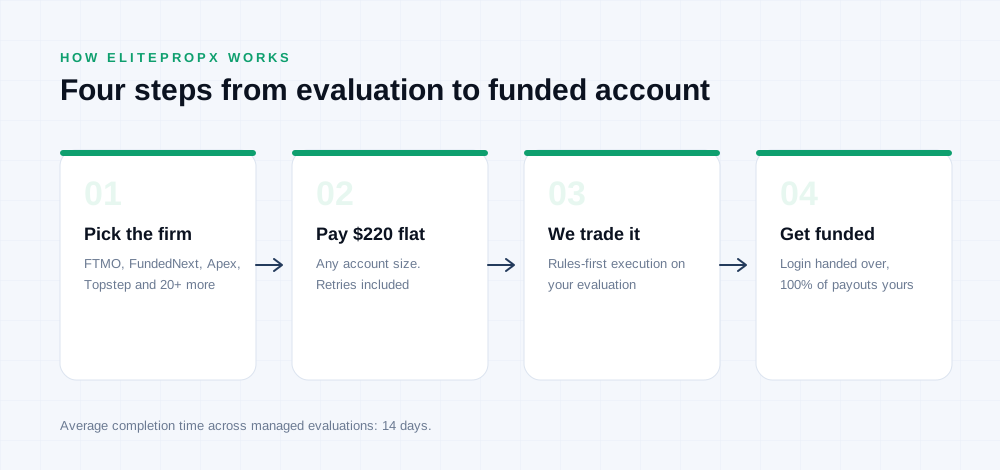
Two numbers: the firm's challenge fee, paid to the firm, and $220 paid to ElitePropX, flat, whatever the account size. There is no subscription, no profit split and no charge at payout.
"How long will it take?"
Quoted in trading days, not calendar days, because that is what the rulebook governs. A two-phase forex evaluation with a 10% target and a 5% daily limit typically requires sixteen to twenty trading days. Futures evaluations with trailing thresholds run eight to eighteen, depending on the trailing behaviour and the minimum day requirement. Anyone promising a fixed number of calendar days is guessing.
"What if it fails?"
The attempt is reset on the same firm and account size at no additional service fee. The firm may charge its own reset or new challenge fee depending on its policy, which sits with the firm rather than with us. The prop firm passing service page states the retry terms in full.
"Do you take a cut of my profits?"
No. The funded account is handed over with no claim attached, and 100% of what it earns belongs to the account holder.
"Can I try before paying?"
Yes. The simplest route is the free 7-day demo trial: open a demo with any broker, send the login, and watch us trade it for a week at no cost. If you want a real prop firm rulebook instead, ask about the trial challenge — a smaller evaluation run through the same process. Neither carries an obligation to continue, and both exist because paying a stranger for two weeks of silence is an unreasonable thing to ask.
"Is my firm going to ban me for this?"
We will tell you what we know about your firm's current terms and enforcement. We cannot promise a firm's future behaviour, and neither can anyone else: terms change, and enforcement is sometimes reactive. If a firm's position makes the arrangement a clear breach, you will hear that before you pay.
Firm compliance check: what we look for before accepting an assignment
Every enquiry triggers the same document review before a fee is quoted. It takes about twenty minutes and it has stopped more bad assignments than any other part of the process.
1. Does the firm's client agreement prohibit third-party trading?
Some firms state plainly that the account must be traded by the holder. Where that language exists and the firm enforces it, the client is told in writing before payment what the clause says and what enforcement has looked like. Not every firm enforces what it writes — but the client decides that risk with the facts in front of them, not after a funded account is voided.
2. Does the firm restrict account access or sharing?
A softer version of the same rule: the agreement may not ban third-party trading, but it may restrict credentials being shared or logins from multiple locations. Those clauses are often unenforced in practice, and they sometimes create friction in the funded phase if a client later travels while the account shows a consistent access pattern from elsewhere.
3. What are the funded-stage rules, not just the evaluation rules?
Consistency windows, first-payout delays and profit thresholds decide whether a passed account produces money. A firm with a comfortable evaluation and an aggressive payout-stage consistency rule is a worse assignment than the evaluation rules suggest, and it is worth knowing that before the client pays anything.
4. Is the evaluation structure workable at all?
Some promotional evaluations combine a short window, a tight trailing threshold and a large target. The result is an evaluation where the outcome depends on luck, and a service that takes the fee anyway is selling a lottery ticket with a process attached. Those are declined, even when the account size looks attractive.
5. Is there anything unusual about the payout path?
Withdrawal methods, processing times, minimum withdrawal amounts and any restriction on taking profit in the first months. None of these affect passing, but all of them affect whether the funded account is useful to the person paying for it.
The outcome of that review is sent in the first reply: proceed, proceed with a caveat, or a recommendation against. Roughly one enquiry in ten comes back with a caveat, and it is not always the one the client expected.
Choosing a firm for a first evaluation
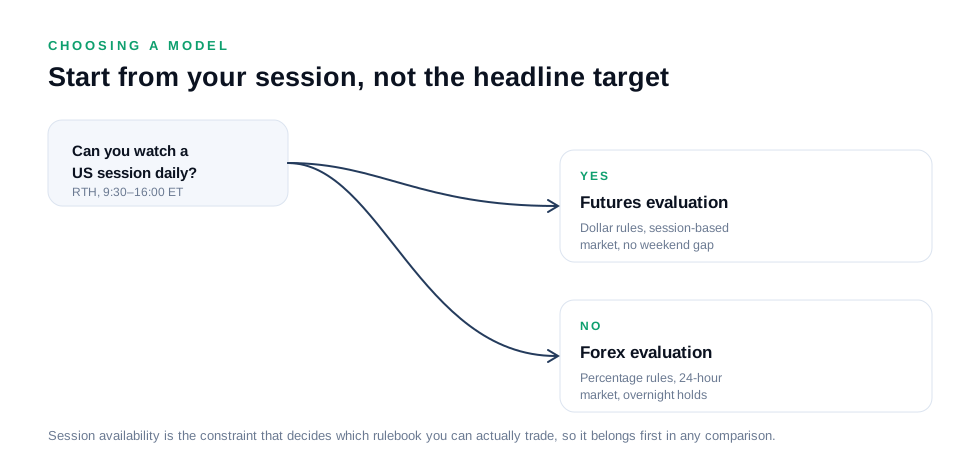
The most common enquiry is not "can you pass my firm?" but "which firm should I buy?" — and the answer is driven by how much room the rules leave, not by the size of the account.
Start with a static maximum loss. Firms whose failure floor never moves give a risk plan its best chance, because profit does not shrink the buffer. On a $100,000 account with a 10% limit and a static floor, the failure level stays at $90,000 whether the balance is $100,000 or $115,000.
Prefer no consistency rule during the evaluation. A payout-stage rule can be managed by adding ordinary winning days before a withdrawal. An evaluation-stage rule constrains pace from the first session and makes a fast target dangerous.
Check for a time limit. No limit is better than thirty days, because a flat week costs time rather than the account. Where a firm imposes a window, the plan has to be tighter and the required profit per session rises accordingly.
Consider the payout cycle before the split percentage. An 80% split paid weekly delivers cash more often than 90% paid monthly, and for a trader withdrawing regularly the difference is larger than the headline suggests.
Read the terms on third-party trading. If the policy is a clear prohibition that is enforced, none of the other criteria matter. This check comes first, not last — which is why it is the second thing asked in every reply.
If you have a shortlist of two firms, send both names and the comparison will be answered in the context of what you plan to trade afterwards. The evaluation is temporary; the funded account is not.
What happens after your first message
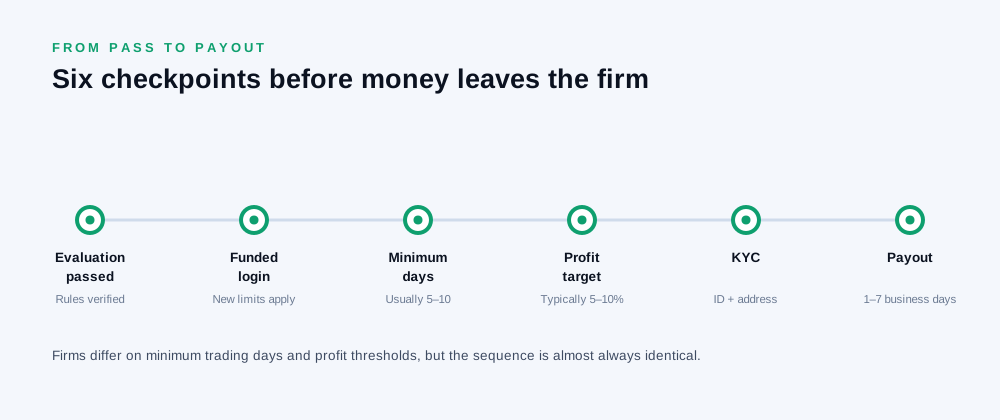
- Reply with the fee and the timeline. Usually within one business day, including any compliance notes about your firm.
- A short exchange about the firm's rules. If your firm's evaluation has an unusual structure — an ambiguous trailing rule, a payout-stage consistency condition, a narrow instrument list — that is discussed before anything is paid rather than discovered mid-attempt.
- Payment and confirmation. The fee is paid once the firm, size and rules are agreed in writing.
- Rulebook summary and risk plan. The one-page document described on the about page, sent to you before the first trade.
- Session logging begins. Equity at close, distance from the failure floor, percentage of target, and trading days used.
- Verification and handover. When the firm confirms the pass, the funded credentials and a funded-phase rules summary are passed to you.
Response times and availability
Enquiries are answered within one business day in most cases. Questions that require checking a firm's current published terms can take longer, because they are verified against documentation rather than answered from memory — a reply that is a day later and correct is more useful than a fast guess about someone else's rules.
Trading sessions are scheduled around the permitted hours of the firm being evaluated rather than around a fixed working day, so time zones are rarely a problem. Communication is asynchronous and works from any region, with the usual exception of jurisdictions a firm does not accept.
Before contacting us, it is worth spending ten minutes on two pages: the prop firm comparison for structure differences between firms, and the rules matrix for the exact targets and limits. Most enquiries are answered by those two pages, which is the point of publishing them.
Payment, timelines and rule changes
Three practical questions come up at the point of payment, and all three have short answers.
What exactly is the fee structure? $220 to ElitePropX, flat, per evaluation, regardless of account size, with retries included. The prop firm's own challenge fee is separate and paid directly to the firm, typically at checkout on the firm's site. There is no subscription, no performance fee and no cut of payouts.
What if the firm changes its rules mid-evaluation? It happens, and the response is to re-read the terms, adjust the plan if the change is workable, and stop if it is not. Where a rule change makes the original plan invalid — a trailing threshold tightened, an instrument removed, a news window extended — the client is told immediately rather than after a surprise. If a change ends an attempt, the session log is used to support a reset request with the firm, and the retry is covered by us either way.
What if I want a second account later? Each evaluation carries its own $220 fee. Most clients who return do so after a payout, usually for a second account at the same firm on a scaling plan. Accounts are typically run sequentially rather than in parallel so that each one gets a full daily risk budget rather than several accounts splitting the same attention.
What we will not do
- Trade a funded account. No managed funded accounts, no profit share, no exceptions — including when a client offers a generous split to keep it running.
- Promise a guaranteed pass. Firm rule changes, platform outages and market gaps can end any attempt, and any service claiming otherwise is misrepresenting the risk.
- Accept an assignment where the rules make the outcome a coin flip. Promotional evaluations with short windows and tight trailing thresholds are flagged before purchase rather than sold as a shortcut.
- Quote a figure for a firm whose terms have not been read. Timelines and pass rates quoted from memory are guesses, and guesses are how clients end up disappointed.
- Tell you your firm permits something it does not. If the client agreement prohibits third-party trading and the policy is enforced, that is the answer, even when it costs the engagement.
A worked enquiry, end to end
Abstract process descriptions are hard to judge. Here is what a real engagement looks like from first email to funded handover, using a typical case: a trader with two failed attempts behind them, evaluating a $100,000 two-phase forex account.
Monday — the first email
"I want to pass an FTMO $100k two-phase evaluation. I have failed twice, both times on the daily loss limit after a bad morning. What do you charge and how long does it take?"
Three things in that message make the reply useful: the firm, the size, and the failure mode. The failure mode is the most valuable of the three — two daily limit breaches says the problem is sizing after a losing session rather than market selection, and it shapes the risk plan that will be used.
Tuesday — the reply
The response contains the flat $220 fee, a timeline in trading days rather than calendar days (sixteen to twenty), a note that FTMO measures its 5% daily limit on equity including floating positions, and confirmation that a reset is covered if an attempt fails on a rule breach. It also asks one compliance question: whether the trader has read FTMO's terms on third-party trading. A summary of what those terms say is included, along with the honest caveat that firms can change policy and that any enforcement decision is the firm's.
Wednesday — the decision
The trader reads the compliance note, decides the risk is acceptable to them, and pays. Payment confirms the firm, size and structure in writing, including the point that the firm's challenge fee is separate and already paid to the firm.
Thursday — the rulebook summary and the risk plan
Two documents go out. The rulebook summary lists target, daily limit with its measurement basis, maximum loss and drawdown type, minimum trading days, instrument restrictions, news windows and the funded-stage payout conditions. The risk plan converts them into numbers: $1,600 maximum risk per trade, three positions maximum, a hard stop at $4,500 of realised daily loss, no trades inside a news window, and a target of $800–1,200 of profit per session rather than a large daily goal.
That last decision matters more than it looks. A trader aiming for $3,000 a day takes roughly three times the risk to reach it, and the daily limit ends the account long before the target arrives. A trader aiming for $1,000 a day reaches $10,000 in about two weeks with the failure floor never in play.
Week one — four sessions logged
Every session is logged with four numbers: closing equity, distance from the failure floor, percentage of target completed, and trading days used. Week one finishes at $2,900 of the $10,000 target, with the account never closer than 8% to the failure floor and the largest single session at $1,150. Nothing dramatic has happened, which is the point.
Week two — phase one complete
The evaluation reaches $10,400 by the ninth trading day. Because FTMO requires four minimum trading days and applies no consistency rule at evaluation, verification proceeds immediately. Phase two begins with risk per trade reduced by a quarter, since the target is $5,000 and over-sizing a smaller target is the most common way a clean phase one is wasted.
Week three — verification and handover
Phase two completes on the sixteenth trading day. The firm verifies the pass and issues its certificate; the funded credentials are passed to the trader along with a funded-phase summary covering the minimum trading days before the first payout, the profit threshold, the firm's consistency position at payout, and the KYC documents that will be required.
After the handover
The engagement closes at that point. The account is the trader's, no profit split applies, and questions about the funded phase are answered as part of the handover rather than as an ongoing service. Traders who want a second account come back; the ones who do not are never contacted again.
What that sequence does not include: a dramatic single session, a large directional bet, or any claim about what the funded account will earn. The value is in pacing a fixed budget across a sufficient number of days and never letting one session decide the outcome.
Complaints and corrections
If something has gone wrong on an engagement — a timeline that slipped, a reset you disagree with, a rule you believe the firm applied inconsistently — say so directly and the session log will be attached to the reply. Disagreements about a firm's rule interpretation are legitimate and are answered with the log rather than with a defence.
If a figure on this site contradicts your firm's documentation, send it with a screenshot. Corrections to the rules matrix and the comparison page are welcome and are acted on: accurate rules data is more useful to every reader than any opinion about which firm is best.
One thing we will not do: quote a pass rate, a timeline or a guarantee for a firm whose rules we have not read. If the reply asks a question about your firm's current terms, it is because the answer depends on them.
Three things that make an enquiry easier to answer
Most enquiries are answered in one reply. The ones that take an extra exchange are usually missing one of three details.
Say which plan you are buying, not just which firm. Firms increasingly sell several structures under one brand — a standard two-phase evaluation, a single-phase version, a trailing-drawdown variant and sometimes an instant funding account. "FundedNext" is ambiguous; "FundedNext two-phase standard, $100k" is not, and it determines which rule set applies.
Mention any restriction you know about. If your firm limits instruments, prohibits holding through the weekend, or restricts trading around news, say so. Those constraints change the plan, and knowing them in advance is the difference between a timeline that holds and one that slips in week two.
Say what the account is for. A trader who intends to withdraw monthly needs a firm with a fast payout cycle; one who wants to scale to multiple accounts needs a firm with a genuine scaling plan. Both are legitimate, and the recommendation differs — which is why the question about the funded phase is asked in every reply rather than treated as small talk.
One further note on expectations: the reply will not contain a promised completion date, a guaranteed pass rate for your specific firm, or a claim that your firm permits third-party trading. Those three things depend on a rulebook that changes without notice, and a service that states them confidently is stating them without having checked. What the reply does contain is the fee, a timeline range in trading days, the specific rules that shape the plan, and a plain answer about compliance risk. Everything else is discoverable during the engagement rather than promised before it.
There is no wrong way to make contact, and no obligation attached to an enquiry. The only requirement is the one repeated throughout this page: check your firm's position on third-party trading before paying anyone, including us.
Contact questions
How quickly will I get a reply?
Usually within one business day. Enquiries that need a firm's current terms checked can take longer because the answer is verified against documentation.
What should I write in the first message?
Firm name, account size, phase structure and the market you trade. Add anything you know about previous failed attempts, as it changes the recommendation.
Can we talk on a call or chat?
Telegram is best for quick questions. For anything that forms part of an engagement — the fee, timeline and compliance notes — email is used so there is a written record. Where a call is genuinely useful, usually for multi-account arrangements, it is arranged from the email thread.
Do you offer the service in every country?
Participation depends on the firm accepting traders from your jurisdiction. Sanctioned regions are excluded, and some firms have their own country restrictions.
Is there a phone number?
No public phone line. Email keeps the timeline, fee and compliance discussion in one auditable place, which matters more in this niche than immediacy.
Can I request a specific firm's rule breakdown before paying?
Yes, and it is encouraged. Ask for the rulebook summary a given firm would produce and it will be sent before any payment is discussed.
What if I want to cancel an enquiry?
Enquiries carry no obligation. Nothing is charged until a firm, size and rule set are agreed in writing, so there is nothing to cancel before that point.
Writing an enquiry that gets a useful reply
Most first messages are one line: "how much to pass FTMO?". The answer is always the same flat fee, and it is rarely the answer the sender needs, because the useful part of the reply depends on four details that a one-line message omits. Supplying them takes about ninety seconds and removes a round trip from the conversation.
| Detail | Why it changes the answer |
|---|---|
| Firm name | Determines the rulebook, which determines the entire plan |
| Account size | Sets the dollar value of every limit, not the difficulty |
| Account type | Swing and normal accounts have different overnight and weekend rules |
| Any deadline | Changes pacing recommendations and whether a reset is sensible |
Two firms with similar marketing can have completely different loss mechanics — one trailing, one static — and the same $100,000 account can be a forgiving assignment at one and a tight one at the other. That is why the firm name is the first question and why an answer without it is generic by necessity.
What you will not be asked for
No platform passwords, no broker login, no identity documents, and no payment details at the enquiry stage. The only things needed to quote and schedule are the four details above. Anyone asking for account credentials before a purchase has been agreed is worth treating with suspicion, including if the request appears to come from this site.
Payment is discussed only after the firm's third-party policy has been confirmed, because a purchase that has to be reversed is worse for both sides than a conversation that ends early. Where a firm prohibits third-party trading, the reply will say so and recommend against proceeding rather than quoting a fee and letting the client discover the terms later.
Response times and time zones
Enquiries are answered within one business day, and most within a few hours during European and US market hours. Messages sent over a weekend are answered on the following Monday, which is also when most new assignments are scheduled — a Friday evening message tends to result in a Monday start rather than a Sunday one, since the first session of an evaluation is a poor place to begin with a half-formed plan.
If a message has gone unanswered for longer than a business day, it is worth resending rather than assuming a decision. Enquiries do occasionally land in spam filters, particularly from corporate addresses, and a second message costs nothing.
What happens after the quote
A quote is valid for the current rulebook as described on the day it is sent. Firm terms change, and a quote that is several weeks old may no longer describe the same assignment — a change to a daily loss measurement or a payout threshold can move the difficulty substantially even though the fee is unchanged. Clients returning after a break are therefore re-quoted rather than offered the earlier price.
Once an assignment is agreed, the rulebook summary and the risk plan are sent in writing before the first trade, so there is a record of what was promised. That document is the reference point for any later disagreement, and it is written for the client rather than for the firm, which is a distinction worth checking when comparing services.
If you are undecided between firms
Send both names and ask which rulebook is more forgiving at the size you can afford. There is a real answer to that question and it does not depend on anyone's opinion of the firms' marketing. Daily loss measurement, whether the maximum loss trails, the number of minimum trading days and any consistency rule at payout are the four variables that decide it, and comparing them takes less time than reading two sets of testimonials.
Confidentiality and records
Correspondence is kept for the duration of an assignment and for a reasonable period afterwards, because disputes about what was promised are settled by the written record rather than by recollection. Nothing is published about a client without explicit permission, and the case studies on the results page are anonymised where the client asked for it — some are not, and that is their choice rather than a marketing decision.
What is never shared: account credentials, funded-account balances, personal identification, or the identity of a client who has asked to remain anonymous. The certificates that appear on the results page are published only with consent, and a client who later changes their mind can ask for one to be removed.
The practical implication for an enquiry is that a single email thread is the best record. Messages that move between platforms tend to lose the detail that matters — the account size quoted, the date a rulebook was checked, the day a plan was agreed — and those details are exactly what a later question will turn on.
If a question concerns a rule rather than an assignment, it is still worth sending. Questions about how a trailing drawdown updates, why a consistency rule delays a payout, or which of two firms is more forgiving at a given size are answered whether or not a purchase follows, and several of the longer articles on this site began as one of those messages. The only thing that will not happen is a recommendation to buy before the rulebook question has been settled — a fee earned on a misunderstood rule tends to come back as a complaint, and the second conversation is longer than the first would have been.
Send the firm and the account size
Telegram for a quick question, the form for a quote in writing.