FTMO vs FundedNext (2026)
FTMO and FundedNext both fund forex and CFD traders, which makes this a genuine head-to-head rather than the mismatch that most "FTMO versus a futures firm" comparisons turn out to be. They also share far more than the marketing suggests: two-step structures, hard daily loss limits measured on equity, minimum qualifying days and a payout-stage consistency check. The differences that matter are narrower and more specific than the brand names imply.
Verify on your dashboard
Both firms revise targets, drawdown figures, pricing and programme availability. The mechanics below are stable; the numbers are not. Confirm current terms inside your own account before buying.
Where the two firms actually differ
| FTMO | FundedNext | |
|---|---|---|
| Programme range | Standard two-step structure | Several products, including lower-target options |
| Drawdown | Static, from the initial balance | Static for standard products; check variants |
| Daily loss limit | Hard stop, measured on equity | Hard stop, measured on equity |
| Payout stage | Minimum days and consistency assessment | Minimum days and consistency assessment |
| Main emotional draw | Long payout track record | Choice of difficulty per programme |
The structural takeaway: FundedNext's advantage is optionality. If you have failed repeatedly at a tight target, a lower-target product with stricter other conditions may suit you better than a standard challenge — because your failure mode is the target, not the drawdown. FTMO's advantage is a track record you can check, which is the one thing that cannot be fixed by reading a rulebook.
The constraint that actually fails traders
At both firms, the maximum daily loss is the rule that ends most evaluations, and it is measured on equity including floating losses. An open position showing a loss can breach it before it is ever closed.
Risk budgeting
Cap each trade at one third of the daily allowance. On a $100,000 account with a 5% limit that is roughly $1,650 per trade, which absorbs three consecutive losers inside the limit. Almost nobody fails from taking too little risk; plenty fail from taking too much after a loss.
The second most common cause is not a rule at all — it is the absence of a daily ceiling. Traders plan their maximum loss and never plan a maximum win, then give back a good day in the last hour.
Where they are identical
- Two-step pacing. Both split the profit target across phases, which rewards even distribution rather than a single strong week.
- Minimum qualifying days. Both require them per phase, so speed is never rewarded.
- Consistency at payout. Both assess profit distribution before releasing a withdrawal, so a pass built on one dominant session needs more trading before it converts to money.
- KYC on first payout, on you, because the account is in your name.
Because the payout check is essentially the same at both, the distribution technique is identical, and it is covered in the consistency rule guide and the payout process guide.
How to choose in four steps
Diagnose your last failed attempt
A daily-limit breach is a sizing problem and no firm fixes it. A target you could not reach in the allowed window is a programme-selection problem, and that is where FundedNext's range helps.
Compare per-phase, not per-firm
Difficulty is not one number. Compare the target-to-drawdown ratio of the specific product you would actually buy, in the phase you would actually trade.
Weight payout reliability above everything
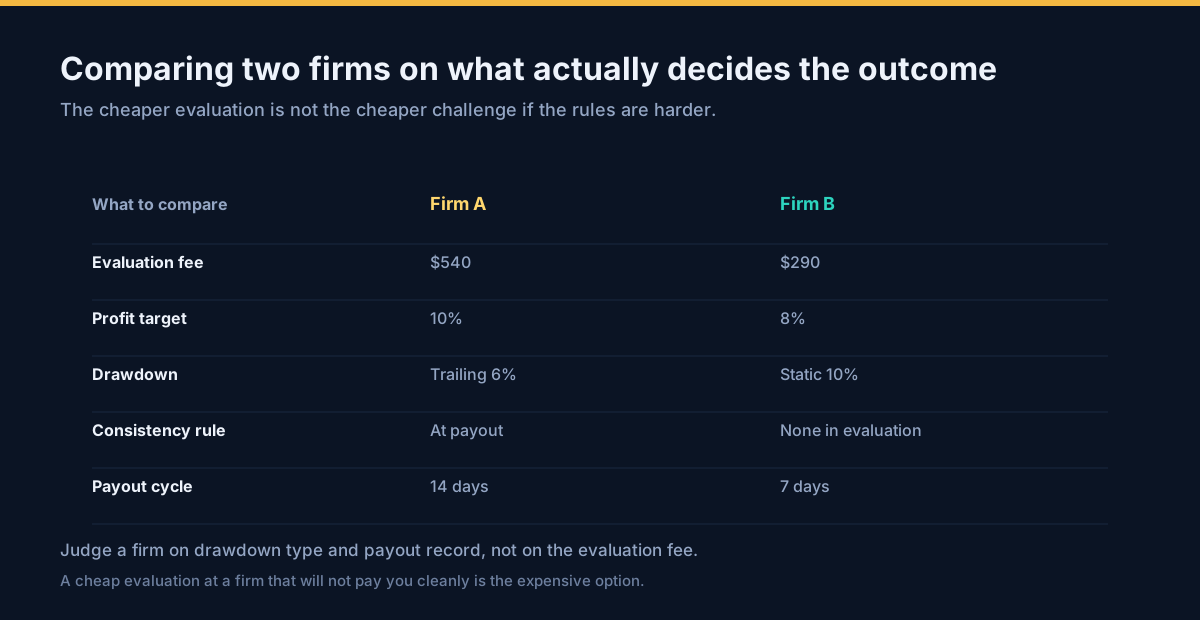
A cheaper evaluation at a firm that stalls withdrawals is the most expensive option available. Check recent independent withdrawal reports rather than testimonials.
Size by ratio, not by headline
A favourable ratio at a small size beats a poor ratio at a large one, and you can scale or duplicate once funded.
Passing either firm
Structurally, passing either requires the same thing: size against the daily limit, pace the target across the minimum days, and distribute profit evenly so the payout check is satisfied without repair work. The differences between FTMO and FundedNext are in programme availability and track record, not in the method.
If the daily limit is the recurring blocker, ElitePropX passes both — and most other major firms — for a flat $220 per evaluation, with retries covered on managed accounts and no profit split. See the prop firm passing service, or read the FTMO rules and the FundedNext challenge passing guide if you would rather do it yourself. Related: FTMO vs Apex and FundedNext vs Funding Pips.
Frequently asked questions
The FAQ block below covers which firm is better, drawdown types, which evaluation is easier, minimum days, consistency rules and whether we can pass both. For provider selection, see the best passing services compared.
Is FTMO or FundedNext better?
Do both firms use a static drawdown?
Which has the easier evaluation?
How many trading days do they require?
Do they have consistency rules?
Can you pass both for me?
Have a question before you commit?
Ask us anything about your firm, your account size or whether a passing service suits you. We answer directly on Telegram — no forms, no queues.
Ready to pass your prop firm challenge?
Flat $220 per evaluation — we trade it for you and hand over a funded account. No hidden cuts, no monthly fees. Message us on Telegram and we will answer in minutes.