
Firm comparison · reviewed October 2026
FundedNext vs Topstep: choosing between a forex and a futures evaluation
These two firms appear in the same comparison tables and are almost never substitutes for each other. FundedNext evaluates a percentage-based forex account that can be traded around the clock; Topstep evaluates a dollar-based futures account tied to a single session. This guide compares the rulebooks line by line, then works backwards from the constraint that decides the outcome for most traders — the hours you can actually be at the screen.
Key takeaways
- The comparison is between rulebook models, not two versions of the same product: one measures targets and losses as a percentage of balance, the other as fixed dollar figures.
- Session availability decides the choice more often than the headline target. Futures evaluations are effectively a New York and Chicago session job; forex evaluations run around the clock.
- A trailing dollar threshold punishes unrealised profit; a static percentage loss does not care what is open. The same equity curve therefore fails at different moments on each.
- Cost structure differs by shape, not just by size: one-off purchase versus recurring subscription. A slow pass is cheap on the first and expensive on the second.
- Whichever you pick, the $220 flat passing service quoted on this site is the same price for either firm.
Contents
- Why these two are not really rivals
- The two rulebook models
- Session availability, the deciding constraint
- Dollar versus percentage arithmetic
- What each evaluation costs to lose
- News windows and event risk
- Payouts: what each model rewards
- Holding overnight and over weekends
- A decision framework
- Where first attempts fail
- A thirty-day plan for either model
- Frequently asked questions
Why these two are not really rivals
FundedNext is a forex and contract-for-difference firm. Its instruments are currency pairs, metals and indices, priced in lots, quoted continuously from Sunday evening to Friday evening, and settled as a cash balance rather than through an exchange. Topstep is a futures firm. Its instruments are exchange-traded contracts — the micro and full versions of the equity index, energy and metals contracts — quoted in ticks, traded inside defined sessions, and subject to exchange margin and exchange hours.
That difference is not cosmetic. It changes the hours a trader must be available, the way a loss limit is expressed, the size of the smallest position that makes sense, and what happens if a position is held over a weekend. A comparison page that ranks the two firms on "profit target" alone is comparing a percentage to a dollar figure and calling the result a score.
So the useful question is not which firm is better. It is which rulebook fits the way you can trade. A trader with a day job and a laptop at 10pm has almost nothing to gain from a futures evaluation whose whole opportunity set lives between the New York open and 11:30am. A trader who is at a desk every morning and wants a cash-settled market with no swap charge and no overnight gap has reason to prefer futures regardless of how attractive a percentage target looks on paper.
There is also a structural difference in what the two firms are testing. A percentage rulebook is scale-free: the same 8% target and 10% maximum loss apply whether the balance is small or large, so a smaller account is neither easier nor harder in relative terms. A dollar rulebook is scale-dependent in a subtler way: the target and the loss limit both scale with account size, but commissions, slippage and the minimum tick value do not. On smaller futures accounts, fixed trading costs consume a larger share of the target, which makes the smallest tier marginally harder than the arithmetic suggests.
The two rulebook models
Laid side by side, the two rulebooks differ in almost every row. The table below is the version worth memorising before you read any firm's marketing page, because it tells you which questions to ask.
| Parameter | FundedNext (percentage model) | Topstep (dollar model) |
|---|---|---|
| Market | Forex, metals, indices, CFDs | CME futures, micro and full |
| Trading hours | Around the clock, Sunday to Friday | Session windows, exchange hours |
| Profit target | % of the starting balance | Fixed dollar amount per tier |
| Maximum loss | Static or trailing, depending on plan | Trailing threshold on peak equity |
| Daily stop | Stated per plan, equity or balance | Stated separately, resets each session |
| Consistency | Applied on some plans only | Best-day expectation at payout |
| Minimum days | Usually none on the first phase | Minimum session count applies |
| Cost shape | One-off per attempt | Recurring subscription |
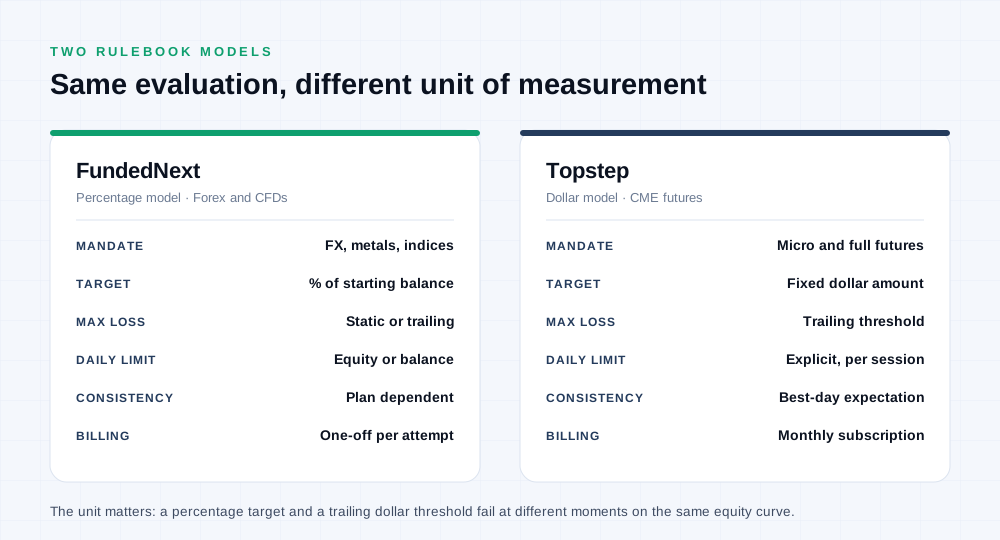
Two rows in that table cause more damage than the rest when they are misread.
The first is the maximum loss row. A static percentage loss is measured from the starting balance and does not move. It means the account's failure point is a fixed distance away for the whole evaluation, so progress never makes the account more fragile. A trailing dollar threshold is measured from peak equity and moves upward as profit accumulates — including unrealised profit, on an intraday structure. Progress shrinks the cushion, so risk per trade has to fall as the target approaches. These are opposite behaviours, and a plan written for one will be wrong on the other.
The second is the cost shape. A one-off purchase means a slow pass costs the same as a fast one. A recurring subscription means the calendar is a cost centre: every week spent not passing is a week paid for. That changes the correct pace for each model. On a one-off fee, patience is free; on a subscription, patience is a line item, which pushes traders towards taking the marginal setup they would otherwise skip.
Session availability, the deciding constraint
Most comparisons start with the profit target because it is the number on the sales page. It is the wrong place to start. The first question is where your trading hours fall, because a rulebook you cannot trade to is not a rulebook — it is a subscription you are paying for.
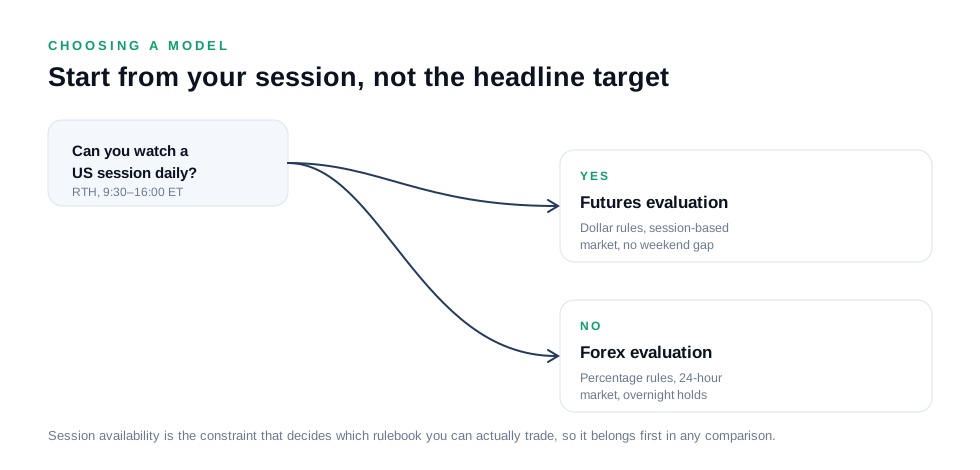
Futures liquidity is concentrated. The equity index contracts are at their most liquid and most orderly during the cash session, and activity thins considerably outside it. A trader operating at 9pm London time is trading the evening of a market that already had its day, with wider spreads, thinner books and a greater chance that a stop is filled somewhere other than where it was placed. None of that is fatal on a large account; on an evaluation with a fixed dollar threshold it is exactly the kind of cost that ends attempts.
Forex is the opposite arrangement. The market transfers its liquidity from one centre to the next across the day, so there is a real, tradeable session at almost every hour. A trader who can only operate between 7pm and 10pm has a legitimate liquid window in the New York afternoon and the start of the Asian session. The same trader attempting a futures evaluation is working with an instrument that has largely stopped moving in the way the plan assumes.
That asymmetry has a second consequence worth stating plainly: futures evaluations reward a fixed routine. The same two or three instruments, the same session, the same number of trades. Forex evaluations reward a flexible one, because the session a trader can attend may shift through the week. If your schedule changes week to week, a percentage-based 24-hour market is the easier environment to build a repeatable process in.
There is one more practical point about session windows and daily limits. On a futures evaluation the daily limit resets with the session, which means the reset is a clean, predictable event you can plan around: the day's budget is restored at a known hour. On a forex evaluation the "day" is defined by the firm, often at a server-time rollover that does not correspond to anything meaningful in your own life. Traders who lose track of the reset try to reason about a budget that has already changed, and the mistake is expensive because it usually happens on a day that is already going badly.
Dollar versus percentage arithmetic
Both models are arithmetic. The difference is which number is held constant, and that determines how a plan has to be written.
On a percentage model, the target and the loss limit are both fractions of the starting balance, so risk per trade can be expressed as a fraction too — one per cent per trade, three losses to a third of the daily budget, and so on. The advantage is that the same plan works at every account size. A trader who has tested a 0.5% risk model on a small evaluation can carry it unchanged to a larger one, and the only variable that changes is the value of the payout.
On a dollar model, the limits are quoted in dollars and the position is quoted in contracts, so risk per trade is computed in ticks: contracts multiplied by ticks at risk multiplied by tick value. That converts a percentage intention into a whole number of contracts, rounding down by necessity. On small accounts this rounding matters. If a 0.5% risk budget buys 1.4 micro contracts, the honest position is one contract, and the plan's real risk is closer to 0.35% than to 0.5%. The evaluation is not harder for that — it is slower, because the target is unchanged while the risk per trade has been rounded down.
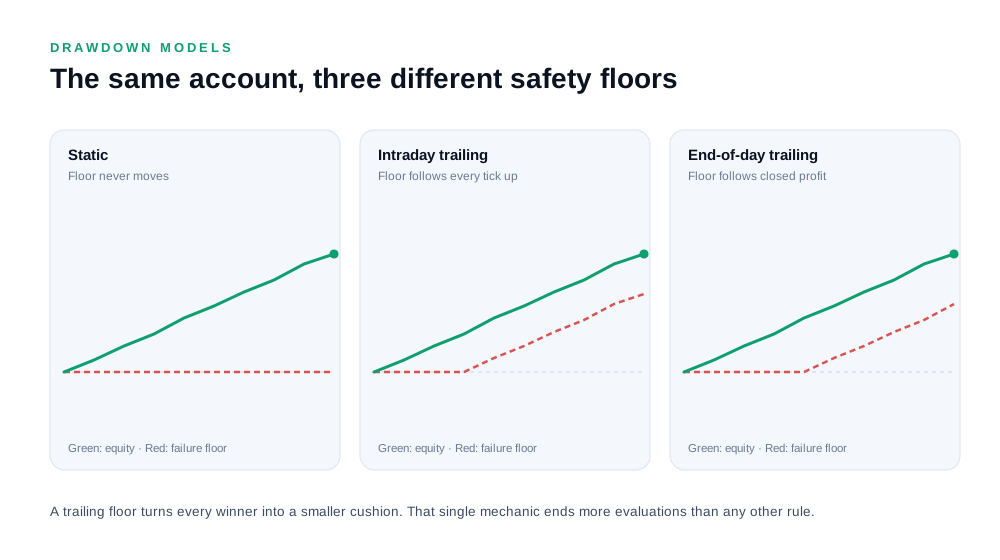
The trailing floor is where the arithmetic turns against an inexperienced trader. Take a futures account that starts with a threshold a fixed distance below the opening balance. If equity reaches a new peak, the threshold rises with it. A $2,000 unrealised gain on one contract moves the floor before the position is closed. If the trade is then closed at +$700 after a retracement, the floor stays where the peak pushed it: the trader banked a third of the profit and surrendered the entire cushion. Do that three times in a week and an account that looks flat on a statement is close to failure.
A static percentage loss has no equivalent mechanism. An open profit cannot tighten the failure point, so a trader is free to let a winner run without making the account more fragile. The trade-off is that the static floor is close from the beginning and never moves away — the protection that a trailing floor gives early in an evaluation is exactly the protection that a static floor never gives.
Put together, the two models fail in different ways. A percentage account with a static floor is lost by an accumulation of losses that each looked small. A dollar account with a trailing floor is lost by a large winner that was given back, taking the cushion with it. A plan that names the dominant failure mode and prices the risk against it is worth more than a plan that optimises the target.
What each evaluation costs to lose
Comparing the sticker price of the two firms is nearly useless without the time dimension. One charges per attempt; the other charges per period. Those are different bets.
A one-off fee is a fixed cost per attempt. It makes a failed attempt cheap to repeat and a slow pass cost nothing extra, which is the arrangement that favours a patient trader. The risk it creates is the opposite of financial: because a retry is only the price of another attempt, the incentive to keep trying with an unchanged plan is strong. Traders on one-off fee models fail repeatedly at the same rule, because nothing about the cost forces a review.
A subscription is a per-period cost, so the effective price of a pass rises with the number of weeks it takes. Two consequences follow. The first is that a fast, disciplined trader pays considerably less than a slow one for the identical account — which is fair, but it means the cheapest tier is not necessarily the cheapest outcome. The second is behavioural: a recurring charge creates pressure to trade, and pressure to trade is the most common source of the low-quality setups that spend a daily budget for nothing.
Whichever shape a firm uses, the real cost of an evaluation is the fee multiplied by the expected number of attempts, plus the cost of the time spent. A trader who fails three times on a subscription has spent three months of fees and three months of attention. A trader who fails three times on a one-off fee has spent three fees and, usually, less time — because there is no monthly meter running.
This is the point at which a passing service changes the calculation rather than competing with the firms. ElitePropX trades the evaluation for a flat $220 across either model — FundedNext, Topstep, and more than twenty other firms — with any account size, retries covered and no profit split on the funded account. That flat fee does not replace the firm's own charge; it replaces the sequence of attempts and the weeks of attention. For a trader whose failure mode is behavioural rather than analytical, that is the variable worth pricing.
A word of caution that belongs in any honest cost discussion: some firms prohibit third-party trading of an evaluation. Where that is the case, a passing service is not an option at all, and the only correct course is to trade the evaluation yourself. ElitePropX states the position up front in writing, because a client who knows the clause is worth more than a purchase that puts the funded account at risk of removal later.
News windows and event risk
Both models restrict trading around scheduled economic releases, but the restrictions bind differently because the instruments react differently.
On a forex evaluation the exposure is continuous. A currency pair responds to a central bank decision, an inflation print or an employment report immediately, and a position held through the release is exposed to a move that can be several times the planned stop distance. Firms respond by closing the window: positions may not be opened in the minutes either side of a listed release, and in some cases must be closed. The rule is not about the direction of the move; it is about the fact that slippage around a release can exceed the stop, which turns a controlled 0.5% risk into an uncontrolled one.
On a futures evaluation the same principle applies with an extra layer. Futures firms often publish a specific list of affected contracts and a specific window, and the list does not always match the intuitive one. An energy inventory report may be restricted while an unrelated index print is not. The practical approach is the strict one: treat every scheduled release on the firm's list as a closed window, be flat before it opens, and do not assume that a position opened legitimately earlier is safe to hold into it.
There is a design consequence worth noting for each model. Forex traders can work around news windows by choosing instruments and hours that avoid them, which is one reason a 24-hour market suits people with unpredictable schedules. Futures traders cannot: the session and the release calendar overlap by construction, so the discipline has to be built into the plan rather than routed around.
In both cases the most expensive version of the mistake is the same. A trader who is behind on the target sees a high-volatility release as the fastest way to close the gap, and takes a position the plan would never have permitted on an ordinary day. The account rarely fails in the release itself; it fails in the ten minutes after, when the plan has already been abandoned.
Payouts: what each model rewards
The funded stage is where the two models diverge most sharply in what they pay for, and it is the stage most traders think about least when they buy an evaluation.
A percentage-based forex firm typically rewards consistent percentage gains on a funded balance with a profit split, and the size of the payout scales with the balance. Because the account's rules are proportional, a trader with a modest edge can produce a meaningful percentage month without needing a large balance, and the split is applied to that month's profit. The relevant skill is repeatability: a 3% month repeated twelve times is a better business than a 12% month followed by a 4% drawdown that ends the account.
A dollar-based futures firm rewards a trader who can hold a funded account through a minimum number of profitable sessions and then withdraw on a schedule. Because the contracts have fixed tick values, a trader's monthly income is a function of contracts traded and ticks captured, not of a percentage. The practical difference is granularity: futures payouts are built from many small, measurable wins inside a session, while forex payouts are built from percentage moves held over hours or days.
Both firms apply a consistency expectation before a payout in some form, and both apply documentation requirements. The consistency rule is discussed in detail in the consistency guide; the short version is that a single dominant day can leave an account at target but unable to withdraw, and the arithmetic to avoid it is to keep the best day below roughly a third of total profit. On a futures account that discipline is doubly valuable, because the same large day that creates a consistency problem also lifts the trailing threshold.
What to do between the pass and the first withdrawal is the same on both models, and it is where most newly funded accounts are lost. Trade small, close the day early, and keep a written running total of both conditions. The first payout's purpose is to prove the pipe works, not to change the trader's month.
Holding overnight and over weekends
Forex and futures treat the space between sessions differently, and the difference shows up in the rules rather than in the marketing.
A forex position held overnight is exposed to swap, to gap risk at the weekly open, and to whatever the firm's terms say about holding through the weekend. Some firms permit it with a reduced effective leverage on the weekend; some prohibit it on evaluation accounts. Where it is permitted, the position is exposed to a gap that can be larger than the planned stop, which matters most on an account with a static floor: the floor does not move, but the price can jump past it.
A futures position is a contract with an expiry, and holding it into a session boundary or across a weekend carries exchange-level rules as well as firm-level ones. Most evaluations are traded flat at the close as a matter of plan rather than rule, because the overnight session is thin and the cost of an adverse gap on a fixed dollar threshold is disproportionate. Where a firm permits an overnight hold, the plan should treat the gap as the largest single risk in the evaluation, not as an afterthought.
For a trader who can only trade in the evening, this section is the strongest argument in the article for one model over the other. An evening-only trader on a forex evaluation has a legitimate market to trade. The same trader on a futures evaluation is either holding overnight positions they cannot monitor or trading a thin session with poor fills — and neither is the behaviour the evaluation is designed to reward.
A decision framework
Four questions, asked in order, resolve the choice for most traders. None of them is about the profit target.
- When can you be at the screen? If the answer includes the New York cash session on most weekdays, both models are viable. If it does not, the futures evaluation is probably the wrong instrument and the percentage-based forex evaluation is the right one.
- What is your smallest sensible position? Futures contracts have fixed tick values and a minimum size of one contract, so small accounts lose precision when converting a risk percentage into a position. If the intended risk budget rounds to a fraction of the minimum position, the account is too small for the model and the pass will be slow.
- Which failure mode have you actually experienced? Traders who lose to a series of small losses are suited to a trailing model, where a rising floor enforces discipline on the way up. Traders who lose to giving back large winners are better served by a static floor, where an open profit cannot tighten the account.
- Is the cost per attempt or per period? If you expect to need several attempts, the one-off fee model costs less and creates less time pressure. If you expect to pass quickly, the recurring model is often cheaper in total.
Answer them honestly and one model usually falls out. The traders who get into trouble are the ones who answer the first question optimistically — assuming they will be at the screen during the cash session because they would like to be — and then discover in week two that the evaluation is being traded in the only ninety minutes they have, on instruments that stopped being liquid an hour earlier.
One further consideration, less about the firm than about the trader: novelty is expensive on an evaluation. Moving from forex to futures means learning tick values, contract sizing, session behaviour and a new platform while also being judged on a fixed target. If the goal is to be funded, the faster route is almost always the market you already trade. The challenge-passing guide covers the general sequence in more depth.
Where first attempts fail
Failure patterns in the two models are different, and naming them is more useful than listing generic advice.
On the percentage model, attempts fail by accumulation. The most common sequence is a promising first week, a day that breaches the daily limit, and a recovery attempt that breaches it again. The static floor survives the first breach; the second one ends the evaluation, and the account usually fails during a period when the trader believed they were still comfortably ahead.
On the dollar model, attempts fail by retracement. The accounts that die usually die after a good day. Equity peaks, the threshold rises, the position is given back, and the remaining cushion is smaller than the trader thinks. The next ordinary losing trade is fatal, and it is a trade the plan would have permitted an hour earlier.
There is also a shared failure that has nothing to do with the firm. Traders run out of attempts before they run out of ideas, because they never wrote down the rule they broke. A journal that records only profit and loss is a scoreboard; a journal that records which rule was closest to breach, and by how much, is a control system. On a percentage account, record the distance to the static floor in percent. On a dollar account, record the distance to the trailing threshold in dollars and in ticks. Both numbers should be visible before the first trade of the day.
The last shared failure is impatience expressed as oversizing. It is more common on subscription accounts, where the calendar is a cost, and it looks identical to a confidence problem. The cure is arithmetic: if the daily budget is $500 and the plan risks $150 a trade, three losses end the day. If the trader risks $400 to make the target faster, one loss ends the day and the account has no way back.
A thirty-day plan for either model
The sequence below works for both evaluations, with the instrument-specific parts noted. It assumes the fee has been paid and the account is live.
Days 1 to 3: calibrate, do not chase
Trade the planned size, not the maximum size. The purpose of the first three sessions is to measure three numbers: the average cost of a round turn in the instruments you picked, the slippage you actually get at the hours you trade, and the number of genuine setups the session produces. On a futures account, that cost measurement is the difference between a plan that works on paper and one that works in ticks. On a forex account, it is the difference between the spread you assumed and the spread you paid.
Days 4 to 12: build the cushion
With costs known, set risk per trade so that three consecutive losses consume no more than a third of the daily budget. Then trade only the setups the plan names. The goal in this window is not the target; it is a positive running total that leaves the failure threshold further away than it was at the start.
On a trailing model this is the only period in the evaluation when the cushion grows in real terms, so it deserves the most conservative sizing of the whole attempt. On a static model the cushion is fixed, so this period is about establishing a repeatable routine rather than about protecting room.
Days 13 to 22: reduce size as the target approaches
This is the section that separates a plan that finishes from one that stalls near the end. On a trailing model, the remaining room is smallest exactly when the trader is closest to success, so risk per trade must fall with progress — a third of the initial size is not an overreaction. On a static model the same reduction is unnecessary for survival, but still useful: the account is closest to the target when a lapse in discipline is most expensive.
Days 23 to 30: finish inside the rules, not on the last day
Target the pass two or three sessions before the deadline the plan sets, because the cheap passes are the ones that do not need a large day. A trader who reaches the target on a single dominant session has a consistency problem at payout and, on a trailing model, a thinner cushion in the funded account. Small, ordinary days at the end cost less than one large one, in both models.
If the account fails, the reset decision should be made from the journal rather than from frustration. Re-read which rule came closest to breach in the final week. If it was the same rule as the previous attempt, the plan is wrong and another attempt will fail the same way. If it was a different rule, the plan is probably right and the execution slipped; that is the case in which a retry, or the flat-fee passing service, is a rational purchase rather than a hopeful one.
Frequently asked questions
Is FundedNext easier than Topstep?
Neither is easier in the abstract — they test different things. FundedNext's percentage rules make a small account behave proportionally to a large one, which suits traders who have a repeatable forex process. Topstep's dollar rules and session structure reward a fixed daily routine, which suits traders who can be at the screen during the cash session. The right question is which rulebook your schedule and instrument experience fit.
Can I pass a FundedNext evaluation trading futures?
No. FundedNext evaluates forex and CFD instruments, not exchange-traded futures. If you want to trade index, energy or metals futures inside an evaluation, that is a futures firm's product. The instruments available on the evaluation are set by the firm and listed in its own terms.
Which firm is cheaper to retry?
It depends on the cost shape rather than on the fee. A one-off fee model makes each additional attempt a fixed, predictable cost, which favours traders who need more than one go. A subscription model makes a slow pass expensive, so a trader who expects to take several weeks pays more in total even where the monthly figure looks modest.
Does the ElitePropX $220 fee cover both firms?
Yes — the flat $220 applies to any of the 20+ firms supported, FundedNext and Topstep included, at any account size. Retries on the same firm and account size are covered by the same fee. The firm's own evaluation or reset charge is separate and paid to the firm. Before payment we tell you in writing what the firm’s third-party trading clause says and where the enforcement risk sits.
Why does the trailing threshold matter more than the target?
Because it changes every decision after the first winner. A dollar threshold that follows peak equity reduces the room available as the evaluation progresses, so risk per trade has to fall and a retracement on a winning day still costs cushion. The target is a fixed number; the threshold is a moving constraint.
How many days does each evaluation usually take to pass?
Both typically land in the two-week to four-week range at disciplined sizing, with the futures evaluation often bounded below by a minimum session count. Passes attempted in a handful of days tend to create a consistency problem at payout, which makes the apparent speed expensive.
Can I trade both evaluations at once?
You can, but it is rarely sensible as a first approach. Two evaluations double the daily attention required and create correlated exposure if the instruments overlap, which firms treat as a single position. Funding one account, trading it, and adding a second is slower to start and much faster to a first payout.
What happens if I breach the daily limit but the account is still above the floor?
On most firms the day ends and the account continues, so the evaluation is not necessarily over. The expensive outcome is the second breach, because a trader who has already lost a day often returns with oversized positions to recover. Treat the day as finished and resume at the plan's normal size the next session.
Do news trading rules differ between the two?
Yes, in how the affected windows are defined. Futures firms usually list affected contracts and specific windows, while forex firms tend to apply a general window around major releases. In both cases the strict reading is the safe one: be flat before the window opens rather than relying on an interpretation of whether a position opened earlier is exempt.
Is a passing service allowed on these evaluations?
It depends entirely on the firm's terms, and the answer has changed over time at several firms. Some prohibit third-party trading of an evaluation or of the funded account; others are silent, which is not the same as permission. Check the firm's terms before paying anyone, and treat a provider that does not raise the question as a warning rather than a convenience.
Which payout model produces steadier income?
The futures model tends to produce steadier, smaller increments because payouts are built from many measured wins inside a session, while the percentage model produces lumpier results tied to how long a position is held. Neither is better; the difference matters if you depend on the funded account for regular income rather than occasional withdrawals.
How should I record progress toward the target?
Record the two numbers that can end the account, not just profit. On a percentage account that is the distance to the static floor; on a dollar account it is the distance from current equity to the trailing threshold, in dollars and in ticks. A trader who can state both from memory before the first trade of the day is far less likely to breach either by accident.
FundedNext or Topstep — traded for you
One flat $220 for either evaluation, any account size. Retries covered, no profit split, funded login in your name. We work with any firm; before you pay we tell you in writing what its third-party trading clause says and where the enforcement risk sits.
Related reading
- Best prop firms in 2026
- How to pass an FTMO challenge
- Topstep Combine rules and pacing
- Apex Trader Funding challenge passing
- Prop firm rules matrix
- Full prop firm comparison
- Daily drawdown explained
- Client reviews of the service
FundedNext and Topstep are named for identification only. ElitePropX is an independent service and is not affiliated with, endorsed by or sponsored by either firm. Rules, fees and payout terms change; verify every figure against the firm's own terms before purchasing an evaluation.