
Comparison · reviewed October 2026
E8 Markets vs FundedNext: which challenge is easier, and for whom
"Easier" is a question with an arithmetic answer, and the answer changes with the trader. Two evaluations with the same headline target can be 40% different in difficulty depending on how the failure floor behaves, how the daily limit is measured, and what a funded payout requires. This comparison sets out the dimensions that decide difficulty, the sizing method that compares two rulebooks against one strategy, and the profiles each structure suits.
Key takeaways
- Difficulty is a function of effective room and the number of simultaneous limits, not of the headline target.
- A smaller target on a tighter drawdown is often harder than a larger target on a static floor.
- Daily limits and consistency rules shorten the survivable streak even when the maximum loss looks generous.
- The right comparison sizes one strategy against both rulebooks and compares the resulting streaks and calendars.
- Both firms revise terms; read the current evaluation and funded documents before paying either.
Contents
- What "easier" actually measures
- Two percentage rulebooks
- The failure floor
- Daily limits and how they are measured
- Targets, stages and time limits
- Consistency rules during the evaluation
- Funded conditions and payout paths
- The comparison method that works
- Which is easier for which trader
- Total cost to funding
- What to verify in both sets of terms
- Frequently asked questions
What "easier" actually measures
Two traders ask the same question for opposite reasons. One wants the account that is hardest to fail on the way to the target. The other wants the account that produces a payout soonest once the target is met. Those are different accounts, and a comparison that does not separate them produces an answer that is right for nobody.
For the first trader, difficulty is a function of effective room — the amount the account can lose before it closes, once the floor mechanism has been accounted for — and of how many limits apply at once. A 10% maximum loss on a static floor and a 10% maximum loss on an intraday trailing floor give the same headline number and materially different room.
For the second trader, difficulty is a function of the payout conditions: the minimum profitable days, the profit threshold, the consistency ratio and the payment interval. A pass that cannot be withdrawn is not a pass. Those conditions are set independently of the evaluation rules and are usually published in a separate document.
There is a third dimension that both traders need and neither usually computes: the calendar. Two rulebooks with identical limits can imply very different completion times, because a daily limit caps the trade count and a time limit caps the calendar from the other direction. The calculator page sets out the formulas for converting a target into a calendar.
Two percentage rulebooks
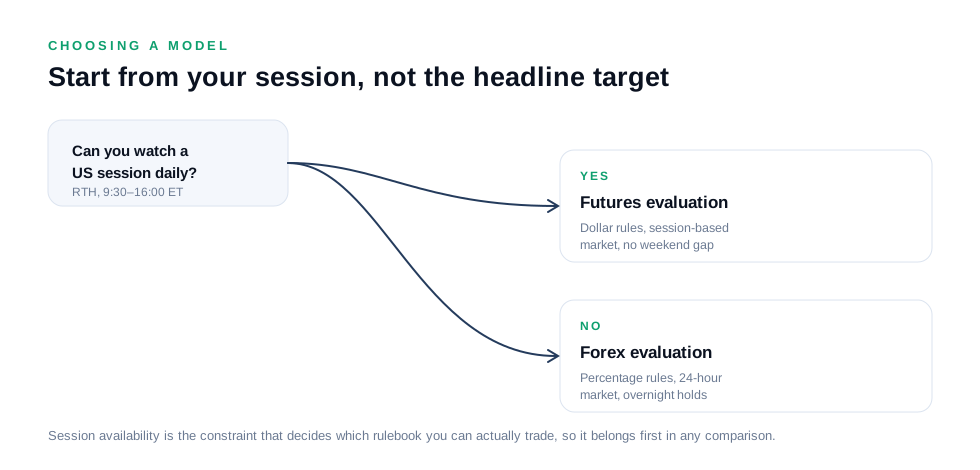
Both firms sit in the percentage-based forex and CFD category: targets and losses expressed as percentages of the balance, position sizes in fractional lots, and a rulebook built around a maximum loss, a daily loss limit and, often, a consistency condition.
That shared architecture reduces the comparison to a set of specific clauses. Where the two firms differ is in how those clauses are configured rather than in which clauses exist.
| Dimension | What to compare | Effect on difficulty |
|---|---|---|
| Maximum loss | Percentage, and static versus trailing | Trailing reduces room as profit accrues |
| Daily limit | Percentage, and measured on balance or equity | Equity-based limits count open positions continuously |
| Target | Per stage, plus any time limit | Sets the required pace, therefore required size |
| Minimum days | Per stage and at payout | A count longer than the plan forces extra sessions |
| Consistency | Applied during the evaluation, at payout, or both | Constrains the daily share of profit, therefore size |
| Lot cap | Per position or per account | A ceiling the sizing formula can exceed on a small stop |
| Funded drawdown | Usually tighter as a percentage | Determines whether the plan that passed can be traded after |
| Payout terms | Threshold, cadence, split, interval | Determines whether a pass becomes income |
Two generalisations hold in this category and matter more than any firm-specific detail. First, percentage targets are scale-free, so the same plan transfers across account sizes — which means the smallest account whose rules can be satisfied is usually the correct purchase, and a larger account is a bigger fee for the same arithmetic. Second, a time limit converts the target into a required pace, and the required pace has to be checked against the daily limit before the fee is paid; if the required weekly return does not fit inside the rules at a survivable size, the evaluation is not passable as configured.
The FTMO playbook covers the same percentage-rulebook mechanics in procedural form, and the rules matrix places the structures side by side across firms.
The failure floor
The single most consequential clause in either rulebook is what happens to the failure floor as the account makes money.
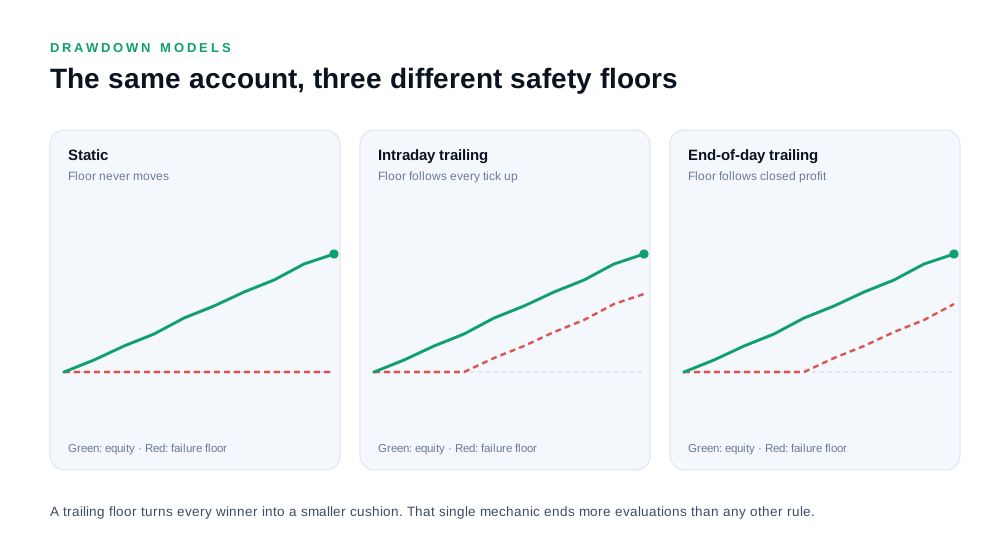
A static floor is fixed at the starting balance and never moves, so profit cannot reduce the room available. An end-of-day trailing floor resets at the daily close, so completed gains raise the floor while intraday spikes are forgiven. An intraday trailing floor follows peak equity continuously, so a winning position raises the failure point immediately and a retracement can breach an account that has never been below its starting balance.
Percentage rulebooks in the forex category predominantly use static or end-of-day structures rather than intraday trailing ones — the trailing mechanism is more common on the futures side. That is a genuine advantage for a plan that holds winners, and it means the floor clause is often a smaller differentiator between two forex firms than between two futures firms. Where one of the two does use a trailing mechanism, however, the difference swamps everything else in the comparison.
Two secondary clauses complete the picture. The first is the measurement basis: balance only, or balance including open positions. An equity-based limit counts unrealised losses continuously, so a position can breach the account before it is closed. The second is whether the floor is affected by withdrawals on the funded account — a withdrawal that reduces the balance without adjusting the peak temporarily shrinks the room, which matters for a trader planning a first payout.
The daily drawdown guide covers the reference-point arithmetic in detail, and the trailing drawdown guide covers the room formula if either firm uses a trailing structure.
Daily limits and how they are measured
The daily limit is the constraint that ends the most attempts in this category, because it fires on ordinary variance rather than on a catastrophic error.
The arithmetic is a single division: the daily limit in money divided by the risk per trade in money gives the number of losing trades a session can absorb. A limit that absorbs two is a session decided by the first two trades of the day. A limit that absorbs six allows a bad start and still leaves the session functional. The design target is four to six.
What matters beyond the percentage is the reference point. A limit measured on equity includes open positions, so an intraday drawdown consumes budget that a balance-based limit would ignore. A limit measured from the day's opening balance behaves differently from one measured from the previous close, particularly for a trader who holds positions overnight. And a limit expressed as a percentage of the starting balance behaves differently again once the account is up or down.
The second measurement that matters is the day boundary. Forex sessions span the firm's server day rather than the trader's local day, and the boundary often falls in the middle of a trading session for traders in some time zones. A position opened late in the trader's evening can belong to the next server day, which means the loss lands against a budget that had not started when the trade was planned. Two evening positions that feel like one day's risk can be counted against two days' limits.
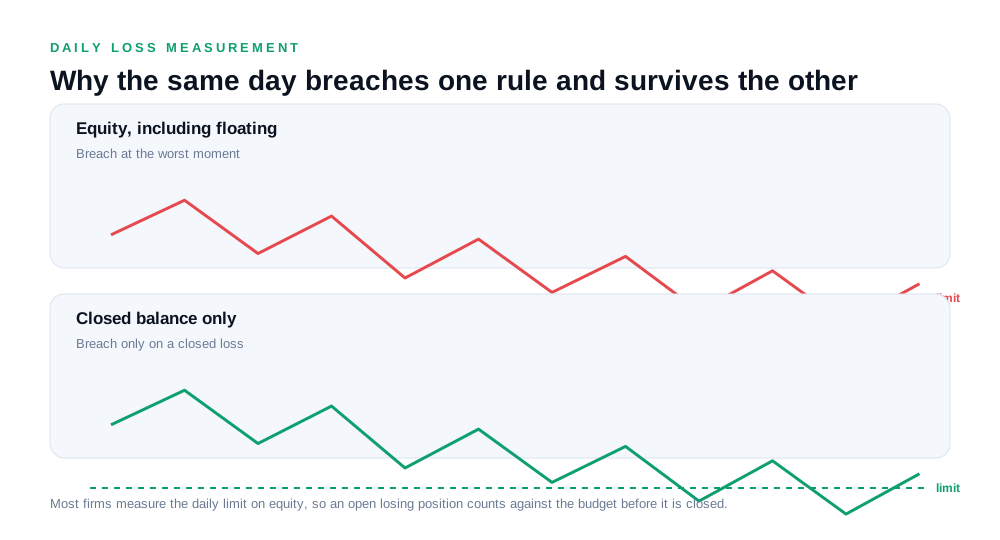
The practical implication for the comparison is that two firms with the same daily percentage can present materially different constraints. Where one measures on equity and the other on balance, the equity-based limit is the tighter rule for any trader who holds positions through drawdowns. Where the two firms' day boundaries fall at different hours, one may align with the trader's session and the other may not — and a misaligned boundary can cost a session's worth of capacity every day.
The leverage guide covers why a leverage cap is usually not the binding constraint on an account like this, and the weekend holding guide covers the gap arithmetic for positions held across a close.
Targets, stages and time limits
Targets decide the calendar, and the calendar decides how much variance the plan must survive. That makes the target a difficulty factor even though it is not a risk factor.
The useful ratio is the target divided by the maximum loss. A target that is a small fraction of the loss limit is reachable at a survivable size with a short calendar; a target that approaches the loss limit requires either a higher trade count or a lower risk per trade, and either of those lengthens the attempt and increases the number of sessions exposed to a losing streak.
Staging changes the arithmetic in two directions. A staged evaluation splits one large target into smaller ones, which lowers the size needed per stage and reduces the cost of an early failure relative to a single-phase account. Against that, the total sequence is longer, and a breach in the final stage wastes the earlier stages as well as the fee. The staged evaluation guide covers that trade-off and the pacing problem it creates.
Time limits are the part of the target specification that traders most often ignore and most often fail against. A stated limit converts the target into a required weekly return, and that number has to be checked against the daily limit: if the required pace implies a risk per trade larger than the daily limit can absorb across a normal losing sequence, the evaluation is not passable at a survivable size. Doing that check before the fee takes five minutes and occasionally saves a purchase.
Minimum trading days run the other way — they are satisfied by activity, not profit, and are rarely the binding constraint on a conservative plan. The trap is a trader who reaches the target early and then trades to fill a count, giving back part of the profit in sessions that had nothing to gain. If the count is longer than the plan, slow the plan so that both finish together.
Consistency rules during the evaluation
A consistency rule is where a percentage rulebook gets harder than it looks, and the two firms may apply it at different stages of the account's life.
Three variants exist. Applied during the evaluation, a consistency condition caps the share of the target that may come from one day, so a trader who reaches the target in a single strong session has not passed. Applied at the payout stage, it caps the share of withdrawn profit attributable to one day, which constrains the first withdrawal rather than the pass. Applied at every withdrawal, it becomes a permanent constraint on daily profit and therefore on position size.
The arithmetic is the same in every variant: if the best day may be no more than a stated share of the total, total profit must reach the largest day divided by that share. Under a one-third rule, $3,000 requires $9,000 of total profit; under a one-fifth rule, the same day requires $15,000. The difference between the variants is where the constraint lands, and a rule applied during the evaluation is materially harder than one applied only at payout.
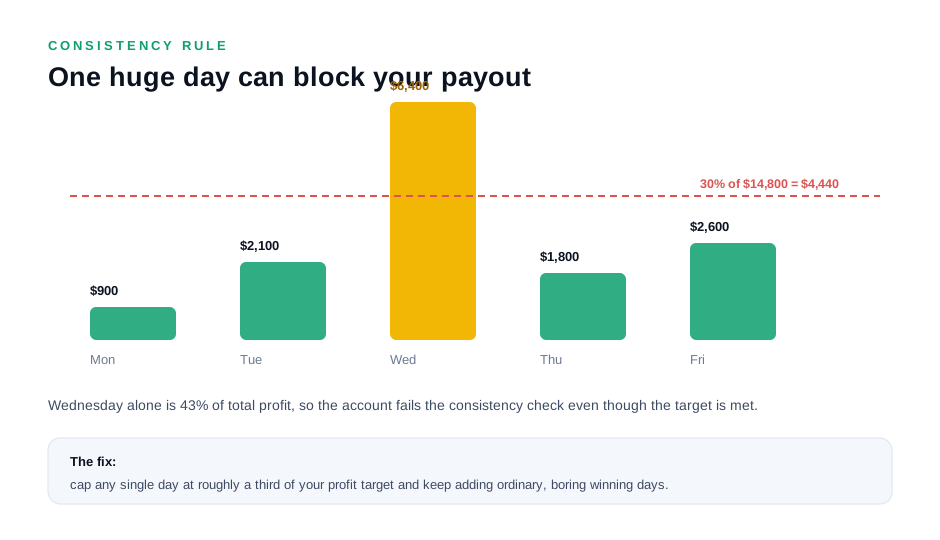
The mitigation is structural rather than psychological: set a daily profit cap below the permitted share from the first session, and the ratio is satisfied automatically by the time the target or threshold is reached. On a plan with a daily average well below the cap, the cost of the cap is negligible; the alternative — discovering the ratio at the payout request — costs a month.
Where one firm applies the rule during the evaluation and the other does not, that is a genuine difficulty difference and should be weighted accordingly. The consistency guide covers each variant and the arithmetic for the common ratios, including how to fix a check that has already failed.
Funded conditions and payout paths
The funded stage is a different product with the same brand on it, and the differences decide whether a pass becomes income.
Three things change. The funded drawdown is usually tighter as a percentage, because the firm is now exposed to real payouts rather than to a fee. Profit becomes income only when it is withdrawn, which means an unwithdrawn balance is a larger target under the same rules. And the payout sequence adds conditions that run on their own clock.
The common structure has four gates: a minimum number of profitable days, a profit threshold, a consistency check on the profit being withdrawn, and identity verification — followed by a payment interval. Each can fail independently of the trading record, and three of the four are administrative.
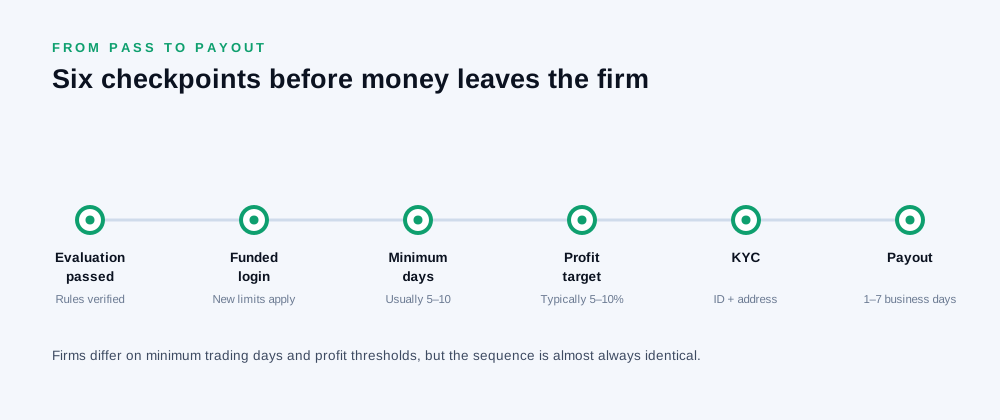
Comparing the two firms on this dimension means asking four questions of each. What is the funded drawdown as a percentage of balance, and is it measured on balance or equity? What is the profit threshold before a first withdrawal, and is the whole balance above it withdrawable? Is the consistency rule applied at the first payout only or at every payout? And what is the interval between a successful request and the funds arriving?
The interval is the most under-weighted of the four. A firm with a generous split and a ninety-day payment cycle pays a trader less in the first year than a firm with a smaller split paying within a week, and the difference is a cash-flow fact rather than a marketing claim. The payout process guide covers the sequence and the common delays, and the post-pass guide covers what to do in the first funded month.
The comparison method that works
A comparison of two rulebooks is only meaningful when both are sized against the same strategy. The method takes about twenty minutes and replaces every ranking table.
Step one: write down the strategy's fixed parameters — stop distance in pips, trades per session, sessions per week, measured win rate and reward-to-risk ratio. These do not change between firms.
Step two: for each firm, derive risk per trade twice. From the maximum loss: loss percentage divided by the number of consecutive losses the plan should survive. From the daily limit: daily percentage divided by the losses a session should absorb. Take the smaller.
Step three: convert each to a calendar. Expectation per trade equals win rate times average win minus loss rate times average loss. Divide the target by that figure for the trade count, then by trades per week.
Step four: record three numbers for each firm — risk per trade as a percentage, survivable streak, and calendar in weeks. Those three are the comparison.
| Output | What it tells you | How to use it |
|---|---|---|
| Risk per trade | How much the plan may risk per position | The lower figure indicates the tighter rulebook |
| Survivable streak | How many consecutive losses the account absorbs | The higher figure is the safer rulebook for this strategy |
| Calendar | Weeks to the target at survivable size | Multiply by recurring costs to compare total cost |
The method also exposes the case where neither fits. If both rulebooks produce a survivable streak below eight at the account size in question, the plan is too aggressive for that size, and the correct change is a smaller account or a smaller position — not a different firm. If one firm's calendar exceeds its own time limit at a survivable size, that evaluation is not passable as configured and should not be bought.
Which is easier for which trader
The comparison resolves differently by profile, and the profiles are more useful than a ranking.
A trader with a high win rate and small targets. A consistency rule applied during the evaluation is the main obstacle, because tight profit-taking rarely produces a dominant day — but the rule can still bite if the target is reached in one session. Whichever firm applies the rule only at payout is the easier account for this profile.
A trader with a low win rate and a wide stop. The daily limit is the binding constraint, because each trade consumes a larger share of the session budget. Whichever firm measures the daily limit on balance rather than equity, and whichever has the later day boundary relative to the trader's session, is easier for this profile.
A trader with a slow, low-frequency plan. The calendar and any time limit dominate. Whichever firm allows the longer calendar at a survivable size is easier, and recurring platform and data costs matter more than the fee.
A trader who holds winners for days. The floor mechanism dominates. A static structure suits this profile; a trailing one does not, and no other clause compensates for it.
A trader who expects to fail the first attempt. The reset structure and the total cost to funding dominate. A firm with a cheap reset and a monthly fee structure is easier for this profile in the only sense that matters: it leaves capital for the second attempt. Running the same strategy on a smaller account is often the better version of that decision, since percentage rules are scale-free.
A trader using a passing service. The decisive clause is whether third-party trading is permitted, separately for the evaluation and the funded account. ElitePropX charges a flat $220 per evaluation at any stage and size, covers retries, takes no profit split, and works with any firm, telling you in writing what that firm’s third-party trading clause says before you pay. The passing services guide covers what to require from any provider, and the scam guide covers the failure modes on both sides of that market.
Total cost to funding
Cost is a difficulty factor in the practical sense: a cheaper route to a funded account leaves more capital for a second attempt if the first fails.
The total is the evaluation fee, plus platform and data subscriptions for the duration of the calendar derived above, plus reset charges for any failed attempt, plus any activation fee on funding. Because subscriptions accrue monthly, a plan with a long calendar pays more for the same fee — which means the firm with the longer calendar needs a real price advantage to be the cheaper option overall.
Running that number is straightforward once the calendar is known. Twelve weeks at a monthly data and platform cost is three times the same subscriptions over four weeks, and on many accounts that difference is larger than the fee itself. The beginners guide covers the selection criteria that matter when there is no track record to compare against, including the recurring-cost trap.
Reset structure belongs in the same calculation. A one-off fee with a paid reset makes each attempt a deliberate purchase; a subscription with unlimited retries lowers the marginal cost of failure and, in doing so, the cost of not fixing the plan first. For a trader whose breach rate is high the subscription is cheaper; for a trader whose plan is sound, the one-off is.
What to verify in both sets of terms
Ten checks, run against each firm's current documentation. Together they replace every comparison, including this one.
One: the maximum loss percentage, and whether the floor is static or trailing, measured on balance or equity.
Two: the daily limit percentage, its reference point, and the exact server hours of the trading day.
Three: the target per stage, and whether a time limit applies.
Four: minimum trading days per stage and at payout.
Five: the consistency rule — ratio, and whether it applies during the evaluation, at the first payout, or at every withdrawal.
Six: any lot cap, per position or per account.
Seven: the funded drawdown, separately from the evaluation's.
Eight: the payout threshold, the profit split, the payment interval and the verification requirements.
Nine: the conduct clauses — news windows, overnight and weekend holding, permitted instruments, and any prohibition on automated or third-party trading, stated separately for the evaluation and the funded stage.
Ten: total cost to funding, including data and platform over the calendar the plan actually needs.
Keep both sets of answers side by side and check them against the sizing method above. Where a clause cannot be resolved from the published terms, ask support one specific question in writing and keep the reply — a clause that cannot be checked before purchase is a clause that cannot be relied on afterwards. The 2026 comparison covers the wider market including futures-side structures, and the FTMO playbook walks the same percentage mechanics in procedural order.
The decision in three questions
Most of the analysis above collapses into three questions that can be answered from the two sets of terms in under half an hour. Where the answers disagree, the sizing method breaks the tie.
One: is the floor static or trailing, and on what basis is it measured? This is the first question because it changes the room available for the rest of the account's life. A static floor means the sizing calculation performed on day one remains valid; a trailing floor means it must be rerun weekly, and a plan that holds winners is more fragile than the same plan on a static structure.
Two: which limit binds first, the maximum loss or the daily limit? Divide each by its own tolerance — the streak the plan must survive, and the losses a session should absorb — and see which produces the smaller risk per trade. That figure is the plan's size, and the limit that produced it is the constraint the plan will live with. A daily limit that binds is easier to trade around than a maximum loss that binds, because it resets.
Three: what must be true before a payout is made? Minimum profitable days, profit threshold, consistency condition, verification and payment interval. A pass that cannot be withdrawn is not a pass, and this is the question most often deferred until after the funded login arrives.
Where the three answers point to different firms, the tie-break is the survivable streak from the sizing calculation — the higher number is the safer account for the strategy in hand. Where they point to the same firm twice, the remaining question is cost, and the calendar from the same calculation converts a monthly subscription into a total figure.
One caveat that applies to every answer here: these terms change. A comparison can only teach the method, which is why this page contains the arithmetic rather than a table of current percentages. Ten minutes with the two firms' current documents and the four formulas above produces a better answer than any published comparison, including this one.
Frequently asked questions
Which challenge is easier, E8 Markets or FundedNext?
There is no general answer. Size the same strategy against both rulebooks — risk per trade from the maximum loss, then from the daily limit — and compare the survivable streak and the calendar. The firm that produces the higher streak for that plan is the easier account for that trader.
Does a smaller target mean an easier challenge?
Only within the same rulebook. A small target on a tight trailing drawdown with an equity-based daily limit can be harder than a larger target on a static floor. The ratio of target to maximum loss matters more than the target alone.
How does a consistency rule make an evaluation harder?
If it applies during the evaluation, reaching the target in one strong day does not count. Expressed as a best-day share, a one-third rule means total profit must reach three times the largest day. Applied only at payout, the same ratio is a milder constraint on the first withdrawal.
What risk per trade should I use on a percentage account?
Divide the maximum loss percentage by the streak tolerance — eight to ten for a plan with a win rate in the forties — and the daily limit by the losses a session should absorb. Take the smaller, keep a quarter of the drawdown in reserve, and round position size down.
How do I compare the two firms in twenty minutes?
Six inputs from each set of terms: maximum loss and mechanism, daily limit and reference point, target and time limit, minimum days, consistency rule, and funded payout conditions. Then run the sizing method and compare survivable streak and calendar.
Does the evaluation's drawdown carry over to the funded account?
No — the funded account has its own, usually tighter, drawdown and its own payout conditions. Read the funded document before paying the evaluation fee, because it determines whether the plan that passed can be traded afterwards.
How often are the terms revised?
More often than most traders expect, which is why any comparison quoting specific percentages is accurate only until the next revision. Read the current evaluation and funded documents on the day you pay, and save the version you agreed to.
Should I pick the firm with the lower fee?
Only after comparing total cost to funding. The fee plus platform and data subscriptions over the calendar the plan needs, plus reset charges, is the number that matters. A long calendar can make a cheap fee expensive.
What if my plan does not fit either rulebook?
That is a valid result. Options are a smaller account with the same percentage rules, a different rulebook model, or a revised plan. Changing firms does not fix a plan whose stop distance and trade frequency do not fit the rules.
Does a passing service work on both firms?
Only where the terms permit third-party trading, which must be confirmed separately for the evaluation and the funded account. ElitePropX charges a flat $220 per evaluation at any stage and size, covers retries, takes no profit split, and works with any firm, telling you in writing what that firm’s third-party trading clause says before you pay.
Which firm pays out sooner after a pass?
Read the funded terms for the profit threshold, the consistency condition, the payment interval and any first-payout restriction. The interval matters more than the split: a larger percentage paid in ninety days is worth less in the first year than a smaller one paid within a week.
Want the evaluation traded for you?
Related reading
- How to pass an FTMO challenge, step by step
- Passing a The5ers challenge
- Apex vs Topstep: which rulebook is safer
- Best firms for beginners
- Daily drawdown explained
- Consistency rule guide
- Risk and target calculator
- Prop firm rules matrix
E8 Markets and FundedNext are named for identification only. ElitePropX is an independent service and is not affiliated with, endorsed by or sponsored by any proprietary trading firm. Targets, daily limits and payout conditions change; verify them against the firms' current terms. Trading involves substantial risk of loss.