
Comparison · reviewed October 2026
How to judge a propfirm passing service in 2026
There is no independent authority ranking passing services, so the only useful comparison page is one that gives you the criteria and the arithmetic to judge them yourself. This is that page: four criteria, a worked cost comparison, and the questions that separate a provider who has read the rulebooks from one who has read the testimonials.
Key takeaways
- Four criteria decide quality: rulebook competence, fee structure, failure terms, and whose name the funded account is in.
- A percentage-of-payout model pays the provider for duration; a flat fee pays for a clean pass. The incentives are different and so is the behaviour.
- The failure case is where every client has the least leverage, so the retry terms matter more than the pass count.
- Price is the last variable to compare, not the first, because a cheap attempt on the wrong rulebook is the most expensive option available.
Contents
What this market actually sells
A passing service sells labour and discipline, not a signal. The deliverable is an evaluation traded to target or failure under a specific firm's rules, with the funded account issued in the client's name. Everything else in the category — the dashboards, the "algorithms", the community channels — is packaging around that one transaction.
Understanding that changes what a buyer should value. If the product were a signal, track record would be the main criterion. Since the product is execution against a rulebook, the main criteria are rulebook competence and the terms that apply when the execution fails. A provider with an ordinary edge and a perfect rulebook process beats a provider with a better edge who misreads a trailing drawdown.
Why there are no reliable rankings
No regulator, no audited body, and no independent sample exists. Review sites are mostly affiliate operations paid per lead, which means the ranking reflects commission rather than quality. Provider testimonials are self-selected, and forum threads are dominated by whichever outcome the last poster had.
The practical consequence is that any page claiming to rank services should be read as a page selling something. The alternative — and the approach taken here — is to give a buyer a method that works on providers the author has never heard of, and then apply it in public to one provider, including its weaknesses.
What a service cannot do
It cannot remove variance, guarantee a pass, or change a firm's rules. It cannot make an unsuitable rulebook suitable: a trader with a swing strategy who buys a trailing-drawdown futures evaluation has bought a problem, and no amount of competent execution fixes that. The most valuable thing a good provider does in the first conversation is occasionally decline.
The four criteria that decide quality
| Criterion | What good looks like | How to test it in one question |
|---|---|---|
| Rulebook competence | Names the measurement mechanics unprompted | "Is the maximum loss static or trailing on my firm?" |
| Fee structure | Fixed price, no share of payouts | "Do you take anything from my withdrawals?" |
| Failure terms | Retries covered in writing | "What happens if a daily limit is breached?" |
| Account ownership | Funded login in the client's name | "Whose name is on the funded account?" |
Criterion one: rulebook competence
The test is whether the provider volunteers a distinction you had not considered. A provider who says "trailing drawdown" has read the marketing page; one who says "intraday trailing, so an unrealised gain that comes back to entry still leaves your floor higher" has read the terms. That difference is the whole product.
A second test costs the same: ask which firms they will not trade, and why. Providers with no refusals either have not read the rulebooks or are willing to accept terms their clients will pay for. The refusals are usually the most informative sentence in the reply.
Criterion two: fee structure
Percentage-of-payout arrangements sound aligned and behave differently. A provider paid from withdrawals has an interest in the account continuing to trade and in the payout being large; a provider paid a fixed fee has an interest in the pass being clean and the client returning for a second account. Neither is dishonest, and the second is easier to verify, because a certificate exists or it does not.
Criterion three: failure terms
Most of the value in a service is in what it does when the attempt fails. A retry covered on the same firm and size is a real term with a real cost to the provider, which is why it is stated precisely when it exists and hedged when it does not. Read the wording: "retries covered" and "discounted resets" are different products.
Criterion four: account ownership
The funded account must be in the client's name, with payouts arriving in the client's account. A provider that wants to hold the login or receive the money is asking the client to take counterparty risk in exchange for convenience. That arrangement also creates an obvious incentive to delay, which is the last thing a trader needs at the payout stage.
Flat fee versus profit split, in numbers
The models can be compared, and the comparison is less favourable to the split model than its marketing suggests once the expected number of attempts is included.
| Model | Cost up front | Cost at payout | Provider incentive |
|---|---|---|---|
| Flat fee | $220, fixed | None | Clean pass, then a second account |
| 20% of payouts | Often lower or zero | 20% of every withdrawal | Larger accounts, longer retention |
| 30% of payouts | Often lower or zero | 30% of every withdrawal | Same, more so |
| Hybrid | Reduced fee | 10–15% plus fee | Mixed |
Consider a trader who passes a $50,000 account and withdraws $4,000 a month for six months — $24,000 in total. A 20% split costs $4,800. The flat fee costs $220. On that arithmetic the flat model is cheaper by an order of magnitude for anyone who intends to keep trading, and the split model is only competitive for a client who passes and never withdraws, which is not a client anyone should be optimising for.
There is a counter-argument worth stating honestly: a split model costs nothing if the provider fails. A flat fee is paid whether or not the evaluation passes. That is why the retry clause carries the weight it does — with retries covered, the flat model's failure case is bounded at $220, and without it the fee is a bet.
What the fee should and should not include
A fee should cover the work: reading the rulebook, writing the plan, trading the evaluation, and the retry if a rule is breached. It should not be presented as covering the firm's challenge fee — that is paid to the firm and is usually separate — and it should not be presented as an investment in a profit share that may never materialise.
A worked comparison of three models
Three hypothetical providers, each competent, differing only in structure. The point is not that one is dishonest; it is that the same client gets a different product and a different cost depending on which structure they choose.
Provider A: flat fee, retries covered
$220 for any firm and size, retries on rule breaches covered at the same firm and size, no profit split, funded account in the client's name. A client who passes on the first attempt pays $220 and keeps every dollar of the funded account. A client who breaches a daily limit twice pays $220 and, if the third attempt passes, still keeps everything.
The risk to the client is capped and the risk to the provider is real: two failures on a $540 challenge cost more than the fee. That is the structure working as intended — the provider's own margin is what disciplines the execution.
Provider B: 20% of payouts
No up-front fee, 20% of every withdrawal, funded account held by the provider. The client's cash outlay is zero, which is why the model sells. Over six months at $4,000 a month, the provider collects $4,800. The client also carries the risk that the provider delays or disputes a payout, and has no certificate to point to if the arrangement sours.
Provider C: cheap fee, no retry
$99, no retries, no split. On the surface this is the cheapest option and it frequently ends up the most expensive: at a realistic 50% pass rate the expected cost is $198 plus the firm's own reset charges, and the client bears the full cost of every failure. Providers of this kind are usually reselling an attempt rather than executing a plan.
| Provider A | Provider B | Provider C | |
|---|---|---|---|
| Up-front cost | $220 | $0 | $99 |
| Cost over six payouts | $220 | ~$4,800 | ~$99 plus resets |
| Failure risk borne by | Provider, within the retry term | Client, via delayed payouts | Client, in full |
| Funded account held by | Client | Provider | Client |
The table makes the argument better than prose can. The client who intends to withdraw more than a few thousand dollars is paying a large premium for the illusion of a free service, and the client who intends to withdraw nothing is not a client a provider should be building a business around.
Red flags worth walking away from
Most of these are visible in the first reply, and any one of them is sufficient reason to stop.
- Requests for platform passwords. A service needs the account to trade it, not the client's bank login, email password or identity documents. Anything beyond the trading account is a security problem.
- No answer on third-party trading policy. The answer determines whether the funded account survives; a provider who has not asked the firm has not read the terms.
- Guaranteed passes. Variance exists, so the claim is either false or the definition of "pass" has been quietly narrowed.
- Funded login held by the provider. Counterparty risk at the exact moment the client has the most to lose.
- Payment only in crypto, only by transfer, no receipt. Not automatically dishonest, but it removes the client's ability to prove what was paid for.
- Screenshots instead of certificates. Evidence that cannot be checked is marketing.
- Pressure to buy today. Rulebooks do not expire overnight, and a provider whose pricing depends on urgency has priced it that way deliberately.
How ElitePropX measures against its own criteria
The criteria should be applied to this provider as readily as to any other, so here is the assessment in the same terms.
Rulebook competence
The service reads each firm's terms before quoting, distinguishes trailing from static drawdowns and equity from balance measurement, and declines assignments where a firm's position on third-party trading makes the arrangement unsafe for the client. The articles on this site exist for the same reason: they are the long version of the rulebook translation.
Fee structure
One flat $220 for any prop firm and any account size. No profit split, no performance fee, no charge at withdrawal. The firm's own challenge fee is separate and paid to the firm.
Failure terms
Retries on rule breaches at the same firm and size are covered under the flat fee; the firm's own reset charge, where it applies, is separate. A client who abandons an evaluation mid-way does not receive a refund, which is stated before purchase rather than argued about afterwards.
Account ownership
The funded account is issued in the client's name and payouts are paid directly to the client. The service does not hold the login after handover and takes nothing from withdrawals.
Where this provider is weaker
It is a small operation, which means capacity is limited and scheduling depends on how many evaluations are running at once. Verification evidence is provided on request rather than published as a live tracker for every account, because several firms' platforms do not support external linking. And the flat fee is paid whether or not an evaluation passes, which is why the retry clause is load-bearing rather than decorative.
Choosing, in the right order
The order of the decision matters more than the criteria, because each step eliminates work in the next.
- Read your firm's rulebook. Two minutes, and it decides whether the rest of the conversation can produce anything useful.
- Confirm the firm permits third-party trading. In writing, to the firm, before any provider is paid.
- Choose the structure. Flat fee if you intend to keep the account and withdraw repeatedly; a split only if you genuinely expect one small payout.
- Ask the four criterion questions. Rulebook mechanic, fee, failure terms, account ownership.
- Ask for evidence. A certificate for a comparable firm and size, dated, plus a verification link where the platform allows one.
- Only then compare price. A $220 pass on a suitable rulebook beats a $99 attempt on one your strategy cannot survive.
Six steps, one afternoon, and the result is a decision that can be explained in three sentences. That is the standard this page holds itself to, and the standard a buyer should hold against it.
The due diligence script, word for word
Buyers often know what to ask and not how to ask it, which matters because vague questions get marketing answers. The wording below is designed to produce answers that can be checked.
Question one: the rulebook mechanic
"On my firm, is the maximum loss static or trailing — and if trailing, does it update intraday or at the close?" A provider who answers with a percentage has not read the terms. A provider who answers with a mechanic, and then explains what it implies for exit discipline, has.
Question two: the measurement point
"Is the daily loss measured on equity including floating positions, or on closed balance?" This is the single most consequential line in most rulebooks and the one most often glossed over. The answer changes how a session has to be managed, not just how it is sized.
Question three: the payout condition
"What has to be true before my first withdrawal — profit threshold, trading days, consistency ratio?" A provider who names all three without being prompted has read the payout section, which is where most surprises live.
Question four: the failure case
"If a daily limit is breached in week two, what happens and what does it cost me?" The answer should be specific: covered retry at the same firm and size, or a stated fee, or a refusal. "We'll work something out" is not a term.
Question five: ownership
"Whose name is on the funded account, and who receives the payout?" If the answer is not "yours", the arrangement has a counterparty problem that no amount of competence resolves.
What a rulebook translation should look like
When a provider says they "read the rulebook", the output should be a short document, not an assurance. Here is what a competent translation contains for a typical $100,000 futures evaluation.
| Item | Value | What it changes |
|---|---|---|
| Daily loss budget | $2,200 | Maximum exposure per session; 3 losses at 0.73% risk |
| Maximum loss mechanic | Trailing from peak, end-of-day | Exit discipline; give-back is free intraday, charged overnight |
| Target | $6,000 | Roughly 8 full-risk wins at 0.73% |
| Minimum days | 5 | Pacing; no benefit to finishing early |
| Payout conditions | 30% best day, 10 days, $2,000 threshold | Distribution planning from day one |
| Third-party policy | Permitted / prohibited / ambiguous | Whether the assignment is accepted at all |
Six lines, one page, and every one of them can be checked against the firm's own terms in ten minutes. A provider who cannot produce something like this before taking money is asking the client to fund an experiment.
Why the translation is the product
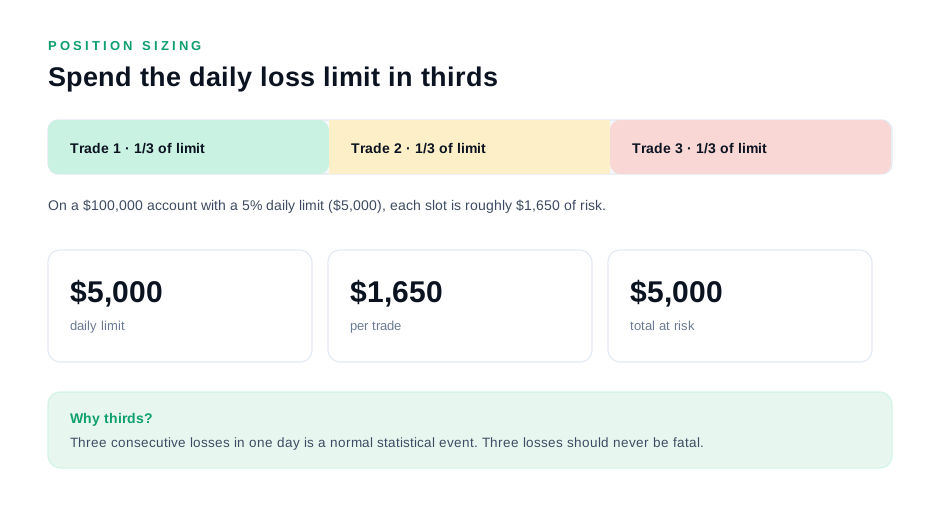
Two traders with identical skill and identical firms can produce different outcomes purely on how they convert the rulebook into a plan. One sizes at the daily budget and loses the account in a fortnight; the other sizes at a third of it and reaches the target in three weeks. The difference is not analysis — it is arithmetic done at the right moment, and the translation is where that arithmetic happens.
The cost of failure, properly counted
Failure is the outcome a buyer should price first, because it is the one with the least negotiating room afterwards. It has three components and buyers usually count only the first.
Component one: the fee
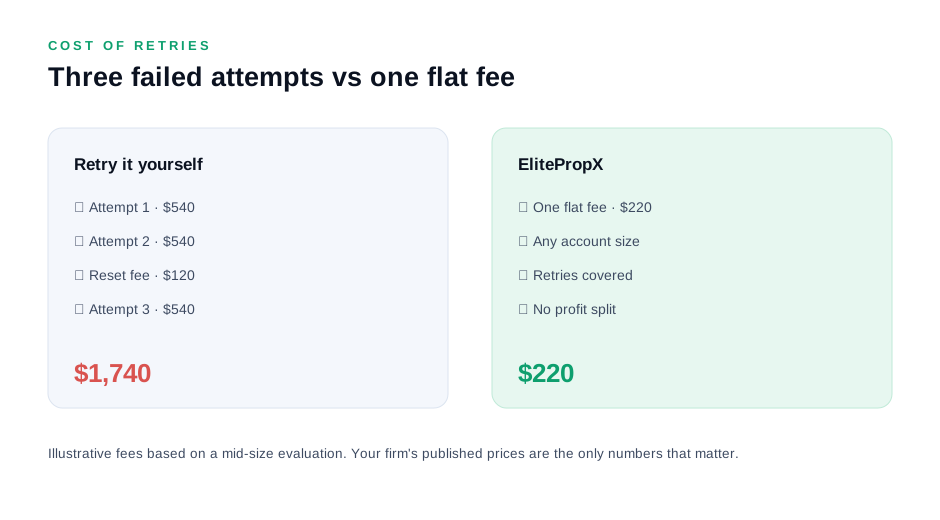
The service fee, plus the firm's challenge fee, plus any reset charge the firm levies. On a $540 challenge with a $220 service fee, a failed attempt without retries costs $760 before anything else. With retries covered, the second attempt costs nothing beyond the firm's own reset, which is often discounted.
Component two: the weeks
Two to four weeks per attempt. A trader who takes three attempts has spent two to three months on the same puzzle, which is a meaningful share of a trading year and, more importantly, of the period during which a track record is being built.
Component three: the information
A failed attempt that is not analysed is a purchase of nothing. A failed attempt that is analysed produces the sentence that prevents the next failure — which rule was broken, in which session, under what conditions. That sentence is worth more than the fee, and it only exists if someone writes it down.
What this means for pricing providers
A provider whose fee covers retries has priced the first two components into a fixed number. A provider who charges per attempt has left the variance with the client. Neither is automatically better, but the first is easier to budget and the second is easier to sell, which explains which one is advertised more heavily.
Case: choosing between two firms with the same target
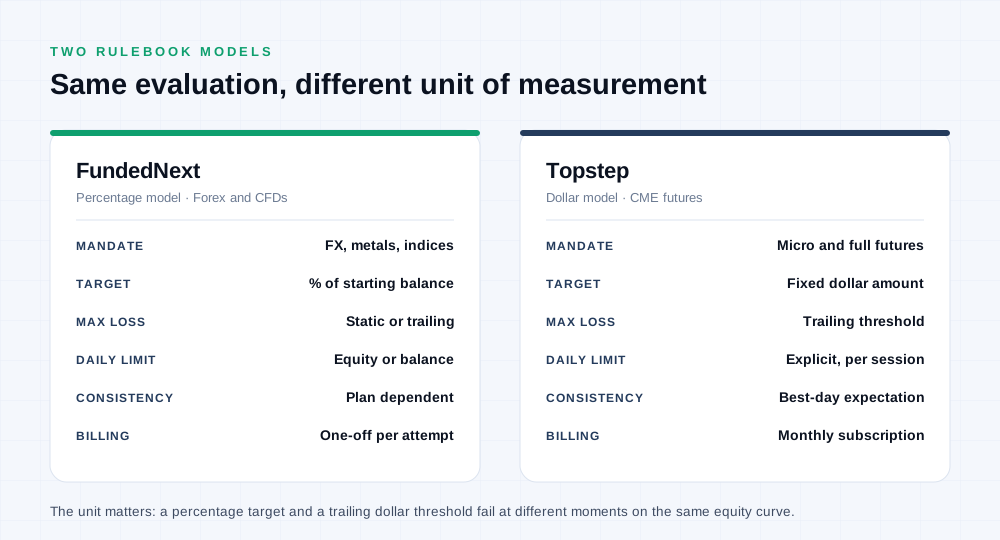
Two firms offer a 10% target on a $100,000 account. Firm one charges $540 with a static 10% maximum loss and no consistency rule. Firm two charges $450 with a trailing maximum loss updated intraday and a 30% best-day consistency rule at payout. The cheaper option looks obvious until the mechanics are applied.
At 1.5% risk, firm one tolerates six and a half full-risk losses from the starting balance and allows a trader to hold size constant throughout. Firm two's floor follows equity, so at 4% profit the available room is roughly 6% and shrinking, and the consistency rule means the payout depends on the distribution of the gain rather than its total.
The realistic pass probability on firm one, for a trader with a modest edge, is materially higher than on firm two, and the expected cost per funded account is lower despite the higher headline fee. That is the whole argument for comparing mechanics rather than prices, and it is the argument most buyers never run.
What the review patterns actually show
Reviews of passing services are a narrow sample, but they do contain information when read by category rather than by score. Five patterns recur often enough to be useful.
Pattern one: complaints about firm rules mistaken for service failures
The most common negative review describes a payout refused by the firm, not a service failure. That is a rulebook problem: a consistency ratio, a day count, or a position held over a weekend. It matters to a buyer because it predicts the next complaint, and it is preventable by reading the payout section before purchase.
Pattern two: silence after payment
The second most common complaint is communication dropping once the fee is paid. It is also the easiest to test in advance: ask a question before buying and time the reply. A provider who answers within hours before payment and within days after has a staffing problem that will show up at the worst moment.
Pattern three: praise for the rulebook explanation
Positive reviews that mention a rule being explained — rather than a pass being achieved — are the most reliable signal in the category, because they describe the product doing its actual job. A buyer who reads five of those has learned more than from fifty reviews about results.
Pattern four: certificates without dates
Where results are shown but dates are missing, the sample is probably older than it appears. Rulebooks change, and a pass from eighteen months ago was obtained under terms that may no longer exist.
Pattern five: clustered reviews
Twenty reviews in a week on a service that had none for a year is solicitation, not evidence. It is not dishonest, and it is not information either.
If you decide to pass it yourself
A fair comparison has to include doing nothing, because a disciplined trader with three weeks and a routine does not need the service. The checklist below is the entire method in one place, and it is deliberately short.
- Read the rulebook twice — numbers, then exceptions — and write the date on it.
- Convert to four numbers: daily budget, distance to failure, target in R, payout constraint.
- Risk one third of the daily budget per trade and hold it constant within 10%.
- Stop at 80% of the daily limit, not 100%, because floating equity is measured.
- Pace for sixteen to twenty-two days and remove any invented deadline.
- Halve risk above 70% of target; stop entirely once the target is banked.
- Journal five fields and review weekly for risk drift and rule violations.
- Check payout conditions before requesting, especially any best-day ratio.
Eight steps, no proprietary knowledge, and they are the same steps a service executes. The reason to pay someone is time and enforcement, not secret information — and any provider who implies otherwise is selling mystique rather than a method.
When doing it yourself is the better decision
If you have passed an evaluation before, have a written plan you have followed for a month, and can commit to a fixed session each day, the marginal value of a service is small. The service is most valuable when the rulebook is unfamiliar, the pacing is hard to sustain without accountability, or the account size is large enough that the fee is trivial relative to the payout.
When a service is the better decision
When the trader's constraint is time rather than knowledge: a full-time job, a business, or a period in which screen hours are simply unavailable. The service converts a three-week task into a fee, and for a trader whose alternative is an abandoned attempt in week two, that conversion is rational.
Three questions buyers forget to ask
What happens if my firm changes its rules mid-evaluation?
Firms revise terms, and an evaluation that started under one rulebook may finish under another. A competent provider will notice a change to a target, a limit or a payout condition and say so rather than continuing silently. Ask directly: "if my firm changes its drawdown mechanic next week, what happens to my assignment?" The answer should be a sentence about the plan being re-run against the new terms, not a shrug.
What happens to the funded account if I stop trading it?
Several firms close accounts that are inactive for a set period, which matters to a trader who wants to bank a payout and pause. It also matters at handover: a funded account issued in your name may have an inactivity clause that no one mentioned, and discovering it after a month of silence is expensive.
What does the service do with my personal data?
An enquiry requires an email address, and a purchase requires a payment record. Beyond that, nothing is needed — no identity documents, no broker login, no platform password. A provider who asks for more than the trading account has given no thought to the security of the person paying them.
None of those three questions appears in most comparison articles, and each of them has been the cause of a real dispute. A buyer who asks them signals that the conversation is being recorded, which tends to improve the answers to everything else.
The general principle is that the questions which cost a provider something to answer are the ones worth asking. A provider with good answers is not merely polite; it has done the reading, priced the risk, and decided what it will refuse — and all three of those are visible before a fee is paid.
That is why this page is structured as a method rather than a ranking: a method keeps working when the provider you are considering is not the one being written about, and it keeps costing nothing to apply. Six questions, one afternoon, and a decision that survives being explained out loud to someone who is not selling you anything at all.
Frequently asked about passing services
What is the best propfirm passing service in 2026?
There is no independent ranking, so the useful answer is a method: rulebook competence, a fixed fee with no split, retries in writing, and the funded account in your name. Judge any provider — including this one — against those four.
How much should a passing service cost?
ElitePropX charges a flat $220 for any firm and any size, with retries covered and no profit split. Anything priced as a percentage of payouts should be compared over several withdrawals rather than one, because the costs diverge quickly.
Is a percentage split ever better value?
Only if you pass once and withdraw a small amount. Over six $4,000 withdrawals a 20% split costs roughly $4,800 against a $220 flat fee, so the flat model is cheaper for anyone who intends to keep trading.
Can a service guarantee a pass?
No. Evaluations contain variance that budgeting discipline reduces but does not remove. A provider claiming certainty has either misunderstood the product or narrowed the definition of a pass.
What happens if my firm bans third-party trading?
You are told before paying and the assignment is declined. Enforcement after funding is the worst outcome available to a client, so it is checked first rather than discovered later.
Whose name is the funded account in?
Yours. The account is issued to the client and payouts are paid directly, with no profit split and no provider-held login after handover.
How long does an evaluation take?
Two to four weeks at a deliberate pace. Faster passes happen and usually indicate risk high enough that a second attempt would have been needed.
Do you cover firms you have not traded before?
Where the rulebook is public and the firm permits third-party trading, yes. The rulebook is read before quoting, and where the terms are ambiguous the firm is asked in writing before any fee is accepted.
Any firm. Any account size. One flat $220.
One flat $220 for any prop firm, any account size. Retries covered, no profit split, funded login in your name. If your firm bans third-party trading we tell you before you pay, and we will not take the job.