
Comparison · reviewed October 2026
FTMO vs The5ers: the comparison that decides which challenge you finish
These two firms are often compared as though the question were which one is cheaper or which one is easier. Neither answer survives contact with the rulebooks. FTMO imposes a deadline and a strict set of loss rules; The5ers removes the deadline and, on its staged model, makes the failure floor static. That single difference changes the arithmetic of every trade, the pace a plan must hold, and the kind of trader who finishes. This comparison works the mechanics rather than the marketing.
Key takeaways
- A static drawdown measured from the starting balance is the most forgiving structure available, because progress cannot make the account more fragile.
- A deadline is a constraint, and removing it removes the mechanism that forces a trader to compute a pace — so the pace has to be self-imposed or the evaluation drifts.
- Both firms apply a daily limit and a maximum limit. The question is which balance each is measured from, because that decides how the account behaves after a drawdown.
- Neither firm's evaluation is the hard part. The payout gate — minimum days, consistency, verification — is where a pass stops being an achievement and starts being an income.
- Cost per funded account is fee multiplied by expected attempts, not the fee on the pricing page.
- Terms change. Confirm current figures on both firms' pages; this comparison describes structure, not a contract.
Contents
The two rulebooks in one table
Start with the structural differences, because they determine everything downstream. Both firms are Forex specialists. Both run staged evaluations. Both apply a daily loss limit and a maximum loss limit, and both require a minimum number of trading days. The differences are concentrated in four places.
| Dimension | FTMO | The5ers |
|---|---|---|
| Time limit | Deadline per phase | No deadline on the staged model |
| Drawdown basis | Percentage limits applied to the account | Static floor, typically measured from the starting balance |
| Structure | Two-stage evaluation, then funded | Staged evaluations, then funded |
| Consistency | Applied at the funded stage | Applied at the funded stage, with rules that vary by program |
| Charging model | Fee per evaluation attempt | Fee per evaluation attempt, with program tiers |
| Practical difficulty | Higher pace requirement | Lower pace requirement, higher self-discipline requirement |
The table looks mild. It is not. Two of those rows — drawdown basis and time limit — interact in a way that makes the two firms suit genuinely different people, and a trader who ignores the interaction will choose the wrong one and then blame their own trading.
Consider the interaction directly. On a static floor, a winning account's cushion does not shrink as profit accumulates, so a trader can keep size constant from the first session to the last. On a trailing floor, the cushion shrinks with progress, so size must fall. On a deadline, the trader must compute a required weekly profit to finish on time; without a deadline, no such computation is forced, so the trader must impose one. Put those together and the two firms ask for opposite disciplines: FTMO asks for a pace and a shrinking size ladder, The5ers asks for a self-imposed pace and a constant size.
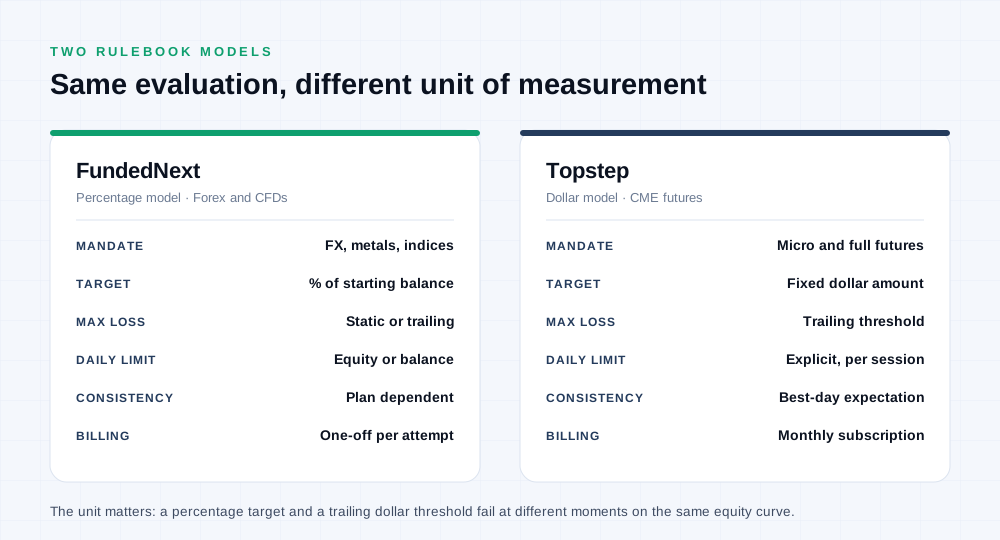
Drawdown basis: the decisive difference
Drawdown is the only rule that can end an account in a single day, so it deserves to be read before the target. The relevant questions are not "how much" but "measured from what" and "does it move".
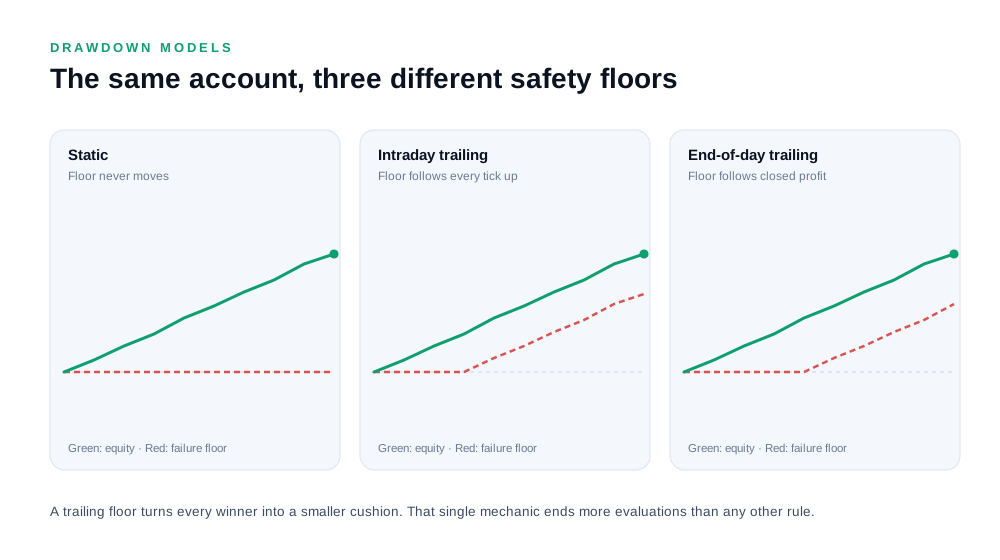
A static floor measured from the starting balance never moves. If the floor is a fixed percentage of the initial balance, then a $100,000 account with a 10% floor fails at $90,000 forever, whether the trader is at $100,000 or at $130,000. The cushion grows with profit: at $130,000 the trader has $40,000 of room. This is the most forgiving structure in the industry, and it is what makes The5ers' staged model attractive for a trader who expects to be profitable but uneven.
A relative floor measured from current equity moves with the balance. A 10% limit on a $100,000 account fails at $90,000; after profit to $120,000 it fails at $108,000. The cushion stays at 10% of equity, so it grows in dollars as the account grows but never as a share. This is stricter than a static floor after a winning run, and more forgiving after a losing run — which is the opposite of what most traders assume.
A trailing floor that follows peak equity is the strictest of the three, because it responds to unrealised profit on an intraday basis. Profit raises the floor immediately, so a winner that retraces permanently reduces the cushion. This structure is common on futures accounts and rare on staged Forex evaluations, but it is worth knowing because traders move between asset classes and carry assumptions with them.
| Structure | Floor after +$30,000 profit on a $100,000 account | Cushion at that point | Behaviour as you win |
|---|---|---|---|
| Static from starting balance (10%) | $90,000 | $40,000 | Gets safer |
| Relative to current equity (10%) | $117,000 | $13,000 | Same share, more dollars |
| Trailing on peak equity (10%) | $117,000 at minimum, higher after any intraday spike | $13,000 or less | Gets more fragile |
The middle row is the one traders misjudge. A relative limit is described as "10% drawdown", which sounds identical to a static 10%, and it is — until the account moves. After a 30% gain the relative floor has climbed $27,000 while the static floor has not moved at all. On a winning account, that difference is the entire margin between a comfortable evaluation and a tight one.
So the first thing to establish about either firm is which basis applies, and whether the evaluation and the funded account use the same one. They often do not: it is common for an evaluation to apply a relative limit and a funded account to apply a static one, or the reverse. Read both, and note that a stricter evaluation with a looser funded stage is a reasonable trade — the difficulty is front-loaded where it costs a fee rather than a payout.
What a deadline actually does
A deadline is usually discussed as a source of pressure, which undersells it. It performs three separate functions, and only one of them is about pressure.
It sets a pace. If a target must be reached in a fixed number of weeks, a trader can divide and get the required weekly profit. That number is checkable: is it achievable at a risk per trade the daily limit can survive? With no deadline, this calculation is never forced, so traders drift. Some go far too slowly and take a year to finish something that required two months. Others trade as though there were a deadline without ever doing the arithmetic, which is the worst of both.
It legitimises stopping. Reaching a target on a deadline account has a natural endpoint: the evaluation is complete. Without one, reaching the target raises a question — should I keep going to build a buffer, or stop? That question has no correct answer, and traders answer it differently every day depending on mood. The result is an account that has already passed and keeps trading, which is the purest form of unnecessary risk available.
It bounds the exposure. Every session is a chance to breach a rule. A deadline bounds the number of sessions, and therefore the number of chances. This is a genuine advantage of a deadline that is rarely stated, and it is the reason some traders pass faster firms more reliably despite the pressure.
Removing the deadline removes all three. The5ers' staged model does not replace them with anything, which is a feature rather than an oversight — it simply returns the responsibility to the trader. The correct response is to impose all three yourself: pick a target date, work backwards to a weekly requirement, decide in advance what counts as finished, and stop.
The self-imposed deadline: choose a date, divide the target by the sessions available before it, and check the result against the daily limit. If the required pace consumes more than a fifth of the daily budget per session, the date is wrong — not the plan.
There is a second-order effect worth naming. Without a deadline, a losing position has no external pressure to be closed, so it is held. On a static floor, holding is not neutral: the position consumes the buffer that the rules measure, and the buffer is the only thing between the trader and a reset. A deadline does not prevent this, but it does create a reason to resolve the position rather than defer it. On a no-deadline account the trader has to supply that reason, and supplying it is a skill that has to be practised.
Target percentages and pace
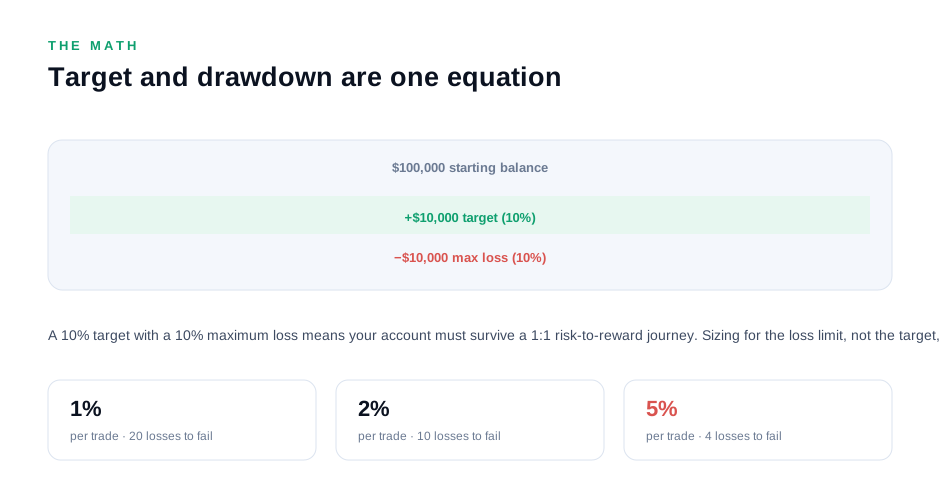
Both firms express targets as percentages of the account, which makes them directly comparable — unlike futures firms, where the dollar target has to be converted first. The comparison that matters is target percentage against daily limit, because that ratio decides how much variance a plan can absorb.
Take a target of 8% and a daily limit of 5%, which is representative of the staged Forex structure. Over twenty trading sessions the required average is 0.4% per session, which is 8% of the daily budget. That is a comfortable plan: twenty losing sessions at a fifth of the daily limit would still leave the account alive, and the target is reached by ordinary trading rather than by a single exceptional week.
Now take a target of 10% with the same daily limit and a deadline of ten sessions. The required average becomes 1% per session, a fifth of the daily budget, and the plan has five sessions of full-limit losses of tolerance before the maximum becomes the binding number. The target has not changed much; the tolerance has collapsed. That is what a deadline does to a plan, and it is why the same trader can pass one firm and fail the other without changing a single decision.
| Target | Sessions available | Required per session | Share of a 5% daily limit | Verdict |
|---|---|---|---|---|
| 8% | 30 | 0.27% | 5% | Comfortable |
| 8% | 20 | 0.40% | 8% | Comfortable |
| 8% | 10 | 0.80% | 16% | Workable |
| 10% | 20 | 0.50% | 10% | Workable |
| 10% | 10 | 1.00% | 20% | Fragile |
The practical rule: a plan that requires more than a fifth of the daily budget per session is depending on the market rather than on execution. It can still pass, but it will pass in the fortnights when conditions cooperate, and those fortnights are not scheduled. A plan under a tenth is relying on the trader showing up, which is a bet worth making.
The payout gates
Both firms gate withdrawals, and the gates are the part of the product that most comparisons omit. There are four, and each one has a failure mode.
Minimum trading days. A payout requires a number of qualifying days, and a qualifying day usually requires a closed profit rather than merely activity. A trader who reaches the profit threshold in a week may still need two more weeks of small positive sessions, and a plan that does not land both conditions on the same date wastes calendar.
The consistency check. A cap on the largest day as a share of total profit. The arithmetic is a division: required total equals best day divided by the permitted share. A trader with a $3,000 best day under a 30% rule needs $10,000 of total profit before the withdrawal clears, and no amount of requesting changes that.
Verification. Identity and, in some cases, source-of-funds checks. Complete them before the first request rather than at it, because a document request is the single most common cause of a delayed first payout.
Processing schedule. Payments run on a posted cadence, so the first request usually takes longer than later ones. Treat the first withdrawal as a test of the process and size it accordingly.

The consistency gate is where the two firms' structures produce different advice. On a no-deadline account, a trader can afford to keep trading at small size until the ratio has headroom, because calendar is not the constraint. On a deadline account, the same trader has less calendar to spend, so the ratio has to be protected from the beginning — which means the daily profit cap is not optional, it is the mechanism that makes the deadline survivable.
Cost per funded account
A fee is a price per attempt. A funded account is the product. The number that compares firms is therefore fee multiplied by the number of attempts a trader of given discipline typically needs, plus reset charges along the way.
Two firms can differ by 40% on the pricing page and reverse their ranking after two attempts. They can also reverse it after one, if the cheaper firm's structure produces a larger expected number of attempts. This is not a hypothetical: the whole point of a static floor is that it raises the pass rate, and a higher pass rate is worth a higher fee.
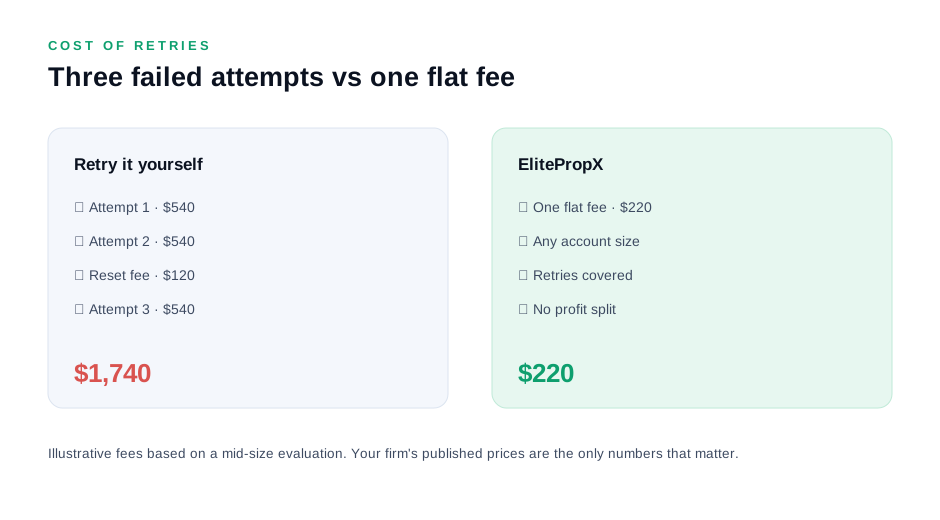
There is a third path that changes the shape of the curve rather than the height: a flat-fee passing service, which trades the evaluation once for a fixed price and covers resets while it runs. At a flat $220 for any firm and any account size, the expected cost is the fee plus the firm's own reset charge if one is needed — not fee times attempts. That does not make it automatically cheaper, because the trader gives up control of the evaluation and, more importantly, because many firms prohibit third-party trading. Where a firm prohibits it, the service should put that in writing rather than decide the risk on the client’s behalf. The 2026 service review sets out what to verify, and the service comparison prices the alternatives.
For the do-it-yourself path, the comparison should include three costs the fee does not capture: the calendar, the attention, and the opportunity cost of a funded account that could have been earning during the attempts. A trader who needs three attempts and six weeks has spent more than three fees. The profit calculator handles the payout side of that question, and the firm comparison puts the fee in context against the rest of the field.
Which trader finishes which
This is where a comparison becomes useful, because the honest answer is that each firm rewards a different temperament.
A deadline suits a trader who works best to a schedule. If you already trade a fixed session, keep a journal with dates, and find open-ended tasks difficult to finish, FTMO's structure supplies the pacing you would otherwise have to manufacture. The cost is a narrower tolerance for a slow start, and the mitigation is choosing a target date early enough that the required pace stays under a tenth of the daily budget.
No deadline suits a trader whose edge is uneven. If your profitable months are strong and your losing months are shallow, a static floor plus unlimited calendar is close to ideal: the good month does not make the account more fragile, and the shallow loss can be recovered without a clock. The risk is drift, and the mitigation is a written target date that you treat as binding even though the firm does not.
Neither suits a trader without a written plan. This is arithmetic rather than judgement. Both accounts have a fixed failure floor and a fixed target. A trader sizing by feel is running an uncontrolled process against a control system, and the control system wins on a long enough timeline. The fix is a page of numbers, not a different firm.
Nor does either suit a trader who cannot trade the news windows. Both firms restrict trading around scheduled releases, and both treat a breach as a breach regardless of outcome. If your available hours overlap the windows consistently, the evaluation is testing your schedule rather than your trading.
One further fit question that is rarely asked: which firm's rulebook does your existing strategy already satisfy? If your strategy holds positions for days, a no-deadline staged model with a static floor fits it and a weekend-holding restriction may not. If your strategy is intraday scalping with tight stops, the deadline matters less than the daily limit and the news windows. Read the conduct rules of both before comparing fees, because the conduct rules decide whether your strategy is admissible at all.
The same plan on both rulebooks
The clearest way to see the difference is to run one plan against both structures with identical trades. The plan is deliberately ordinary: 1% risk per trade, a daily stop at 3%, a daily profit cap at 2.5%, four sessions a week, and a rule that size never increases.
The trade record over ten sessions: +1.8%, +2.4%, −1.0%, flat, +1.6%, −1.0%, −1.0%, +2.2%, +1.4%, +1.0%. Total: +7.4%. The largest day is +2.4%, which is 32% of the total.
On a static floor the sequence is unremarkable. Progress does not move the failure floor, so the cushion at the end is the starting cushion plus the profit. The only gate left is the consistency ratio: 32% against a 30% rule is a fail by a fraction, which is exactly the kind of near-miss that a daily cap at 2.2% would have prevented. The plan's structure was sound and its cap was one setting too loose.
On a relative floor the picture changes twice. Early losses reduce the balance, so the 10% floor drops in dollars — the account loses room as it loses money, which is stricter than a static floor during a drawdown. Later profits raise the floor, so the cushion at +7.4% is smaller in dollars than the static case. The plan survives both, but the margin is thinner in both directions, and a trader who had a 2% drawdown in week three would have had less room to recover than on a static account.
| After ten sessions (+7.4%) | Static floor | Relative floor |
|---|---|---|
| Failure floor | Unchanged | Raised with the balance |
| Cushion in dollars | Starting cushion + profit | Roughly the original percentage of a larger balance |
| Size discipline required | Constant | Constant, but recomputed each morning |
| Worst week | −2.0%, absorbed | −2.0%, absorbed with less room |
| Consistency ratio | 32% — fails a 30% rule | 32% — fails a 30% rule |
Note what the table shows: the consistency ratio is identical on both accounts, because it is computed from realised profit and the rule does not change that. Only the failure floor differs. Traders routinely assume the stricter structure is stricter everywhere; it is stricter in exactly one dimension, and that dimension is the one that closes accounts.
The pacing lesson follows. On the static, no-deadline structure, the same seven-point-four percent could have been earned over fourteen sessions instead of ten with no cost other than calendar. On the deadline structure, those four extra sessions do not exist, so the plan has to earn the same amount faster — which means either more risk per trade or a better selection of setups. If neither is available, the deadline converts into a consistency problem, because the only way to compress time is to have a bigger day.
How to choose in practice
Four questions, answered in order, produce a decision without reference to a review or a ranking.
- Does your strategy fit the conduct rules? Holding period, instruments, news windows, weekend exposure. If the answer is no for one firm, the comparison is over, and no fee difference justifies it.
- Is your edge even or lumpy? Even edges do well with a deadline, because the required pace is achievable by ordinary trading. Lumpy edges do better without one, because the good month carries the evaluation.
- Do you finish open-ended tasks? Be honest. A trader who drifts on open-ended work should buy the deadline, even at a higher pace requirement, because the alternative is an evaluation that never ends.
- What is the cost per funded account? Fee times expected attempts, including resets. Compare that number, not the headline fee, and include the flat-fee alternative if the firm permits third-party trading.
The order matters. Most traders start at question four because the fee is the only number on the page, and then discover at question one that their strategy was never admissible. Reading the rulebook costs twenty minutes; failing an evaluation for a conduct breach costs a fee and a month.
A decision procedure, not a verdict
There is no universal answer, and any comparison that offers one is describing its own preferences. What can be said with confidence is this: the static floor is strictly more forgiving than the relative floor at equal percentage, the deadline is strictly more helpful to a trader who needs pacing and strictly more harmful to a trader whose edge is lumpy, and the payout gates are identical in kind even when they differ in number.
The practical recommendation, for a trader who has not yet bought either, is to run the plan on a demo account under both sets of rules for four weeks. Same trades, two rulebooks, and record which one your equity curve survives. That exercise costs nothing and answers the question more reliably than any review, because it tests your behaviour rather than the firm's marketing.
If the answer is that neither fits — because the fee is repeated, the pace is unreachable, or the calendar is short — the flat-fee route exists precisely for that case. At $220 for any firm and account size, with resets covered while the evaluation runs, it converts a repeated wager into a single fixed cost, and it is available only where the firm's terms allow third-party trading. The passed challenges page shows what completed evaluations look like, and the rules matrix lets you check any firm's mechanics against these two before committing.
Whichever route you take, the same three rules travel with you: a written risk per trade, a daily stop at 80% of the limit, and a daily profit cap at about a third of the target. Those three numbers survive every firm, every rulebook and every fee schedule, and they are the difference between an evaluation that measures your trading and one that measures your temperament.
Five comparison mistakes that cost a fee
Comparisons fail in predictable ways, and each failure has a price.
Comparing headline fees. The fee is per attempt, so the comparison is fee times expected attempts. A firm 40% cheaper that needs two attempts costs more than a firm that needs one, and the difference is larger than the fee gap.
Reading the target and skipping the daily limit. The target sets the destination and the daily limit sets the route. A modest target with a tight daily limit is harder than a larger target with a generous one, because the second permits the losing days that a real plan contains.
Assuming a percentage means a fixed dollar amount. "10% drawdown" describes a static floor, a relative floor, or a trailing peak, and the three behave differently the moment the account moves. The percentage is not the rule; the basis is.
Ignoring the payout gates until after the pass. Minimum days, consistency and verification are part of the product. A firm whose evaluation is easy and whose payout is gated at a 20% best-day share is harder to earn from than its evaluation suggests.
Choosing the firm whose marketing matches your self-image. The trader who believes they are aggressive buys the tightest structure and discovers that aggression is a cost. The trader who believes they are patient buys the open-ended structure and discovers that patience needs a deadline. Buy the rulebook your last twenty sessions would have survived, not the one that flatters you.
Each of those mistakes is cheap to fix before payment and expensive to fix afterwards. A twenty-minute read of both rulebooks, a written plan, and one demo month under each structure is the entire preparation, and it costs nothing but attention.
For the mechanics of either firm specifically, the FTMO guide and the The5ers guide go deeper than a comparison can, and the FTMO versus Apex comparison covers the cross-asset question. The FAQ answers the questions that recur, and the contact page is where a flat-fee evaluation starts if you would rather not run it yourself.
Frequently asked about FTMO and The5ers
Is FTMO harder than The5ers?
FTMO is harder on pace, because a deadline compresses the calendar and forces a required profit per session. The5ers is harder on self-discipline, because no deadline means nothing external enforces a pace or tells you when to stop. Which is harder depends on which of those two constraints you handle worse.
Which firm has the more forgiving drawdown?
On its staged model, The5ers uses a static floor measured from the starting balance, which is the most forgiving structure available — profit does not reduce the cushion. FTMO's percentage limits are applied to the account, so the cushion moves with the balance. Read the current terms for both, because the basis can differ between the evaluation and the funded stage.
Does a no-time-limit evaluation mean I can take months?
Technically yes, practically no. The firm will not stop you, but an evaluation that runs for months has spent more in calendar and attention than it saved in pace, and the account remains exposed to a rule breach the entire time. Impose your own target date and treat it as binding.
How long does each challenge take to pass?
On a deadline structure, the phase length dictates the pace and a realistic pass uses most of the available sessions. On a no-deadline structure, fifteen to twenty-five sessions at a pace under a tenth of the daily budget is typical. Faster passes on either are possible and usually create a consistency problem at payout.
What risk per trade should I use on either?
A third of the daily limit at most, with the session closed at 80% of the budget. On a 5% daily limit that is roughly 1.7% per trade, which survives three consecutive losses and keeps the plan executable.
Do both firms apply a consistency rule?
Both gate payouts on consistency in some form, with the details varying by program and changing over time. The arithmetic is the same everywhere: required total profit equals the best day divided by the permitted share. Cap the best day at a third of the target and the rule is satisfied by construction.
Can I hold positions over the weekend?
Policies differ by firm and by program. Where holding is permitted, size for the weekend gap rather than for the stop, because a gap can open beyond the stop and the loss becomes the gap. Where it is restricted, be flat before the close.
Is it worth buying two evaluations at once?
No. Correlated positions across accounts can be read as hedging, and split attention produces worse execution on both. Sequential funding — pass one, trade it, then add another — is slower to start and faster to reach a first payout.
Which is cheaper per funded account?
It depends on how many attempts each structure requires for a given trader. Multiply each fee by the expected number of attempts, add reset charges, and compare. A cheaper fee on a stricter structure is bought more than once.
Do either of these firms permit a passing service?
Many prop firms prohibit third-party trading of an evaluation, and a funded account passed in breach of the terms can be voided at payout. We work with any firm, and we put its third-party trading clause in writing before payment so the client can decide with the facts; the risk of a voided account sits with the client. The service reviews explain how to check before paying.
What is the most common reason a funded account is lost?
Increasing size after the pass. The evaluation rewards a controlled plan and the funded stage rewards the same plan, but the pressure that produced discipline disappears the moment the fee is earned. Keep the risk per trade unchanged for the first three months.
How do I compare a firm I have never traded?
Read four things in this order: the drawdown basis, the target as a percentage, the daily limit, and the payout gates. Then run your plan on a demo under those rules for four weeks. The demo month answers more than any review, because it tests your behaviour against the rulebook.
Rather not run the evaluation yourself?
Related reading
- Passing an FTMO challenge
- Passing a The5ers challenge
- How to pass an FTMO challenge, step by step
- FTMO vs Apex
- Daily drawdown explained
- Consistency rule guide
- Weekend holding rules by firm
- Profit and payout calculator
- Prop firm comparison 2026
- Apex Trader Funding vs The5ers
- The5ers review
FTMO and The5ers are named for identification only. ElitePropX is an independent service and is not affiliated with, endorsed by or sponsored by any proprietary trading firm. Targets, drawdown rules and payout conditions change; verify them against the firms' current terms. Trading involves substantial risk of loss.