
Firm guide · reviewed October 2026
Passing a The5ers challenge: what changes when there is no deadline
A staged evaluation with no time limit removes the constraint most traders plan around — and replaces it with a harder one, because without a deadline there is nothing to stop a position staying open for three weeks while the drawdown quietly erodes. This guide covers the structure of the challenge, the static-drawdown arithmetic that makes it forgiving, the pacing problem that a deadline normally solves, and the sizing plan that finishes inside the rules without treating the account as a permanent experiment.
Key takeaways
- No time limit is not an invitation to trade slowly; it is a requirement to hold a pace you set yourself, because nothing external enforces one.
- A static drawdown measured from the starting balance is the most forgiving structure available — progress cannot make the account more fragile.
- Percentage targets are scale-free, so the same plan transfers unchanged from the smallest stage to the largest.
- Payout rules, not evaluation rules, decide when the funded phase produces income; a consistency or day-count gate applies there.
- The flat $220 passing service is available on The5ers if the firm's terms permit third-party trading — check the terms for the evaluation and the funded account separately.
Contents
- The deadline you no longer have
- The staged structure
- Static drawdown, and what it permits
- Target arithmetic across stages
- Consistency and the payout gate
- Sizing for an evaluation without a clock
- Where attempts actually fail
- Time as a cost, not a comfort
- Scaling and the funded phase
- Staged versus one-phase evaluations
- Reading the funded terms first
- A four-week execution template
- Frequently asked questions
The deadline you no longer have
Most evaluation programs impose a time limit, and the limit does more work than traders realise. It sets the pace, it decides how much the trader can wait for a good setup, and it provides a legitimate reason to stop trading once the target is reached. Remove it and all three of those functions disappear at once.
The immediate effect is psychological and pleasant: a losing week no longer means the clock is running out. The second effect is subtle and expensive. Without a deadline, a losing position has no external pressure to be closed, so it is held — and on a static drawdown account, holding a losing position is not neutral. It consumes the buffer that the rules measure, and the buffer is the only thing standing between the trader and a reset.
The third effect is the one that decides outcomes. A deadline forces a decision about pace: to reach a percentage target in a given number of weeks, a trader must risk a certain amount per week, and that number can be checked against the daily limit. With no deadline, that calculation is never performed, so traders drift — some trade far too slowly to finish inside a reasonable period, and others trade exactly as they would in a hurry but without the justification.
The right response is to impose the deadline yourself. Set a target date, work backwards to a required weekly profit, and check that the required profit is achievable at a risk per trade the daily limit can survive. A self-imposed deadline restores every function the firm's deadline would have provided, without adding a rule that can breach the account.
The staged structure
The challenge is a staged evaluation: one or more phases with a profit target each, a drawdown limit that governs the whole account, and a funded stage on completion. The stages exist to make each step smaller than a single large target would be, which is a structural advantage for a trader with a plan that compounds slowly.
| Element | How it is expressed | Planning consequence |
|---|---|---|
| Target per stage | Percentage of the starting balance | Same plan works at any account size |
| Drawdown | Static, measured from the starting balance | Progress never reduces room |
| Daily limit | Stated per plan | Governs the session, not the account |
| Time limit | None on the standard path | The trader must supply the pace |
| Minimum days | Usually satisfied long before the target | Not the binding constraint |
| Funded stage | Profit split with its own withdrawal conditions | Payout gates apply here, not during evaluation |
Three properties of that structure are worth absorbing before anything else. Percentage targets mean the challenge is scale-free, so a trader who has passed one stage knows exactly what the next one requires in relative terms — only the fee and the payout change. A static drawdown means the failure point is a fixed distance below the start, so the account cannot become more fragile as it grows. And the absence of a time limit means the only clock is the one the trader brings.
Firms revise schedules, so the exact percentages and stage counts on this page are deliberately described by mechanism rather than quoted as current figures. Read the firm's own evaluation page for the numbers, and treat the structure above as the part that does not change.
Static drawdown, and what it permits
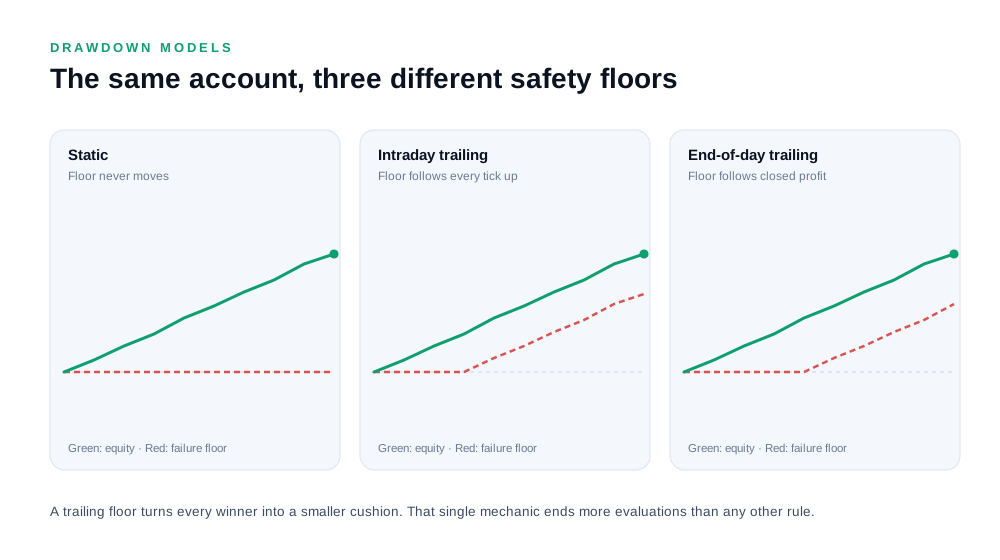
A static drawdown is the single most important difference between this kind of evaluation and the futures-style trailing accounts that dominate current marketing. The failure point is fixed at the start and never moves, regardless of how much profit the account produces.
What that permits is significant. A trader can be up on the evaluation and still let a position breathe without reducing the cushion, because the cushion is defined by the starting balance rather than by peak equity. Open profit cannot tighten the account, and a retracement on a winning day costs the profit but not the room. That is a materially different game from a trailing threshold, where the same sequence reduces both.
What it does not permit is the behaviour traders bring from trailing accounts. On a static structure, the temptation is to hold a losing position because "there is still room" — and there usually is, until there is not. The floor is fixed but it is not far away, and a position that is 2% against an account with a 10% limit has already consumed a fifth of the total budget. Static drawdown rewards patience with winners and punishes patience with losers, which is the opposite of the intuition most traders carry.
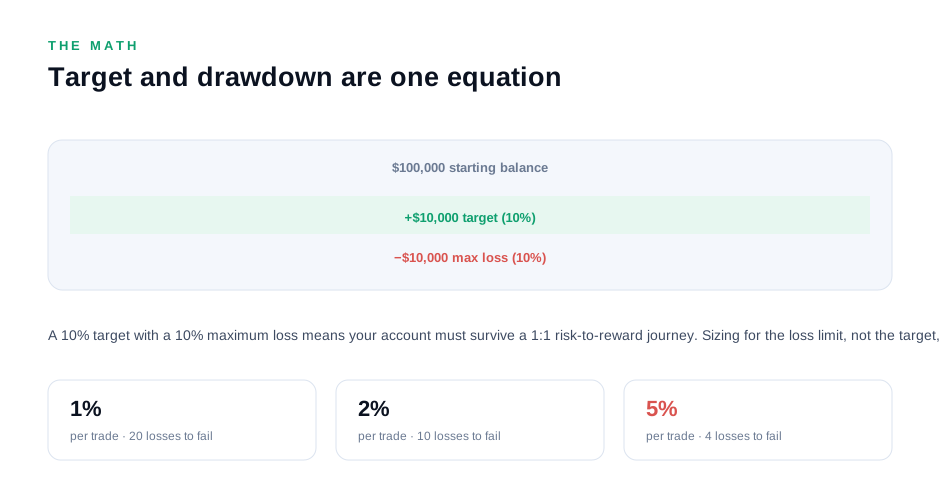
The practical rule that follows is to convert the static number into a per-trade budget once, at the start, and then never revisit it. If the maximum loss is 10% of the balance and the plan is to survive eight consecutive losses, risk per trade is 1.25% at the limit and 0.6% for comfort. Written down on day one, that number governs every position in every stage. Recalculated mid-evaluation, it drifts upward under the pressure of a target.
Target arithmetic across stages
Because targets are percentages, the arithmetic of passing is identical at every stage and every account size. What changes is the cost of failure, and therefore the correct level of caution.
Take a stage that requires a given percentage return. At a risk per trade of 0.6% and a reward-to-risk ratio of 2, a plan with a 40% win rate produces roughly 0.2% of expected value per trade. Reaching a 6% target takes about thirty trades at expectation — six weeks at five trades a week, or three weeks at ten. Those numbers are the plan's own pace, and they are the reason a self-imposed deadline should be set generously rather than optimistically.
The same arithmetic exposes the most common error in this kind of evaluation: trading more, at the same risk, to reach the target faster. It does not change the expected value per trade, it only increases the number of trades — and with it the variance and the chance of touching the drawdown. A trader who doubles their trade count to halve the calendar has not sped up the plan, they have bought lottery tickets with the drawdown budget.
Across stages, the important change is behavioural rather than mathematical. In the final stage, the trader is close to a funded account, and the temptation to accelerate is strongest exactly when the cost of failure is highest — a reset means repeating every prior stage plus the fee. The correct response is to reduce risk per trade in the last third of the final stage, not increase it. The plan finishes slower and survives; the alternative finishes faster when it works and costs everything when it does not.
Consistency and the payout gate
The evaluation's rules are only half of the rulebook. The funded account has its own conditions, and they decide whether a pass becomes income.
The pattern across the industry is a minimum number of profitable days, a profit threshold before withdrawal, and a consistency expectation that no single day dominates. On a funded account, that gate is applied to the profit being withdrawn rather than to the evaluation target, which means a trader who passed with one strong stage can start the funded phase already close to the limit.
The arithmetic is the same everywhere: under a best-day share of around a third, total profit must reach roughly three times the largest day. A trader whose largest day is $2,000 needs $6,000 of total profit before the ratio allows a full withdrawal. The practical implication is a daily profit cap set well below half the target, so the ratio is satisfied as the threshold is reached rather than afterwards.
There is a particular trap on a no-deadline evaluation. Because there is no pressure to finish, a trader can spend three weeks building a modest, even profit — and then take one large position at the end to clear the target. That single day creates the consistency problem, and it does so at the exact moment the trader believes they have succeeded. The even record was the asset; the final flourish destroyed it.
The mitigation is structural rather than psychological: set a maximum profit per day, close the platform when it is reached, and treat the target as something to be approached over multiple sessions. The consistency guide covers the arithmetic in detail for each common threshold.
Sizing for an evaluation without a clock
Without a deadline, sizing has to be derived from survivability rather than from pace, because nothing else is forcing a decision.
Start with the drawdown, not the target. If the maximum loss is 10% and the plan should survive a ten-loss streak — which is a normal event for a 40% win rate over a few hundred trades — then risk per trade cannot exceed 1%. For comfort against a longer streak than the sample showed, halve it to 0.5%. That number is the plan's foundation, and it does not change because a stage is taking longer than expected.
Then check the daily limit against it. If the daily limit is a third of the maximum loss and risk per trade is 0.5%, the trader can take two or three losing trades in a session before stopping. If the arithmetic produces a number below one trade, either the account is too small for the plan or the plan's stop distance does not fit the instrument. Both are worth discovering before paying a fee.
Then compute the pace, and only then decide whether the self-imposed deadline is realistic. A plan that needs sixty trades to reach the target at expectation will not finish in three weeks at five trades a week, and pretending otherwise produces the acceleration that ends accounts.
Three habits make this survivable over a multi-week evaluation. Trade a fixed number of sessions per week rather than every session. Cap the number of trades per session before the market opens. And review the risk number weekly, comparing it to the written rule rather than to the current mood — because the arithmetic never changes, and the mood always does.
Where attempts actually fail
Failure on this kind of evaluation rarely comes from a single catastrophic trade. It comes from three patterns that a static drawdown makes possible.
Holding a loser because there is time. The no-deadline structure makes it easy to leave a losing position open in the belief that the market will come back. On a static drawdown the buffer is finite and does not replenish, so each day of holding consumes room that the next stage will need. The account does not fail on the day the position is opened; it fails on the day the trader finally accepts the loss, which is often after it has grown.
Overtrading a slow week. With no deadline, a trader who has nothing to do still opens the platform. The trades that come from boredom are the ones with no plan behind them, and they are indistinguishable in size from the trades that had a reason. Two or three of those in a week can consume a week's expected profit.
The final-stage acceleration. As described above, the last stage invites a larger position to finish the job. The stage structure makes this worse than a single-phase evaluation would, because the trader has already invested time and fee in earlier stages and wants the whole sequence to be over.
Each has the same remedy: a written rule that does not depend on the state of the market or the trader's mood. No position stays open past a stated adverse level. No trade is taken without a setup from the plan. Risk falls, rather than rises, in the final third of a stage.
Time as a cost, not a comfort
One-off fees are the standard in this category, which means a longer evaluation does not cost the firm money and does not cost the trader a subscription. That sounds like a pure advantage, and it is not.
The cost of time is opportunity. Every week spent in an evaluation is a week not spent trading a funded account, and the funded account is where the income is. A trader who takes three months to pass a stage that could have been passed in five weeks has not lost money on fees; they have lost seven weeks of funded profit, which is usually the larger number.
The second cost is attention. A multi-week evaluation is a sustained cognitive load, and the probability of a lapse rises with the duration. This is the argument for finishing decisively rather than treating the account as a long-term experiment: the plan should be efficient enough to finish in a reasonable number of weeks and conservative enough to survive them.
The third cost is behavioural drift. Over weeks, the plan erodes. Risk per trade creeps up after a win, stops move after a loss, and a position that would have been closed in week one is still open in week three with a story attached. Deadlines slow this drift because they force a review; without one, the review has to be scheduled rather than triggered.
A simple discipline covers all three: a weekly review with four numbers — trades taken, expectation per trade, worst drawdown so far, distance to target. If the numbers are trending in the right direction, keep going. If the expectation has fallen or the drawdown has grown, the plan has drifted and the review should end with a specific correction rather than a resolution to be more careful.
Scaling and the funded phase
The funded stage is not the evaluation with a bigger balance. It has withdrawal conditions, a profit split, and typically a scaling path that rewards consistency rather than size.
The first change is that profit only becomes income when it is withdrawn. An unwithdrawn profit sits in the account, contributes to drawdown calculations, and does not pay anything. Traders who treat the funded balance as a high-score table leave money in an account that can lose it back.
The second change is that the drawdown is often tighter as a percentage, because the firm is now exposed to real payouts. A plan that ran at 1% risk per trade during the evaluation may need to run at half that in the funded stage, at least until the first withdrawal is complete.

The third change is the scaling logic itself. Firms increase allocations on the basis of completed payouts, not on the basis of a single good month. The fastest route to a larger account is therefore a boring record: small, regular, on-time withdrawals with the rulebook intact. A trader who produces one spectacular month and then breaches a limit has produced nothing the firm can scale.
For the first fortnight after funding, the correct approach is to halve the evaluation's risk, satisfy the minimum day count, keep the consistency ratio intact, and complete identity verification before the first withdrawal request. The payout process guide walks through the sequence, and the instant funding guide covers the alternative route for traders who want to skip the evaluation entirely.
Staged versus one-phase evaluations
The staged, no-deadline structure suits a particular kind of trader, and it is worth being honest about which.
It suits traders with a slow, compounding plan and a full-time schedule elsewhere: the absence of a deadline removes the pressure that makes a part-time trader take marginal setups at the end of a long day. It suits traders who have failed timed evaluations on the final stage, because the stage arithmetic is smaller per step. And it suits traders who want to learn under a rulebook without paying for the same evaluation three times in a month.
It suits less well traders who need external structure. A trader who accelerates without a deadline will accelerate here too, and the resulting losses are larger because nothing is forcing a stop. If that describes you, the honest options are to impose a hard deadline with a written consequence, or to choose a timed evaluation where the constraint does the work.
For a direct comparison of the two dominant rulebook models — percentage forex rules versus dollar futures rules — the FundedNext versus Topstep guide covers the mechanics and the session constraints. For the wider market, the firm comparison and the rules matrix list the structures side by side.
Reading the funded terms before you start
The evaluation page is marketing; the funded terms are the contract. Four clauses deserve reading before the first fee, because each one changes how the evaluation should be traded.
Withdrawal conditions. Look for the minimum number of profitable days, the profit threshold per payout period, and any first-payout delay. These are the conditions that sit between a funded account and income, and they determine whether the trader should aim for a fast pass or a steady one. A long minimum-day requirement rewards a slow evaluation; a short one rewards speed.
The consistency clause. Establish whether it is applied once, at the first payout, or at every withdrawal. Applied every time, it becomes a permanent constraint on position size and profit targets. Applied once, it is a hurdle that can be cleared and forgotten.
The drawdown on the funded account. It is frequently tighter than the evaluation's, as a percentage of balance. A plan calibrated to the evaluation may be twice as aggressive as the funded account permits, which is how newly funded accounts are lost in the first fortnight.
The third-party and account-sharing clause. Whether assistance is permitted on the evaluation and on the funded account are separate questions, and the funded answer is the one with money attached. Where the answer is unclear, get it in writing from support and keep the reply.
None of this is reading for pleasure, and all of it is cheaper than discovering a condition after a payout request. A trader who reads the funded terms first often makes a different decision about account size, because the smallest account whose funded rules they can satisfy is usually a better purchase than the largest they can finance.
A four-week execution template
Because the challenge has no built-in clock, the plan has to supply one. This template works for a single stage and repeats for each subsequent one.
Week one: two trades a day, no more. The purpose is calibration, not progress. Measure the spread actually paid at the hours you trade, the average cost of a round turn, and how many setups the market produced at the size you intend to use. Two trades a day is a hard cap that prevents the week from becoming an experiment in overtrading.
Week two: add size only if week one was positive. If the first week finished flat or down, keep the same size and repeat the calibration. Increasing size after a losing week is the single most common way a static-drawdown account is lost, because it converts a normal variance sequence into a drawdown that touches the limit.
Week three: protect the accumulated buffer. By this point the account is either ahead or behind, and the response differs. Ahead, risk per trade falls by a quarter and the daily trade cap stays. Behind, the plan continues unchanged and the target date moves; the daily limit is not increased to catch up.
Week four: decide, do not drift. At the end of four weeks the numbers are known: expectation per trade, distance to target, worst drawdown. If the plan is on pace, continue. If it is behind on pace but the expectation is healthy, extend the deadline. If the expectation has gone negative, stop and review rather than continuing to pay for information the account has already provided.
The template's value is that it makes the decision weekly rather than continuously. A trader who reviews every day reacts to noise; a trader who reviews every week reacts to the plan. On an evaluation with no deadline, that difference is the whole discipline.
One addition worth making for the final stage: shorten the review cycle to twice a week and drop risk per trade by a third. The cost is a slower finish, and the benefit is that the last weeks of a staged sequence are not where the account fails. Almost every trader who fails a final stage can name the position; almost none of them had reduced size first.
Frequently asked questions
Does The5ers really have no time limit?
The standard evaluation path is structured without a deadline on the stages, which means the targets do not expire. Firms revise schedules, so confirm the current terms on the firm's own evaluation page rather than relying on any guide, including this one.
What kind of drawdown does the challenge use?
A static drawdown measured from the starting balance is the defining feature: the failure point does not move as profit accumulates. That makes the account more forgiving than a trailing structure, because progress never reduces the remaining room.
How long should I take to pass it?
Set your own deadline from the arithmetic: expectation per trade multiplied by trades per week gives a realistic date. Most plans finish a stage in four to eight weeks at disciplined sizing. Taking three months is not a failure, but it costs funded-account time, which is usually the larger number.
What risk per trade should I use?
Derive it from the drawdown rather than the target. If the maximum loss is 10% and the plan must survive eight to ten consecutive losses, risk per trade is 0.5% to 1%. Halve it for comfort against a streak longer than the sample showed.
Why do traders fail a challenge with no deadline?
Three patterns: holding a loser because time is available, overtrading a quiet week, and accelerating in the final stage to finish the sequence. All three are solved by written rules that do not depend on mood — a hard adverse level, a setup requirement, and risk that falls rather than rises at the end.
Is the challenge easier than a one-phase evaluation?
Different rather than easier. Each stage has a smaller target, which helps, and the static drawdown is more forgiving than a trailing one. Against that, the sequence is longer and the final stage carries the cost of every prior stage, which is where disciplined traders win and impatient ones lose.
Can I hold positions over the weekend?
Check the firm's current weekend and overnight policy for the specific instrument and account stage. Where holding is permitted, price the gap as a multiple of the stop and cut the size accordingly — the weekend holding guide covers the arithmetic.
What happens after I pass?
A funded account is issued with its own rules: a minimum number of profitable days, a profit threshold before withdrawal, a consistency check, identity verification and a payout schedule. Trade the first fortnight at half the evaluation's risk and complete verification before requesting anything.
Does a passing service work on this firm?
Only if the firm's terms permit third-party trading, which must be checked for the evaluation and the funded account separately. ElitePropX charges a flat $220 per evaluation at any stage and size, with retries covered, and works with any firm, telling you in writing what that firm’s third-party trading clause says before you pay.
How does consistency apply on a no-deadline challenge?
Consistency is normally applied at the payout stage on the funded account rather than during the evaluation. The risk is finishing a stage with one dominant day, which then constrains the first withdrawal. Cap daily profit well below half the target to keep the ratio intact.
Should I trade every session?
No. Four or five planned sessions a week produces a slower pass and a lower breach rate than trading every available window. Without a deadline, session count is the only external structure a trader has, so it should be fixed deliberately rather than left to the calendar.
What is the biggest mistake on this type of evaluation?
Treating the absence of a deadline as permission to hold losing positions. On a static drawdown the buffer never replenishes, so patience with a loser is the one behaviour that converts a small planned loss into a failed account.
Where these rules come from
Firm figures on this page are read from the rulebooks below rather than from other comparison sites. Every link was opened and checked on . Firms revise targets and drawdown rules without notice, so confirm the figures on the plan you are buying before paying. How we check firm rules sets out what a checked date means, what we publish when a figure cannot be confirmed, and how corrections are handled.
- The5ers — High Stakes plan rules
Want the challenge traded for you?
Related reading
- Recently passed evaluations
- Weekend holding rules and gap risk
- FundedNext vs Topstep
- Passing an FTMO challenge
- Consistency rule guide
- Daily drawdown explained
- Best firms for beginners
- Prop firm rules matrix
- Frequently asked questions
The5ers is named for identification only. ElitePropX is an independent service and is not affiliated with, endorsed by or sponsored by any proprietary trading firm. Challenge structures, targets and payout terms change; verify them against the firm's current terms. Trading involves substantial risk of loss.