
Comparison · reviewed October 2026
FTMO vs Apex: a percentage rulebook against a contract rulebook
This is not a comparison of two firms in the same category. It is a comparison of the two rulebook models that divide the prop industry: percentage targets with fractional position sizing on currency pairs and indices, against dollar targets with whole contracts on futures. The instruments, the sizing arithmetic and the way accounts fail are all different. This page sets the two side by side and gives the method for deciding which one a given strategy belongs in.
Key takeaways
- The sizing models are incompatible: fractional lots against whole contracts, pips against ticks.
- Percentage rules are scale-free; dollar rules are quantised, so rounding up by one contract can double risk.
- Trailing drawdowns are far more common on the futures side, which changes how winners must be managed.
- Daily limits exist on both, but the futures daily limit is usually the binding constraint.
- Choose by instrument and schedule first; the fee differences are second-order compared with a plan that does not fit.
Contents
- Two sports, not two brands
- Sizing: lots against contracts
- Targets and what they imply
- Drawdown mechanisms
- Daily limits and sessions
- Cost structure and the calendar
- Consistency and payouts
- The same strategy, sized for both
- Which suits which trader
- Switching categories, and what does not transfer
- What to verify in either rulebook
- Frequently asked questions
Two sports, not two brands
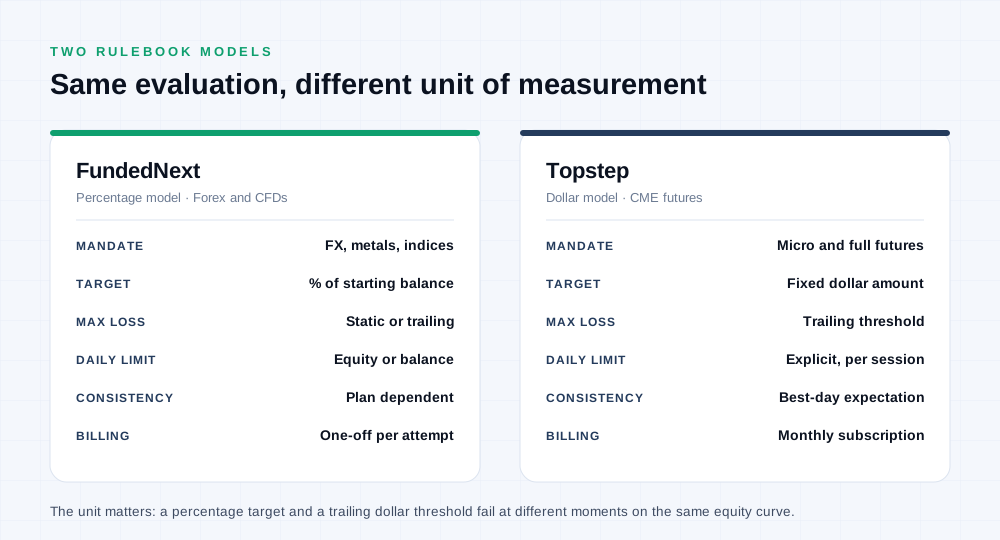
Most prop firm comparisons place every firm on one axis of difficulty. That works within a category and fails across categories, because the two rulebook models measure risk in different units. FTMO's structure is percentage-based: the target, the maximum loss and the daily limit are all expressed as percentages of the balance, and positions are fractional lots on currency pairs, metals and indices. Apex's structure is dollar-based: the target, the drawdown and the daily limit are dollar amounts on a fixed account size, and positions are whole contracts on futures, usually index futures.
That difference is not cosmetic. A percentage target is scale-free, so the same plan works unchanged on a $25,000 account and a $200,000 one — only the dollars per pip change. A dollar target on a fixed account is not scale-free in the same way: the account size is chosen, and the contract count is derived from the dollars available. One model lets a trader carry a plan across account sizes without alteration; the other requires the sizing calculation to be redone for each instrument and each account.
The second difference is what the trader is actually reading. Currency pairs and cash indices move in pips and points with a fixed value per lot, and the position can be scaled smoothly — 0.37 lots is a legitimate size. Futures contracts move in ticks with a fixed dollar value per contract, and the position is a whole number: one contract or two, never 1.4. That quantisation is the single most consequential practical difference between the two, and it is where traders moving from one category to the other most often miscalculate.
A third difference follows from the second. Because futures risk is quantised in large increments, small accounts are effectively forced into one-contract positions on the full-size contracts, which means the strategy's stop distance — not the trader's risk preference — decides the dollar risk per trade. Micro contracts exist precisely to restore that flexibility: the same stop distance in ticks at a tenth of the dollar value, which is why they are the standard tool for futures evaluations on smaller accounts. The micro futures guide works through the account-size arithmetic.
Sizing: lots against contracts
The two sizing calculations look similar and behave differently. Both divide a money risk figure by the cost of the stop, but the cost term is built differently and the result is rounded differently.
| Step | Percentage rulebook | Contract rulebook |
|---|---|---|
| Money at risk | Maximum loss % ÷ streak tolerance | Maximum loss $ ÷ streak tolerance |
| Cost of the stop | Stop in pips × pip value per lot | Stop in ticks × tick value per contract |
| Result | Lots, fractional allowed | Contracts, whole numbers only |
| Rounding | Down to the platform increment | Down to the nearest contract |
| Error from rounding | Small — increments are fine | Potentially large — one contract can double risk |
Consider a worked pair. On a $100,000 percentage account with a 10% maximum loss and a streak tolerance of ten, money at risk is $1,000 per trade. At a stop of 40 pips and a pip value of $10 per standard lot, the cost of the stop at one lot is $400, so the size is 2.5 lots — rounded down to 2.4 on most platforms, which retains 96% of the intended risk.
On a dollar-based futures account with an $8,000 maximum loss and the same tolerance, money at risk is $800 per trade. At a stop of 30 ticks and a tick value of $10, the cost per contract is $300, so the size is 2.67 contracts — rounded down to two, which retains 75% of the intended risk. The plan is 25% smaller than the arithmetic allows, purely because contracts do not subdivide.
That gap is why micro contracts matter and why they are not a compromise. Where a micro carries a tenth of the tick value, the same $800 budget permits a size that tracks the strategy's stop much more closely, so the effective risk per trade matches the plan rather than falling short of it. Where micros are unavailable on the instrument, the alternative is a longer streak tolerance and a smaller derived size, which lengthens the calendar but keeps the arithmetic honest.
Targets and what they imply
A percentage target and a dollar target produce different calendars, and the calendar is what decides how much variance a plan must survive.
On the percentage side, the target scales with the account and is expressed as a return. That makes it directly comparable to the plan's measured monthly return: a plan that returns 5% a month takes roughly two months to produce a 10% target, regardless of whether the account is $25,000 or $200,000. It also means the target and the maximum loss are measured in the same unit, so the ratio between them — the number that really decides difficulty — is transparent.
On the dollar side, the target is a fixed amount against a chosen account size. The ratio to the maximum loss is equally transparent, but the account size is a decision rather than a given, which means two traders with the same strategy can face different targets in percentage terms. Choosing the account size therefore becomes part of the planning rather than a purchase decision made separately.
The profit target guide covers the three legitimate levers — reward-to-risk ratio, selectivity and session count — that shorten a calendar without raising risk, and the profit calculator converts a target into a trade count and a break-even figure. Both apply to either rulebook; only the units change.
Time limits belong in this section because they convert a target into a required pace. A stated limit implies a required weekly return, and that return has to fit inside the daily limit at a survivable risk per trade. If it does not, the evaluation is not passable as configured — a conclusion that is arithmetic rather than motivational, and one worth reaching before the fee rather than after a second attempt.
Drawdown mechanisms
The failure floor is the clause that most often decides an outcome, and the two categories differ in how commonly the harsher version appears.
Percentage-based rulebooks in the forex category predominantly use a static maximum loss: the floor is fixed at the starting balance and never moves, so profit cannot reduce the room available. Some also use an end-of-day trailing floor that resets at the daily close. Intraday trailing floors — where the floor follows peak unrealised equity continuously — are less common on this side, though they exist and should be checked for rather than assumed absent.
Contract-based rulebooks use trailing mechanisms much more often, and intraday trailing in particular. That is the single largest risk-management difference between the two categories. A strategy that holds winners through pullbacks is viable on a static floor and structurally fragile on an intraday trailing one, because the pullback is measured from a floor the winner has already raised behind it.
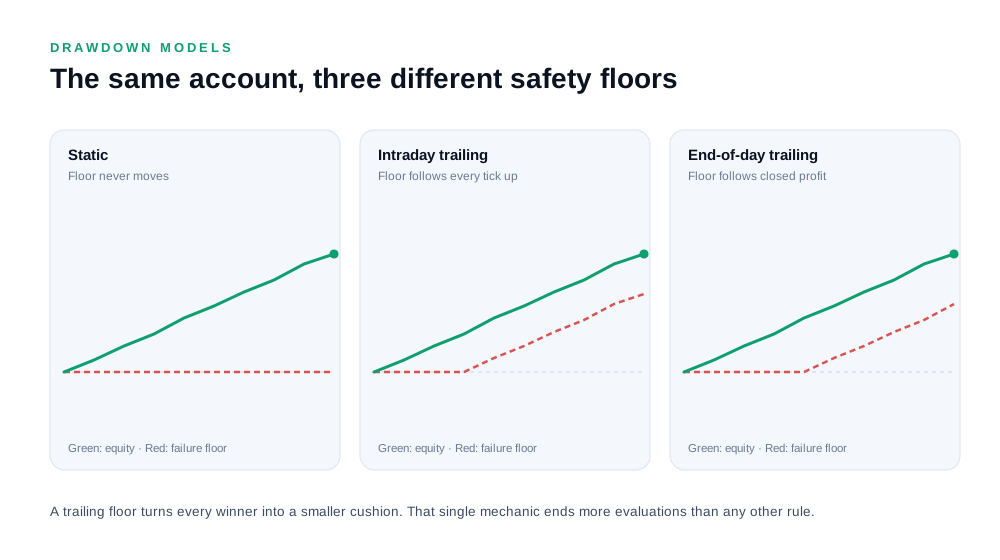
The practical consequence is a change in how winners are handled rather than in how positions are opened. On a static floor, a profitable position can be left to run with the plan's ordinary tolerance. On an intraday trailing floor, the plan needs an explicit exit rule for winners — a stop moved to breakeven at a stated distance, a partial bank at a second distance, and a time or level limit on the remainder. The trailing drawdown guide sets out the room formula and those exit rules.
Daily limits and sessions
Daily limits appear in both rulebooks, and in both they end more attempts than the maximum loss does — but the arithmetic that makes them binding differs.
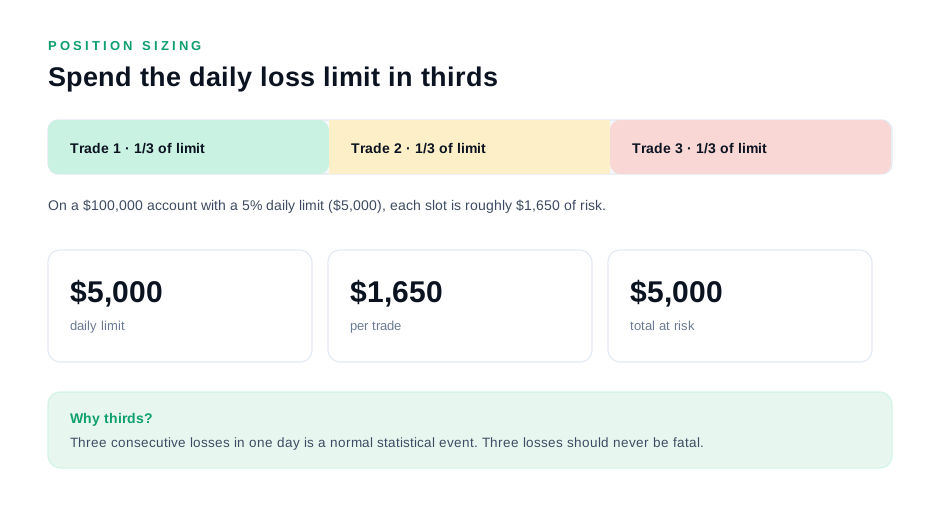
On the percentage side, the daily limit is a percentage of balance or equity, and the calculation is a division: limit divided by risk per trade gives the number of losses a session absorbs. Four to six is a workable design target. Below four, the session is decided by its first trades; above six, risk per trade is so small relative to the day that the calendar stretches.
On the dollar side, the same division applies with dollars in both terms, but the result is more sensitive to the quantisation problem. If rounding leaves the plan trading a size that puts 75% of the intended risk on each trade, the session capacity is unaffected; if a trader rounds up instead — three contracts rather than two, at $300 each — the session capacity falls by a third and the daily limit starts firing on ordinary variance.
Session structure differs too. Currency pairs trade continuously from the Sunday open to the Friday close, with liquidity concentrated at the London and New York overlaps. Futures contracts have defined sessions with a settlement window, and index futures have a cash session that concentrates the volatility into a few hours. A plan built for a currency pair's overnight drift does not transfer to an index future's opening range, and the daily limit's day boundary sits in a different place for each.
Establishing the server day boundary is a five-minute check that prevents a class of avoidable failures on both rulebooks. The daily drawdown guide covers the reference-point and boundary arithmetic, including the difference between a limit measured on balance and one measured on equity.
Cost structure and the calendar
Total cost to funding looks different in the two categories, and the difference is driven by how the accounts are priced rather than by the size of the numbers.
Percentage-rulebook evaluations are commonly sold as a one-off fee with a reset policy, which makes a long calendar cheap in fee terms but still exposed to platform and data subscriptions. Contract-rulebook evaluations are frequently sold on a monthly basis, which makes the calendar a direct and recurring cost: a four-month attempt on a monthly plan costs four times the advertised figure.
Commission is the second structural difference. Futures account for their transaction costs per contract per round turn, so an active plan pays in proportion to its trade count, and on a sixty-session attempt the commissions can exceed the evaluation fee. Currency pairs are typically spread-based with commission on some account types, which shifts the cost into the spread — visible on every trade rather than invoiced monthly.
Both categories carry a data or platform cost of some kind. The practical comparison is total cost over the calendar the plan actually needs, which is why the calendar calculation belongs in the purchase decision rather than after it. The profit calculator and the risk calculator between them produce the calendar, the break-even and the size that make the comparison concrete.
Consistency and payouts
Payout conditions are set independently of evaluation rules on both sides, and both categories use the same three instruments: a minimum number of profitable days, a profit threshold, and a consistency ratio that caps a single day's share of the withdrawn profit.
The arithmetic is identical across categories: if the best day may be no more than a stated share, total profit must reach the largest day divided by that share. Under a one-third rule, a $2,000 best day requires $6,000 of total profit before a full withdrawal; under a one-fifth rule, $10,000. The practical response is the same on both — set a daily profit cap below the permitted share from the first funded session — and it is the single most transferable habit between the two rulebooks.

Two differences are worth naming. Futures accounts sometimes apply an end-of-day settlement convention to profit recognition, which shifts the timing of when a gain counts, and evaluations sometimes carry a maximum-day rule in absolute dollars as well as a ratio. Percentage rulebooks more often apply the ratio as a share of the target rather than of the withdrawn amount, which makes it a pass condition rather than a payout condition — a materially harder version of the same rule. The consistency guide covers each variant, and the payout process guide covers the sequence from pass to payment.
The same strategy, sized for both
The method that resolves the comparison is to size one strategy against both rulebooks and compare the outputs. Three numbers matter: the effective risk per trade as a percentage, the survivable streak, and the calendar in weeks.
The strategy. A single setup, one position at a time, a stop of 30 ticks or the pip equivalent, two setups a session, five sessions a week, a measured win rate in the forties and a reward-to-risk ratio of 1:2.
Percentage rulebook. Maximum loss 10% of a $100,000 balance, daily limit 5%, target 8%. Money at risk per trade is $1,000 before the reserve; with the reserve, $750. The stop's cost per lot is scale-dependent, but the resulting position is fractional, so the plan trades at 0.75% risk per trade and the survivable streak is thirteen losses. Expectation per trade is 0.45 × 1,500 − 0.55 × 750 = $262, so the $8,000 target needs 31 trades and the calendar is about three weeks.
Contract rulebook. Maximum loss $8,000 on a $50,000 account with a daily limit of $2,500 and a target of $3,000. Money at risk per trade is $800 before the reserve, $600 after. At $10 per tick and a 30-tick stop, the cost per contract is $300, so two contracts risk $600 — exactly on budget — and the survivable streak is thirteen losses. Expectation per trade is 0.45 × 1,200 − 0.55 × 600 = $210, so the $3,000 target needs 15 trades and the calendar is under two weeks.
The comparison. Both accounts produce the same survivable streak, so the risk profiles are comparable; the contract rulebook has the shorter calendar and the lower dollar target, and the percentage rulebook has the larger account and the scale-free plan. The choice then comes down to instrument and schedule rather than to safety, which is the correct place for it to land — the Apex versus Topstep page applies the same method within the contract category, and the E8 versus FundedNext page applies it within the percentage category.
Which suits which trader
Four profiles, and the recommendation in each follows from the mechanics rather than from a preference.
A trader with a currency-pair edge and a part-time schedule. The percentage rulebook fits, because the plan is scale-free, fractional sizing lets the risk track the stop precisely, and the 24-hour session means the trading window is a choice rather than a constraint.
A trader who already reads index futures intraday. The contract rulebook fits, because the instrument and the session are already understood, and the sizing calculation becomes a one-line derivation rather than a translation.
A trader who holds positions for days or weeks. A static or end-of-day drawdown is essential, which puts most trailing futures accounts out of scope. A percentage account with a static floor, or a futures firm with an end-of-day mechanism and a lock-in clause, are the candidates.
A trader whose plan has a wide stop relative to the account. Neither rulebook fits at a small size unless micro contracts or fractional lots are available, because the derived size rounds to zero. The honest response is a smaller contract size or a larger account, not a wider stop or a smaller tolerance.
Where the evaluation is going to be traded on the trader's behalf, the category matters for a different reason: the firm's third-party clause. Whether assistance is permitted, separately for the evaluation and the funded account, decides availability. ElitePropX charges a flat $220 per evaluation at any stage and size across both categories, covers retries, takes no profit split, and works with any firm, telling you in writing what that firm’s third-party trading clause says before you pay. The passing services guide covers what to require from any provider, the service review shows how providers are compared, and the client feedback page collects what buyers report.
Switching categories, and what does not transfer
Traders move between the two categories regularly, usually after a failed attempt, and the moves fail for predictable reasons.
What transfers: the discipline of deriving size from the rules rather than from preference; the daily-cap habit that satisfies a consistency rule; the practice of recomputing size whenever the room changes; and the arithmetic itself, which is a division in both models. Those are the parts of an evaluation that are genuinely portable.
What does not transfer: the position sizing, because lots and contracts do not convert; the session plan, because currency liquidity and index futures volatility peak at different hours; the exit rules, because a trailing floor demands faster profit-taking than a static one; and the cost model, because commissions scale with contracts while spreads scale with volume and instrument.
The most common failure of a category switch is a trader who keeps the old size in the new units. A 1% risk on a $100,000 percentage account and a two-contract position on a futures account can look similar in dollars and be very different in survival terms, once tick values, the daily limit and the floor mechanism are applied. The size must be re-derived, not converted.
The second most common failure is the exit rule. A trader arriving from a static-drawdown account has usually never needed a rule for banking profit on a winner, because leaving it running cost nothing. On a trailing account it costs room, and the absence of that rule is the most frequently cited cause of a breach from a profitable position. The post-pass guide makes the same point for the funded month, where the drawdown is usually tighter again.
What to verify in either rulebook
Eight checks, run against the current terms of whichever firm is under consideration. They apply to both categories and reduce the comparison to numbers.
One: the maximum loss, and whether the floor is static, end-of-day trailing or intraday trailing, measured on balance or equity.
Two: the daily limit, its reference point, and the exact server hours of the trading day.
Four: minimum trading days per stage and at payout.
Six: the instrument list, the contract sizes available, and any lot or contract cap.
Seven: the funded drawdown, payout threshold, split, payment interval and verification requirements.
Eight: total cost to funding — fee, platform, data, activation and reset — divided by the calendar the plan needs.
Keep the answers for each candidate side by side, then run the sizing method from the worked example against each. The rules matrix collects those fields across firms, the 2026 comparison covers the wider market, and the futures firm guide applies the criteria to the contract side specifically. Where a clause is ambiguous, a written answer from support is the only version that can be relied on later — and the contact page is the place to ask what a specific account size would require before committing to an attempt.
What both rulebooks require of the trader
After the units, the mechanisms and the payout conditions have been compared, four requirements turn out to be identical on both sides of the divide. They are worth stating because they are the parts of an evaluation that no firm choice can change.
Size derived from the rules, not from preference. On both rulebooks the position size is a quotient: the money the account can lose divided by the cost of the stop. A trader who begins with a preferred size and looks for an account that tolerates it has the calculation backwards, and the market will demonstrate that at the least convenient moment.
A streak tolerance chosen before the account is bought. Eight to ten consecutive losses is the design case on either side, because a win rate in the forties produces runs of that length within a few hundred trades. The number is a property of the plan; the account size that satisfies it is the consequence.
A daily profit cap as well as a daily loss limit. The consistency rule appears in both categories, and it penalises a single dominant day whether the profit is measured in percentages or in dollars. A cap set below the permitted share satisfies the rule from the first session rather than at the withdrawal request — and on a trailing account it limits the rise of the floor at the same time.
A review that is scheduled rather than triggered. Four numbers, weekly: trades taken, expectation per trade, worst drawdown, distance to target. Both rulebooks punish drift in the same way, by letting a plan that was correct at the start quietly become oversized, and a weekly review is the only reliable way to catch it before the account does.
Those four requirements are the transferable part of everything above. A trader who satisfies them can move between a percentage rulebook and a contract rulebook without relearning the discipline — only the units change, and the units are a conversion rather than a skill.
Frequently asked questions
Is FTMO or Apex better?
They are not competing products. FTMO's rulebook is percentage-based on currency pairs and indices with fractional lot sizing; Apex's is dollar-based on futures contracts with whole-contract sizing. Choose by the instrument you actually trade and by whether your plan needs fractional sizing.
Can I trade the same strategy on both?
The logic transfers, the sizing does not. Position size must be re-derived for each rulebook because lots and contracts do not convert, and the exit rules have to change if one account has a trailing floor and the other does not.
Why are trailing drawdowns more common on futures?
The contract-based rulebook is usually built around a dollar floor that follows account equity, and payouts are settled against it. Percentage rulebooks in the forex category more often use a static floor. Verify the mechanism in each set of terms rather than assuming.
How do I size a position on a futures account?
Divide the maximum dollar loss by the streak tolerance, then divide by the tick value multiplied by the stop distance in ticks, and round down. If the result is zero, use a micro contract or a larger account — a wider stop is not the fix.
How do I size a position on a percentage account?
Divide the maximum loss percentage by the streak tolerance to get risk per trade, then divide by the stop in pips and the pip value per lot. The result is fractional, so rounding error is small — but always round down.
Which category has the cheaper evaluation?
Contract-based evaluations are often cheaper at signup, and percentage-based ones are often one-off rather than monthly. Compare total cost to funding over the calendar your plan actually needs, including platform, data, activation and reset charges.
Do micro contracts make a futures evaluation easier?
They make it possible at a small size. A micro keeps the strategy's stop distance while cutting the dollar risk by roughly an order of magnitude, which is often the difference between a derived size of zero and a derived size of several contracts.
Does a daily loss limit exist on both rulebooks?
Usually yes, though the reference point differs — percentage of balance or equity on one side, a dollar amount on the other. Derive risk per trade from the daily limit as well as the maximum loss, and use the smaller result.
What changes for the funded account in each category?
Both tighten the drawdown and add payout conditions: minimum profitable days, a profit threshold, a consistency ratio and verification. Futures accounts may also settle profit at the end of the day. Read the funded terms before paying the evaluation fee.
Can I hold positions overnight on either?
Often yes with conditions — reduced size, restrictions around certain events, and a daily limit that resets on server time. On a trailing account the cost of a gap is higher, because it consumes room that subsequent profit cannot restore.
Does a passing service work in both categories?
Only where the firm's terms permit third-party trading, confirmed separately for the evaluation and the funded account. ElitePropX charges a flat $220 per evaluation at any stage and size, covers retries, takes no profit split, and works with any firm, telling you in writing what that firm’s third-party trading clause says before you pay.
Which is quicker to pass?
It depends on the target-to-loss ratio and the calendar each implies, not on the category. Run the sizing and calendar calculations for both and compare weeks. A shorter calendar reduces the sessions exposed to variance, which is a genuine difficulty difference.
Want the evaluation traded for you?
Related reading
- How much money you need for micro futures
- Trailing drawdown maths
- Passing a Topstep combine
- How to pass an FTMO challenge, step by step
- The two rulebook models compared
- Profit, payout and break-even calculator
- Passed challenges and certificates
- Frequently asked questions
FTMO and Apex Trader Funding are named for identification only. ElitePropX is an independent service and is not affiliated with, endorsed by or sponsored by any proprietary trading firm. Targets, drawdown mechanisms and payout terms change; verify them against the firms' current terms. Trading involves substantial risk of loss.