
Firm guide · reviewed October 2026
Top prop trading firms in 2026
There is no single best prop firm, only a best fit for a style, a budget and a rulebook tolerance. This guide explains what "best" has to mean for you, how to compare firms whose marketing looks identical, and how to run the comparison in an afternoon.
Key takeaways
- Difficulty is set by three mechanics: whether the maximum loss trails, how the daily limit is measured, and what happens at payout.
- For a first account, a static drawdown and no payout consistency rule beat a lower fee every time.
- Payout reliability matters as much as difficulty and is judged separately — from the terms, not the testimonials.
- Account size is the last decision, not the first: percentage rules are identical at every size.
Contents
What "best" can actually mean
Any page ranking prop firms is doing one of two things: selling referrals, or describing its own preferences. Neither is a ranking, because there is nothing to rank on. Firms differ in rulebooks, payout speed and reliability, and those three dimensions point in different directions for different traders.
The useful reframing is that a firm is a set of constraints, and the best firm is the one whose constraints your trading style can satisfy repeatedly without changing what you do. A scalper with tight exits can survive an intraday trailing drawdown that would ruin a swing trader. A swing trader can thrive on a static drawdown that bores a scalper to the point of over-trading. Neither firm is better; one of them fits.
The three questions that replace a ranking
First, can I reach the target on this rulebook without breaching a limit? Second, will the payout arrive when the rules say it should? Third, can I afford to fail here, including the firm's own reset terms? A firm that answers yes, yes and yes is the best firm for that trader, whatever any comparison table says.
Where the marketing misleads
Firms advertise account size and fee, because those are the two numbers that can be compared without reading anything. They under-emphasise drawdown mechanics and payout conditions, which are the two numbers that decide outcomes. A buyer who has learned to look at the second pair can compare firms that market themselves as incomparable.
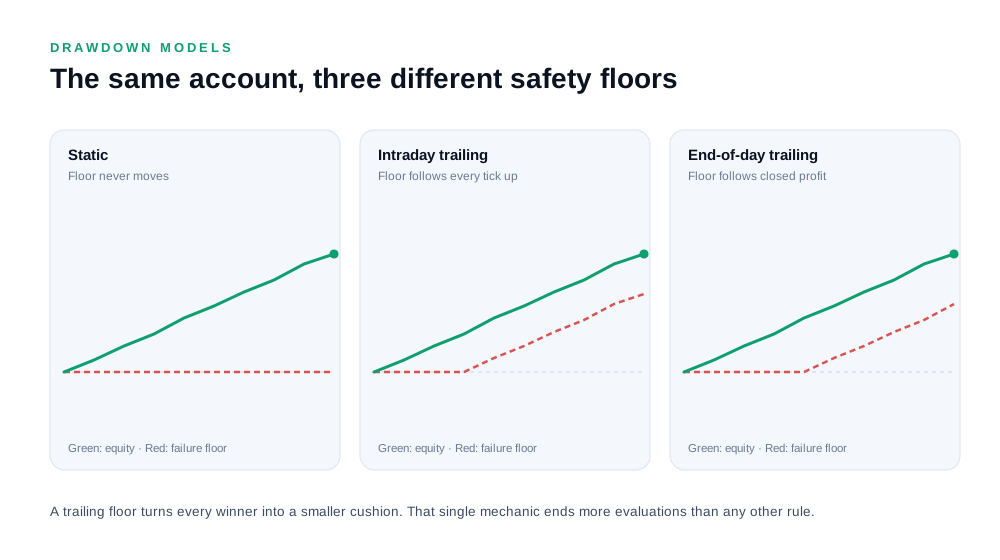
The three mechanics that decide difficulty
| Mechanic | Forgiving | Strict | What it does to a plan |
|---|---|---|---|
| Maximum loss | Static from starting balance | Trailing peak equity, intraday | Whether size can stay constant |
| Daily loss | Closed balance only | Equity including floating | How much room a position has to breathe |
| Consistency | None at evaluation or payout | Best day capped at payout | Whether distribution matters as much as total |
Mechanic one: does the maximum loss trail?
A static maximum loss sits at a fixed level — on a $100,000 account with a 10% limit, the failure line is $90,000 and never moves. A trailing maximum loss follows peak equity, so profit reduces the room available rather than increasing it. On an intraday trailing model, an unrealised gain that comes back to entry still leaves the failure line higher than it was, which charges the trader twice for the same movement.
This single difference changes what a trader can do. On a static account, size can stay constant from the first trade to the last. On a trailing account, size must shrink as equity rises, because the room for a normal losing sequence is shrinking at the same time as confidence is rising. Traders who fail trailing accounts almost always fail by ignoring that second half.
Mechanic two: how is the daily limit measured?
A daily limit measured on closed balance allows a position to move against you intraday without a breach, as long as it recovers or is closed inside the limit. A limit measured on equity including floating positions counts the worst moment of the day, which is a stricter and more common rule. The practical effect is on stop placement and position size, not on strategy: a trader on the equity version needs the eighty-percent stop, and a trader on the balance version can afford to be less precise.
Mechanic three: what happens at payout?
Consistency rules live at payout rather than at evaluation at most firms, and they are the most common reason a profitable account cannot withdraw. A 30% best-day rule means the best session cannot exceed 30% of total profit at the moment of the request. An account at target with one dominant day is not a failed evaluation; it is a delayed payout, and the delay is planned for or suffered.
Firm types, and who each suits
Firms cluster into recognisable types once mechanics are used as the organising principle rather than brand.
Type one: static drawdown, no consistency rule
Usually forex and CFD firms. The most forgiving structure available: a trader can hold size constant, can give back an unrealised gain without the floor moving, and can reach a payout without worrying about the distribution of profit. This is the correct first firm for almost everyone, at a slightly higher fee than the alternatives.
Type two: trailing drawdown, consistency at payout
Usually futures firms. Harder in two ways at once, and popular because account sizes and payout ceilings are attractive. Suited to traders with tight exits and genuinely small best days — scalpers, mostly — and to traders who can plan a distribution deliberately rather than accidentally.
Type three: instant funding, stricter payout terms
Skips the evaluation and charges more for it, with a first-payout condition that is often heavier than the evaluation it replaced. Sensible for a trader who has already passed evaluations and whose constraint is time; a poor first purchase, because the evaluation phase is where the routine is built.
Type four: subscription or scaling plans
Cheap per month and expensive over a year, with terms that reward duration. The payout schedule decides whether it is worth it: a firm that pays frequently on a subscription model can be good value, and one that pays monthly on a slow process usually is not.

Payout terms: the second half of the decision
Difficulty decides whether an account is passable. Payout terms decide whether passing it was worth anything. Three conditions do most of the work.
Profit threshold and day count
Most funded programs require a profit threshold plus a minimum number of trading days before the first withdrawal. The efficient plan lands both on the same date; the inefficient plan reaches the threshold in week one and waits three weeks for the calendar, trading the whole time with a live floor.
The consistency ratio
Where it exists, compute the gap before requesting: required total profit equals best day divided by the threshold percentage. If the account shows less than that, the request will be refused, and the fix is small ordinary profit rather than a second large session.
Processing and method
On-demand withdrawals are worth more than a marginally higher profit split, because money that can be requested is money that can be banked. Monthly windows, name-matching requirements and slow processing all delay the only event that proves the arrangement works.
What to ask about payouts before buying
Ask for the last three payout dates the firm processed for accounts of the size you are considering. A firm that cannot answer is not necessarily unreliable; a firm that answers with a specific pattern has told you something concrete about how it operates when money is due.
Comparing two firms in ten minutes
The comparison below uses two fictionalised firms with realistic structures. The point is the method, which works on any pair.
Firm A offers a $100,000 account for $540 with a 10% target, a 5% daily limit measured on equity, a static 10% maximum loss and no consistency rule. Firm B offers $100,000 for $450 with an 8% target, a 5% daily limit, an intraday trailing maximum loss and a 30% best-day rule at payout.
Step one: convert the limits into losses
At 1.5% risk per trade — $1,500 — firm A's daily limit allows three losses and its maximum loss allows six and a half. Firm B's daily limit is identical, and its maximum loss starts at six and a half losses but shrinks with every new equity high: at 3% profit the room is closer to five losses, at 6% profit it is closer to four.
Step two: convert the targets into wins
Firm A needs 6.7 full-risk wins; firm B needs 5.3. On paper B is faster. Combined with the shrinking tolerance, B is also the account where a normal losing sequence near the target is most likely to end the attempt, which is precisely when a trader is most tempted to hold size.
Step three: apply the payout conditions
A payout requires a distribution under B's 30% rule. A trader with one strong session — common on a small target — must keep trading to dilute it before withdrawing. A has no such condition, so the pass converts to cash sooner even though the target is larger.
Step four: price the failure
B is $90 cheaper and harder. Expected cost is fee divided by pass probability: at 55% on A and 40% on B, that is roughly $980 against $1,125, before counting the reset terms and the extra weeks. A wins on expected cost despite the higher headline price, and it wins by more once the wasted time is priced.
| Firm A | Firm B | |
|---|---|---|
| Fee | $540 | $450 |
| Target | 10% (6.7R) | 8% (5.3R) |
| Tolerance at 6% profit | 6.5 losses | ~4 losses |
| Payout condition | None | 30% best day |
| Expected cost at realistic pass rates | ~$980 | ~$1,125 |
Choosing a first firm, step by step
For a first evaluation the objective is not the best payout ceiling; it is the highest probability of a clean pass followed by a payout. That rules out the harder structures on purpose.
Step one: static or end-of-day drawdown only
Intraday trailing is a mechanic to learn later, ideally once the daily routine is established. A first account should not punish a trader for giving back an unrealised gain, because that is the behaviour every new trader has to unlearn anyway.
Step two: no consistency rule at payout
Consistency rules are manageable and they add a second puzzle to the first. For a first attempt, choose a firm where passing is enough.
Step three: an explicit daily limit that can be tracked
A daily limit measured on equity is fine, and it must be explicit — firms that express the daily limit only through the trailing floor leave a trader guessing about the number that ends a session.
Step four: a payout schedule that is on request
On-demand or frequent payouts matter for a first funded account because the first withdrawal is where the arrangement is proved. Waiting a month to learn whether the pipe works is a slow way to learn it.
Step five: the smallest size with a meaningful payout
Percentage rules are identical at every size, so a larger account buys a bigger ceiling and a bigger bill. Sequence instead: pass one, trade it to a payout, then decide whether a second account adds anything beyond administration.
Step six: read the reset terms before buying, not after failing
The cost of a second attempt is part of the price of the first. Where a service covers retries at the same firm and size — as this one does under a flat $220 — the failure case is bounded and the comparison between two firms becomes a comparison of difficulty rather than of exposure.
Choosing when the evaluation will be traded for you
When the evaluation is not going to be traded by the person paying for it, the selection criteria shift. Difficulty still matters, and two additional questions become decisive.
Question one: does the firm permit third-party trading?
Policies vary and some firms enforce them after funding rather than during the evaluation, which is the worst possible moment for a client. Any provider that treats this as a technicality is transferring its own risk. The honest approach is to ask the firm in writing, keep the reply, and put the answer in front of the client before accepting an assignment.
Question two: whose name is on the funded account?
The account should be issued to the client, with payouts paid directly and no profit split. A provider holding the login or receiving the money introduces counterparty risk at the point where the client has the most to lose, and it creates an incentive to delay that no amount of goodwill fixes.
Which firms suit a managed evaluation
Firms with static or end-of-day drawdowns, clear daily limits and on-request payouts are the best fit, because the plan does not need to change shape as equity moves. Firms with intraday trailing floors are workable but demand a stricter exit discipline, and firms whose terms are ambiguous should be avoided entirely: an unclear rulebook becomes a dispute, and a dispute is the one outcome that costs the client more than a failed attempt.
Red flags in firm marketing
- A headline drawdown with a footnote that changes it. "10% drawdown" plus a trailing clause is a different product from a static 10%.
- No stated daily limit. Expressing the daily limit only through a trailing floor leaves the most important number unstated.
- Payout terms that require a support request to read. Terms that are not published are terms that can change quietly.
- Account sizes that scale faster than payouts. Very large accounts with monthly payout windows and high thresholds are marketing assets, not income.
- Reviews that all appear in one week. Not fraudulent, and not information.
- No published answer on third-party trading. Silence on the question that decides whether a funded account survives.
What a good firm page looks like
It states the target, the daily limit and its measurement point, the maximum loss mechanic and whether it trails, the minimum trading days, the payout conditions and the prohibitions — on one page, without a support ticket. Firms that publish all of that are not automatically better traders' firms, and they are far easier to plan around, which is most of what a trader needs.
Rule changes, and how to plan around them
Firms revise terms. Targets move, drawdown mechanics change, payout windows tighten, and a rulebook read in March can describe a challenge that no longer exists in June. That reality belongs in the selection process rather than in a complaint afterwards.
How to check whether terms have changed
Date the rulebook when you read it, and re-read the objectives and payout pages before starting an attempt rather than before buying one. Two minutes of re-reading catches the most expensive category of surprise: an evaluation planned against mechanics that have moved.
What to do when a change lands mid-attempt
If a target rises or a drawdown becomes stricter mid-evaluation, the plan's arithmetic changes and size must be recalculated rather than assumed. Where the change makes the target unreachable within the original risk budget, the decision is between accepting a longer timeline at reduced size and abandoning the attempt. Both are legitimate; continuing at the old size while hoping the old rules apply is not.
Why this favours firms with published, versioned terms
A firm that publishes its terms and updates them visibly is easier to plan around than one whose conditions surface in support tickets. It is also a reason to prefer firms that state mechanics on the objectives page rather than relying on a help centre article written two years earlier.
Account size, scaling and running more than one
Most firms offer a scaling path — either larger accounts as a trader proves consistent, or the ability to hold several accounts at once. Both are worth reading carefully, because scaling terms determine what a funded account becomes after six months.
Scaling criteria are usually unspecified
Where scaling depends on "consistent performance" without stating a period, a profit level or a maximum drawdown, it is not a criterion; it is a possibility. Ask for the specifics in writing. A firm that can state them has a policy; a firm that cannot has a marketing line.
Multiple accounts multiply correlation, not profit
Three accounts traded with the same setup are one position at three times the size, with three failure thresholds that trip together. If several accounts are running, halve the per-account risk for each additional one so the combined exposure stays near the original figure. Sequencing — pass one, fund it, trade it to a payout, then add — produces a funded portfolio faster than running several evaluations in parallel and splitting attention.
The payout ceiling is rarely the binding constraint
Most traders imagine that a bigger account or more accounts will increase income, and discover that the constraint is the size of the edge rather than the size of the account. A single $50,000 account traded carefully to a monthly payout produces more than five accounts traded carelessly to a single reset.
The one-page selection procedure
- List your style's requirements: static or trailing drawdown, holding period, instrument set.
- Shortlist two or three firms whose published mechanics match.
- Read the payout section and compute the first-withdrawal condition in dollars.
- Convert target and limits into wins required and losses tolerated at your risk per trade.
- Check the reset and retry terms, including any firm charge.
- Confirm the third-party trading policy in writing if the evaluation will be traded for you.
- Choose the smallest size with a meaningful payout, and plan two attempts' worth of budget.
Seven steps, one afternoon, and a decision that can be checked later against the record. That is the closest thing this market offers to a ranking, and it has the advantage of working regardless of which firm is fashionable in a given quarter.
Eight mistakes in firm selection
These recur across every account size and every market, and each has a straightforward fix.
Mistake one: choosing on fee
Fee is the only number that never determines the outcome. A cheaper attempt on a rulebook the strategy cannot survive is the most expensive purchase available.
Mistake two: choosing the largest account
Percentage rules are identical at every size, so a larger account is the same puzzle with a bigger bill. Size is a payout decision, not a difficulty decision.
Mistake three: ignoring the daily limit's measurement point
Equity versus closed balance changes how a position must be managed, and it is the most commonly misread line in a rulebook.
Mistake four: reading the drawdown as a static percentage
"10% drawdown" with a trailing clause is not a 10% static drawdown. The difference shows up in the last third of an evaluation, which is where attempts end.
Mistake five: planning the payout after the pass
Payout conditions should shape the plan from day one, because a distribution requirement is easier to satisfy deliberately than to repair.
Mistake six: running several evaluations at once
Correlated positions with multiple failure thresholds, and divided attention. Sequence instead.
Mistake seven: treating a service as a guarantee
Variance exists. What a service sells is process and enforcement, and the terms that matter are the retry terms rather than the claimed pass rate.
Mistake eight: not asking about third-party policy
Where a firm prohibits the arrangement and enforces it after funding, the client loses the account after the work is done. One email prevents it.
After the decision: what the first month looks like
Once a firm is chosen, the difference between traders who fund accounts and traders who collect resets shows up in the first month, and it has little to do with entries.
Week one is spent establishing the four numbers and trading small — often at half the planned risk — while the routine settles. Week two builds toward the target without letting any single day dominate, which protects the payout ratio later. Week three is where size comes down as the target approaches, because progress reduces the room available for a normal losing sequence on any trailing account. Week four converts the pass into a funded login and, if the dates align, into the first withdrawal request.
That sequence is unglamorous, repeatable and boring, which is exactly why it works and why it is rarely advertised. A firm chosen well and traded this way produces a funded account in three to five weeks. A firm chosen on price and traded on instinct produces a drawer of receipts and an opinion about the industry.
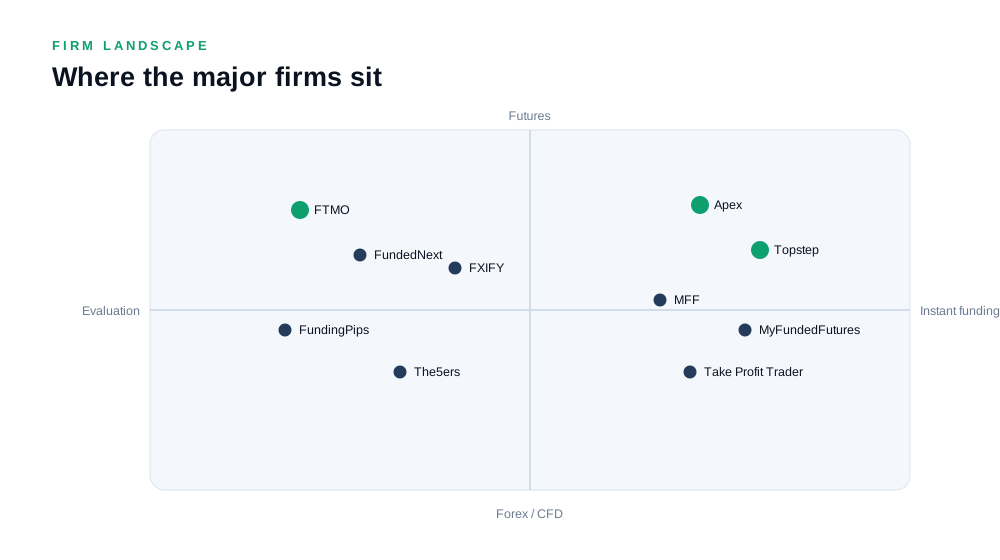
Firm categories in practice
Ten firms is too many to evaluate and three is a shortlist. Categories make the pruning mechanical.
Category one: the forgiving generalist
Static drawdown, equity-based daily limit, no consistency rule, payouts on request, moderate fee. The default recommendation for a first account and for any trader whose strategy involves holding through noise. Its weakness is that payout ceilings are usually modest relative to the futures firms that advertise aggressively.
Category two: the disciplined futures house
Trailing drawdown, dollar-denominated daily limit, 30% consistency rule at payout, larger account sizes. Suited to traders with tight exits and small best days, and to anyone willing to plan profit distribution deliberately. It rewards exit discipline more than analysis.
Category three: the instant product
Higher fee, no evaluation, heavier first-payout conditions. Rational for a trader who has already passed evaluations and whose binding constraint is time. A poor first purchase, because it removes the phase in which the daily routine is built.
Category four: the subscription house
Cheap per month, expensive per year, with terms that reward duration. Only worth it where payouts are frequent and easy to request, because the model's economics point away from the client's interest.
How to use the categories
Decide which category your style fits, then shortlist only within it. A trader who does this before reading any review has already made the decision that most buyers spend a month failing to make, and the remaining questions — which firm in the category, at which size — are comparatively small.
The honest summary
There is no best prop firm in 2026, and any page that produces a single name is answering a different question from the one a trader needs answered. What exists is a set of mechanics, a set of payout terms, and a style — and the selection problem is matching them.
The mechanics that matter most are whether the maximum loss trails and how the daily limit is measured, because those decide whether a plan can stay the same shape for three weeks. The payout terms that matter most are the first-withdrawal conditions, because those decide whether a pass becomes money. Everything else — brand, bonus, community, dashboard polish — is packaging around those two questions.
Where a service is involved, add the two questions that a rulebook cannot answer: does the firm permit third-party trading, and whose name will be on the funded account. At ElitePropX the answer is that any firm can be worked with, that you are told in writing what its third-party clause says and who carries the risk, and that the funded account is issued in the client’s name — for one flat $220, any firm, any account size, with retries on rule breaches covered and no profit split.
If you are still choosing between two firms, send both names. The reply will usually be a recommendation with a reason attached, and the reason is the useful part: it names which rulebook is more forgiving at the size you can afford, which is a question with an answer independent of anyone's opinion about the firms themselves. Ask a candidate provider the same question before you pay them, and the quality of the answer will tell you more than any comparison table on the internet, including this one.
One closing note on timing. Firms change terms, and the comparison that was correct in the spring may be wrong by the autumn, so the seven-step procedure is worth re-running before each purchase rather than once. It takes an afternoon, it costs nothing, and it is the only part of this process that a trader fully controls — the market, the rules and the variance are all outside that boundary, which is exactly why the pieces inside it deserve the attention. Run the seven steps, write the answer down, and keep the dated note with the rulebook it came from, so the next comparison starts from evidence rather than from memory and the second comparison takes ten minutes instead of an afternoon. That is the compounding advantage of writing these things down: the work is done once and used many times, across firms, sizes and market conditions — and once written, the note never has to be reconstructed under time pressure.
Frequently asked about choosing a prop firm
What are the top prop trading firms in 2026?
There is no defensible single answer, which is why this page ranks firms on mechanics rather than on brand. The firms that come out ahead in 2026 for most traders are the ones whose maximum loss is static or measured at end of day, whose daily limit is stated against equity, and whose payout terms do not add a consistency rule after the money is made. Two firms with identical marketing can sit at opposite ends of that list, and the same $100,000 account can be forgiving at one and tight at the other.
Does a refundable challenge fee make a firm cheaper?
Not usually, and the word itself is ambiguous — a cash refund, a fee credit and a free reset are three different products. Most firms that advertise a refundable fee attach conditions that exclude exactly the failures that cost you money. The refund page sets out how to read the clause in two minutes.
What is the best prop firm for a beginner?
One with a static or end-of-day drawdown, an explicit daily limit, no consistency rule at payout, and payouts on request — at the smallest size that still produces a meaningful payout.
Is a cheaper account better value?
Almost never, once expected cost is calculated. A $450 evaluation with a 40% pass rate costs more in expectation than a $540 evaluation at 55%, and it costs more in weeks as well.
Does account size change the difficulty?
No. Percentage rules scale exactly, so a $200,000 account is the same challenge as a $25,000 one with a bigger payout ceiling and a bigger fee.
How do I compare two firms quickly?
Convert both to full-risk losses tolerated and wins required at your risk per trade, then check the payout conditions and the reset terms. The pair of numbers plus the payout rule is the whole comparison.
Are trailing drawdowns always worse?
They are stricter, not worse. Traders with tight exits and small best days handle them well; traders who hold through pullbacks are charged twice and usually fail.
What if my firm bans third-party trading?
You are told in writing before paying what the clause says, and the enforcement risk stays with the account holder. Enforcement after funding is the most expensive outcome available to a client, so the clause is checked first.
What does a passing service cost?
At ElitePropX, one flat $220 for any firm and any account size, with retries on rule breaches covered at the same firm and size, no profit split, and the funded account in your name.
How long should a challenge take?
Two to four weeks at a deliberate pace. Fast passes are a property of the risk taken rather than of the firm's quality.
Where these rules come from
Firm figures on this page are read from the rulebooks below rather than from other comparison sites. Every link was opened and checked on . Firms revise targets and drawdown rules without notice, so confirm the figures on the plan you are buying before paying. How we check firm rules sets out what a checked date means, what we publish when a figure cannot be confirmed, and how corrections are handled.
- FTMO — 2-Step Challenge trading objectives
- FundedNext — CFD trading objectives
- The5ers — High Stakes plan rules
- Apex Trader Funding — EOD evaluation parameters, intraday trailing drawdown, 50% consistency requirement
- Topstep — maximum loss limit, daily loss limit, consistency targets
Any firm, any size, one flat $220
Related reading
- Propfirm passing service: flat $220, any firm
- Passing services compared
- What buyers report: the 2026 service review
- Recently passed evaluations
- Prop firm rules matrix
- The complete guide to passing a challenge
- Start an evaluation for a flat $220
- Alpha Capital Group review
- Best instant funding prop firms 2026
- Best firms for gold
- Prop Firms without Consistency Rule