A forgiving daily drawdown
The daily limit fails more beginners than everything else combined. A 5% daily limit is meaningfully kinder than a 4% one, and both are more forgiving than a futures-style daily loss rule combined with a trailing floor.
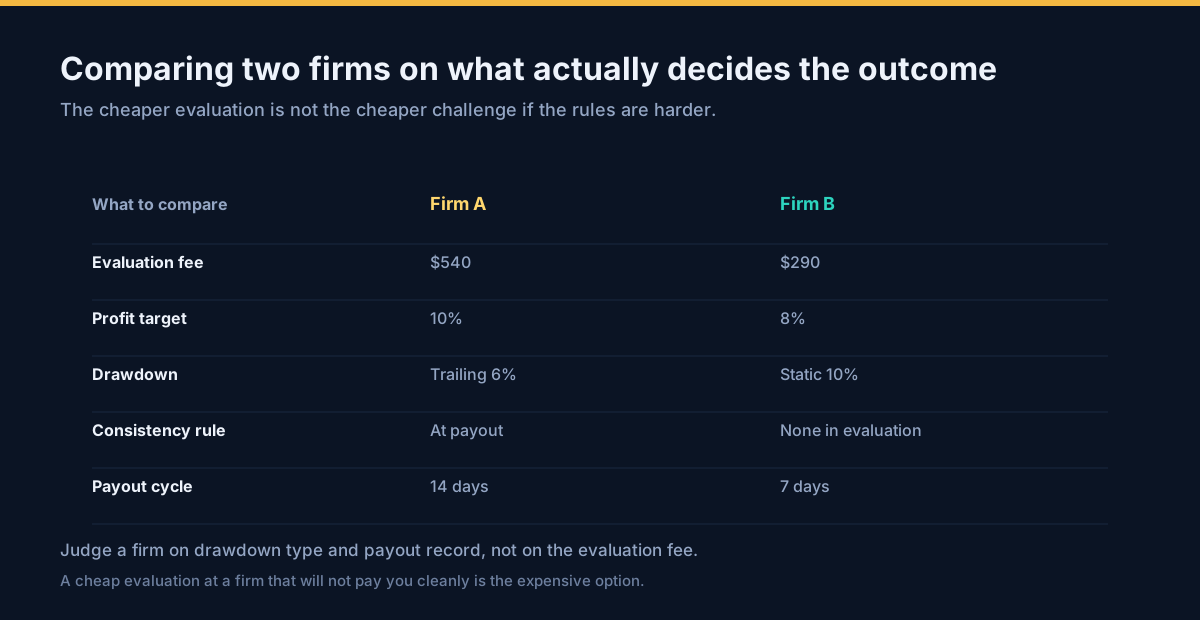
Most "best prop firm for beginners" lists are ranked by affiliate commission. This one is ranked by the only thing that matters when you are starting out: how cheaply and safely you can learn the format. That means small accounts, forgiving rules, low entry costs and firms that actually pay. Here is how to choose your first evaluation so that your money buys education rather than an expensive lesson in hindsight.
When you buy your first challenge, you are not primarily buying a funded account. You are buying information: how you personally behave when a hard daily loss limit applies, whether you can hold a stop, whether you can walk away after two losses. That information is genuinely valuable, and it is the same information regardless of account size.
Which leads to the central principle: your first evaluation should be the cheapest evaluation that uses the same rulebook. A $10,000 two-step challenge teaches exactly the same lesson as a $200,000 one, at a fraction of the cost of getting it wrong. Traders who buy the largest account they can afford are paying a premium for a lesson they have not yet learned.
The daily limit fails more beginners than everything else combined. A 5% daily limit is meaningfully kinder than a 4% one, and both are more forgiving than a futures-style daily loss rule combined with a trailing floor.
A static overall limit does not shrink as you profit. This single difference removes the hardest concept in prop trading and makes learning far more tractable.
Monthly-payment evaluations and small account tiers let you learn for tens of dollars rather than hundreds. Some firms offer trial evaluations outright.
0.01 lots or micro contracts let you take real setups without risking a meaningful fraction of the daily limit.
Check independent reports of withdrawals arriving on time. Marketing is free; a payment history is not.
Rules that change retroactively are a trap. Prefer firms whose terms have been consistent over time.
This is the first structural choice, and it changes what you have to learn.
| Forex / CFD firms | Futures firms | |
|---|---|---|
| Overall drawdown | Usually static | Usually trailing |
| Minimum size | 0.01 lots — very small | Micro contracts (MES, MNQ) |
| Target style | Percentage of account | Fixed dollar amount |
| Extra constraint | Daily loss limit | Daily loss limit + trailing floor |
| Beginner difficulty | Lower | Higher |
The trailing drawdown is the deciding factor. It is conceptually counter-intuitive — profit shrinks your buffer — and beginners routinely lose accounts by not understanding it. If you have never traded an evaluation, a forex firm with a static overall drawdown removes an entire class of mistake while you learn the basics.
Recreate your chosen firm's target, daily limit and minimum days on a demo account. Trade it for a month without paying anything. Most people discover their core problem here — and it is almost always the daily limit.
Several firms offer free or near-free trials. They are the cheapest legitimate way to experience live platform conditions.
Not the largest you can afford — the smallest that lets you take your normal setups. $5,000 or $10,000 is ideal.
Learn the platform's execution, spreads and session behaviour. You cannot fail on size that small, so the first week is free information.
Once you have passed one evaluation and understand the funded-account rules, then consider a larger tier or a second account.
For a first evaluation, it usually does not. The value of a first pass is the skill you build managing the funded account afterwards; outsourcing it leaves you funded but unprepared. We say this even though we sell the service.
Where a service does make sense is later: once you have passed a challenge, understand the format, and want to run several accounts across firms without spending weeks on each evaluation. That is a legitimate efficiency decision rather than a shortcut past learning. Our passing service is a flat $220 per evaluation with retries covered and no profit split; read the honest category review before deciding.
The FAQ block below covers the best beginner firm, how much to risk on a first challenge, whether beginners should use a passing service, the most common mistake, free trials, how long to practise and forex versus futures. Related: the ultimate guide to passing a prop firm challenge and the daily drawdown explainer.
Ask us anything about your firm, your account size or whether a passing service suits you. We answer directly on Telegram — no forms, no queues.
Flat $220 per evaluation — we trade it for you and hand over a funded account. No hidden cuts, no monthly fees. Message us on Telegram and we will answer in minutes.