FTMO Challenge Passing: The Complete Guide
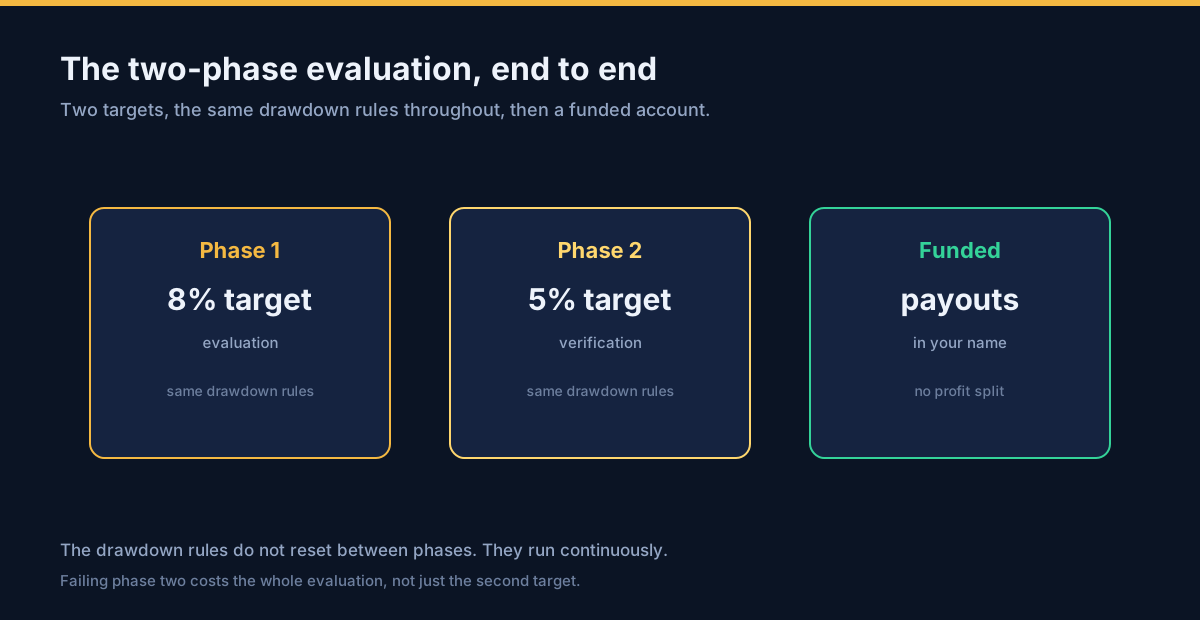
FTMO is the firm most traders attempt first, and the one whose rulebook the rest of the industry copied. Passing it is not primarily a market-analysis problem — it is a risk-budgeting problem, because the 5% daily loss limit is far tighter than the profit target is demanding. This is the full breakdown of how to pass both phases.
Confirm before you trade
FTMO adjusts parameters periodically. The structure below explains how the evaluation behaves and how to pass it. Verify the exact percentages and day counts on your own dashboard.
The two phases
| Phase | Profit target | Max daily loss | Max overall loss | Min days |
|---|---|---|---|---|
| Challenge | ~10% | ~5% | ~10% | ~4 |
| Verification | ~5% | ~5% | ~10% | ~4 |
| Funded | — | ~5% | ~10% | Payout rules apply |
Two facts about this table are more important than the numbers themselves. First, the loss limits do not reset downward with the target — Verification asks for half the profit with the same risk budget, which makes it riskier per unit of profit required. Second, the rules apply afresh in each phase, so passing the Challenge tells you nothing about whether you will pass Verification.
Why the daily loss limit decides everything
The 5% daily limit is measured on equity, including floating losses on open positions. Breach it in a single session and the phase ends immediately, even with substantial overall drawdown remaining.
The classic FTMO failure, in four steps
1. A small loss in the morning. 2. A larger position at lunch to recover it. 3. A second loss. 4. A doubled position into the close to get back to flat. The daily limit is breached and the phase is over. Ninety percent of FTMO failures we review follow some version of this sequence, and every one is preventable with one rule.
The risk budget that prevents it
Cap each trade at one third of the daily allowance. On a $100,000 account that is a $5,000 allowance, so no single trade should risk more than roughly $1,650. Three consecutive losses then leave you approximately $50 inside the limit. You cannot fail from trading too small — only from trading too large on the wrong day.
| Account | Daily allowance (5%) | Max risk per trade (⅓) | Losses absorbed |
|---|---|---|---|
| $10,000 | $500 | $165 | 3 |
| $50,000 | $2,500 | $830 | 3 |
| $100,000 | $5,000 | $1,650 | 3 |
| $200,000 | $10,000 | $3,300 | 3 |
The static drawdown advantage
FTMO's maximum overall loss is generally static relative to the initial balance rather than trailing. This matters more than most guides acknowledge. On a trailing account — the norm at futures firms — your buffer shrinks as you profit, so winning creates new risk. On a static account, profit simply moves you further from the floor, and the account gets easier over time.
That single structural difference is why FTMO is genuinely more approachable than an equivalent futures evaluation, and why traders who struggle with Apex or Topstep often pass FTMO without difficulty. See the futures firms comparison for the contrast.
A phase-by-phase plan
Week 1 — 0.01 lots, calibration only
Learn the platform's execution, spread behaviour and session characteristics. Target a small gain. The purpose of this week is information, and it cannot fail the evaluation.
Weeks 2–3 — steady accumulation
Trade two or three best setups at a size capped at one third of the daily allowance. Target roughly 0.5–0.7% per day and bank gains rather than holding winners.
End of phase — close without drama
As the target approaches, hold sizing constant. Increasing size near the finish is the most common way a nearly complete phase is lost.
Verification — reset, do not accelerate
Same size, same daily ceiling, same daily stop, treated as a brand-new evaluation. This is where complacency costs the most.
Funded — keep the same discipline
The rules largely carry over. Do not scale up immediately; see how to keep your funded account.
What it costs, versus failing repeatedly
| Route | FTMO fees | Service fee | Expected total |
|---|---|---|---|
| Self-traded at ~35% pass rate | ~$900 (2.9 attempts) | $0 | ~$900 |
| Self-traded at ~85% pass rate | ~$365 (1.2 attempts) | $0 | ~$365 |
| ElitePropX flat fee | ~$310 (one evaluation) | $220 | ~$530 |
If you pass FTMO reliably, do it yourself — the service adds nothing. If the daily limit is the recurring blocker, the flat fee is cheaper than continuing to buy attempts at your own failure rate. Run your numbers on the profit calculator.
The risk we will not hide
FTMO's terms of service restrict account sharing and third-party trading. Using a passing service means someone else trades your evaluation, which can breach those terms and, worst case, result in a denied payout or closed account. No service can eliminate that risk. We say so before you pay, not after. Read our account sharing rules page for the full picture, and if strict compliance matters most, pass it yourself using the FTMO passing tips and phase 1 and 2 strategy.
Frequently asked questions
The FAQ block below covers how to pass FTMO, the profit target, the most common failure cause, drawdown type, realistic timelines and whether a service can pass it for you. Related: FTMO challenge rules 2026 and the challenge passing service.
How do you pass the FTMO challenge?
What is the FTMO profit target?
Why do most people fail the FTMO challenge?
Is FTMO's drawdown trailing?
How long does it take to pass FTMO?
Can someone pass the FTMO challenge for me?
Have a question before you commit?
Ask us anything about your firm, your account size or whether a passing service suits you. We answer directly on Telegram — no forms, no queues.
Ready to pass your prop firm challenge?
Flat $220 per evaluation — we trade it for you and hand over a funded account. No hidden cuts, no monthly fees. Message us on Telegram and we will answer in minutes.