The Prop Firm Consistency Rule, Explained
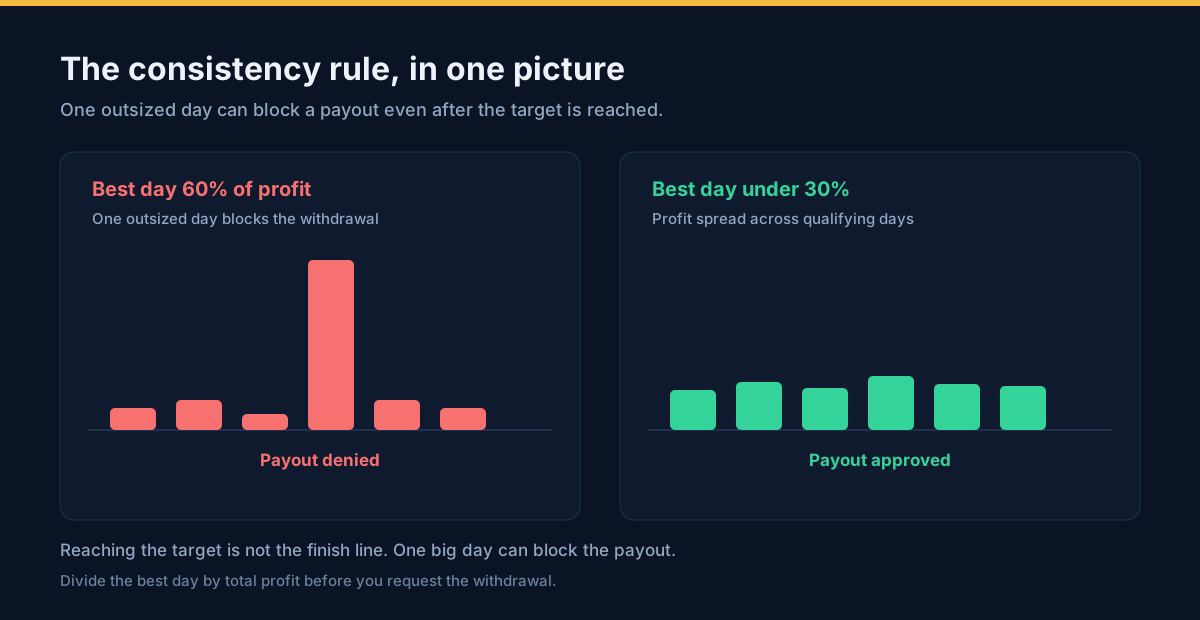
The consistency rule is the least understood and most expensive rule in prop trading. Traders spend weeks carefully passing an evaluation, reach the profit target, request a payout — and discover that a single great day has locked their own money behind a rule they never read. This guide explains the maths, and how to stay on the right side of it.
What the consistency rule says
In its standard form, the consistency rule states that no single trading day may account for more than a set percentage of your total profits. The percentage varies by firm — 30% and 40% are the most common — and sometimes the rule applies only at payout rather than during the evaluation.
Read it again slowly, because the wording trips people up. The rule does not limit how much you can make in a day in absolute terms. It limits how much that day can represent of everything you have made so far. That means the constraint is not on the size of the day but on its proportion — and you can fix a violation by making the other days bigger, but not by making the big day bigger.
A worked example
Suppose a firm applies a 30% consistency rule. You pass a $100k evaluation with the following days:
| Trading day | Profit | Running total | Best day as % of total |
|---|---|---|---|
| Day 1 | $800 | $800 | 100% |
| Day 2 | $1,100 | $1,900 | 58% |
| Day 3 | $6,000 | $7,900 | 76% ❌ |
| Day 4 | $900 | $8,800 | 68% ❌ |
| Day 5 | $1,200 | $10,000 | 60% ❌ |
On day 3 you had a spectacular session and hit the profit target. But that $6,000 day is 76% of your profit — far above the 30% cap. Even after two more decent days you are still at 60%, so the payout is blocked. To satisfy a 30% rule with a $6,000 best day, your total profit must reach at least $20,000 — meaning you need another $10,000 of ordinary, well-spread gains before you can withdraw the first dollar.
The counter-intuitive lesson
The fastest route to a payout is a flat, boring grind of comparable winning days — not one brilliant session. A huge day does not accelerate your payout; it delays it.
Why firms use it
The rule is not arbitrary. Prop firms are effectively paying a salary against a trader's edge, and they need some filter for "would this person make money again next month?". A trader whose entire record is one lucky gap trade is a liability; a trader who grinds out 15 modestly profitable days is clearly repeatable. The consistency rule is the firm's proxy for repeatability.
There is also a self-interested layer. A firm with an unlimited ability to pay can use the rule to make withdrawals harder, retaining more revenue. That is a legitimate criticism, and it is one reason to choose firms with published, stable consistency thresholds rather than firms that change them between payout requests.
How to trade in a consistency-safe way
Set a daily profit ceiling, not just a loss limit
Most traders plan their maximum loss. Very few plan a maximum win. On a consistency-constrained account, stopping when you reach a modest daily target protects your payout eligibility.
Bank comparable amounts daily
Aim for winning days of a similar size — for example, roughly 1–2% of the account each. Even distribution is the whole point.
Never let one day dominate
If you have an unexpectedly large day, treat it as a liability to be diluted, not a win to celebrate. Add ordinary days until the percentage falls under the cap.
Check the percentage before requesting
Before submitting a withdrawal, run the maths: best day ÷ total profit × 100. If it is over the firm's limit, keep trading.
Know whether the rule applies during or after the evaluation
Some firms enforce it only at payout, which changes your strategy. Confirm which applies to your account.
How firms apply it differently
| Firm type | Typical consistency treatment | Practical effect |
|---|---|---|
| Futures firms (Apex, Topstep) | Usually enforced at payout, commonly ~30% | You can hit target fast, but payouts may be delayed |
| Forex firms (FTMO, FundedNext) | Often no consistency test, or a mild one | Fewer payout surprises, but other rules bite |
| Strict/alternative firms | Sometimes 40%+ or tested during evaluation | Requires a patient, evenly paced approach |
Because the specifics vary so much, the only safe rule is to read your own firm's terms and confirm the current threshold on your dashboard. Our guide to the challenge rules that matter covers how the consistency rule interacts with drawdown and payout rules.
Consistency during the evaluation vs at payout
Some firms enforce consistency only when you withdraw; others apply it to the pass itself. That distinction changes your strategy. If the rule applies to the evaluation, you must reach the target evenly from the start. If it applies only to payouts, you can pass however you like but must trade the funded account evenly before withdrawing. Always confirm which applies to your firm — it is the single most common expensive misunderstanding in funded trading.
The rule and our passing service
A significant share of our clients come to us specifically because the consistency rule has cost them a payout they had already earned. When we pass an evaluation, we trade it in a deliberately evenly distributed way, so that the account is not just at target but payout-ready — satisfying the consistency test at the moment the target is hit. That is a meaningfully different objective from simply reaching a number, and it is core to how we work. See the passing service page for details.
Frequently asked questions
The FAQ block below covers the definition, the calculation, why thresholds differ between firms, and whether your profit is lost when the rule blocks a withdrawal (it is not — it is gated, not confiscated). For the next step after passing, see the funded account payout process.
What is the prop firm consistency rule?
Why do prop firms have a consistency rule?
How do I calculate my consistency percentage?
Does making more money on a big day ever help?
Do all prop firms use the same consistency threshold?
Can I withdraw if I fail the consistency rule?
Have a question before you commit?
Ask us anything about your firm, your account size or whether a passing service suits you. We answer directly on Telegram — no forms, no queues.
Ready to pass your prop firm challenge?
Flat $220 per evaluation — we trade it for you and hand over a funded account. No hidden cuts, no monthly fees. Message us on Telegram and we will answer in minutes.