
Reviewed · how we check firm rules
Evaluation service · reviewed October 2026
What the flat fee covers, phase by phase
Firms differ far less than their marketing suggests. Almost every evaluation is one of four rulebook families, and once a plan is written for a family, the numbers change between firms but the method does not. That is what makes a flat fee possible. This page sets out how the service adapts to each family, what the terms check covers before any payment, how the handover works, and what the funded stage asks of the account holder afterwards. One flat $220 for any firm and any account size, retries covered while the evaluation runs, no profit split.
Key takeaways
- Evaluations cluster into four families: static drawdown, trailing drawdown, staged targets and instant funding. The family decides the plan; the firm decides the numbers.
- A trailing floor requires size to fall as progress accumulates; a static floor does not. That single difference changes the whole risk plan.
- The terms check happens before payment and covers the evaluation and the funded account separately.
- A pass typically runs one to five weeks depending on the family, the target and the minimum day count.
- The service covers the evaluation only. The funded account keeps its own thresholds and belongs to the client.
- Flat $220 at any firm, retries covered, no profit share, and a written refusal where the firm's terms forbid the arrangement.
Contents
The four rulebook families
Firms market themselves as unique, and the flourishes are real — different platform, different fee curve, different customer service. The failure mechanics are not unique. Nearly every evaluation sold today belongs to one of four families, and identifying the family is the first step in any plan.
Static drawdown. The failure floor is fixed, usually as a percentage of the starting balance. Profit does not move it, so the account becomes safer as it succeeds. This is the most forgiving structure and the one that permits constant position size from first session to last.
Trailing drawdown. The floor rises with equity and never falls. Where it trails on closed profit, the risk is that progress reduces the cushion. Where it trails on unrealised profit, a winner that retraces has already consumed room. This is the strictest family and the one that punishes otherwise good trading.
Staged targets. Two or more phases, each with its own target and minimum day count. The mechanic is not the drawdown but the calendar: the evaluation has to be completed across checkpoints, and each phase is an opportunity to breach a conduct rule.
Instant funding. No evaluation; the account is funded immediately, and the conditions that would have been an evaluation are attached to the payout instead. The trade-off is usually a smaller initial balance, a longer path to a first withdrawal, or a fee structure that recovers the cost across more accounts.
| Family | Failure floor | Effect of profit | Planning consequence |
|---|---|---|---|
| Static drawdown | Fixed at a starting balance | Account gets safer | Constant size; concentrate on the target |
| Trailing, closed profit | Rises with the close | Cushion shrinks in dollars | Size ladder down as completion rises |
| Trailing, unrealised | Rises with the peak | A retracement spends room | Cut winners early; reduce size after any good session |
| Staged targets | Per phase | Checkpoint at handover | Pace backwards from day counts |
| Instant funding | On the funded account | Payout gated, not pass gated | Plan the payout conditions before the first trade |
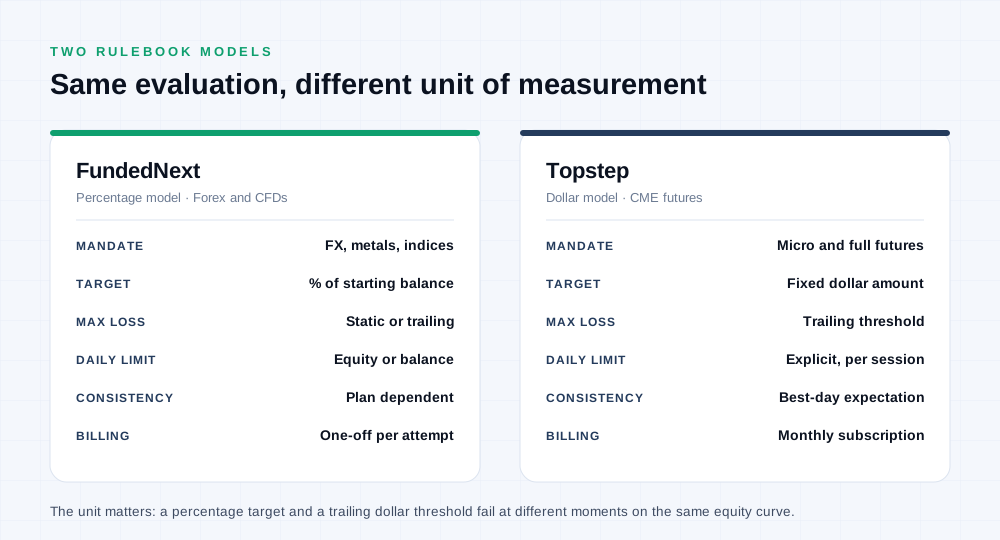
Two clarifications save a lot of confusion. First, families combine: a staged evaluation with a trailing floor is common, and then both the calendar and the cushion have to be managed. Second, the basis of a percentage rule matters as much as the percentage, because a limit measured from the current balance behaves differently from one measured from the starting balance once the account moves. Both questions belong in the first two minutes of reading any terms page.
How the plan adapts to each
The plan is written from the family rather than from the firm, and four numbers carry across every family: risk per trade, the daily stop, the daily profit cap and the weekly pause. What changes between families is the size ladder and the pace.
On a static drawdown evaluation, the ladder is flat. Risk per trade is set at a third of the daily limit and stays there. The pace is the target divided by the sessions available, and if that consumes more than a fifth of the daily budget, the schedule is extended rather than the size increased. There is no reason to reduce size near the target, because progress does not make the account fragile.
On a trailing evaluation, the ladder steps down. Full size to roughly 40% of the target, three quarters from 40% to 70%, and half beyond 70%. The reason is ratio arithmetic: as completion rises, the gain at risk grows while the buffer shrinks, so the trade that produced the first 70% is not the trade to take at 70%. On a floor that trails unrealised profit, there is a fifth rule: winners are cut at a target rather than ridden, because an excursion that retraces has already moved the floor.
On a staged evaluation, the pace is planned backwards from the day counts rather than forwards from the target. The risk per trade stays at a third of the daily limit throughout, and the numbers are recomputed at the handover against the new balance. The critical discipline is refusing to increase size at a phase boundary: finishing phase one proves the plan works at that size, not that the size was too small.
On an instant funding account, there is no evaluation to pass, so the work is the payout plan. The threshold, the minimum qualifying days and the consistency condition are the constraints from day one, and the daily profit cap is set at a fraction of the threshold so that the payout gate is satisfied by construction rather than repaired later.
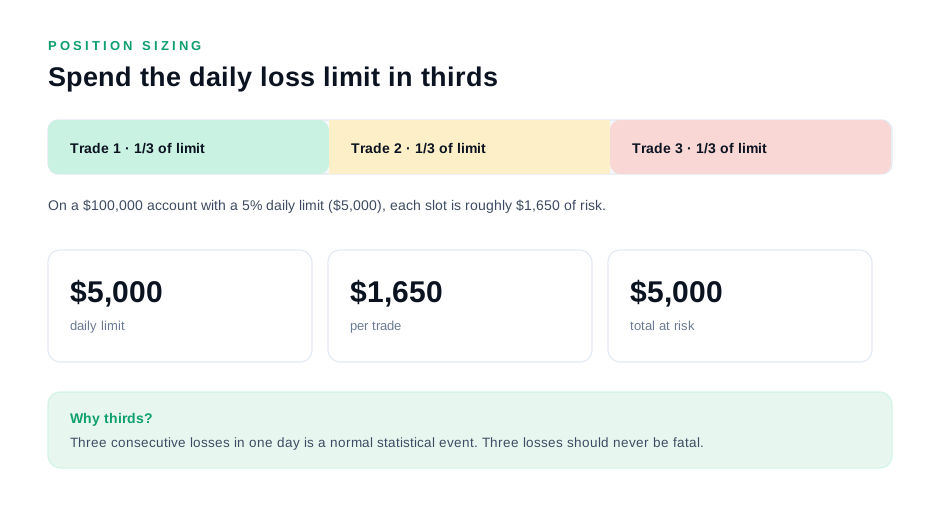
The consistency condition deserves a note because it appears in a different place depending on the family. On an evaluated account it usually binds at the payout, which means the daily profit cap is a planning decision taken weeks before it matters. On an instant funding account it binds from the first payout request, which means the cap is a day-one decision. Either way, required total profit equals the largest day divided by the permitted share, and capping the day at a fraction of the target satisfies it before it is ever tested.
Forex, futures and the differences that matter
Two asset classes dominate the industry, and they differ in ways that change the plan beyond the rulebook family.
Futures accounts are denominated in contracts with a fixed tick value, so position sizing is discrete and the dollar risk of one contract is knowable to the cent. That is a genuine advantage for a rules-based plan: the daily limit expressed in dollars translates directly into a contract count. The complication is that futures firms enforce conduct rules harder — session windows, news restrictions, contract caps and, at some firms, a cap on how many contracts may be held at any moment. Those rules fail accounts quietly because they are often stated in the terms rather than on the evaluation page.
Forex accounts are denominated in lots, so sizing is continuous and dollar risk depends on the pair, the lot size and the stop distance. That flexibility makes it easier to fit a risk number to a daily limit, and harder to know what the risk actually is without doing the arithmetic. Forex firms tend to be more explicit about percentage limits than futures firms are about conduct, which inverts the failure profile: Forex accounts fail on limits, futures accounts fail on rules.
The practical consequence for a service pass is that the plan is the same shape in both cases but the risk of a conduct breach is concentrated differently. On futures, the first thing read is the conduct schedule. On Forex, the first thing read is which balance each percentage limit is measured from. The micro futures sizing guide covers the contract arithmetic, and the leverage guide covers the Forex equivalent.
The terms check, firm by firm
Before any payment, the terms for the specific firm and program are read and the answer is confirmed in writing. The check is free, it happens before anything is bought, and it produces one of three answers: permitted, prohibited, or silent — and silent is treated as prohibited unless the firm confirms otherwise in writing.
Six items are checked, and the first two decide whether the job happens at all.
- Third-party trading on the evaluation. If it is prohibited, we decline and say so before payment.
- Third-party trading on the funded account. Some firms permit the evaluation to be traded externally and prohibit it after the pass. That distinction decides whether the pass is worth having.
- The rulebook family and the limits. Which balance each limit is measured from, whether the floor trails, and whether a daily limit applies alongside a maximum limit.
- The conduct schedule. News windows, maximum position size, prohibited strategies, session hours, and holding policies for overnight and weekends.
- The payout conditions. Profit threshold, minimum qualifying days, consistency share and any first-payout restriction, read at the funded stage rather than the evaluation stage.
- Ownership and verification requirements. How the account must be purchased, who must complete identity checks, and what evidence the firm accepts at payout.
The reason the check is free is that it is the cheapest part of the job and the most consequential. A funded account passed in breach of the terms can be voided at the withdrawal, which is worse than a failed evaluation: the firm's fee and the service fee are both spent, and the record of a completed pass is not worth anything. There is no fee high enough to make that trade sensible.
What to send: the firm, the program name and the account size. If you already have a support response about third-party trading, include it. The check usually completes the same day.
The process and the handover
Five steps, in order, and each one is documented so that nothing depends on memory.
One — terms check. Firm, program and size are read against the current terms, and the answer is confirmed in writing, including the conduct schedule the plan has to respect.
Two — purchase. The client buys the evaluation directly from the firm, in their own name, with their own payment method. The evaluation fee is never routed through the service, which keeps ownership unambiguous and puts the client's identity where the firm expects it.
Three — handover of access. The scope of access is agreed in writing before it is granted and limited to the evaluation account. Nothing else is requested, and the funded account is never accessed.
Four — trading. The evaluation is traded to the target within the family-appropriate plan, with progress reported at agreed checkpoints and a failure reported the day it happens.
Five — pass and return. The evaluation completes, the firm's own confirmation is shared with the client, access is returned or removed, and the funded account passes to the client with a written summary of its conditions.
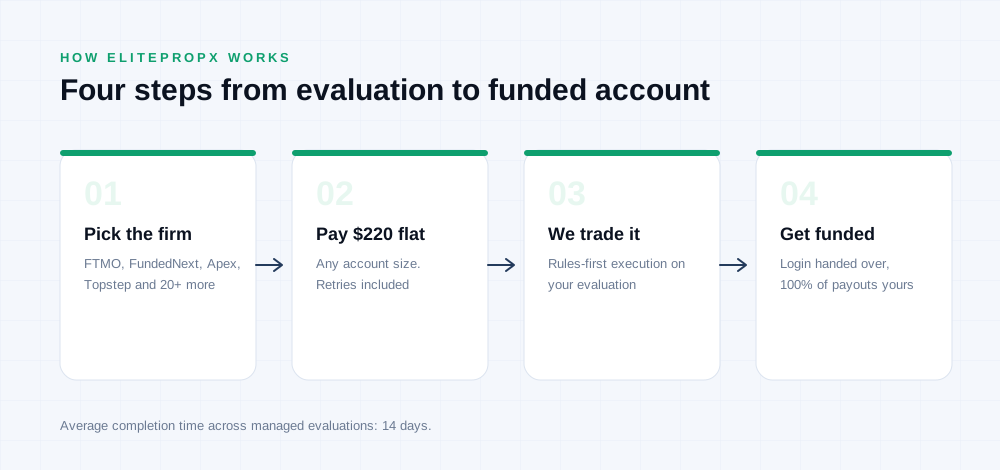
Two points in that sequence are worth emphasising because they are the industry's usual failure points. Step one: a provider that accepts any firm without reading the terms has not checked whether the pass can be paid for. Step five: credentials should be returned or removed at handover, and the password changed afterwards regardless — a completed job does not require continuing access to a funded account.
Timelines by family
Clients ask for a date, and the honest answer depends on the family and the day count rather than on effort.
| Family | Typical window | Binding constraint |
|---|---|---|
| Static drawdown, single target | Two to three weeks | Minimum day count |
| Static drawdown, staged | Three to five weeks | Two day counts and a handover |
| Trailing, intraday | Two to four weeks | Size ladder slowing progress near the target |
| Trailing, end-of-day | Two to three weeks | Minimum day count |
| Instant funding | Payout cycle, not a pass | Threshold, qualifying days and consistency |
Two habits keep a timeline honest. First, the day count is planned backwards so the profit target and the minimum sessions complete on the same date; a trader who reaches the target early still waits. Second, restricted news windows are subtracted from the calendar in advance, because a week with several scheduled releases has a materially shorter usable window than a quiet one.
What a timeline should never do is imply speed. A provider promising a three-day pass on a staged evaluation has not read the day counts, and one promising a fixed date regardless of the firm has not read the rulebook at all. The honest version is a range with the constraint named, which is what the table above provides.
The flat fee, and the honest case against it
The fee is $220 for any firm and any account size, with retries covered while the evaluation is running and no profit split on the funded account. The scope is deliberately narrow, and stating it in full is the only way to avoid the disputes that dominate this industry.
| Item | Covered | Notes |
|---|---|---|
| The evaluation attempt | Yes | Traded to the firm's target within its rules |
| Retries while the evaluation runs | Yes | No additional service fee |
| Terms check before payment | Yes | Confirmed in writing, free |
| The firm's evaluation and reset fees | No | Paid by the client directly to the firm |
| The funded account | No | Traded by the client under the firm's terms |
| Identity verification | No | Completed personally |
| Profit split | None taken | Payouts belong to the client |
The case against the service is straightforward and worth stating: a disciplined trader who passes first time is better off self-trading. At a firm fee of roughly $500, one attempt on your own costs about $500 and the service costs about $720 — so the service is $220 worse, and the client also gives up the experience of trading the evaluation. From the second attempt the arithmetic reverses, because the service absorbs retries while self-trading is billed each time. Break-even is a single failure.
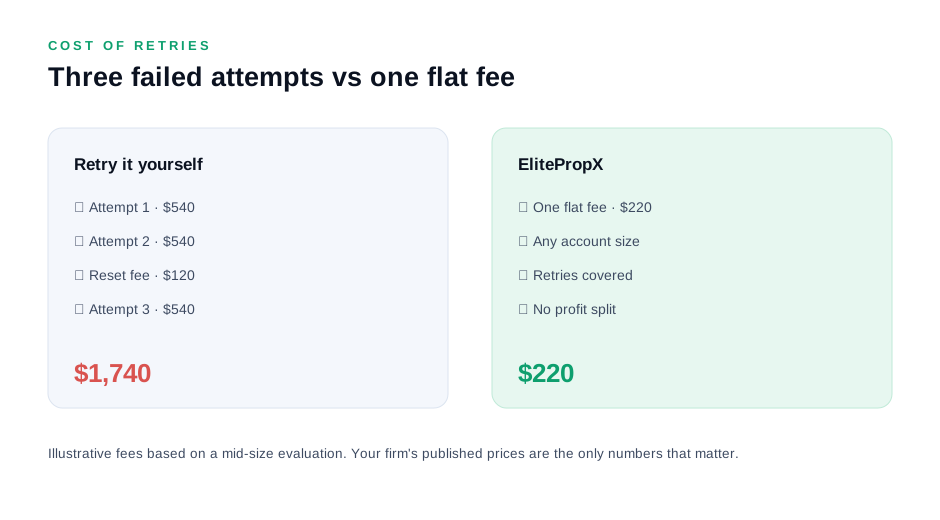
Three costs the fee does not remove: the firm's evaluation fee, the firm's reset charge where one applies, and the calendar. Minimum day counts apply to a service pass exactly as they apply to anyone else, which is why no honest provider can compress a staged evaluation indefinitely. What the fee does buy is the removal of the reset multiplication and of the attention cost — the weeks a trader would have spent on a failed attempt, which for most people is worth more than the fee difference.
For the payout side of the arithmetic, the profit calculator models what an account produces once its conditions are met, and the 2026 service review applies the same tests to other providers.
After the pass
The pass produces a funded account and transfers responsibility. The service covers the evaluation; the funded account is governed by the firm's payout conditions, which are usually stricter than the evaluation was.
Three conditions carry over and three are new. Carried over: the loss limits in some form, the conduct schedule, and the permitted trading hours. New: a profit threshold before any withdrawal, a minimum number of qualifying days, and a consistency condition capping the largest day as a share of total profit.
The consistency condition is the one that catches clients who assume the hard part is done. Required total equals the largest day divided by the permitted share, so a single large session can multiply the requirement several times over. The remedy is the same as during the evaluation: cap daily profit at a fraction of the threshold and the gate is satisfied before it is tested.

Four steps in the first week, in order. Change the password regardless of how access was provided. Confirm the account is in your name with your payment details and verification complete. Read the funded terms yourself rather than relying on a summary. And write the funded plan before the first trade: risk per trade, daily stop, daily profit cap, minimum qualifying days.
The payout process guide covers the withdrawal sequence and the delays that block first requests, and the failure recovery guide covers what to do if the funded account is lost. The short version of both: complete verification early, request the first payout on the earliest permitted date rather than at the largest available amount, and treat that payment as a test of the process rather than as income.
What we will not do
Four refusals define the service as much as the fee does, and each exists because the alternative moves risk to the client without saying so.
We will not trade a firm whose terms prohibit third-party trading. Not quietly, not for a higher fee, and not with a disclaimer buried in a message. A funded account passed in breach of the terms can be voided at payout, which turns a paid evaluation into the loss of two fees.
We will not hold the funded account. The account is in the client's name and access is returned or removed at handover. Continuing to trade someone else's funded account is a managed account in disguise and is prohibited by most firms.
No income promises. What is sold is a completed evaluation. Trading the funded account is the owner's job under the firm's rules, and nobody can guarantee a payment they do not control.
No profit share. A provider paid a slice of earnings has a reason to keep trading once the job is done — more exposure, more chance of losing the account, all in pursuit of a bigger fee.
Two practices are worth mentioning because they are the shortcuts this industry usually takes. We do not purchase evaluations on the client's behalf — the purchase is made in the client's name with the client's payment method, because ownership is what keeps a funded account valid. And we do not request identity documents, because verification is the account holder's step and cannot be delegated.
Frequently asked questions
Does the $220 fee change with the firm or the account size?
No. The fee is flat for any firm and any account size, because the work is the same four-number plan applied to a different rulebook. Size affects the payout ceiling and the firm's own fee, not ours.
Which firms can you trade?
Any firm whose terms permit third-party trading on the evaluation. We check the terms before payment and decline where the arrangement is prohibited, because a funded account passed in breach can be voided at the withdrawal.
How long does a pass take?
One to five weeks depending on the rulebook family, the target and the minimum day count. Staged evaluations sit at the longer end because there are two targets and two day counts, with a handover between them.
Do you trade both phases of a staged evaluation?
Yes. The fee covers every phase and the retries that occur while the evaluation is running. The plan is re-based at the handover — limits recomputed against the new balance, risk per trade unchanged.
Who owns the funded account?
The client. The evaluation is purchased in your name with your payment method, identity verification is completed personally, and access is returned or removed at handover. Change the password afterwards regardless.
What happens if an attempt fails?
The day it happens you are told, the failure is sorted into drawdown or conduct breach, and the attempt is re-run at no extra service charge for as long as the evaluation stays open. Any reset charge the firm itself levies stays with the client.
Do you take a share of the payouts?
No. The funded account and its payouts belong to the client and no profit share is taken. A provider paid a percentage has an incentive to keep trading after the job is done, which is a conflict we choose not to have.
Does the service cover the funded account?
No, and it should not. The funded account has its own profit threshold, qualifying-day requirement and consistency condition, and it has to be traded by its owner under the firm's terms. The service ends at handover.
Is a flat fee cheaper than doing it myself?
Only if you would have needed more than one attempt. At a $500 firm fee, one attempt costs $500 and the service costs $720. From the second attempt onward it reverses sharply, because retries are covered rather than billed.
Which rulebook is easiest to pass?
A static drawdown with a single target and a generous day count is the most forgiving family, because profit cannot make the account more fragile. A trailing floor that follows unrealised profit is the strictest, because a winner that retraces has already spent room.
Do I need to tell you my strategy?
No. The plan is built from the firm's rulebook rather than from your approach, and the only strategy question that matters is whether the firm's holding and session rules make your approach admissible at all.
What if the firm changes its terms mid-evaluation?
The evaluation is traded to the terms in force when it started, and any material change is raised with you immediately. A firm that changes payout conditions retroactively is a risk no service can remove, which is why reviews on this site look at payout behaviour as well as rulebooks.
The same trades on three rulebooks
The clearest way to see why the family matters is to run one identical sequence of trades against three structures. The plan is deliberately ordinary: 1% risk per trade, a session stop at 3% of the account, a daily profit cap of 2%, and no size increase at any point.
The trade record over ten sessions: plus 1.6%, plus 2.0%, minus 1.0%, flat, plus 1.8%, minus 1.0%, minus 1.0%, plus 2.0%, plus 1.2%, plus 0.8%. Total: plus 6.4%. The largest day is plus 2.0%, which is a little over 30% of the total.
On a static drawdown account, the sequence is unremarkable. The failure floor does not move, so the cushion at the end is the starting cushion plus the profit. The only gate left is the consistency ratio, and a 2.0% best day against 6.4% of total profit sits just outside a 30% limit — close enough that a cap of 1.5% would have settled it in advance. The plan was sound; one setting was a little loose.
On a trailing account following closed profit, the picture changes once. Profit raises the floor, so the cushion at the end is smaller relative to the balance than at the start. The evaluation survives because the sequence is profitable and the losses are shallow, but the room available at the end is thinner than on the static account, and the size ladder should have stepped down after the fourth session.
On a trailing account following unrealised profit, the same trades are riskier than they look. Assume the 2.0% days touched 2.8% and 2.6% before closing at 2.0%. Those peaks moved the floor, so the cushion is smaller than the closed profit implies. Nothing in the record shows a loss, and yet the account ends the sequence with less room than either of the other two structures.
| After ten sessions (plus 6.4%) | Static | Trailing, closed | Trailing, unrealised |
|---|---|---|---|
| Failure floor | Unchanged | Raised by 6.4% | Raised by the peaks, more than 6.4% |
| Cushion vs balance | Best of the three | Reduced | Smallest |
| Size discipline needed | Constant | Step down after progress | Step down, and cut winners early |
| Consistency ratio | 31% — fails a 30% rule | 31% — fails a 30% rule | 31% — fails a 30% rule |
Two lessons fall out of the table. The consistency ratio is identical on all three accounts, because it is computed from realised profit and the rulebook does not change that. And only the failure floor diverges, which is the dimension that closes accounts. A trader who assumes the strictest structure is stricter everywhere is half right: it is stricter in exactly one place, and that place decides survival.
The pacing consequence is worth stating plainly. On the static account the sequence above could have been spread over fourteen sessions at no cost other than calendar. On the intraday trailing account, the same spread would have saved the room that the peaks consumed, because smaller size on the strong sessions would have moved the floor less. Same trades, same profit, different outcomes — decided entirely by which family the rulebook belongs to.
Before you buy any evaluation
Seven steps, and each takes minutes. They apply whether the evaluation is traded by a service or by its owner, and they decide whether a pass is worth having.
- Identify the family. Static, trailing, staged or instant — and if trailing, which equity the floor follows.
- Establish which balance each limit is measured from. Starting balance and current equity behave differently the moment the account moves.
- Convert the target to a percentage and check it against the daily limit rather than against the account size.
- Read the conduct schedule. News windows, size caps, session hours and holding policies are the rules that fail accounts quietly.
- Read the funded terms, not just the evaluation. The threshold, the qualifying days and the consistency share are part of the product.
- Confirm the ownership rules. The account must be in your name, verified by you, with your payment method on it.
- Write the plan before the first trade. Risk per trade, daily stop, daily profit cap, weekly pause — four numbers that survive every firm on the market.
The seventh step is the one that makes the other six worth doing. A rulebook is only as good as the plan applied to it, and a service pass is no different: the deliverable is a completed evaluation, and the account that follows it needs its own plan. The flat-fee model explained covers the pricing side, the complete passing guide covers the plan, and the rules matrix lets you check a firm's mechanics against the rest of the market before buying.
Start with the terms check
Send the firm, the program and the account size. We confirm in writing whether third-party trading is permitted — before you pay anything — and decline the job if it is not.
Related reading
- How the flat-fee passing model works
- FTMO challenge passing service
- FundedNext passing service
- The complete guide to passing a challenge
- Instant funding, explained
- Daily drawdown explained
- Passing services compared
- Recently passed evaluations
- Profit and payout calculator
ElitePropX is an independent evaluation service and is not affiliated with, endorsed by or sponsored by any proprietary trading firm named on this site. Services are offered only where a firm's terms permit third-party trading. A funded account is not a guarantee of income, and trading involves substantial risk of loss. Verify current terms before purchasing an evaluation.