How Much Do Prop Firm Traders Actually Make?
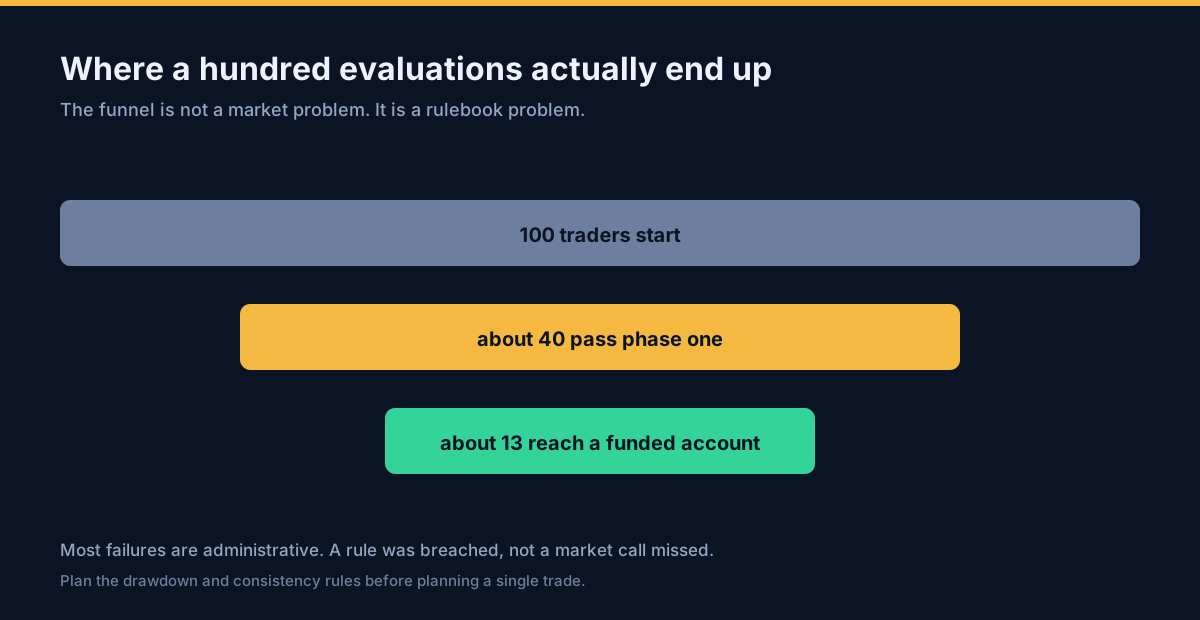
"How much do prop firm traders make?" is the question every funded-account video answers with a cherry-picked screenshot. The honest answer is far less glamorous and far more useful: income is a formula, and once you understand its terms you can estimate your own number instead of borrowing someone else's.
The formula most people ignore
Monthly funded income is the product of four numbers: account size, your monthly return percentage, your profit split, and how often you withdraw. Most discussions fixate on account size, which is the one number you can least control once funded — and ignore the return percentage, which is where both the money and the risk live.
| Account | Monthly return | Gross profit | At 80% split |
|---|---|---|---|
| $50k | 3% | $1,500 | $1,200 |
| $100k | 3% | $3,000 | $2,400 |
| $100k | 5% | $5,000 | $4,000 |
| $200k | 3% | $6,000 | $4,800 |
Those figures are illustrative, not promises. What matters is the shape: a modest, repeatable 3% on a mid-size account produces a real monthly income, while an aggressive 10% month that breaches drawdown produces nothing at all and puts the account at risk.
Why the headline account size misleads
A "$200k funded account" does not pay on $200k of your money — it pays a share of the profit you generate on the firm's capital, subject to drawdown limits and consistency rules. The limits cap how much you can safely earn in any month, so the account size sets a ceiling on income only loosely. Two traders on the same $200k account can earn wildly different amounts based on discipline alone.
The consistency ceiling
Many firms require that no single day account for too large a share of your profit. That rule mathematically prevents the "one huge day" strategy from being withdrawable in full. It is a ceiling on explosive returns, and it rewards exactly the steady trading most tutorials ignore.
What actually separates earners from the rest
They keep accounts alive
An account that survives for a year out-earns five that breach in a month. Survival is the whole game.
They withdraw regularly
Profit that stays in the account is exposed to the next breach. Taking money out converts performance into income.
They scale across accounts
After a proven system, adding a second or third funded account multiplies income without increasing the size of any single account.
They accept modest returns
A repeatable 2–4% beats a volatile 10% that eventually breaches, both in income and in time spent.
Scaling is where the real income is
The path from a first funded account to meaningful income is not a single huge month — it is accumulation. Firms offer scaling plans that increase your allocation after sustained performance, and traders can run multiple evaluations in parallel. Ten funded $50k accounts returning a modest monthly percentage produce more than one $500k account ever could, and they spread the risk of any single breach across the portfolio. Read our guides on getting multiple funded accounts and scaling plans for how that works in practice.
The honest bottom line
Prop firm trading can produce real income, but not the numbers in the marketing. Expect to keep a modest single-digit monthly percentage on funded accounts you manage carefully, to lose some accounts to breaches along the way, and to grow income mainly through survival and scale over many months. The traders who make it are the ones who treat the drawdown rule as sacred and treat a small, repeatable edge as a business. To start that journey, you need accounts — our challenge passing service passes yours for a flat $220, and takes nothing from the income you go on to earn.
Frequently Asked Questions
How much can you make from a prop firm account?
What percentage return do prop firm traders average?
How much do you keep after the profit split?
How much can you make with multiple funded accounts?
Do most prop firm traders make money?
Have a question before you commit?
Ask us anything about your firm, your account size or whether a passing service suits you. We answer directly on Telegram — no forms, no queues.
Ready to pass your prop firm challenge?
Flat $220 per evaluation — we trade it for you and hand over a funded account. No hidden cuts, no monthly fees. Message us on Telegram and we will answer in minutes.