
Reviewed · how we check firm rules
Every major firm, one page
Prop firm comparison 2026: every major firm side by side
Targets, daily loss limits, drawdown type, minimum trading days, payout structure and the rules that actually decide whether an evaluation is passed. Sourced from firms' published terms and updated as those terms change.
Key takeaways
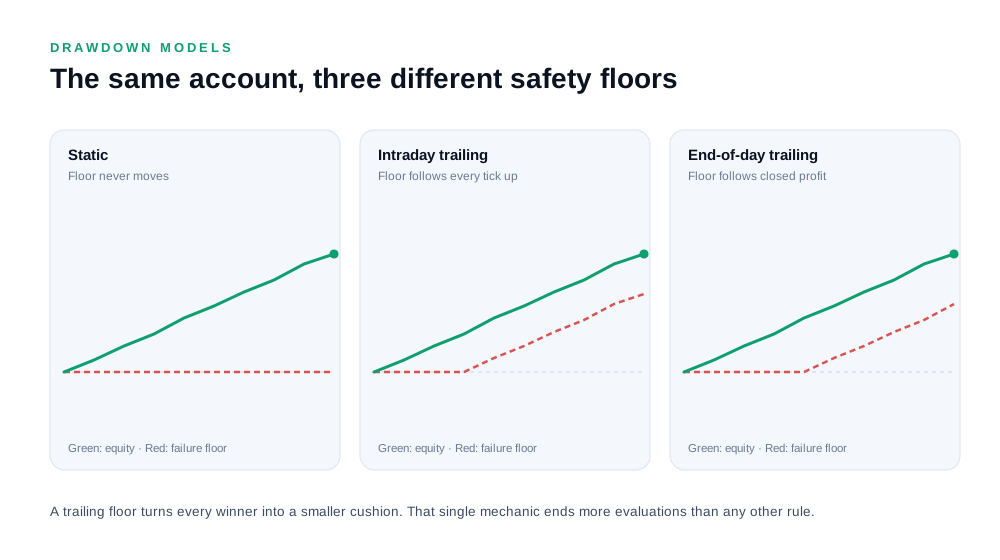
- Drawdown type matters more than target size. Static beats end-of-day trailing, which beats intraday trailing.
- Futures firms are stricter at payout. Consistency rules are common there and rare on forex evaluations.
- Instant funding is a different product — higher price, tighter early withdrawal rules, no evaluation.
- Headline percentages mislead. A 5% daily limit measured on equity is far stricter than the same number measured on closed balance.
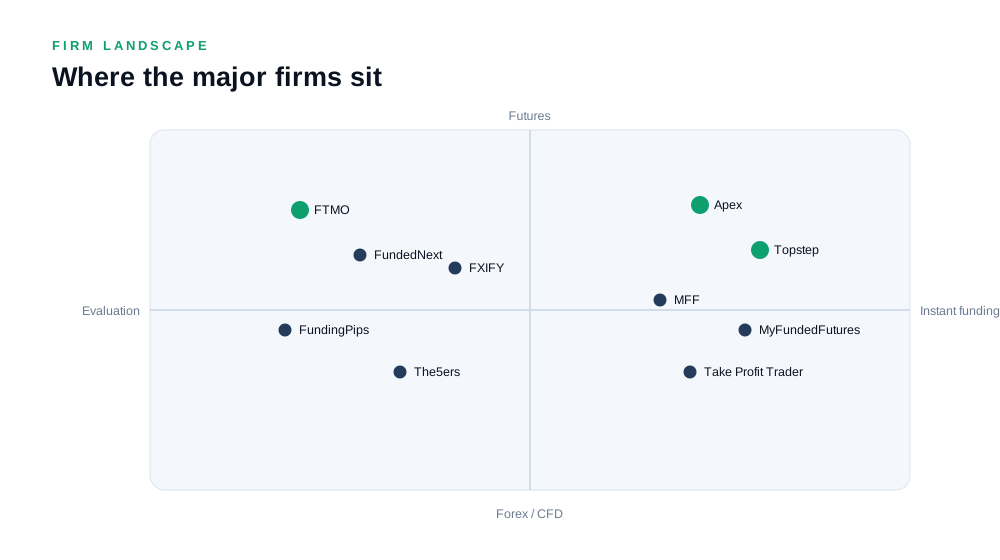
How to read any prop firm comparison
Most comparison tables are marketing with columns. They list account sizes and profit splits — the numbers firms advertise — and leave out the four rules that determine whether an evaluation is survivable. Before looking at any table, including this one, decide what you are comparing.
Drawdown structure. A static maximum loss never moves. An end-of-day trailing drawdown follows your closed profit higher, tightening the buffer at the end of each day. An intraday trailing threshold follows your unrealised equity, which means a normal pullback can end the account while the day is still net positive. Identical headlines — "10% maximum drawdown" — describe three very different products.
Daily loss measurement. Firms publish a daily loss limit, but the basis varies: closed balance, equity including floating positions, or equity plus unrealised intraday peaks on trailing accounts. The stricter the measurement, the smaller the effective risk per trade, regardless of the number on the page.
Consistency rules. Some firms apply a consistency requirement during the evaluation, others only when you request a payout, and some not at all. A payout-stage rule is more manageable because you can add ordinary winning days before requesting a withdrawal. An evaluation-stage rule constrains pace from day one.
Payout mechanics. Minimum trading days, profit threshold, first-payout delay, split percentage and the withdrawal methods offered. A firm with a 90% split and a 30-day first payout is not better than one with 80% and a seven-day cycle for most traders.
Read the full rule detail on the 2026 rules matrix, which lists exact figures for the firms below without narrative.
Forex and CFD firms compared
The table below covers the forex firms most traders evaluate first. Rows are named by plan rather than by brand, because most of these firms sell several rulebooks under one logo. The FTMO, FundedNext, The5ers, Alpha Capital and E8 rows were read from those firms' own published rules and are linked at the foot of this page. FXIFY, FundingPips and FX2 describe the plan structures those firms publish without a primary source checked in this pass, so treat their figures as indicative and confirm them on the plan page before paying.
| Firm | Phases | Target | Daily loss | Max loss | Drawdown type | Time limit | Consistency |
|---|---|---|---|---|---|---|---|
| FTMO — 2-Step | 2 | 10% / 5% | 5% | 10% | Static | None | None; 4 minimum trading days per phase |
| FundedNext — Stellar 2-Step | 2 | 8% / 5% | 5% | 10% | Static | None | None; 5 minimum trading days per phase |
| The5ers — High Stakes | 2 | 10% / 5% | 5% | 10% | Static | None | None; 3 profitable days |
| FXIFY — Two Phase Standard | 2 | 10% / 5% | 4% | 10% | Trailing, locks at starting balance | None | None; one trade per 60 days |
| FXIFY — Two Phase Pro | 2 | 4% / 8% | 4% | 8% | Static | None | None; 3 days of 0.5%+ on the funded account |
| Alpha Capital — Alpha Pro 8% | 2 | 8% / 5% | 4% | 8% | Static | None | None; 3 minimum trading days per phase |
| FundingPips — 2-Step Standard | 2 | 8% / 5% | 5% | 10% | Static | None | None; no minimum trading days |
| E8 Markets — E8 Pro | 1 | 8% | 2.5% | 8% | Static | None | None; 2% daily profit cap, 40% best day at payout on other E8 products |
| FX2 Funding — 2-Step | 2 | 8% / 5% | 4% | 10% | Static | None | None; no minimum trading days |
Which forex firm is easiest to pass? On structure alone, plans with a static maximum loss, no consistency rule and no time limit give the risk plan the most room. FundingPips' 2-Step Standard, FX2's 2-Step, FXIFY's Two Phase Pro and E8 Pro fit that description. FTMO and The5ers High Stakes also use static floors but require 4 and 3 qualifying days respectively. FXIFY's Two Phase Standard trails and its Classic plan carries a funded-stage consistency rule, so those two need different arithmetic. The table names the plan each row describes, because the plan name is the rulebook: Alpha Pro has variants with different daily and maximum loss limits, and E8's products differ enough that a single set of figures would be wrong for most of them.
Which pays most reliably? Payout reliability correlates with firm age, transparent terms and a public record of withdrawals — not with the advertised split. A firm offering 95% of profit but taking three weeks to process a withdrawal is a worse home for a funded account than one offering 80% on a weekly cycle.
Futures firms compared
Futures evaluations behave differently from forex ones, and the differences are structural rather than cosmetic.
| Firm | Target | Max loss | Drawdown type | Daily limit | Consistency | Account sizes |
|---|---|---|---|---|---|---|
| Apex Trader Funding — EOD | Fixed dollar target | $1,000 / $2,000 / $3,000 / $4,000 | End-of-day, fixed through the next session | $500 / $1,000 / $1,500 / $2,000 by size | 50% best day at payout (30% legacy) | $25k–$300k |
| Apex Trader Funding — Intraday | Fixed dollar target | Dollar threshold | Intraday trailing, stops at target | Via the trailing floor only | 50% best day at payout (30% legacy) | $25k–$300k |
| Topstep — Combine | $3,000 / $6,000 / $9,000 | $2,000 / $3,000 / $4,500 | End-of-day trailing, locks at starting balance | Optional add-on: $1,000 / $2,000 / $3,000 | 55% best day vs target in Combine; 40% on the consistency payout path | $50k–$150k |
| MyFundedFutures | Fixed dollar target | Dollar threshold | End-of-day trailing on its plans | Varies by plan | At payout | $50k–$150k |
| Take Profit Trader | Fixed dollar target | Dollar threshold | End-of-day trailing | None | 50% best day at payout | $25k–$150k |
| TradeDay — Quick Pay | Fixed dollar target | Dollar threshold | Intraday trailing | None | 30% consistency, 5 minimum days | $50k–$150k |
The Apex, Topstep and MyFundedFutures rows are cited at the foot of the page; the Take Profit Trader and TradeDay rows describe published structures that were not re-checked for this pass.
Three patterns matter. First, futures firms almost universally use trailing thresholds, which makes them harder than forex evaluations with equivalent headline numbers; Apex's EOD model and TradeDay's intraday trail are the clearest examples of how differently two trailing rules can behave. Second, consistency rules are standard at payout and the threshold varies by firm — Apex 50%, Take Profit Trader 50%, Topstep 40% on one payout path, TradeDay 30% — so an evaluation can be passed and the first payout request still refused. Third, targets are dollar-denominated, so a $3,000 target on a $50,000 account is a 6% target, and that arithmetic is worth doing before comparing firms.
Which futures firm is easiest to pass? Whichever has the most forgiving trailing behaviour. A threshold that stops trailing once it reaches the starting balance, or trails only on closed profit, is materially easier than an intraday trailing floor on a small account. Where a firm offers both an intraday and an end-of-day structure, the end-of-day version is the better assignment.
Firm notes: what each structure means in practice
Tables compress differences that matter, so here is what each firm's structure actually implies for someone trading it — or for a service trading it on your behalf.
FTMO
The reference point of the industry: two phases, a 10% target on the first and 5% on the second, a 5% daily loss limit measured on equity including floating positions, and a 10% static maximum loss. No time limit, no consistency rule at evaluation, and an exceptionally well-documented rulebook. The static floor makes it the most workable large-scale forex structure available, and the fact that it is measured on equity is the detail that catches traders who assume closed-balance accounting. Passing it is a test of pacing rather than of forecasting, which is exactly why it suits a structured approach.
FundedNext
Offers both single-phase and two-phase structures, with the important caveat that some plans use a trailing drawdown rather than the static floor most traders assume. Where a plan trails, the cushion shrinks as profit accumulates, and the plan must reduce risk toward the end of the evaluation. FundedNext also applies consistency conditions at the payout stage on several plans, which means an evaluation can be passed cleanly and the first withdrawal request still refused if one day dominates total profit.
The5ers
Built around slower, lower-leverage progression rather than fast passes. Targets are modest but so are drawdown allowances, and the firm's multi-stage structures reward patience: several of its evaluations expect the trader to grind a small return over a long period rather than hit a headline number. For a passing service this is a question of pacing, and the timeline is longer than the industry average for that reason. Payout cycles are generally reliable, and the firm is well regarded for supporting traders who want to build slowly.
FXIFY
Six programs with genuinely different rulebooks, so the plan name is the only useful unit of comparison. Two Phase Standard pays 10% then 5% with a 4% daily limit and a 10% trailing floor. Two Phase Classic reverses the targets (5% then 10%), keeps the 10% floor static and adds a 25% consistency rule on the funded account. Two Phase Pro pays 4% then 8% with an 8% static floor and no consistency rule. Three Phase uses 5% at each step with a 5% static floor and 5% daily limit. None of them has a time limit, but Two Phase Pro counts a day toward its funded-stage minimum only if the day closes at least 0.5% up. A trader who compares "FXIFY" to another brand without naming the program is comparing a logo to a rulebook.
Alpha Capital Group
Several products under one brand, and the numbers differ sharply between them. Pro 8% is the plan most often quoted: 8% then 5% targets, a 4% daily loss limit, an 8% static maximum loss and three minimum trading days. Pro 10% widens those to a 5% daily limit and 10% static maximum loss. A trader who assumes the 8% plan's targets come with the 10% plan's daily room has the arithmetic wrong by a fifth before the first trade.
FundingPips
Two-phase, 8% and 5%, static maximum loss, no consistency rule during the evaluation, and pricing that sits at the aggressive end of the market. Structurally one of the friendlier evaluations for a rules-based approach, with the usual caveat that cheap challenge fees sometimes come with tighter payout-stage conditions — worth checking the current payout schedule rather than assuming last year's terms.
Apex Trader Funding
The most recognisable futures firm, with dollar-based targets and account sizes that extend to $300,000 — higher than almost any competitor. Apex now runs two drawdown models: an EOD evaluation, where the threshold is calculated at the close and held fixed through the next session, and an intraday evaluation, where the threshold follows peak equity including unrealised profit. On the intraday model the buffer shrinks on every tick in your favour, so the plan has to reduce size as the target approaches instead of accelerating. Apex applies a 50% best-day consistency rule at payout on current accounts (30% on legacy Performance Accounts), which is the single most common reason a passed futures account cannot withdraw. Discounted evaluation pricing and a large promotional cadence make it inexpensive to enter and easy to over-trade once inside.
Topstep
Futures Combine with an end-of-day trailing threshold that locks at the starting balance, a fixed dollar target, and a daily loss limit that is optional at checkout. That last word matters: a Combine bought without the add-on has only the trailing maximum loss, while one bought with it has a fixed daily stop as well. The Combine also carries a 55% best-day expectation relative to target, and the 40% rule applies only on the optional consistency payout path. Apex and Topstep are frequently compared directly; the useful distinction is that Topstep's threshold stops trailing at the starting balance while Apex's intraday model trails to the target, which changes how much room a give-back costs.
MyFundedFutures
Dollar-based futures evaluations with more flexibility on drawdown behaviour than most competitors, including end-of-day trailing options on some plans. End-of-day trailing is materially easier than intraday trailing, because the floor only moves on closed profit — a distinction worth a great deal in practice and invisible in a headline comparison. Consistency is enforced at payout.
Take Profit Trader
Take Profit Trader removed its daily loss limit, so the only evaluation constraint is the end-of-day trailing drawdown — a materially different product from the version of TPT described in older reviews. Evaluations became three-day assessments in August 2026, and payouts are available daily from the funded account, subject to a 50% best-day rule. The end-of-day trail still moves against a trader who gives profit back, but it does not react to unrealised peaks during the session.
TradeDay
TradeDay 2.0 runs an intraday trailing maximum drawdown, no daily loss limit, a 30% consistency rule and five minimum trading days on Quick Pay. That combination is the opposite of the old "EOD trailing, no consistency" description that still circulates: the trail reacts during the session, and the payout rule constrains how concentrated the profit can be. It suits a trader who can keep the day's give-back small, not one looking for an end-of-day floor.
Choosing between two similar firms
Most decisions come down to two firms with nearly identical headline numbers. Five tie-breakers, in the order they usually matter.
- Which drawdown is static? If one firm's floor moves and the other's does not, the static one wins for almost every trader.
- When is consistency enforced? At payout is easier than during the evaluation, and not at all is easier still.
- What is the first-payout timeline? Minimum trading days plus processing time. A fast cycle matters more than a marginally higher split percentage.
- Which firm's terms are clearer about third-party trading? Clarity is protection. A firm that states its position explicitly is safer to work with than one that leaves it ambiguous.
- Which platform do you actually want to trade? MT5, cTrader, Tradovate and NinjaTrader behave differently, and the funded phase is where platform familiarity pays.
How this comparison is sourced and updated
Figures come from firms' published rulebooks and their own documentation pages, cross-checked against the terms shown at the point of purchase. Where a firm operates multiple plan types, the table reflects the plan named in the row and the notes above flag where plans diverge — trailing versus static drawdowns, for example. Every firm with a checked row is linked at the foot of this page, and the rows that were not checked in this pass say so in the table notes rather than borrowing the checked rows' authority.
Firms change terms frequently, sometimes without a public announcement, so this page is a starting point rather than a substitute for the terms you agree to at checkout. Corrections are welcome: if a number here contradicts your firm's current documentation, send the page and the rule and it will be fixed. How we check firm rules explains the sourcing standard, the review dates and what happens when a firm changes a threshold.
Instant funding providers
Instant funding skips the evaluation: you buy a funded account and trade it immediately, subject to early payout restrictions. It is not a shortcut so much as a different trade-off.
| Model | Cost | First payout | Best for |
|---|---|---|---|
| Standard evaluation | Lower purchase price, one or two phases | After evaluation plus minimum days | Traders who can pass a rules-based assessment and want the lowest entry cost |
| Instant funding | Higher purchase price | Often after a longer minimum period or a higher profit threshold | Traders who want funding exposure without a two-phase clock |
| Passing service on an evaluation | Firm fee plus flat $220 | Same as a standard evaluation | Traders who can manage a funded account but keep breaching evaluation rules |
The mistake traders make with instant funding is treating the absence of an evaluation as the absence of constraints. Instant accounts typically carry tighter early-stage rules: a higher profit threshold before the first withdrawal, a longer minimum period, or a restriction on how much of the account can be withdrawn in the early months. Those restrictions exist precisely because the firm has skipped the screening step that an evaluation provides.
Read the instant funding guide for the full breakdown of how the model works and when an evaluation is the better choice.
The rules that actually decide pass rates
Across managed evaluations, four rules account for most outcomes. Ranking them by how often they end an attempt produces a different order than ranking them by how prominently firms advertise them.
- Daily loss limit (measured on equity). The single most common cause of failure. Firms measuring on equity including floating losses are far stricter than their headline number suggests.
- Trailing drawdown. The second most common cause, and the one most often misunderstood. Traders habitually assume the floor is fixed and discover otherwise after a large winning day.
- Consistency at payout. Not a cause of evaluation failure but a cause of refused payouts, which for a funded trader is the same outcome delayed.
- Minimum trading days. Rarely fatal, frequently inconvenient: an evaluation finished in three sessions with a minimum of ten days is not finished at all.
Sizing for the first two rules — and checking the third before requesting a withdrawal — removes most of the risk that a well-executed evaluation ends in disappointment. The consistency rule guide covers the arithmetic in detail.
Evaluation rules and funded rules are two different rulebooks
The comparison above is about getting funded. Staying funded is governed by a second set of terms that most comparison tables ignore entirely, and it is where a surprising share of otherwise well-executed plans fall apart.
| Rule | Typical evaluation | Typical funded account |
|---|---|---|
| Profit target | 8–10% to pass | 5–10% before each withdrawal on some firms |
| Daily loss limit | Usually 5%, measured strictly | Often relaxed or removed |
| Maximum loss | Trailing or static threshold | Usually static at the starting balance |
| Consistency | Rare during evaluation | Common at payout; 30–50% best-day depending on firm |
| Minimum days | Often none | Usually 5–10 before the first payout |
| Identity checks | At registration | Again before the first withdrawal |
The pattern is consistent across firms: evaluation rules punish risk, and funded rules punish concentration. A trader who passes by taking consistent, modest profits is in a good position; a trader who passes with one exceptional day has cleared the first test and walked into the second. That is the mechanism behind the most common surprise in this market — a passed account whose first payout request is refused for a consistency breach.
Four comparison mistakes that cost traders money
- Comparing split percentages instead of payout cycles. An 80% split on a weekly cycle delivers cash more often than 90% on a monthly one, and cash in hand compounds.
- Assuming percentages are measured the same way. A 5% daily limit on closed balance is roughly a third more forgiving than a 5% limit on equity including floating losses. The number is identical; the constraint is not.
- Ignoring instrument restrictions until the evaluation is live. A permitted list that excludes the instruments you actually trade does not just slow an evaluation — it changes the plan, sometimes mid-assignment.
- Treating a discount offer as a structural advantage. Firms run heavy promotions precisely because discounted entries produce repeat purchases. The rules you agree to are worth more attention than the price you paid to agree to them.
Where ElitePropX fits
ElitePropX passes every firm in this comparison for a flat $220, including firms with trailing thresholds, consistency rules and minimum trading days. The firm's own challenge fee is separate and paid to the firm.
Two honest qualifications belong here. First, firms whose terms prohibit third-party trading are flagged rather than quietly accepted — if your firm takes that position, using any passing service risks the funded account, and that risk is yours to weigh. Second, the easiest firm to pass is not always the best firm to be funded with: a firm with a static drawdown and an 80% split on a fast payout cycle is usually a better home than one with a 95% split and a slow withdrawal process.
A practical sequencing rule that comes out of the tables above: pass the most forgiving structure first, even if it is smaller than the account you eventually want. A $50,000 evaluation at a firm with a static floor and no consistency rule builds the funded record, the payout history and the confidence that make a $200,000 trailing-threshold assignment at a stricter firm manageable. Traders who start with the hardest structure available tend to spend their retries learning a lesson that a smaller account would have taught more cheaply.
There is also a third qualification that is easy to overlook: the best firm on this page for a trader who will manage their own funded account is not automatically the best firm to pass through a service. Structures with intraday trailing thresholds are harder to pass reliably and slower to complete, which is a cost that only matters if you are paying for the pass. If you intend to trade the funded account yourself, the evaluation rules are transient and the funded rules are permanent — weight them accordingly.
One asymmetry is worth naming because it changes recommendations: passing a firm is a one-time event, but being funded with it is indefinite. A firm with an awkward evaluation and excellent payout reliability is a better long-term home than one with an easy evaluation and slow withdrawals — and no firm publishes a withdrawal-reliability column, which is why community reporting matters more than marketing on that specific point.
If you want a recommendation for your situation, send the market you trade and the account size you are targeting. The answer will come back with the sequencing rather than a single firm name, because most traders are better off passing a forgiving structure first and adding a stricter account afterwards.
Comparison questions
Which prop firm is the easiest to pass in 2026?
Firms with a single phase, a static maximum loss, no consistency rule and no overall time limit. Those four properties, rather than account size or target percentage, determine how much room the risk plan has.
Is a 10% target harder on a $200,000 account than a $50,000 one?
Not in relative terms — a 10% target is 10% at any size. What changes is that absolute dollar slippage and per-trade costs are identical while the target scales, so costs consume a smaller share of the target on larger accounts. The rule structure, not the size, is what makes a large evaluation harder.
Do futures prop firms have daily loss limits?
Some do explicitly, and others enforce an equivalent constraint through the trailing threshold, which tightens as equity rises. On an intraday trailing account, the effective daily buffer shrinks through the day even without a separate daily rule.
What is the difference between a static and a trailing drawdown?
A static floor stays at a fixed level regardless of profit. A trailing floor follows equity upward, so a winning account has less room than a losing one. Intraday trailing follows unrealised profit; end-of-day trailing updates only on closed profit.
Which firms have no consistency rule?
Most forex firms apply none during the evaluation, and several apply none at payout either. Futures firms are the opposite: consistency expectations at payout are the norm. The rules matrix lists which firms enforce it and at which stage.
Is a higher profit split always better?
No. Payout reliability, withdrawal speed and the frequency of payout windows usually matter more than a few percentage points of split. A 90% split paid monthly is worth less than 80% paid weekly for a trader who withdraws regularly.
Should I choose forex or futures?
Whichever you intend to trade on the funded account. Forex evaluations are typically percentage-based with static drawdowns; futures evaluations are dollar-based with trailing thresholds. Learning a new market during an evaluation adds a variable you cannot control.
How often do these comparison figures change?
Frequently. Firms adjust targets, drawdown behaviour and split percentages — sometimes quarterly. Treat this page as a starting point and confirm the numbers on the firm's own terms before purchasing.
How to compare two firms in ten minutes
Comparison pages are usually ranked lists, and ranked lists hide the only thing that matters: the rules are not comparable across firms unless you convert them into the same units. A firm with a 6% target and a trailing drawdown is not easier than a firm with a 10% target and a static one, and a table that places them in order of fee tells you nothing about the difficulty of either.
The method below takes ten minutes per firm and produces a number that can be compared honestly: the number of consecutive full-risk losses it takes to fail, and the number of full-risk wins it takes to pass.
Step one: convert both limits into losses
Divide the daily loss limit by your per-trade risk. At 1.5% risk and a 5% daily limit, three losses end the day; at 2% risk, the same limit ends the day after two and a half. Do the same for the maximum loss: 10% static at 1.5% risk is roughly six and a half full-risk losses from the starting balance. Those two numbers — three and six — describe the account's tolerance far more usefully than the percentages do.
Step two: convert the target into wins
Divide the target by the same per-trade risk. A 10% target at 1.5% risk is 6.7R; a 6% target at 1.5% risk is 4R. Now the comparison has a shape: a firm requiring 6.7R of profit while tolerating 6.5 losses is a different proposition from one requiring 4R while tolerating 3.5. The ratio between the two figures is the closest thing to a difficulty score available without trading the account.
| Structure | Target | Max loss | Losses tolerated at 1.5% risk | Wins needed |
|---|---|---|---|---|
| Static, generous target | 10% | 10% static | 6.7 | 6.7 |
| Trailing, small target | 6% | 6% trailing | 4.0 | 4.0 |
| Trailing, standard futures | $3,000 on $50k | $2,000 trailing | 2.7 | 4.0 |
| Static, high target | 12% | 8% static | 5.3 | 8.0 |
Read the last column against the fourth. Where wins needed are far above losses tolerated, the account demands a high win rate or a favourable distribution; where they are close, the account is symmetric and a normal sequence of wins and losses gets there. Most traders assume the small-target firm is easier, and the arithmetic often says otherwise once the trailing mechanic is applied to the tolerance figure.
Step three: check what happens at payout
Two firms can be identical on every evaluation number and completely different after funding. The variables to check are the profit threshold before a first withdrawal, any consistency requirement on the best day, the processing schedule, and whether the profit split changes at a particular level. A firm with a 30% best-day rule and a clean 40% best day will hold a withdrawal that an evaluation said was complete.
Step four: price the failure case
Multiply the fee by the expected number of attempts at your realistic pass probability. At 50%, that is two attempts; at 30%, more than three. Then add the elapsed time, which is the number traders forget: two attempts of three weeks each is six weeks, and six weeks is a meaningful share of a trading year for someone building a track record.
This is where a service's flat fee changes the comparison rather than the arithmetic. If a single fee covers retries at the same firm and size, the expected cost of a first-pass attempt is fixed at the price of the service, and the comparison between two firms becomes a comparison of difficulty rather than of fee. That is the right basis on which to choose.
Comparisons that mislead, and why
Three comparison errors account for most of the bad decisions in this market, and each is easy to avoid once named.
The fee trap
A $99 challenge with a 30% pass rate has an expected cost above a $540 challenge with a 60% pass rate, before counting the weeks. Fees are the most visible number in the market and the least informative, which is precisely why they lead every advertisement.
What a firm does after a failure changes that arithmetic as much as the headline price does: a cash refund, a fee credit and a free reset are three different products, and most "refundable" badges describe the second or third. The challenge fee refund rules explain how to read that clause before it matters.
The headline-target trap
A 6% target sounds easier than a 10% target until the drawdown is described properly. A trailing 6% maximum loss on a 6% target leaves almost no room once the account is 2% up, because the floor has followed the profit. Comparing targets without comparing drawdown mechanics is comparing two different sports by their scorelines.
The review trap
Reviews describe payout experiences, and payout experiences depend on rules the reviewer may not have read. A firm with a consistency rule will generate one-star reviews from traders who passed cleanly and were then held, and the reviews are accurate about the experience while useless as a guide to difficulty. Read the payout terms first, then the reviews, and the pattern usually becomes obvious.
Choosing when you plan to use a passing service
If the evaluation is not going to be traded by you, the selection criteria shift slightly. The rulebook still decides difficulty, but two additional questions matter: whether the firm permits third-party trading, and whether the funded account is issued in the client's name with payouts paid directly.
On the first, there is no compromise worth making. Firms that prohibit the arrangement and enforce the prohibition after funding are the single worst outcome available to a client, because the forfeit lands at the point of maximum value. On the second, a provider that wants to hold the funded login or receive the payouts is asking the client to accept counterparty risk in exchange for convenience, and that is a trade worth refusing.
A third question is worth asking too: what the provider does when a firm changes its rules mid-assignment. Firms do revise terms, and a provider that has no answer has not thought about the case where its client's evaluation is invalidated by a rulebook update rather than by a trade.
Where these rules come from
Firm figures on this page are read from the rulebooks below rather than from other comparison sites. Every link was opened and checked on . Firms revise targets and drawdown rules without notice, so confirm the figures on the plan you are buying before paying. How we check firm rules sets out what a checked date means, what we publish when a figure cannot be confirmed, and how corrections are handled.
- FTMO — 2-Step Challenge trading objectives
- FundedNext — CFD trading objectives
- The5ers — High Stakes plan rules
- Apex Trader Funding — EOD evaluation parameters, intraday trailing drawdown, 50% consistency requirement
- Topstep — maximum loss limit, daily loss limit, consistency targets
- MyFundedFutures — help centre — evaluation rules and parameters
- E8 Markets — challenge rules and account configurator
- Alpha Capital Group — evaluation objectives and payout terms