
Challenge risk management · reviewed October 2026
Risk Management for a Prop Firm Challenge
Risk management on an evaluation is not the same as risk management on a personal account. The firm has already defined the maximum loss, the daily loss and the calendar, so the trader's job is to fit a position-sizing and stop framework inside limits they did not choose. This guide builds that framework from three budgets, works through the sizing math, and shows how the risk should change as the account moves from the start of the challenge to the final phase.
Key takeaways
- Three budgets govern every decision: the account budget, the daily budget and the per-trade budget. Size from the smallest one that binds.
- A third of the daily budget per trade is a robust default; it turns a daily limit into a bound rather than a target.
- The risk should fall as the account approaches the target, especially on a trailing drawdown.
- Correlation is the hidden risk: three correct positions can breach the daily limit together.
Contents
The three budgets
Every risk decision on a challenge is constrained by three budgets. The account budget is the maximum loss, the daily budget is the daily loss limit, and the per-trade budget is the amount the trader is willing to lose on one position. The three are related, and the binding one changes as the account moves.
The account budget
The account budget is the distance from current equity to the failure floor. On a static challenge, it is the starting balance minus the maximum loss, adjusted for profit or loss. On a trailing challenge, it is the current floor, which may be higher than the starting floor. The account budget is the total room available; it should never be spent in one session. A common rule is to keep at least five normal risks between current equity and the floor, and to reduce size when the distance falls below that.
The daily budget
The daily budget is the firm's daily loss limit, usually stated as a percentage of the account or a dollar figure. It resets at a defined time, and it is often measured on equity, which means an open losing position counts before it is closed. The daily budget is the binding constraint for most traders, because it is smaller than the account budget and because a normal losing sequence can consume it in a single session. The per-trade budget should be a fraction of the daily budget, not a fraction of the account.
The per-trade budget
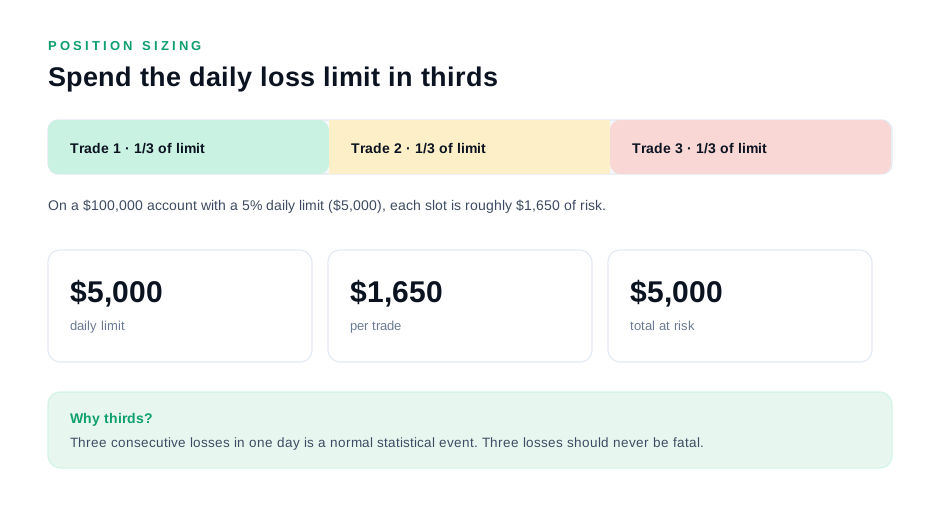
The per-trade budget is the amount risked on one position, from the entry to the stop. It should be small enough that three consecutive losses do not end the day, and large enough that the target is reachable in a reasonable number of trades. A third of the daily budget is a useful default: it requires three full losses to end the day, which is a common enough sequence to test discipline but not common enough to end the challenge quickly. A quarter is more conservative; a half is too aggressive for most traders.
| Budget | Source | Typical expression | What it controls |
|---|---|---|---|
| Account | Maximum loss | 6–12% of the account | Total room and survival |
| Daily | Daily loss limit | 3–5% of the account | The worst session |
| Per trade | Trader's rule | One third of the daily budget | The size of one position |
The relationship between the three budgets is the risk architecture. If the daily budget is 5% and the per-trade budget is one third of it, the per-trade risk is about 1.67% of the account. If the account budget is 10%, the trader can absorb six full per-trade losses before the floor, but only three before the day ends. The daily budget binds first, which is why it should drive the size.
Position sizing math
Position sizing converts the per-trade budget into a number of lots, contracts or shares. The formula is the same for every market: position size equals the dollar risk divided by the dollar distance from entry to stop, adjusted for the instrument's value per point.
The formula in words
First, calculate the dollar risk: the per-trade budget. Second, calculate the stop distance in price terms: the difference between the entry and the stop. Third, convert the stop distance into dollars per unit: for forex, the pip value times the number of pips; for futures, the tick value times the number of ticks; for shares, the price difference. Fourth, divide the dollar risk by the dollar stop distance to get the number of units.
A forex example
A $100,000 account with a 5% daily limit has a $5,000 daily budget. One third of that is about $1,667 per trade. If the stop is 50 pips away on EURUSD and one standard lot is $10 per pip, the stop distance is $500 per lot. The position size is $1,667 divided by $500, or about 3.3 lots. If the trader rounds down to 3 lots, the risk is $1,500, which is slightly below the budget. Rounding down is safer than rounding up.
A futures example
A $50,000 futures account with a $2,500 daily limit has a per-trade budget of about $833. If the stop is 10 points on the E-mini S&P and one contract is $50 per point, the stop distance is $500 per contract. The position size is $833 divided by $500, or about 1.6 contracts. Since contracts are indivisible, the trader can take one contract ($500 risk) or use a micro contract to get closer to the budget. The micro contract is the better choice when the budget is between whole contracts.
Why the stop comes first
The stop distance is an input to the size, not an output. A trader who decides the size first and then places the stop is sizing by position, not by risk. The correct sequence is: identify the setup, place the stop where the idea is invalidated, measure the distance, then calculate the size. If the resulting size is too small to be practical, the setup is not worth taking at that stop distance.
Stops and R
R is the risk unit: the dollar amount risked on a trade. A trade that risks $500 and makes $1,000 is a 2R win; one that risks $500 and loses $500 is a 1R loss. Thinking in R makes the challenge arithmetic simple and comparable across account sizes.
Converting the target into R
If the target is 10% of the account and the risk per trade is 1.67%, the target is about 6R. At 1% risk, it is 10R. The number of R is the number of normal wins required, assuming each win is 1R. If the average win is 1.5R, the target is reached in fewer trades. The R calculation tells the trader how many opportunities the challenge needs and therefore how much time it should take.
Converting the floor into R
If the maximum loss is 10% and the risk per trade is 1.67%, the floor is about 6R away. The trader can absorb six full losses before the account ends. If the daily budget is 5%, the daily limit is 3R away. The smaller number is the binding constraint. A trader who can state both numbers from memory is far less likely to breach one by accident.
Stop placement
A stop should be placed where the trade idea is invalidated, not at an arbitrary distance that makes the size convenient. If the stop is too tight, normal noise will take the trader out; if it is too wide, the size becomes too small to reach the target. The stop is a market decision; the size is an arithmetic consequence. A trader who adjusts the stop to fit the size is doing the process backwards.
| Account | Daily limit (5%) | Per trade (third) | Target 10% in R | Floor 10% in R |
|---|---|---|---|---|
| $25,000 | $1,250 | $415 | 6R | 6R |
| $50,000 | $2,500 | $830 | 6R | 6R |
| $100,000 | $5,000 | $1,667 | 6R | 6R |
| $200,000 | $10,000 | $3,333 | 6R | 6R |
The R figures are identical at every account size, which is the point: percentage rules scale exactly. A larger account is not easier or harder in R terms; it is the same challenge with larger numbers. The trader who can manage the R risk on a $25,000 account can manage it on a $200,000 account, provided the dollar swings do not change their behaviour.
Correlation and aggregate exposure
Position sizing controls the risk per trade. It does not control the risk of the book. Three positions, each sized correctly, can lose together if they are correlated, and the aggregate loss can breach the daily limit before any single stop is hit.
What correlation means in practice
Long EURUSD, long GBPUSD and short USDCHF are three expressions of the same dollar view. A dollar rally moves all three against the trader at once. The positions look diversified because they are different instruments, but the risk is concentrated. The same applies to index futures, gold and silver, and any basket of risk-on assets. The trader should treat correlated positions as one exposure, not as separate trades.
The aggregate cap
A practical rule is to cap the aggregate risk at twice the per-trade budget, or at 60% of the daily budget, whichever is smaller. If three positions are open, the sum of their risks to the stops should not exceed that cap. A trader who wants to hold more positions must reduce the size of each one. The cap is not a suggestion; it is the rule that prevents a correct set of individual decisions from becoming a collective breach.
Floating loss and the equity rule
On an equity-measured daily limit, the aggregate floating loss is the number that matters. A book of three positions can be $3,000 in floating loss at its worst point even if each position is inside its stop, and the daily budget can be consumed before the stops are hit. The trader should monitor the total floating loss, not just the risk per ticket. A simple dashboard or spreadsheet is enough; the important thing is to look at the total.
Risk across the drawdown phases
The risk should change as the account moves from the start of the challenge to the target. The phase determines which rule is closest and therefore how much room the trader has.
The start: room is widest
At the start, the account budget is at its maximum and the target is far away. The daily budget is the binding constraint, and the per-trade risk can be at its normal level. The goal is to build a buffer, not to sprint. A 2–3% gain with the daily budget intact is a better position than a 6% gain with two near-breaches, because the buffer gives the trader room to absorb a normal losing week later.
The middle: the floor may move
In the middle of the challenge, the account may be up 3–6%. On a static floor, the room is unchanged; on a trailing floor, the floor has risen and the room is smaller. The risk should be reduced if the distance to the floor divided by the per-trade risk falls below five. This is the phase where many otherwise competent attempts fail, because the trader is close enough to feel confident and far enough to keep pressing.
The final phase: protect the buffer
Near the target, the risk should be at its lowest. The remaining target is small, and the cost of a breach is the entire challenge. A trader who needs 1R to finish should risk a fraction of the normal size, not increase it to finish faster. The finish is a risk-management decision, not a trading decision.
| Phase | Account up | Binding rule | Risk posture |
|---|---|---|---|
| Start | 0–3% | Daily loss | Normal size |
| Middle | 3–7% | Daily loss; trailing floor | Normal to reduced |
| Final | 7–10% | Maximum loss | Reduced to half or less |
| Verification | Target met | Verification conditions | Minimal |
Losing streaks and risk of ruin
A losing streak is not a rare event; it is a normal part of a probabilistic process. The question is whether the streak is survivable at the chosen size. The answer can be estimated before the first trade.
The streak table
If the per-trade risk is one third of the daily budget, three losses end the day. If the per-trade risk is one sixth of the daily budget, six losses end the day. The probability of a streak depends on the win rate. A strategy with a 50% win rate will see a run of five losses roughly once in thirty-two sequences; a strategy with a 40% win rate will see it more often. The size should be chosen so that the expected worst streak is survivable.
The account floor
The account budget is the ultimate constraint. If the per-trade risk is 1.67% and the maximum loss is 10%, six consecutive losses end the account. If the trader's strategy can produce eight consecutive losses, the size is too large, even if the daily limit is never breached. The fix is to reduce the per-trade risk until the expected worst streak fits inside the account budget with a margin.
The risk of ruin
Risk of ruin is the probability of losing the account before reaching the target. It increases with size and with the length of the challenge. A trader who risks 1% per trade has a lower risk of ruin than one who risks 3%, but a longer challenge exposes the account to more opportunities for a streak. The trade-off is between speed and survival; the correct size is the one that survives the expected streak, not the one that reaches the target fastest.
The daily risk protocol
The protocol is the practical form of the framework. It should be written before the session and followed without negotiation.
- Write the three budgets in dollars. Account, daily and per-trade. Update them from current equity, not from the starting balance.
- Set the maximum number of trades. Usually two or three, depending on the strategy. The number is a cap, not a target.
- Set the session stop. Two consecutive losses, or 60% of the daily budget, whichever comes first.
- Set the aggregate cap. No more than two correlated positions, and no more than 60% of the daily budget in aggregate risk.
- Set the cut-off time. No new entries in the last hour before the daily reset.
- Record the highest floating loss. At the end of the session, write the worst unrealised point. It is the number that explains an equity-measured breach.
The protocol takes five minutes and covers the decisions that are hardest to make in the moment. A trader who follows it will still have losing days, but the losses will be inside the budgets, which means the account survives to trade another day.
Risk after a loss and after a win
The risk should change after a significant result, but not in the direction the trader usually wants.
After a loss
The instinct is to increase size to recover. The correct response is to reduce size or stop. After two losses, the trader's judgement is worse than it was at the start of the session, and the remaining budget is smaller. A reduction to half size for the next session is a reasonable response; doubling the size is the behaviour that turns a bad day into a breach.
After a win
The instinct is to press. The correct response depends on the drawdown type. On a static floor, the room is unchanged, so the risk can stay at the normal level. On a trailing floor, the floor has risen, so the risk should be reduced. A trader who keeps the same size after a large win on a trailing account is taking more risk at the moment the room is thinnest.
After a streak
After a winning streak, the trader may believe the strategy is working and increase size. After a losing streak, the trader may believe the strategy is broken and abandon it. Both responses are emotional. The correct response is to check the process: was the size inside the budget, was the stop followed, was the journal updated? If the process was followed, the streak is normal variance; if it was not, the process needs to change.
Risk and the calendar
The calendar affects risk because it determines how much time the trader has to recover from a loss. A no-limit challenge allows a patient approach; a thirty-day challenge does not. The trader should choose the size that fits the calendar, not the size that reaches the target fastest.
If the target is 6R and the trader has four weeks, a pace of 1.5R per week is enough. A pace of 1.5R per week can be achieved with one or two good trades, which means the trader does not need to press. If the target is 10R and the trader has two weeks, the required pace is 5R per week, which is much harder and encourages larger size. The calendar is a risk input, not just a scheduling detail.
A trader who is behind should extend the calendar or reduce the account size, not increase the risk. A trader who is ahead should reduce the risk and protect the buffer. The calendar is a constraint, like the daily budget; it should be managed, not fought.
A worked plan for a $100,000 account
The framework is easier to apply with a single account. The numbers below are illustrative, but the structure is the same at any size.
The inputs
A $100,000 account, a 10% target, a 6% intraday trailing maximum loss and a 3% daily limit. At the start, the floor is $94,000 and the daily budget is $3,000. The target is $10,000. The trader chooses a per-trade risk of $1,000, which is one third of the daily budget and about 1% of the account.
The R map
The target is 10R, the floor is 6R and the daily budget is 3R. The trader can absorb three full losses in a day and six before the account ends. The expected worst streak should be less than six; if it is not, the per-trade risk is too large. The trader checks the strategy's last fifty trades and finds a worst streak of four, which fits inside the floor with a margin of two.
A normal day
The trader takes two trades, one win at 1.5R and one loss at 1R. The day ends at +0.5R, or +$500. The daily budget used is 1R of the 3R, and the floor has moved up by $500 because the account is trailing intraday. The next morning, the distance to the floor is $5,500, and the per-trade risk of $1,000 is still inside the five-times rule.
A bad day
The trader takes three losses at 1R each. The daily budget is fully used, and the session ends. The account is down $3,000, the floor has not moved (because there was no profit), and the distance to the floor is $3,000. The per-trade risk is now three times the distance, which is too large, so the next session is traded at half size until the buffer is rebuilt.
The final phase
After a good run, the account is up $8,000. The trailing floor has risen by $8,000, leaving only $2,000 of room above the starting balance. The remaining target is $2,000, or 2R at the original size. The trader reduces the per-trade risk to $500, which is half the normal size, and accepts a slower finish. A normal pullback no longer threatens the floor, and the remaining target is reachable in a few trades.
The plan shows the key discipline: the size is recalculated from the current floor, not from the starting balance. A trader who keeps the $1,000 risk after an $8,000 gain is risking half of the remaining room on a single trade. The worked example is simple, but it is the difference between finishing and giving back the profit.
Common risk mistakes
- Sizing from the account balance. The daily budget is the binding constraint. Use it.
- Risking a half of the daily budget per trade. Two losses end the day, which is too fragile for most strategies.
- Ignoring correlation. Three correct positions can breach the daily limit together.
- Keeping the size after a trailing floor rises. The room is smaller, so the risk should be smaller.
- Increasing size near the target. The remaining target is small; the cost of a breach is the whole challenge.
- Moving the stop. It converts a sized risk into an unsized one.
- No session stop. The daily limit is a bound, not a target; stop before it.
- Ignoring the highest floating loss. On an equity-measured account, the worst moment is the number that matters.
The common thread is that every mistake increases the size relative to the budget at the moment the budget is smallest. The correction is always the same: reduce the size, write the rule, and check the numbers before the session.
Frequently asked questions
How much should I risk per trade on a prop firm challenge?
A third of the daily budget is a robust default. On a 5% daily limit, that is about 1.67% of the account per trade. It requires three full losses to end the day, which is a manageable sequence.
Should I risk more to pass faster?
No. A larger size reduces the distance to the floor and the daily limit at the same time. The faster finish is not worth the higher probability of a breach, especially near the target.
What is the difference between the account budget and the daily budget?
The account budget is the maximum loss that ends the account; the daily budget is the loss that ends the day. The daily budget is usually smaller and binds first.
How do I size a forex position?
Divide the dollar risk by the dollar value of the stop distance. For EURUSD, multiply the stop in pips by the pip value per lot, then divide the per-trade budget by that figure. Round down.
How do I size a futures position?
Divide the dollar risk by the tick value times the stop in ticks. If the result is between whole contracts, use a micro contract or round down to one contract.
Why does correlation matter?
Because positions that move together can breach the daily limit as a group, even when each is individually sized correctly. Treat correlated positions as one exposure.
Should I reduce size after a win?
On a trailing drawdown, yes, because the floor has moved up. On a static drawdown, the size can stay at the normal level. Check the distance to the floor, not the profit.
How much does ElitePropX charge to trade an evaluation?
The fee is a flat $220 for any firm and account size. Retries after a rule breach are included, there is no profit share, and the firm's own challenge fee is paid separately to the firm.
The risk framework in five sentences
Three budgets govern the challenge: the account, the day and the trade, and the smallest one binds. A third of the daily budget per trade is a robust default. The stop comes first and the size follows; R makes the arithmetic comparable across account sizes. Correlation and the aggregate book are the hidden risks that a per-trade rule does not cover. And the risk should fall as the account approaches the target, because the cost of a breach grows while the remaining reward shrinks.
Any firm, any size, one flat $220
We map the daily budget and the size before trading, and report progress session by session.
Related reading
- Daily drawdown explained
- Trailing versus static drawdown
- Lot size for a $100k account
- Challenge mistakes to avoid
- Challenge rules explained
- Position size calculator
- Recently passed evaluations
- Start an evaluation for a flat $220
- How to Set Stop Loss MT5
This guide is general information, not financial advice. Rules, fees and payout terms change; verify every figure against the firm's current terms before purchasing. Trading involves substantial risk of loss. ElitePropX is an independent service and is not affiliated with, endorsed by or sponsored by any proprietary trading firm.