
Long-form essay · reviewed October 2026
The prop firm passing playbook: what actually moves the needle
Most challenge advice is about finding a better strategy. The evaluation is not primarily a strategy test. It is a constraint test, and the constraint is the rulebook. This essay is about the distance between those two ideas: why profitable traders fail evaluations, what a passing service is actually selling, and which five levers move the probability of a funded account more than any indicator ever will.
Key takeaways
- An evaluation converts a trading method into a funded account only if the method survives the rulebook's loss, time and payout constraints.
- Execution is a process: a written risk plan, a daily number, a journal and a stop rule. Strategy is one input into that process, not the whole of it.
- A passing service sells the completion of a rulebook, not a market opinion. Its economics depend on the firm permitting third-party trading.
- The levers that matter are size, distribution, calendar, payout conditions and conduct — in that order.
Contents
- The thesis: a constraint test, not a strategy test
- The economics of a passing service
- Why most challenge advice misses the constraint
- The four constraints that decide the outcome
- What a funded account is actually for
- The process that survives a review
- The journal as evidence
- Five levers that actually move the needle
- Five myths that move it the wrong way
- A worked example: the same method, two rulebooks
- What this means for your next attempt
The thesis: a constraint test, not a strategy test
There is a question that separates traders who pass evaluations from traders who keep buying them: what is the evaluation testing? The common answer is "whether I can make money". The more useful answer is "whether my method can make money inside these specific limits, on this specific calendar, with these specific payout conditions". The first answer leads to strategy research. The second leads to rulebook research, and the second is where most of the improvement is available.
A constraint test is different from a performance test in one important way. In a performance test, more return is always better. In a constraint test, more return can be worse if it comes with a distribution the rules reject. A method that makes 4% a month with a maximum adverse excursion of 2% is a different product from a method that makes 6% a month with occasional 7% drawdowns, even if the second has a higher average return. The first may pass a 6% trailing floor; the second may fail it in a normal month. The evaluation is not asking which method is better in the abstract. It is asking which method fits the box.
This is why profitable traders fail. They are not lacking edge. They are applying an edge that was calibrated to a different box: a personal account with no daily limit, no consistency rule and no payout schedule. The evaluation box has all three, and the same trades that produce a good year on a personal account can produce a breach in week three of an evaluation. The trader concludes that the evaluation is unfair, or that the firm is a scam, when the more accurate conclusion is that the method was never tested against the constraints.
The practical shift is to stop asking "how do I make more?" and start asking "what does this rulebook do to my normal distribution?" That question has a concrete answer, and it can be calculated before the first trade.
The economics of a passing service
A passing service is an execution business, not a trading-advice business. Its product is the completion of a rulebook under a deadline, and its cost is the time and risk of doing that work. That framing explains most of the service's behaviour, including why the fee is flat, why the process is documented and why a serious provider refuses certain firms.
The flat fee exists because the work is roughly the same at any account size. Reading the terms, building a risk plan, executing the evaluation and reporting progress are tasks that scale with the number of rules, not with the number of dollars in the account. A $25,000 evaluation and a $200,000 evaluation require the same rule map, the same daily budget calculation and the same session log. The dollar risk is larger on the bigger account, but the process is identical. Charging more for the larger account would be charging for the size of a number rather than for more work.
The economics only work when the firm permits third-party trading. If the terms prohibit it, the service is selling a pass that can be reversed at payout. That is not a rulebook technicality; it is the difference between a product and a liability. A serious service checks the conduct section before quoting, and a quote without a terms check is incomplete. The fee is small compared with a funded account that cannot be withdrawn from, which is why the compliance question belongs before the payment, not after.
There is a second economic point that is less discussed. A service paid a percentage of profit has an incentive to reach the target quickly, because the sooner the account is funded, the sooner the payout stream begins. A flat fee removes that incentive. The service earns the same whether the evaluation takes two weeks or eight, so the economically sensible choice is the one with the highest probability of a clean pass: smaller size, more margin around the daily limit, and a refusal to trade firms whose rules make the arrangement fragile. The fee structure is not a marketing detail; it shapes the process.
Why most challenge advice misses the constraint
Search for prop firm advice and you will find an enormous supply of content about entries, indicators, sessions and psychology. Very little of it is about the rulebook, and the part that is often reduces to "don't hit your daily loss". The imbalance is understandable: strategy content is more engaging, easier to produce and easier to sell. But it misses the thing that decides most evaluations.
Consider the questions a trader actually needs answered before starting. What is the maximum loss, measured from what point? Is the daily limit on equity or closed balance, and when does it reset? Does the target have to be reached within a time limit, and is there a minimum number of days? Is there a consistency rule, and does it apply during the evaluation or only at payout? Are there conduct rules that prohibit the strategy? Those six questions determine whether the method is viable. None of them is a strategy question.
The advice gap has a cost. A trader who spends three months optimising an entry signal and one afternoon reading the terms has optimised the wrong variable. The entry signal might add 5% to the expected return; the rulebook might determine whether the account survives at all. The first hour of preparation belongs with the terms, not the charts.
There is a second reason the advice misses: the rulebook is boring. It is a list of conditions, written in legal language, with footnotes. It does not produce the feeling of progress that a new indicator does. The trader who reads it feels informed but not improved. The trader who backtests a new system feels improved but may be no closer to a funded account. The useful discipline is to treat the rulebook as the first backtest: a method that fails it is not a candidate, regardless of its equity curve.
The four constraints that decide the outcome
Every evaluation can be reduced to four constraints. They interact, and the binding one changes as the account moves.
The loss floor
The maximum loss is the constraint that ends the account. Its difficulty depends on whether it is static, end-of-day trailing or intraday trailing, and on how much room remains after profit. A static floor is the most forgiving because it never moves. An intraday trailing floor is the hardest because unrealised profit raises it permanently. The first calculation is always the distance from current equity to the floor, in dollars, divided by the normal risk per trade. That quotient is the number of normal losses the account can absorb, and it is the most important number in the evaluation.
The daily stop
The daily limit is the constraint that ends the day. Its difficulty depends on the measurement point and the reset time. On an equity-measured account, an open losing position counts before it is closed, which means the worst moment of the day matters. On a closed-balance account, only realised losses count. The daily stop is usually the first constraint to bind, because a normal losing sequence can consume it in a single session. The sizing rule that follows is to risk a fraction of the daily budget per trade, not a fraction of the account.
The calendar
The calendar is the constraint that decides whether a pass is eligible. A maximum duration punishes slow progress; a minimum trading day requirement punishes fast progress. Some evaluations have both, which creates a corridor. The calendar also affects the optimal risk: a trader with a thirty-day limit may need to take more risk than a trader with no limit, because waiting for perfect setups is expensive. The calendar is the constraint most often ignored in strategy advice, and it is the one that makes a good method fail at the end.
The payout condition
The payout condition is the constraint that decides whether a pass becomes money. Consistency rules, minimum payout days, profit thresholds and KYC requirements can delay a withdrawal even after a clean pass. A trader who passes with one exceptional day may find that the consistency rule blocks the first payout until more profit is earned on ordinary days. The payout condition is not part of the evaluation in the trader's mind, but it is part of the contract, and it should be read before the first trade.
| Constraint | What it ends | Key unknown | Number to calculate |
|---|---|---|---|
| Loss floor | The account | Static or trailing | Distance to floor ÷ risk per trade |
| Daily stop | The day | Equity or closed balance | Daily budget ÷ risk per trade |
| Calendar | Eligibility | Minimum days and time limit | Sessions required at current R pace |
| Payout condition | The money | Consistency and payout days | Profit distribution required |
The four constraints are not independent. A larger size reduces the number of losses to the floor and the number to the daily stop at the same time. A faster pace reduces the calendar risk but increases the distribution risk. A consistency rule can force more trading after the target, which increases exposure to the daily stop. The evaluation is a system of constraints, and changing one variable moves all of them.
What a funded account is actually for
A funded account is a capital allocation, not a lottery ticket. Its purpose is to produce a repeatable payout stream while keeping the account alive through normal drawdowns. That purpose changes the optimal behaviour: a trader who protects the floor and withdraws regularly will usually outperform one who swings for a large month and loses the account. The account is the asset; the monthly payout is the return on it.
The allocation also comes with a cost. Subscriptions, data fees, time and the risk of a breach are real expenses. A funded account that is not traded still costs money, and one that is traded too aggressively may not survive the quarter. The economics work when the payout exceeds the cost by enough to justify the risk, not when the headline account size is large. A $200,000 account that produces one $2,000 payout and then fails is a worse asset than a $50,000 account that produces $1,500 a month for a year.
This is why the "how much can I make?" question is the wrong first question. The better question is "how long can I keep this account alive while withdrawing?" A trader who can answer that has a business model. A trader who focuses only on the target has a project. The difference shows up in the second and third payout, not the first.
There is also a psychological dimension. A funded account feels like a reward, and rewards invite celebration. The trader who increases size after funding to "make it count" is taking more risk at the moment the account is most valuable. The correct response is the opposite: reduce size after funding, protect the first payout, and let the account prove it can survive a normal month before scaling the risk. The first payout is not the finish line; it is the first data point.
The process that survives a review
A pass is a sequence of decisions recorded in a journal: the setup, the risk, the stop, the result and the remaining room. The record is what makes the process reviewable and what makes a payout review possible. A trader who cannot show the record is relying on the firm's goodwill; a trader who can show it has evidence.
The process should also include a stop rule for the trader, not just the account. Three losing sessions in a row are a signal to review, not a signal to increase size. The account is a business asset; the process is what keeps it alive across cycles. A stop rule written before the session is a decision made by a calmer version of the trader, and it is the only defence against the version that is currently looking at a losing position.
There are four elements to a reviewable process. First, a written risk plan with the daily budget, the per-trade risk and the maximum exposure. Second, a session log with the closing equity, the distance to the floor, the percentage of target completed and the trading days used. Third, a rule map with the measurement points and reset times, dated. Fourth, a decision log for any deviation from the plan, with the reason. The four together are enough to reconstruct what happened and to answer a firm's questions.
The process is also the product a passing service sells. A service that cannot describe its process in those terms is selling an outcome, not a method.
The journal as evidence
The journal is often described as a learning tool. It is also an evidence tool, and in prop trading the second function is underrated. Firms review trading before paying, especially on large withdrawals. A journal that shows a consistent process, a clear risk unit and no suspicious patterns is a defence. A trader who cannot produce one is asking the firm to trust a story.
What should the journal contain? At minimum: the date, the instrument, the direction, the entry, the stop, the size, the risk in dollars, the result in dollars and R, the reason for the trade, and the state of the account after the trade. That is enough to show that the risk was controlled and the process was consistent. It does not need to be elaborate; a spreadsheet with those columns is sufficient.
The journal also supports the consistency calculation. If the firm applies a best-day rule, the journal shows the distribution before the payout request. A trader who can see that one day is 45% of profit can add winning days before asking for money, rather than discovering the problem after the request. The journal turns a payout rule from a surprise into a planning variable.
Five levers that actually move the needle
If the evaluation is a constraint test, the improvements that matter are the ones that change the relationship between the method and the constraints. Five levers do most of the work.
Lever one: size relative to the daily budget
This is the highest-leverage decision in the entire evaluation. Risking a third of the daily budget per trade requires three full losses to end the day; risking half requires two. The difference is not a small adjustment; it changes the probability of a daily breach by a large factor. A trader who fixes this one variable will often pass an evaluation they previously failed with the same strategy.
Lever two: the distribution of profit
Consistency rules reward an even distribution. A trader who plans to reach the target over a number of sessions, with no single day dominating, is less likely to be blocked at payout than one who makes the target in two explosive days. The lever is smaller size and more sessions, which feels slower but is more robust against the rule that actually blocks the money.
Lever three: the calendar
The calendar determines how much time the trader has to be patient. A no-limit evaluation allows waiting for good setups; a thirty-day limit does not. The lever is to choose the plan whose calendar matches the method's natural frequency. A swing method on a thirty-day plan is a mismatch; a scalping method on a six-month plan may be a waste of fees.
Lever four: the payout conditions
The payout conditions decide whether a pass becomes money. The lever is to read them before starting and to plan the distribution and the payout timing. A trader who knows the consistency rule can build the distribution from the first trade; one who ignores it may pass and still wait months for a withdrawal.
Lever five: conduct
The conduct rules decide whether the account survives a review. The lever is to avoid any behaviour that looks like an exploit and to confirm ambiguous rules in writing. A strategy that depends on a platform quirk or a news loophole is not a strategy; it is a dispute. The trader who keeps the conduct clean keeps the account.
| Lever | What it changes | Typical adjustment | Effect on pass probability |
|---|---|---|---|
| Size vs daily budget | Number of losses to end the day | One third of budget per trade | Large |
| Profit distribution | Consistency eligibility | More sessions, smaller size | Moderate to large |
| Calendar | Time available | Choose plan matching method frequency | Moderate |
| Payout conditions | Access to money | Plan distribution and timing | Moderate |
| Conduct | Account survival after review | Clean process, written confirmations | Protective |
Five myths that move it the wrong way
For every useful lever there is a popular belief that pulls the trader in the opposite direction. These five are the most common.
- "A higher win rate is the key." A high win rate with a poor risk-reward can still produce a losing streak that breaches the floor. The evaluation cares about the distribution of outcomes, not the win rate alone.
- "I need a better strategy." A profitable strategy that is incompatible with the rulebook is not a candidate. The first improvement is fit, not edge.
- "Faster is better." A fast pass can be ineligible because of minimum days, and it often requires size that makes the daily limit fragile. Speed is a constraint, not a virtue.
- "The firm is against me." Some firms are predatory, but most failures are sizing and distribution problems. Blaming the firm prevents the trader from fixing the variable they control.
- "Once I'm funded, the hard part is over." The funded phase has its own rules, including consistency and payout conditions. The first payout is the start of a new constraint set, not the end of the challenge.
The myths share a common flaw: they focus on the trader's edge and ignore the box. The correction is not to abandon strategy work; it is to put it in the right order. First, confirm the method fits the box. Then improve the method. A better method inside a bad fit is still a failed evaluation.
A worked example: the same method, two rulebooks
Consider a method with a 55% win rate, an average win of 1.5R and an average loss of 1R. The expectancy is positive: 0.55 × 1.5 − 0.45 × 1 = 0.375R per trade. Over a hundred trades, the method produces about 37.5R. That is a good method. Now put it inside two rulebooks.
Rulebook A: 10% target, 6% static floor, 3% daily, no consistency
At 1% risk per trade, the target is 10R and the floor is 6R. The daily stop is 3R, so three consecutive losses end the day. The method's longest losing streak in a hundred trades might be five, which would breach the floor if all five occurred at 1% risk. The trader reduces risk to 0.6% per trade, making the target 16.7R and the floor 10R. The daily stop is 5R. The method now survives its normal streak, and the expected time to target is about 45 trades. The calendar has no limit, so the pace is acceptable.
Rulebook B: 10% target, 6% intraday trailing floor, 3% daily, 40% consistency
The same method, the same 0.6% risk. The floor trails intraday, so a winning trade that retraces raises the floor. The effective room is smaller than 10R, especially after a good run. The consistency rule requires that no day exceed 40% of total profit, which means a single 4R day cannot dominate the target. The trader has to spread the profit across at least three days, which is compatible with the method's frequency but requires planning. The pass is still possible, but the margin is thinner and the distribution constraint is new.
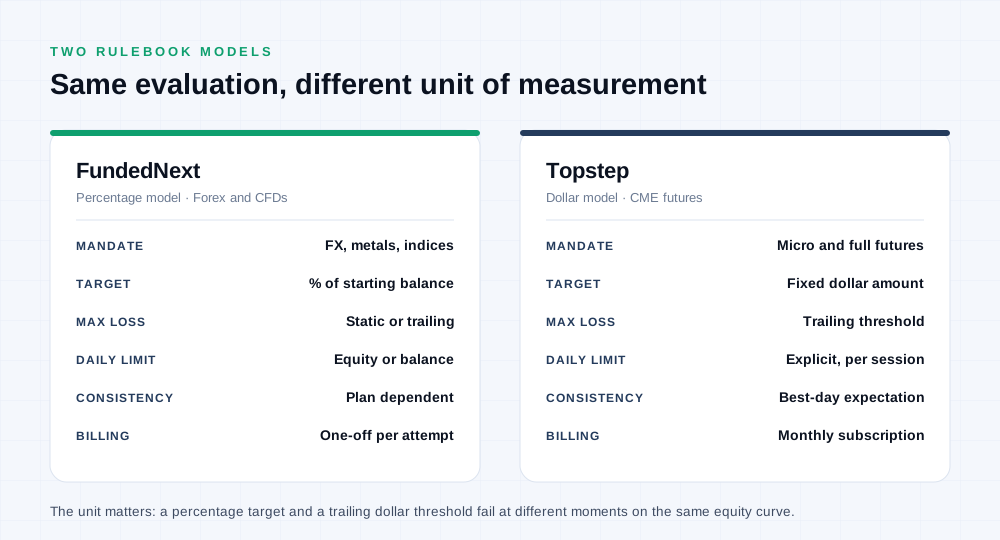
The example shows that the method did not change; the box did. The trader who understands the box can adjust size and distribution to fit it. The trader who only optimises the method will run the same 1% risk in both rulebooks and wonder why one fails. The difference between the two outcomes is not skill; it is fit.
What this means for your next attempt
The next evaluation should begin with a page, not a chart. Write the four constraints in dollars, calculate the number of losses to the floor and the daily stop, and check whether your normal distribution survives. If it does, the method is a candidate. If it does not, no entry signal will save it. That page is the first backtest, and it is the cheapest one you will ever run.
Then choose the plan whose calendar and payout conditions match the method's frequency. A method that produces a few large wins needs room and time; a method that produces many small wins needs a tight daily budget and a consistency-friendly distribution. The plan is part of the strategy, not an administrative wrapper around it.
Finally, decide who executes. If you trade it yourself, the process is your responsibility: the journal, the stop rule, the daily numbers. If a service trades it, the process is what you are buying, and the questions to ask are the ones in this essay: which constraints bind, how the size is set, how the distribution is planned, and what happens if the firm's terms prohibit the arrangement. The answers are the product. The fee is just the price.
ElitePropX charges one flat $220 for any firm and any account size, with retries on rule breaches at the same firm and size covered, no profit split, and the funded account issued in your name. The service reads the terms before accepting the job and tells you in writing what the firm’s third-party trading clause says before you pay. That is the economics of an execution business: the work is the same at any size, the process is the product, and the flat fee removes the incentive to rush a target at the expense of the rules.
Frequently asked questions
What is the main constraint in a prop firm challenge?
The rulebook, not the strategy. The loss floor, daily stop, calendar and payout condition decide whether a profitable method becomes a funded account.
Why does a passing service need a terms check?
Because third-party trading is prohibited at some firms. Without permission, a pass can be reversed and a payout refused, which makes the fee a loss rather than an investment.
What records should a trader keep?
The setup, risk, stop, result and remaining room for every trade, plus the rule summary and support replies. The record is what makes the process reviewable.
Is a higher win rate the key to passing?
No. The distribution of outcomes matters more than the win rate alone. A high win rate with a poor risk-reward can still produce a losing streak that breaches the floor.
How much should I risk per trade on an evaluation?
A fraction of the daily budget, usually one third, rather than a fraction of the account. That keeps three full losses inside the day and leaves a buffer for floating drawdown.
Does the evaluation end when I reach the target?
Not always. Minimum trading days, verification stages and payout conditions can delay funding. Read the calendar and payout sections before planning the finish.
Why do profitable traders fail evaluations?
Usually because their method was calibrated to a personal account with no daily limit, no consistency rule and no payout schedule. The evaluation is a different box, and fit matters as much as edge.
How much does ElitePropX charge for an evaluation?
One flat $220 for any firm and any account size, with retries on rule breaches covered and no profit split. The firm's own evaluation fee is separate and paid directly to the firm.
The essay in five sentences
An evaluation is a constraint test, and the rulebook is the constraint. A method that is profitable on a personal account can fail the same test if its distribution is incompatible with the loss floor, daily stop, calendar or payout condition. The five levers that matter are size relative to the daily budget, profit distribution, calendar fit, payout conditions and conduct. The process — a written plan, a daily number, a journal and a stop rule — is what makes the result repeatable and reviewable. And a passing service is an execution business: the process is the product, the flat fee aligns the incentive, and the compliance check is the first question, not the last.
Want the rulebook traded for you?
Flat $220, any firm, any account size, retries covered. We read the terms before accepting the job.
Related reading
- Challenge rules explained clause by clause
- How prop firm rules work in practice
- Daily drawdown explained
- The consistency rule guide
- Passing services compared
- The 2026 passing service review
- Recently passed evaluations
- Start an evaluation for a flat $220
ElitePropX is an independent service and is not affiliated with, endorsed by or sponsored by any proprietary trading firm. Rules, fees and payout terms change; verify every figure against the firm's own terms before purchasing an evaluation. Trading involves substantial risk of loss.