Cap each trade at a third of the daily allowance
If the daily limit is 5% of a $100,000 account, risk no more than ~$1,650 per trade. Three consecutive losers must still leave you inside the limit. This single rule prevents the majority of failures.
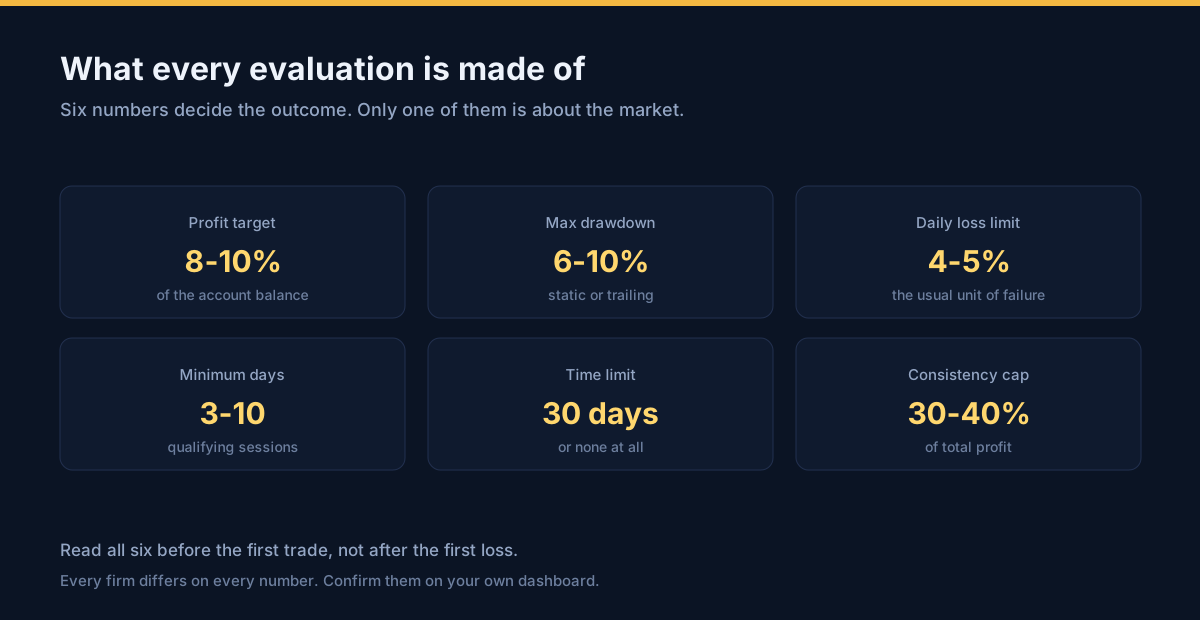
There is no shortage of FTMO advice online, and most of it is about entries. This is not that. These fifteen rules come from the failure patterns we see repeatedly, and almost none of them concern market analysis — because almost none of the failures do. Every one of them is something you can implement today without learning a new strategy.
If the daily limit is 5% of a $100,000 account, risk no more than ~$1,650 per trade. Three consecutive losers must still leave you inside the limit. This single rule prevents the majority of failures.
Floating losses count towards the daily limit in real time. A large open position can breach it before it is ever closed. Size for the worst case, not the entry.
Half the official limit, if you are prone to revenge trading. The gap between "I should stop" and "I stopped" is where accounts die.
Very few traders plan a maximum win. A ceiling keeps profit distributed evenly, which protects your payout eligibility later.
Most breaches happen in the minutes after a trader has already decided to stop. Make stopping a mechanical action, not a decision.
A 10% target across a 30-day window is roughly 0.33% per day. Framed that way there is no urgency, and urgency is the parent of most bad decisions.
FTMO requires a minimum number of trading days per phase, so you cannot pass instantly. Treat the extra sessions as free buffer to build profit evenly.
Learn the platform's execution, spread widening and slippage at minimum size. The evaluation cannot be failed by trading too small.
Invert the revenge instinct. Smaller size after losses is mechanically protective and psychologically calming.
Target, daily loss, overall loss, minimum days, verification target. If you cannot recite them, you are not ready to trade the account.
The FTMO verification phase is where a large share of otherwise successful attempts fail, and the reason is psychological rather than technical. After clearing the harder first phase, traders relax. The verification target is smaller, so it feels like a formality — and size creeps up to "get it done".
The target resets, the loss limits stay the same, and the minimum trading days apply again. Trade it with the same discipline as phase one, at the same position size. The traders who fail verification almost always failed by increasing size, not by trading badly.
News handling is the most common technical question, and the answer has two parts.
On session timing: trade your own edge's session, not the "best" session. A trader whose setup appears in the London morning should not be forcing New York afternoon trades to feel productive. On an account with a tight daily limit, forced trades are the most expensive thing you can do.
Establish platform familiarity and identify the two or three setups that consistently present themselves. Target a modest gain, not the full daily allowance.
Trade the identified setups at a size capped at one third of the daily allowance. Aim for comparable daily gains, roughly 0.3–0.6%, and bank them.
With the target within reach, hold your sizing constant. Resist the urge to accelerate. Check that your best day as a share of total profit is comfortably low.
Fresh target, same size, same discipline. Do not increase risk to finish quickly; you have already proven you do not need to.
A worked example makes the arithmetic concrete. On a $100,000 FTMO account with a 5% daily limit and a 10% target:
| Metric | Value | Why |
|---|---|---|
| Daily loss allowance | $5,000 | 5% of account |
| Max risk per trade | $1,650 | One third of the allowance |
| Consecutive losses absorbed | 3 | Leaves ~$50 of margin before the limit |
| Daily profit target | $500 – $700 | 0.5–0.7% — no urgency, well distributed |
| Days to reach target | ~15 – 20 | Comfortably inside a typical window |
Nothing in that table requires an edge superior to average. It requires only that the trader accepts a modest daily target and refuses to increase size when it feels safe to do so. That refusal is the entire skill.
If you have read this and recognised your own pattern — profitable analysis, failure on the daily limit — the honest options are to implement the sizing cap above and try again, or to have the evaluation handled. Our FTMO passing service covers both phases for a flat $220, with retries funded on managed accounts and no profit split. Full rule detail is in the FTMO challenge rules guide.
The FAQ block below covers the most common failure cause, trade frequency, sizing, the verification phase, news rules and realistic timelines. Related reading: FTMO phase 1 and phase 2 strategy and the daily drawdown explainer.
Ask us anything about your firm, your account size or whether a passing service suits you. We answer directly on Telegram — no forms, no queues.
Flat $220 per evaluation — we trade it for you and hand over a funded account. No hidden cuts, no monthly fees. Message us on Telegram and we will answer in minutes.