
Reviews · reviewed October 2026
Propfirm passing service reviews 2026
Reviews of passing services are the strangest evidence in retail trading: written by a self-selected sample, about a binary outcome, on platforms where competitors can post freely. This page sets out what the reviews actually show, which patterns carry information, and how to test a provider in an afternoon without relying on any of it.
Key takeaways
- Most negative reviews describe a firm's rule, not a provider's failure — a distinction that changes what you should check.
- The most useful positive reviews mention a rule being explained, not a pass being achieved.
- Review volume is a marketing metric; review specificity is an evidence metric.
- Any provider — including ElitePropX, at a flat $220 for any firm and size — can be tested with five questions before payment.
Contents
Why this sample is unusual
A review section is normally a sample of customers. In this category it is a sample of outcomes, because the product is binary: an evaluation either reaches its target or it does not. That single feature distorts everything downstream.
A trader who was funded and paid writes while the experience is fresh, usually within a fortnight of the payout. A trader whose evaluation failed writes immediately, often the same evening. A trader whose evaluation is still running writes nothing, and that group is the largest of the three. The published sample is therefore dominated by the two extremes and barely represents the median experience.
The three biases to correct for
First, selection: unhappy people write more often than contented ones, except in this category where a successful payout is exciting enough to produce a review. The two effects partly cancel, which is why review scores in this market cluster around extremes rather than the middle.
Second, attribution: a client cannot easily tell whether a refused payout was the provider's error or the firm's rule. Reviews frequently attribute a rulebook outcome to the service, and the reader has no way to check unless the reviewer names the rule.
Third, solicitation: reviews can be requested, and requested reviews are warmer than unsolicited ones. A cluster of five-star entries in a single week is not evidence of fraud; it is evidence of a campaign, which is a different thing and equally uninformative.
What would a good sample look like
Ideally: every client, pass or fail, reviewing within a month, naming the firm, the account size and the fee. That sample does not exist anywhere in this market, and the absence is not a conspiracy — it would require a provider to publish its own failures, which no commercial operation volunteers.
The practical substitute is to read reviews for categories rather than scores, and to test the provider directly on the things reviews cannot establish. The rest of this page is that method.
What clients praise, and whether it means anything
Positive reviews fall into four groups, and they are not equally informative.
Praise for the outcome
"Passed in 16 days" is the most common positive review and the least informative. It establishes that the service can produce a pass, which is the minimum viable claim for a business that sells passes. It says nothing about the failure case, which is where the risk sits.
Praise for communication
"Answered every question before I paid" is useful, and it has a limitation: communication before payment is the cheapest thing a provider can do well. The test is communication after payment, and specifically after a problem, which is rarely reviewed because it rarely happens to a reviewer.
Praise for the rulebook explanation
"They explained why my payout would be blocked before I even asked" is the most valuable sentence in the category. It describes the product doing its actual job — translating a rulebook into a plan — and it is hard to write convincingly without having experienced it.
Praise for speed
Fast passes read well and should be treated with mild suspicion. A pass in six days on a 10% target implies risk high enough that the account had little margin, and the same approach that produced the pass would have produced a reset in a different week. Speed is a property of the risk taken, not of the service's skill.
What clients complain about
Negative reviews cluster into six causes. Reading them by cause tells you what to check before buying; reading them by score tells you nothing.
| Complaint | Usually caused by | What to check in advance |
|---|---|---|
| Payout refused | A consistency ratio or day count in the firm's terms | The payout section, before purchase |
| Account closed after funding | A rule breach found in review | The firm's prohibition list and enforcement clause |
| No response after payment | Small operation, no process | Response time to a pre-sale question |
| Reset charged again | Firm's own reset fee, not the service's | Whether retries are covered in writing |
| Funded account not in client's name | Provider-held arrangement | Whose name is on the certificate |
| Evaluation traded too slowly | Conservative pacing | Expected timeline, agreed in advance |
Four of the six are rulebook questions that a buyer can settle before paying anything. One is a communication question answerable with a single test email. Only the last is a genuine disagreement about method, and even that is resolvable by asking for a timeline.
The complaint that should worry you most
A funded account closed after review is the worst outcome in the category, because it arrives after the work is done and the client has the least recourse. It is also the most preventable: firms that prohibit third-party trading tend to say so, and a provider that checks the policy before accepting an assignment removes the risk entirely. A provider that treats the prohibition as a technicality is transferring its risk to the client.
Five patterns worth reading for
Across review pages, five patterns repeat and each maps to a question a buyer can ask.
- Specifics predict reliability. Reviews naming the firm, size, dates and fee are checkable; reviews with adjectives are not.
- Answered negatives predict conduct. A provider who replies to a one-star review with a reason behaves differently from one who replies with a reassurance.
- Deleted negatives predict everything. A page with no negative reviews in a market where payouts are routinely refused is a page that has been curated.
- Clusters predict campaigns. Twenty reviews in a week on a service that had none for a year is solicitation, not evidence.
- Rule mentions predict competence. Reviews that mention a trailing floor, a consistency threshold or a payout window were written by clients who understood what they bought, usually because someone explained it.
How to test a provider yourself
Five questions, one email, and the answers either hold together or they do not. This is the substitute for a reliable review sample, and it takes less time than reading fifty entries.
Question one: the mechanic
"On my firm, is the maximum loss static or trailing, and if trailing does it update intraday or at the close?" The answer distinguishes a provider who has read the terms from one who has read the pricing page. It also produces a useful side effect: if the answer is wrong, everything else in the reply becomes suspect.
Question two: the payout condition
"What has to be true before my first withdrawal?" A complete answer names a profit threshold, a trading-day minimum and any consistency ratio. An incomplete answer names the threshold only, which is the one on the marketing page.
Question three: the failure case
"If a daily limit is breached in week two, what happens and what does it cost?" This is the question that matters most and is asked least. A provider who says "retries covered at the same firm and size, the firm's own reset separate" has priced the risk. A provider who says "we'll sort it out" has not.
Question four: ownership
"Whose name is on the funded account, and who receives the payout?" The only acceptable answer for a client who intends to keep the account is their own name and their own bank account.
Question five: the refusal
"Which firms will you not trade, and why?" A provider with no refusals has not read enough rulebooks. The refusals are the most informative sentence in any reply, because they show where the provider has decided to lose a sale rather than take a risk.
The honest review of this provider
Any page reviewing the category should review its own operator in the same terms, including the parts that are not flattering.
What works
One flat $220 for any prop firm and any account size, with retries on rule breaches at the same firm and size covered, no profit split, and the funded account issued in the client's name. The rulebook is read before quoting, and assignments are declined where a firm's third-party policy makes the arrangement unsafe for the client.
The fee structure is the part that is genuinely different from most of the market. A flat fee removes the incentive to keep a client trading longer than the rules require, and it removes the argument at payout about who is owed what.
What does not work as well
It is a small operation with limited capacity, so scheduling depends on how many evaluations are running at once. Verification is provided on request rather than published as a live tracker for every account, partly because several firms' platforms do not support external linking. And the fee is paid whether or not an evaluation passes, which is why the retry clause carries so much weight — without it the fee would be a bet rather than a purchase.
The honest summary is that this is a service for a trader who wants the rulebook handled and the account in their own name, and who is willing to check the terms before paying. It is not a service for someone who wants a guarantee, and it will not pretend otherwise.
Leaving a review that helps someone
Most reviews in this market are written from inside an emotion rather than from inside a file. A review that helps contains five things: the firm, the account size, the dates, the fee, and whether the payout arrived. Add one sentence on what went wrong, if anything, and one on how the provider responded.
That is about sixty words, and it is worth more than any rating. It also protects the reviewer: a specific review is harder to dispute than a general complaint, and it can be checked by anyone reading it a year later when the rulebook has changed.
What to do if a review is wrong
Providers are entitled to reply, and a reply should state the rule and the date rather than question the reviewer's competence. Where a review is factually wrong — a fee misquoted, a firm's rule attributed to the service — the correction belongs beside the original, not in place of it. Deleting a review is the one action that makes every remaining review suspect.
How a firm's rulebook manufactures reviews
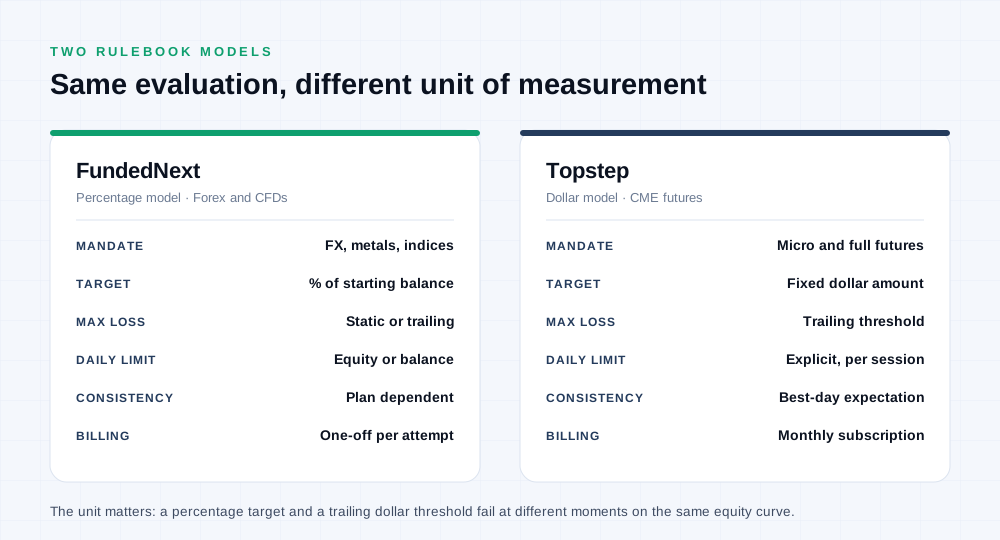
The reviews a provider receives are partly a function of the firms it trades, because some rulebooks generate complaints no matter how well they are explained. Understanding that relationship explains why a service can look excellent on one firm and dreadful on another in the same month.
Firms with consistency rules generate payout complaints
A 30% best-day rule means a profitable account can be refused a withdrawal, and the client experiences that as a service failure. The rule is disclosed, the client agreed to it, and the emotion is real. A provider trading only firms of that type will accumulate negative reviews that describe the industry rather than the service.
The defence is on the first page of the plan: a client who is told at purchase that the first payout may need more ordinary profit than the evaluation target is not surprised three weeks later.
Firms with trailing drawdowns generate reset complaints
A trailing floor makes a profitable session more fragile, and traders who give back an unrealised gain often believe the account was mishandled. On an end-of-day model the give-back is free intraday; on an intraday model it is charged. A service that does not explain the difference before trading will be blamed for the mechanic.
Firms with slow payout windows generate delay complaints
Monthly payout windows and multi-day processing produce a gap between "I earned it" and "I have it". That gap is where trust is tested, and it is the one thing a provider can manage by setting expectations rather than by promising speed.
Firms with vague terms generate disputes
Ambiguity is the real problem. When a rulebook contradicts itself, the outcome depends on who reads it, and disputes become unanswerable. That is why the assignments worth refusing are the ones where the terms are unclear, not the ones where they are strict.
Pricing across the market, in plain numbers
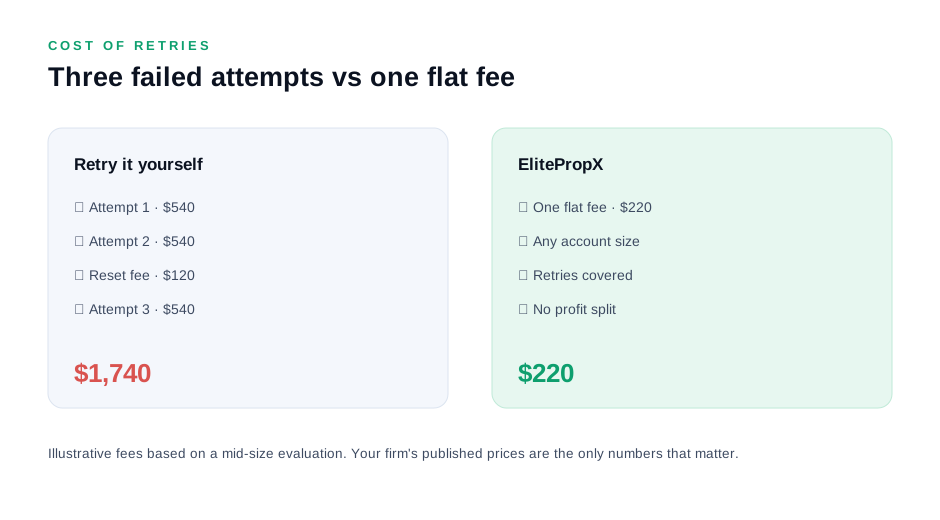
Prices in this category range from nothing to several hundred dollars per attempt, and the spread is only partly explained by quality. It is mostly explained by the model, and the model determines what the client pays over a year rather than per attempt.
| Pricing model | Typical structure | Cost after six $4k payouts |
|---|---|---|
| Flat fee | $220 per assignment, retries covered | $220 |
| Percentage split | 20–30% of every withdrawal | $4,800 – $7,200 |
| Subscription | Monthly fee while the account runs | Depends entirely on duration |
| Per-attempt resale | Low fee, no retries | Fee × expected attempts |
The subscription model deserves a note because it is the one that quietly costs the most. Its economics reward a client who pays for months without withdrawing, which is the opposite of what a funded trader should be doing. Where a subscription is the only option, the payout schedule should be aggressive enough to make the duration short.
The percentage split is the most advertised and the least examined. It is genuinely free if the service fails and genuinely expensive if the client succeeds, which means the provider's revenue is highest for the clients who need it least. That is not fraudulent, and it is a strange thing to call alignment.
What the fee does not cover
Every model leaves the firm's own challenge fee with the client, and every model treats reset charges differently. A buyer should ask for the total outlay in the failure case — service fee plus challenge fee plus reset — as a single number, because that is the number that decides whether a second attempt is affordable.
Building a shortlist without reviews
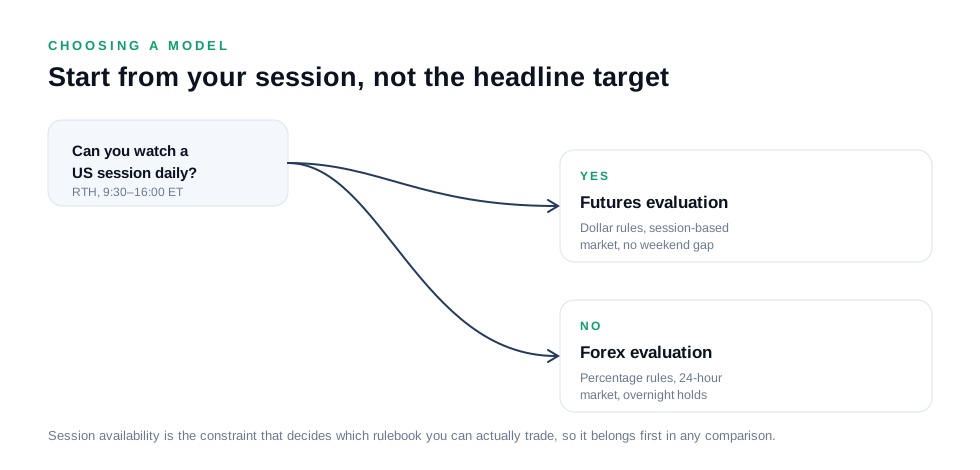
A buyer can construct a defensible shortlist in an hour without reading a single review, using four inputs that are all publicly available.
Input one: the firm rulebooks you can trade
List two or three firms whose rules suit your style. For most discretionary traders that means a static or end-of-day drawdown and a daily limit measured in a way that can be tracked. This list determines which providers are even relevant.
Input two: the fee model
Decide in advance whether you will accept a percentage split. If you intend to withdraw repeatedly, the arithmetic in the table above makes the answer obvious. If you genuinely expect one small payout, a split can be cheaper.
Input three: the refusal list
Ask each candidate which firms they will not trade. A provider whose refusals include the firms on your list has saved you both an afternoon.
Input four: the evidence
Ask for a dated certificate on a comparable firm and size. Where a live verification link exists, follow it and run the four checks: sync status, age, worst drawdown, distribution of winning days.
With those four inputs, the shortlist is usually two names, and the decision between them turns on communication and price rather than on reputation. That is a better ordering than starting from a review page and working backwards, because reputation is the one input that cannot be checked.
Common claims, translated
Marketing language in this category is consistent enough to translate. Six phrases appear constantly and each means something narrower than it appears.
"95% pass rate"
Almost always calculated on a denominator that flatters: enquiries, or clients who agreed to proceed, or passes counted against the accounts that were traded to completion. A meaningful rate needs the denominator named and the period. Where it is not named, the number is decoration.
"Funded in two weeks"
Possible, and it describes a risk level. A 10% target reached in ten trading days at 2% risk has a plausible mechanism; reached in four days it required 2.5% a day with no losing days, which is a direction rather than a process. The phrase describes the best case, not the median.
"No fee unless you pass"
More often a percentage split with a delayed payment than a free service. The money comes from withdrawals instead of a card, and the total is usually larger. That is not a deception as long as the split is stated in the same sentence, which it rarely is.
"Proprietary algorithm"
Prop firm evaluations are not an algorithmic problem. They are a budgeting problem with a rulebook attached, and the disciplines that pass them are arithmetic and consistency. A provider selling an algorithm is selling mystique; a provider selling a plan is selling the thing that works.
"Verified results"
Meaningful only if the verification is checkable. A certificate naming firm, size and date is checkable; a screenshot is not; a claim of verification without a link is a claim about the provider's own honesty, which is the thing being tested.
"Any firm, any account size"
This one is also the offer here, so it deserves a straight answer: it means the fee does not change with the firm or the size, because the work does not. It does not mean every firm is acceptable — firms that prohibit third-party trading are declined — and any provider using the phrase should be asked which firms it excludes and why.
A worked provider comparison, start to finish
A trader with a $50,000 futures evaluation in mind, a modest edge, and roughly three weeks available. Four candidates, all found through search results rather than reviews.
Candidate one: flat fee, retries covered
$220, retries on rule breaches at the same firm and size, funded account in the client's name. The reply to the first email names the firm's drawdown mechanic correctly and explains why the trailing floor makes exits important. The refusal list includes two firms the trader had considered, with rulebook reasons.
Candidate two: 25% split, no up-front fee
Free to start, 25% of each withdrawal, funded account held by the provider. Over five $3,000 withdrawals the cost is $3,750 against $220. The email does not mention the payout conditions and answers the drawdown question with a percentage.
Candidate three: low fee, no retries
$99, no retries, client holds everything else. On a first attempt the arithmetic is acceptable; on an expected two attempts it is $198 plus the firm's reset charge, and neither attempt is informed by the first, because there is no process to improve.
Candidate four: subscription
$150 a month while the evaluation is live. A three-week evaluation costs about $115, which looks like the cheapest option until the payout phase extends the subscription by another two months. The model's incentives point at duration, which points away from the client's interest.
| C1 flat | C2 split | C3 cheap | C4 subscription | |
|---|---|---|---|---|
| Cost over a year | $220 | ~$3,750 | ~$198 + resets | ~$900 |
| Rulebook answer | Correct and unprompted | Percentage only | Vague | Correct |
| Funded account held by | Client | Provider | Client | Client |
| Failure risk | Provider, within retry term | Delayed payouts | Client, in full | Client, via duration |
Candidate one wins on three of four criteria and is the only one that answered the rulebook question without prompting. Candidate four is the interesting case: its pricing looks competitive per month and becomes expensive because the payout phase is slow, which is a rulebook fact the buyer has to know in advance.
What the comparison shows
The decision did not require any reviews. It required the firm's rulebook, four questions, and a multiplication. Reviews would have added colour and no new information, which is the correct role for them in this category: colour, notes, and questions to ask — not a verdict.
The first week with a provider, and what to expect
Reviews rarely describe the first week, and it is where most of the avoidable friction lives. Six things should happen, and their absence is a signal rather than a delay.
One: a written rulebook summary before trading
Before a single order, the client should receive the firm's numbers in writing: daily budget, failure distance, target, payout conditions and the firm's position on third-party trading. This document is the reference point for every later conversation, and a provider who does not produce one is improvising.
Two: an agreed timeline
Two to four weeks is the honest range for most evaluations. A provider quoting four days is describing the best case, and a provider quoting six weeks should explain which constraint is binding. Either is fine as long as the number is checkable against the plan.
Three: confirmation the evaluation has started
A date, ideally with an account identifier. Vague reassurance that "we're on it" costs nothing to give and nothing to verify, which is exactly why specificity matters here.
Four: a mid-point update, unprompted
The useful update is short: sessions completed, profit to date, distance to the failure level, and whether any rule has been approached. A provider that only reports at the end has removed the client's ability to ask a question at the point where questions are still useful.
Five: the pass, with evidence
On a pass, the certificate or dashboard should arrive with the funded login details. Where a firm supports external verification, the link should arrive too. This is the moment the arrangement becomes checkable, and it should not require a request.
Six: the failure, explained
Failures happen. What matters is whether the report names the rule that was breached, the session it happened in, and what changes before the retry. A failure without that explanation is a payment without a product.
The summary this page would put in a review
If this article were written the way reviews are normally written, it would be a score out of five and an adjective. The method above is the alternative, and it produces three sentences instead of a rating: the reviews in this category describe outcomes more than conduct, the failures that matter are payout conditions that could have been read in advance, and a provider can be tested in one email with five questions.
Applied to ElitePropX, that test produces a flat $220 for any firm and any size, retries covered on rule breaches at the same firm and size, no profit split, and the funded account in the client's own name — plus a refusal list that includes firms whose terms make the arrangement unsafe. The weaknesses are worth stating in the same breath: a small operation with limited capacity, verification provided on request rather than published per account, and a fee payable whether the evaluation passes or not.
That is what a review looks like when it is written to be useful rather than to be persuasive, and it is the standard a buyer should hold every page in this category to — including the ones that rank well and the ones that rank badly.
One last point about scores. A five-star average from nine reviews is statistically meaningless, and so is a four-star average from forty in a market where a single refused payout produces a one-star entry. Read the text, ignore the average, and leave the page with a question rather than an opinion — the question is worth more when you email the provider.
Which question, though, depends on your firm. A trader on a trailing-drawdown futures account should ask about exits and the floor's update timing; a trader on a static-drawdown forex account should ask about how floating losses are counted against the daily limit. Same five questions, different weightings, because the rulebook that will decide the outcome is not the same one, and the provider's answer to it is the single most useful thing a review page cannot give you. Ask it before you pay, and treat a vague answer as the most useful review you will read all year — and then go and ask it.
Frequently asked about passing service reviews
Are reviews of passing services trustworthy?
As a sample, no: they are self-selected, small and often attribute a firm's rule to the provider. As a source of specific details — firm, size, dates, payout outcome — they are useful, and those details can be checked.
Why do most complaints mention refused payouts?
Because payout conditions are the least-read part of a rulebook. A consistency ratio or a minimum day count can block a withdrawal on a profitable account, and the client experiences that as a service failure when it is a term they agreed to.
What is the flat fee at ElitePropX?
$220 for any prop firm and any account size, with retries on rule breaches at the same firm and size covered, no profit split, and the funded account issued in your name.
What should I check before paying a passing service?
That the firm permits third-party trading, that the retry terms are in writing, that the funded account will be in your name, and that the provider can explain your firm's drawdown mechanic without prompting.
Is a fast pass a good sign?
Not necessarily. A pass in six days on a 10% target implies risk high enough that the account had little margin, and the same approach would have failed in a different week.
How do I verify a provider's results?
Ask for a dated certificate naming the firm and account size, plus a live verification link where the platform supports one. A payout receipt closes the loop; a screenshot does not.
Can I leave a review here?
Yes, including a negative one. It is published with personal details removed, and where a correction is needed it is added as a reply rather than by deleting the original.
What if my firm bans third-party trading?
You are told before you pay and the assignment is declined. Enforcement after funding is the worst outcome available to a client, so the policy is checked first.
Any firm, any size, one flat $220
One flat $220 for any prop firm, any account size. Retries covered, no profit split, funded login in your name. If your firm bans third-party trading we tell you before you pay, and we will not take the job.