
FundedNext review · October 2026
FundedNext review 2026: what you buy, what it costs, where it bites
Most reviews of this firm describe the challenge. This one reviews the purchase: what each model actually asks of an account, what an attempt costs relative to the capital it unlocks, which add-ons are worth paying for, and the three clauses that decide whether a funded account ever produces a payment. The figures below are the published terms as of October 2026, read from FundedNext's own help centre and plan pages rather than from promotional copy.
Key takeaways
- Two models with opposite problems: the one-step asks for 10% inside a 3% daily stop, the two-step splits 8% and 5% inside a 5% daily stop.
- Price per attempt runs from roughly $60 on a $6,000 account to about $1,100 on $200,000, so the fee is never the expensive part — the retry is.
- Quick Strike must stay under 30% at all times, in both models, and it is measured per reward cycle.
- Expert advisors are only permitted below $50,000, which rules the automated route out for the accounts that pay most.
- The base reward share is 80%; the 95% lifetime add-on is the only upgrade with a clear break-even.
- The no-minimum-days add-on exists only on the three smallest accounts, which is where it matters least.
Contents
- The short verdict
- The model family in 2026
- What an attempt costs
- The one-step arithmetic
- The two-step arithmetic
- The Quick Strike gate
- Add-on economics
- Payout terms and rhythm
- What this review cannot verify
- Who each model fits
- FundedNext against three rivals
- The flat-fee alternative
- Bottom line
- Frequently asked about FundedNext
The short verdict
FundedNext is a professionally run evaluation business with a rulebook that is unusually well documented for the sector: each model has its own help-centre article stating the target, both loss limits, the minimum day count, the time limit and the automation policy in the same place. That documentation is worth something. Half the disputes in this industry come from traders who bought a plan without reading terms that were never clearly stated; here the terms are stated, and the honest criticism is that some of them are stricter than the marketing headline suggests.
The structural finding is that the two models answer opposite problems. The two-step spreads a 13% total target across two phases with a 5% daily stop and a 10% maximum, which is generous relative to what it asks. The one-step asks for 10% in a single arc with a 3% daily stop and a 6% maximum, which is one of the tightest risk-to-target ratios among mainstream CFD evaluations. Neither is unfair; they test different things. Buying the one-step because it is faster, when your plan was built for a 5% daily stop, is the most common expensive mistake this firm's product line invites.
| Dimension | Score | Basis |
|---|---|---|
| Rule clarity | Strong | Per-model help articles with complete parameter tables |
| Target-to-risk generosity | Mixed | Two-step generous, one-step tight |
| Price per attempt | Competitive | Broadly in line with FTMO and below FXIFY on mid sizes |
| Payout flexibility | Good | Five-business-day rhythm on one-step, 21-day base cycle on two-step |
| Automation policy | Restrictive | EAs barred at $50,000 and above |
| Hidden difficulty | Moderate | Quick Strike gate applies in every cycle |
The model family in 2026
The Stellar range is the core of the CFD offering: a one-step, a two-step, and a Lite variant that reduces the second target in exchange for a lower first-phase ask. There is also an instant funding product and a futures programme. This review concentrates on the two models a CFD trader is actually choosing between, because the Lite and instant products are variations on the same arithmetic rather than separate arguments.
| Parameter | Stellar 1-Step | Stellar 2-Step |
|---|---|---|
| Phases | One | Two |
| Profit target | 10% | 8% then 5% |
| Daily loss limit | 3% | 5% |
| Maximum loss limit | 6% | 10% |
| Minimum trading days | 2 | 5 per phase |
| Time limit | None | None |
| Reward share | 80% base | 80% base |
| Quick Strike ceiling | Under 30% | Under 30% |
| Automation | EAs below $50,000 only | EAs below $50,000 only |
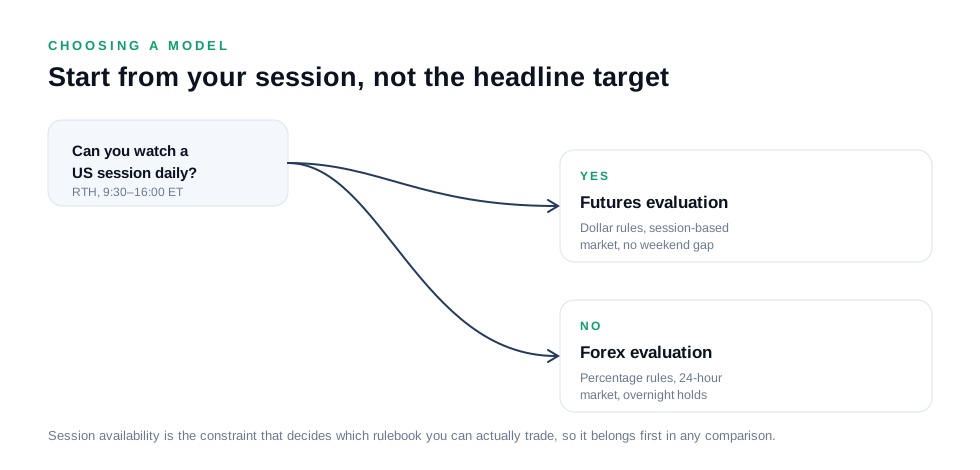
The minimum-day figures deserve a note because they invert the usual expectation. The one-step, which sounds like the impatient product, asks for two qualifying days; the two-step asks for five per phase, or ten in total. A trader who wants to finish an attempt in a week is therefore buying the model with the tighter risk limits, not the looser ones.
What an attempt costs
The published price list makes the fee look like the cheap part of the transaction, and it is. On the two-step, a $100,000 attempt lists at $549.99 and a $200,000 attempt at $999.99; on the one-step the same sizes list at $569.99 and $1,099.99. Set against the capital those accounts control, the fee is between half a percent and one percent of the balance.
| Account size | Stellar 2-Step | Stellar 1-Step | Fee as % of balance (two-step) |
|---|---|---|---|
| $6,000 | $59.99 | $65.99 | 1.00% |
| $15,000 | $119.99 | $129.99 | 0.80% |
| $25,000 | $199.99 | $219.99 | 0.80% |
| $50,000 | $299.99 | $329.99 | 0.60% |
| $100,000 | $549.99 | $569.99 | 0.55% |
| $200,000 | $999.99 | $1,099.99 | 0.50% |
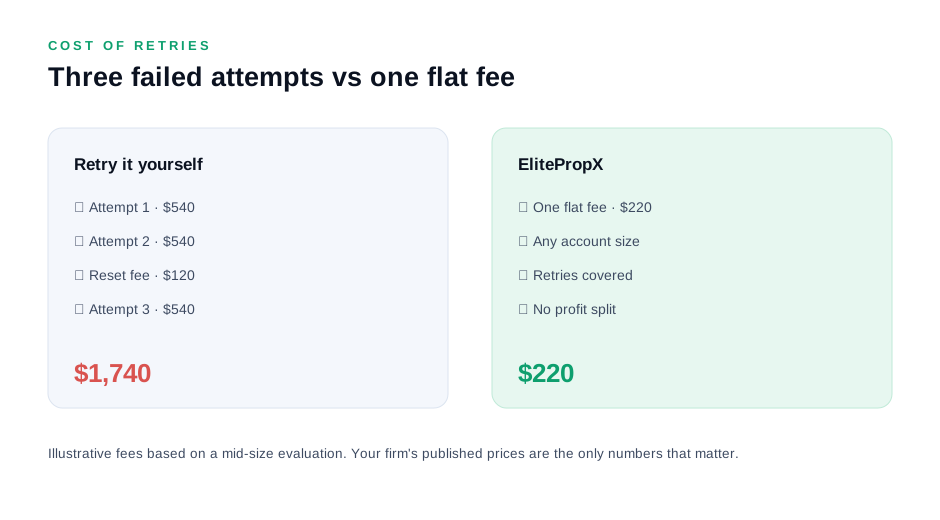
Read the last column as a measure of how much the fee matters, and it says: not much. The real cost of an evaluation is the expected number of attempts. A trader who passes first time pays one fee. A trader with a 30% pass probability pays, on average, about three, which turns a $549.99 attempt into $1,650 of expected cost for the same $100,000 account — and that is before counting the weeks spent.
Retries are the budget line. Before buying, write down your pass probability and multiply. If the honest answer is "one in three", the plan should budget three fees per funded account, and any route that removes retry cost deserves to be priced against that number rather than against a single attempt.
The one-step arithmetic
The one-step is the model that punishes a sizing mistake fastest. Its 10% target sits above a 6% maximum loss, so the target is 1.67 times the total risk the account is ever allowed to take. No plan can lose a third of its target and continue; there is simply not enough room. Compare that with a two-step, where phase one's 8% target sits inside a 10% maximum and the ratio is a comfortable 0.8.
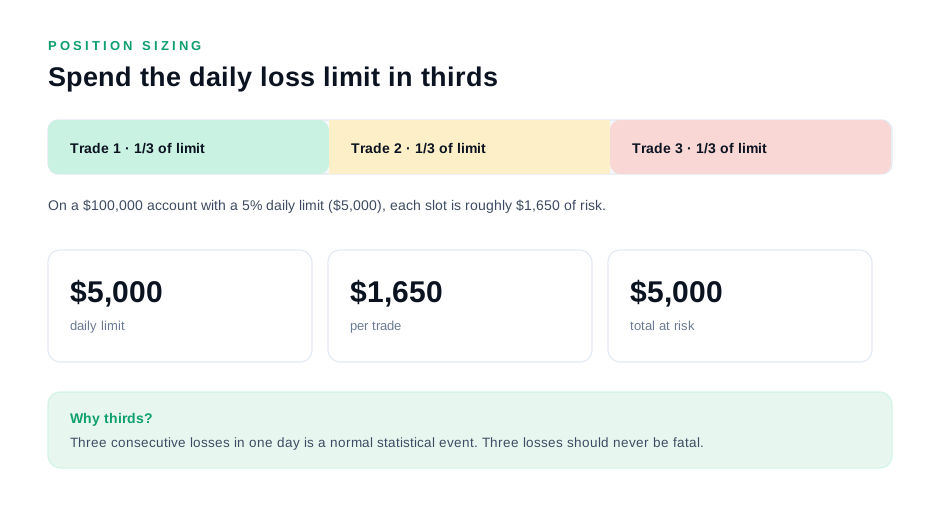
The daily limit compounds the problem. A 3% daily stop inside a 6% maximum means two full losing days end the account. Three consecutive losses at 1% use the whole day. The arithmetic does not make the one-step impossible; it makes it narrow, and it eliminates the traditional evaluation strategy of taking several medium-sized swings a week and hoping one lands.
| Sessions used | Required pace per session | Share of the $3,000 daily budget | Character of the plan |
|---|---|---|---|
| 10 | 1.00% | 33% | Aggressive; one bad day is a third of the maximum |
| 15 | 0.67% | 22% | Workable for a high hit-rate method |
| 20 | 0.50% | 17% | The realistic target for a discretionary plan |
| 40 | 0.25% | 8% | Patient, and the safest version of the same target |
The row that sells the model is the last one. There is no time limit, so a trader can take forty sessions at a quarter of a percent and never stress the daily stop. The row that kills accounts is the first, because a 1% average day inside a 6% maximum is a plan that expects to be right quickly, and the one-step's whole design assumes the opposite: a small number of high-conviction trades rather than a stream of them.
What the one-step genuinely rewards is selectivity. A trader with an edge that fires four times a month and produces 2.5% when it works is better served here than by any two-step, because the two qualifying days are easy to meet, the target arrives after four good trades, and the 5%-per-phase day count of the two-step would simply stretch the calendar. A trader who needs fifteen trades a week should not be in this model at all.
The two-step arithmetic
The two-step is the more forgiving product and the more expensive one in calendar terms. Phase one asks for 8% against a 5% daily stop and a 10% maximum; phase two asks for 5% against the same limits, with five trading days required in each phase. Total target is 13%, total risk is 10%, and the ratio is the most comfortable in the firm's CFD range.
The checkpoint is the feature worth paying for. A trader who clears phase one has a validated method and a fresh phase with a smaller target and the same limits; the maximum drawdown resets to the phase-two starting balance, so the 10% floor is ten points below the new balance rather than nine points below a balance that already absorbed a drawdown. That reset is the difference between a two-step and a single long attempt, and it is the reason a slower model is often the faster route to a funded account for a trader whose problem is temperament rather than analysis.
| Phase | Target | Daily budget | Maximum floor | Minimum sessions |
|---|---|---|---|---|
| Phase 1 | 8% — $8,000 | 5% — $5,000 | 10% — $90,000 | 5 |
| Phase 2 | 5% — $5,000 | 5% — $5,000 | 10% — resets to phase-two balance | 5 |
| Combined | 13% — $13,000 | $5,000 per day | Never more than 10% below the phase start | 10 |
Where the two-step punishes is the day count combined with a fast start. A trader who clears phase one in six sessions and then pushes phase two at the same intensity is running 13% of target against ten days of requirement in a market that has to cooperate twice. The correct reading of a five-day minimum is not "five days is enough" but "the minimum is the floor, and the plan's pace should be set by the target".
The Quick Strike gate
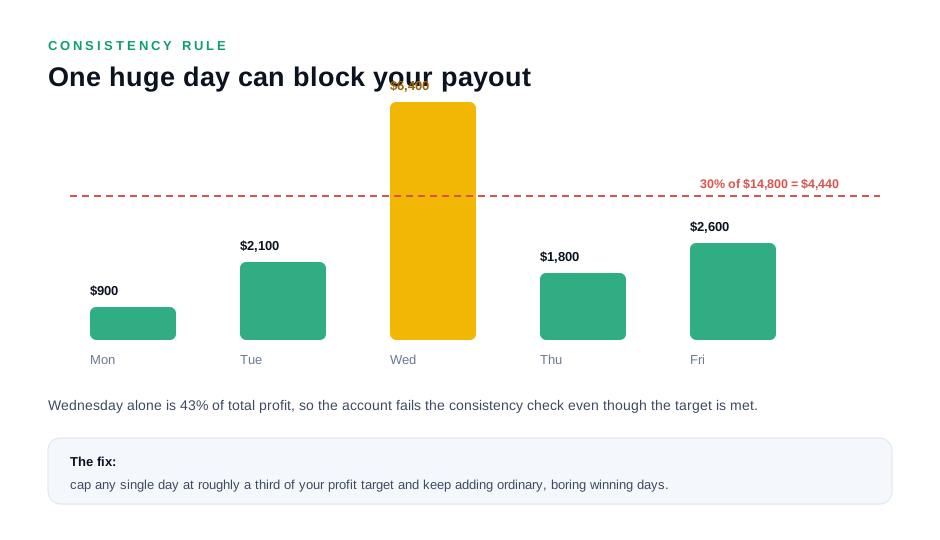
Both models carry a rule that most review sites skip: Quick Strike must stay below 30% at all times. FundedNext defines a Quick Strike trade as one closed within thirty seconds of opening, and the Quick Strike percentage as the share of total recorded profit derived from those trades, evaluated per cycle. In plain terms, if a third of your profit comes from positions held for less than half a minute, the reward request can be refused and the account reviewed.
This is not a prohibition on scalping. A scalper who holds for two minutes is unaffected. It is a prohibition on a specific shape: many tiny fast wins that add up to a large share of the cycle's profit. That shape appears in latency-sensitive strategies, in grid and tick-scalping systems, and occasionally in a manual trader who happens to close quickly during news. It is the one rule in the firm's range that a profitable trader can breach without ever losing money.
| Cycle profit | Profit from sub-30-second trades | Share | Position |
|---|---|---|---|
| $10,000 | $2,000 | 20% | Comfortably inside the ceiling |
| $10,000 | $2,900 | 29% | Inside, with almost no margin |
| $10,000 | $3,200 | 32% | Above the ceiling — request at risk |
| $4,000 | $1,400 | 35% | Above the ceiling on a small cycle |
Two mitigations are cheap. The first is a hold timer: a rule that no position is closed inside sixty seconds converts a borderline strategy into a compliant one at the cost of a few ticks of slippage. The second is volume: a large slow trade dilutes the fast share, because the test is a proportion rather than an absolute. Neither is a strategy change; both are engineering around a measurement.
Add-on economics
The add-on list is where a review earns its keep, because it is where the firm's margin lives. Eight options are offered at checkout on the two-step: swap-free trading, a lifetime 95% reward share, a no-minimum-days waiver, a 150% reward refund, a bi-weekly reward cycle, EA access, VPS with EA, and a second account at a discount after phase one.
The 95% lifetime upgrade is the only one with an unambiguous break-even. It raises the reward share by fifteen points permanently, including after any scale-up. On a $100,000 account, a single $5,000 reward cycle at 80% pays $4,000 and at 95% pays $4,750 — a $750 difference on one cycle. If the add-on costs less than that, it pays for itself on the first withdrawal and is close to free thereafter.
The no-minimum-days waiver is the opposite case. It removes the challenge-phase day requirement, but it is only sold on the $6,000, $15,000 and $25,000 accounts. Those are precisely the accounts where five trading days is cheap to satisfy with small positions, because a qualifying day needs one trade rather than a profitable day on the two-step. The waiver solves a problem that the small account does not have.
The 150% reward refund converts the subscription fee into a refundable amount credited at the first or third reward. It is a financing arrangement rather than a discount: you are paying now for a credit later, and the value depends on whether you reach a reward at all.
| Add-on | What it changes | Worth buying when |
|---|---|---|
| Lifetime 95% reward | Reward share, permanently | Almost always, if the price is below one cycle's uplift |
| Bi-weekly reward | Cycle length from 21 days to 14 | You want cash flow rather than compounding |
| EA access | Automation below $50,000 | Your strategy is mechanical and the account is small |
| Swap-free | Overnight financing cost | You hold positions for days on pairs with expensive carry |
| Double up | A second account at 60% off after phase one | You have already proven the method on the first |
| 150% reward refund | Timing of the fee credit | You are confident of reaching a reward |
| No minimum days | Five days per phase, small accounts only | Rarely — a day is one trade, not a profit target |
Payout terms and rhythm
The base reward share is 80% on both models. The one-step pays on a five-business-day rhythm; the two-step runs an initial 21-day trading cycle, which the bi-weekly add-on shortens to fourteen days from the start. The fee is refundable under the 150% add-on arrangement described above, and the reward is requested against a cycle rather than on demand.
Three consequences follow, and they matter more than the headline percentage. First, an 80% share is competitive but not the best available: firms with 90% shares exist, and the gap on a $5,000 cycle is $500. Second, cycle length is a cash-flow parameter, not a performance one — a trader who intends to compound should care less about the rhythm than one who needs the money. Third, every gate described in this review is tested at the reward request, not during the evaluation, so a clean pass and a compliant cycle are two separate achievements.
| Stage | What is checked | Typical failure |
|---|---|---|
| Cycle completion | Trading days and cycle dates | Requesting before the cycle closes |
| Profit validation | Closed profit against the cycle | Depending on floating positions |
| Quick Strike | Sub-30-second share of profit | A scalping method that was never measured |
| Conduct review | Copying, automation, account access | Sharing an account with a third party |
| Verification | Identity documents on file | Expired ID, mismatched address |

The verification point is the one traders control completely. FundedNext uses a single profile-level identity check that applies to every account, reviewed in roughly two days, requiring a photo of a physical ID and a liveness check. Completing it before the first cycle closes removes the only gate that can delay a payment for reasons unrelated to trading.
What this review cannot verify
An honest review has to say where its evidence stops. Everything above is a published term, which is a fact about the contract. Whether a firm pays promptly, how often reward requests are refused, and what support does when a review drags are questions about operations, and no public source settles them.
Two things would settle them, and neither is available here. A payout ledger with dates and amounts would show whether the stated rhythm is the actual rhythm. A sample of refused requests with reasons would show whether the Quick Strike gate is enforced narrowly or used broadly. Without either, a review can only say that the terms are clearly written, the documentation is better than the sector average, and the operational claims are the firm's own.
What a reader can do instead is reduce exposure to the unknown. A first reward requested at the earliest permitted date and at a modest size tests the pipe cheaply. Photos of the dashboard at each stage, a written record of reward requests, and a copy of the terms in force on the purchase date all convert an operational dispute from an argument into a document. That is worth more than any review's opinion, including this one.
Who each model fits
The firm's range is broad enough that fit is a genuine question rather than a rhetorical one. The matrix below is a decision aid: it maps a trader's actual behaviour onto the model whose arithmetic rewards it.
| If this describes you | Choose | Because |
|---|---|---|
| Four to eight high-conviction trades a month | One-step | Ten percent arrives in a handful of trades; two qualifying days is trivial |
| Fifteen or more trades a week | Two-step | The 5% daily stop gives a normal losing day room to exist |
| A method with a 40–50% hit rate and 2:1 payoff | Two-step | Phase targets are reachable without a hot streak |
| You need a funded account inside a month | Neither, honestly | Both reward a full cycle of days; the calendar is the constraint |
| Mechanical strategy on a $15,000 account | One-step with EA add-on | Automation is permitted below $50,000 |
| Mechanical strategy on a $100,000 account | Not this firm | EA access is barred at $50,000 and above |
| You want the largest possible split | Either, with the 95% add-on | The base 80% is the weakest term in the range |
The row about automation is the sharpest limit in the range, and it deserves emphasis rather than a footnote. A trader running an expert advisor on a $100,000 account cannot use this firm's CFD models, because the add-on is disabled at that size and above. That is a policy choice with a clear rationale — large automated accounts are the hardest to risk-manage — and it is also an outright disqualification for a whole category of trader who would otherwise find the two-step attractive.
FundedNext against three rivals
The useful comparison is structural, because headline targets across the industry have converged. What differs is how each firm splits target against maximum loss, and how much of the daily limit it allows you to spend.
| Term | FundedNext 2-Step | FTMO | FXIFY Pro | FundingPips |
|---|---|---|---|---|
| Total target | 13% | 15% | 12% | 13% |
| Daily limit | 5% | 5% of equity | 4% | 5% |
| Maximum limit | 10% | 10% static | 8% static | 10% static |
| Minimum days | 5 per phase | 4 per phase | 3, at +0.5% | None typical |
| Consistency | Quick Strike only | None in evaluation | None | None in evaluation |
| Where it bites | Cycle gates | Equity-based daily stop | Qualifying-day rule | Tight floors on cheap plans |
Seen this way, FundedNext's two-step sits in the middle of the field and its strength is the reset between phases rather than any single number. FTMO's differentiator remains the equity-based daily stop, which is stricter than it reads because an open loss consumes the allowance before the position closes. FXIFY's is choice, with three genuinely different two-phase rulebooks. FundingPips competes on price. None of those differences will matter as much as the trader's sizing plan, which is the unglamorous conclusion of every comparison in this industry.
The flat-fee alternative
There is a commercial alternative to buying attempts, and it should be evaluated with the same arithmetic as the retry budget above. A flat $220 covers an evaluation and its retries on any account size, against $549.99 for a single $100,000 attempt on the two-step. On those numbers the flat fee is cheaper than two attempts and comparable to one, which is why the case for it is about variance rather than about price.
The rule that has to be disclosed with it is straightforward. FundedNext's terms prohibit unauthorised third-party access to an account, and a funded account produced in breach can be voided when the reward is requested. A client who buys a pass is therefore accepting a risk that falls on them at the payout, not at the pass. That is the arrangement in writing, and any service that presents it as frictionless is misrepresenting the terms. The propfirm passing service sets out what is included, how the disclosure works, and the firms where the clause is prohibitive.
What the service cannot do is substitute for a plan. A trader whose sizing breaches a 5% daily stop will breach it on a funded account too, and the funded account is where the money is. The honest sequence is: build a plan that survives the strictest limit in the model you are buying, run it on a demo for a cycle, and then decide whether the evaluation is worth doing yourself. The service comparison covers the cases where buying the attempt is the rational choice.
Bottom line
FundedNext is a good product with one clear restriction and one clear cost. The two-step is among the more sensible CFD evaluations available, because 13% of target inside a 10% static maximum, split by a checkpoint and a reset, is a structure that rewards process. The one-step is a specialist instrument: appropriate for a selective trader with a small number of high-conviction setups, and a trap for anyone who buys it expecting speed without changing their sizing.
The restriction is automation above $50,000. The cost is the base 80% reward share, which is a few points below the best in the market and worth upgrading at checkout for most traders. The risk is procedural rather than arithmetic: the cycle gates, the Quick Strike measurement and the verification queue are all places where a profitable account can wait.
If the decision comes down to one sentence: buy the two-step if your plan needs room and your calendar is flexible; buy the one-step only if your trade count is low and your risk per trade is already below a fifth of a percent of the balance. Everything else about the choice is detail. The traders who fail either model do so by sizing for the target instead of for the limit, and no evaluation design has ever fixed that.
Frequently asked about FundedNext
Is the one-step or the two-step easier to pass?
The two-step, for most discretionary traders. Its 13% total target sits inside a 10% maximum and a 5% daily stop, and the phase reset gives the account a second full allowance. The one-step asks 10% against a 6% maximum and a 3% daily stop, which leaves almost no room for a normal losing sequence.
What exactly is the Quick Strike rule?
Trades closed within thirty seconds of opening count toward a Quick Strike percentage, defined as their share of total recorded profit for the cycle, which must stay under 30%. It is measured per cycle, so a compliant month followed by a scalping sprint can still put a reward request at risk.
Can I use an expert advisor?
Only on accounts below $50,000, and the EA add-on must be purchased. On $50,000 and above the add-on is disabled and trading must be manual. That is a hard boundary rather than a guideline, so an automated strategy on a large account needs a different firm.
What is the base reward share, and should I upgrade?
Both models start at 80%. The lifetime 95% add-on raises it permanently, including after scale-up, and pays for itself within a single reward cycle on a five-figure profit if the add-on price is below that uplift. It is the one upgrade in the list with a clean break-even.
How often are rewards paid?
The one-step pays on a five-business-day rhythm. The two-step runs an initial 21-day trading cycle, which the bi-weekly add-on shortens to fourteen days from the start. Cycle length is a cash-flow decision rather than a performance one, so it should be chosen from your needs, not from the number.
Do the loss limits trail or stay fixed?
They are fixed: the balance or equity may not fall below 90% of the initial balance on the two-step, or 94% on the one-step, at any point. Profit therefore adds room rather than moving the failure line, which is the opposite of a trailing structure and the reason a profitable account here is safer, not closer to failure.
Is there a time limit on either challenge?
Neither model has one. The constraint is the minimum-day requirement rather than a deadline, which means a slow plan is permitted and the only schedule that matters is the one you write for yourself.
How long does verification take?
FundedNext states roughly two days for the profile-level identity review, which covers a photo of a physical ID and a liveness check, and applies to every account you hold. Submitting does not equal approval, and the documents must be approved before a funded account is issued.
What is the Double Up add-on?
A second identical challenge at a 60% discount, unlocked after passing phase one, with a maximum total allocation of $600,000. It is a reasonable purchase for a trader who has just demonstrated the method on the first account and a poor one for a trader who wants two attempts at the same unresolved sizing problem.
Are the published prices the whole cost?
No. Commissions, spreads and swaps apply according to the account's pricing feed, add-ons are charged at checkout, and retries are charged in full. The fee as a share of the balance is small, between 0.5% and 1% on the listed sizes, but the expected number of attempts is the number that decides the budget.
Can I run two challenges at the same time?
Copy trading between challenge accounts owned by the same trader is permitted, which makes two simultaneous attempts technically possible. Strategically it is a poor use of risk: correlated positions across accounts create conduct questions and double the chance of two breaches from one bad session. Sequential funding remains the better pattern.
Is FundedNext a good choice for a flat-fee pass?
The two-step is, because its limits are the most forgiving in the firm's CFD range and a disciplined execution can work inside them. The one-step is the harder sell for a service, since a 6% maximum leaves little room for an execution error. The service terms explain how the account-access clause is handled before payment.
Where these rules come from
Firm figures on this page are read from the rulebooks below rather than from other comparison sites. Every link was opened and checked on . Firms revise targets and drawdown rules without notice, so confirm the figures on the plan you are buying before paying. How we check firm rules sets out what a checked date means, what we publish when a figure cannot be confirmed, and how corrections are handled.
- FundedNext — CFD trading objectives
Want the challenge traded for you?
Related reading
- What the propfirm passing service includes
- Having the FundedNext challenge traded for a flat $220
- Passing a FundedNext challenge, session by session
- Stellar one-step versus two-step in detail
- Passing a FXIFY challenge: six programs, one arithmetic
- FTMO review: the rulebook, the cost and the verdict
- The consistency rule, worked out
- Prop firm comparison 2026
- Daily drawdown calculator
- Passing services compared
FundedNext and other firms are named for identification only. ElitePropX is an independent service and is not affiliated with, endorsed by or sponsored by any proprietary trading firm. Prices, targets, loss limits, add-on availability and reward terms change; verify them on the firm's current plan pages before purchasing. Trading involves substantial risk of loss.