What Happens After You Fail a Prop Firm Challenge — and How to Recover
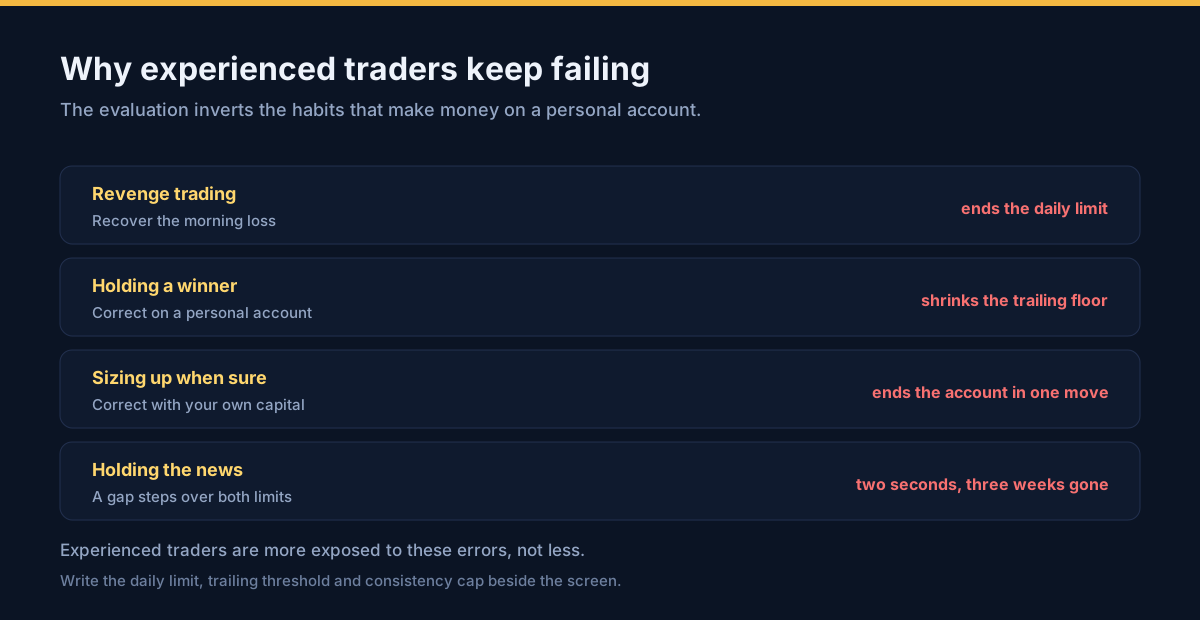
Failing a prop firm challenge feels different from losing money in the market. You did not blow up an account through a bad read; you paid for a test and a rule closed it. This page covers what happens to the account afterwards, why the risk framework most traders were taught is the wrong one for an evaluation, and how to set up the next attempt so it does not end in the same place.
If you have just failed, read this first
Check whether it was a hard breach (account closed, usually no refund) or a soft breach (account survives with a restriction). They leave you in completely different positions, and the firm's failure notice states which one applied. Our breach explainer covers the difference, and the refund guide covers whether the fee is recoverable.
The toll that nobody prices in
Most guides jump straight to the retry. It is worth naming the other cost first, because it drives the decision more than the fee does.
The fee is the easy part. It is gone, most firms do not refund it, and you can write the number down. The harder part is that an evaluation is a paid, time-boxed, pass-or-fail test of your judgement, so a failure reads as a verdict on whether you are cut out for this at all. Traders carry that verdict for far longer than they carry the losing trade that produced it.
The response is usually one of three things. Buy the next evaluation immediately, to prove the last one wrong. Quit prop trading outright. Or read for a few weeks and change nothing about how the failed attempt was actually traded. The first is the most expensive, because it retakes the same test with the same process while the frustration is still fresh. The second throws away work that was probably closer to paying off than it felt. The third is the only one that can lead anywhere, and it only does so if it ends in something written down.
The three-day rule
Do not buy a retry within three trading days of a failure, and never within the same session. The decision to retry should be made with numbers, not with the need to answer a bad day. Some of the most expensive evaluation fees in this industry are bought to prove a point rather than to pass a test.
What actually happens, procedurally
Strip the emotion out and a failure is one of two administrative states. Which one you are in decides what you do next.
| Outcome | What it means | What you still have | Immediate next step |
|---|---|---|---|
| Hard breach | Daily loss, maximum drawdown or another hard rule is breached; account closed | Your knowledge of the rulebook and the market; nothing on the account | Read the failure notice, then wait three sessions before deciding anything |
| Soft breach | Account survives but a restriction applies, such as paused payouts or a reset requirement | A live account that is currently unusable for withdrawal | Get the exact restriction in writing before trading it again |
| Failure at payout | Evaluation passed but the consistency rule blocks the withdrawal | A funded account that needs more, evenly spread trading | Dilute the dominant day rather than trying to earn your way out with another big day |
The third row catches people out because it does not feel like a failure at all: you passed. You simply cannot withdraw yet, because one trading day is too large a share of your total profit. It is fixable without buying anything new, and the consistency rule guide walks through the dilution.
The retry arithmetic, done honestly
The fee is not the real cost of failing. The real cost is the expected cost of reaching a funded account from where you now stand, and that number surprises almost everyone:
expected cost = challenge fee ÷ pass rate
At a $500 two-step fee and a realistic 30% pass rate, the expected cost of a self-traded fund is roughly $1,670, more than three times the sticker price. At a 20% rate it is $2,500. The fee on the checkout page buys one attempt; the arithmetic above is what the result costs. That gap is the commercial argument for a flat-fee alternative, and it is also the argument against retrying blindly, because every attempt at the same pass rate adds another multiple of the fee to the total.
The analytical case: why standard risk metrics fail under stress
This is the part that explains how the same trader can run a personal account profitably for years and still fail evaluations. The standard risk framework was built for an account with no end date. An evaluation has an end date, and three of its features quietly break the framework.
1. Fixed-percentage risk ignores a moving buffer
Conventional sizing risks a fixed percentage of the account per trade, one percent say, and assumes the survival threshold is a known, static distance away. On a trailing drawdown it is not. The floor follows your peak, so your remaining room is:
room = trailing_threshold − (peak − current)
One percent means one thing at the open and something else after the account has run up, because the floor moved with it. A $50,000 account that peaked at $52,000 and now sits at $51,000 has $1,500 of room, not the $2,500 the balance implies. The fixed-percentage rule measures the wrong object: it measures the balance, while the thing that can end the account is the distance to the floor.
2. R-multiples assume you can execute the plan
Risk-reward ratios measure outcomes, not adherence. They can tell you a strategy is sound across five hundred trades. They cannot tell you whether you will take the fourth trade after three losses, or whether your hand will move the stop on the fifth. Under a deadline and a small daily allowance, adherence is what breaks, and it is the one thing the ratio does not model. The trading psychology breakdown deals with the behaviour itself; the point here is that a number assuming perfect execution is not measuring the risk you actually face.
3. Correlation defeats the trade-level view
Per-trade frameworks treat each position as independent. At the moment it matters they rarely are: in forex it is the same dollar move wearing four different pair names, in futures it is one index across several contracts. Three "independent" trades risking a third of the daily allowance each are, once the correlation bites, one trade risking all of it. The daily limit tends to be breached by arithmetic nobody ran, not by bad luck.
The stress test that actually predicts failure
Not "how many R did this strategy return?" but "if my next three trades all lose, what is my remaining buffer, and would I still be able to reach the target?" A framework that cannot answer that question in one line is not sized for an evaluation, and it will fail at exactly the moment you need it.
The recovery plan that survives the next attempt
Write down the actual cause, mechanically
Not "I got emotional". The precise line: which rule was breached, at what balance, from what peak, and what position size did it. A failure you cannot describe as a number is one you are likely to repeat, because you have not yet identified the thing to change.
Re-derive your size from the threat, not the account
Use the buffer, not the balance. On a $50,000 futures account with a $2,500 trailing threshold, risk 10% of the threshold per idea — $250 — and solve for contracts from the tick value and the stop distance. That number is not a feeling, which is the only property that matters under pressure.
Kill the correlated cluster before it forms
Cap total exposure across correlated instruments as a single risk unit. This costs nothing in good conditions and is the single most common cause of a daily-limit breach in bad ones.
Set the retry decision on evidence, not on date
Buy the next evaluation when the written plan above exists and has been followed for a defined number of sessions — not on the Monday after the failure, and not to answer a bad day.
If the gap is execution, remove the executor
If the analysis is sound and the failure is consistently human, if the plan existed and you did not follow it, then the variable to remove is you. That is the case for having the evaluation traded for you, and it is narrower than most passing services admit.
How ElitePropX works as the shield against the next failure
ElitePropX is a flat-fee prop firm challenge passing service, built around the diagnosis above: most failures are execution under pressure rather than analysis. The service removes the execution step by removing the person doing it, for the duration of the evaluation.
- A flat fee of $220 per evaluation, whatever the account size — no account-size multipliers, no "contact us for pricing".
- A 0% profit split. When the funded account is verified, it is entirely yours. We take nothing from your payouts, ever.
- Retries covered. If an account we manage fails, we fund the next attempt at our own cost and continue. Our outcome is tied to yours rather than to volume.
- A free test trial. You can see how we work before paying anything, with no obligation.
- Nobody's emotion in the loop. Positions are sized from the buffer and the rulebook against a written plan, by a trader with no stake in the session's result. That is the difference between a plan that gets followed and a third attempt that ends like the first two.
Start a free test trial, or ask us anything directly on Telegram @voraspas. If you would rather go again yourself, which is cheaper and usually the right call when the failure was analytical rather than behavioural, begin with the 17 mistakes that fail challenges and the risk management framework.
One caveat, repeated on every page: most firms restrict third-party trading in their terms, so using any passing service can conflict with your agreement and put a payout at risk. Read your firm's terms first. If that rules the service out for you, the free guides are still worth your time.
Frequently asked questions
The FAQ block below answers what happens immediately after a failure, whether the fee is refunded, whether to retry the same firm, why standard risk management fails on an evaluation, and whether we can pass the challenge you just failed. Related reading: why most challenges fail, the soft vs hard breach explainer and how to keep a funded account once you are through.
What happens immediately when you fail a prop firm challenge?
Do prop firms refund the challenge fee if you fail?
Should I retry the same firm or switch after failing?
Why does standard risk management fail on a prop firm challenge?
Can ElitePropX pass the challenge I just failed?
Have a question before you commit?
Ask us anything about your firm, your account size or whether a passing service suits you. We answer directly on Telegram — no forms, no queues.
Ready to pass your prop firm challenge?
Flat $220 per evaluation — we trade it for you and hand over a funded account. No hidden cuts, no monthly fees. Message us on Telegram and we will answer in minutes.