
Costs · reviewed October 2026
Paying to pass a prop firm challenge — what the money actually buys
"Pay to pass" is used for three transactions that have nothing in common: hiring someone to trade the evaluation, deferring a firm's activation fee until you have passed, and splitting payouts with a provider who charges nothing upfront. Each has a different price curve and a different failure cost, and the phrase hides the difference. This page separates them, puts published 2026 rates next to each, works out what a failed attempt actually costs under each model, and sets out what to get in writing before any money moves.
Key takeaways
- "Pay to pass" describes three unrelated products: an upfront service fee, a deferred activation fee, and a profit share. They are not variants of one price.
- The headline fee is the price of one attempt. Whether a retry is covered or billed again is the number that decides what a pass costs.
- Published 2026 rates at a $100k account run from $220 flat to $588, and at $200k two of those nearly double while the flat one does not move.
- Almost every firm prohibits third-party trading, and enforcement usually arrives at payout rather than at sign-up, which converts a paid pass into a total loss.
- The break-even against trading it yourself is a single failure. From the second attempt onward the flat fee is cheaper in cash, and by a wide margin in calendar.
- What you are buying is a completed evaluation in your own name. If that sentence cannot be put in writing, the payment is a gamble rather than a purchase.
Contents
- Three transactions, one phrase
- The three payment models
- What the published numbers look like
- Who carries a failed attempt
- The break-even arithmetic
- Whether paying to pass is permitted at all
- The four ways the money is lost
- Structuring the payment
- Eight questions before you pay
- The deferred-fee alternative
- A worked case
- Frequently asked questions
Three transactions, one phrase
The phrase is used loosely because the outcome people want is identical — a funded account without having traded the evaluation themselves — while the way they intend to buy it is not. Three distinct arrangements sit under the same three words, and confusing them is how a trader ends up comparing a fee to a percentage as though they were the same kind of number.
The first is a service. You pay a third party to trade the evaluation on your behalf. The money moves before any work is done, the provider carries the risk of a failed attempt, and the deliverable is a passed evaluation in an account that stays in your name. This is the model this site runs, and it is the only one of the three where the price is fixed and the retry is the provider's problem.
The second is a deferred fee. A firm lets you start an evaluation for a nominal amount and charges the real activation fee only once the profit target is met. Nothing is being outsourced here: you trade every session yourself. What is being bought is time — the ability to begin without paying the full fee upfront — and the fee is still owed in full on success. Brokers of this structure describe it as paying after you pass, which is accurate and also a little flattering, since the trading is entirely yours.
The third is a commission. A provider charges nothing to start and takes a percentage of each payout instead. The fee is contingent, so it is cheap if the account never pays and expensive if it pays repeatedly. The percentage is usually quoted as a share of profit rather than of the account, which makes it feel smaller than it is over a long horizon.
These three are frequently discussed in the same thread as though a choice between them were a matter of taste. It is not. They differ in when cash leaves, who absorbs a failed attempt, and what the total is once the account has paid out twice. A trader asking "how much does it cost to pay someone to pass my challenge" is asking a question with three different correct answers, depending on which of these they mean.
The three payment models
Laid side by side, the differences that matter are timing, risk allocation and the shape of the cost curve. Everything else — marketing, testimonials, the wording on the landing page — is downstream of those three.
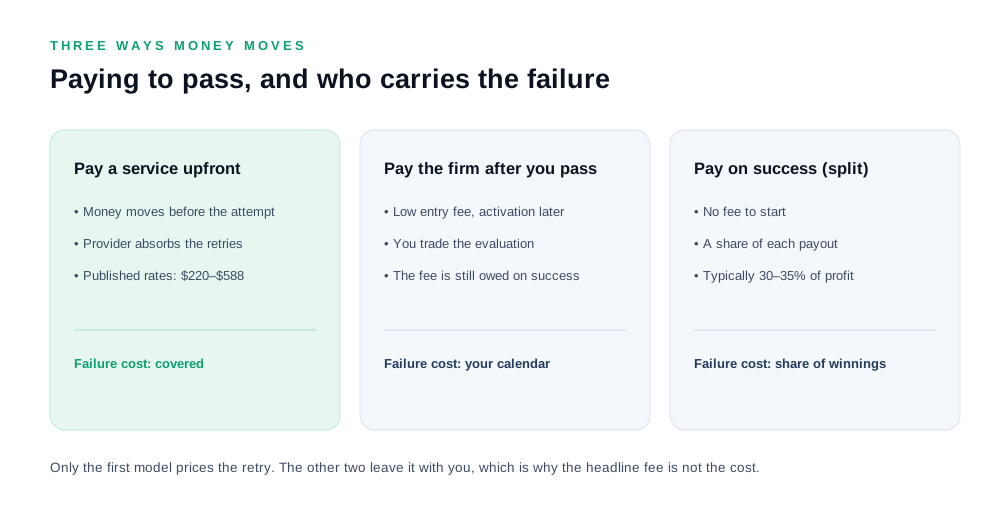
| Model | When money moves | Who pays for a failed attempt | Cost curve |
|---|---|---|---|
| Upfront service | Before the work begins | The provider, via covered retries | Flat: one fee regardless of attempts |
| Deferred activation | On meeting the target | You, in full, per attempt | Linear with attempts, plus your calendar |
| Profit share | Out of each payout | You, and nobody refunds the time | Percentage of everything the account earns |
The cost curves are the part worth dwelling on, because they diverge in opposite directions.
A flat service fee is front-loaded and capped. You pay once, the number is known before you start, and additional attempts do not add to it. The weakness is that if the first attempt succeeds immediately, you have paid for insurance you never used. That is a real cost and it should be admitted: a trader with a genuine 60% first-attempt success rate is better off self-trading.
A deferred activation fee is back-loaded and linear. Nothing much leaves your account until you succeed, which is genuinely easier on cash flow. But every failed attempt is charged in full, and the fee arrives at the moment you are least likely to walk away — you have passed, and the fee is the price of claiming it. The arithmetic only works out well if you pass early.
A profit share is contingent and perpetual. No fee to start makes it the cheapest option on paper for a trader who fails, and the most expensive over a year for a trader who succeeds repeatedly. A 35% share of a $10,000 payout is $3,500 — more than a flat fee several times over, arriving after you have done the work.
Which is the right model depends on which constraint is binding. If it is cash upfront, the deferred or contingent models exist for exactly that problem. If it is total cost and certainty, the flat fee wins as soon as a second attempt is likely. If it is the funded account rather than the evaluation, none of these solve it — the account still has to be traded by its owner.
What the published numbers look like
Most of the category does not publish a price. Of the five providers that appear in the usual comparisons, four publish a figure and one quotes per client, which means the first useful move is often refusing to engage until a number is on the table.
Where figures are published, the spread is wider than most buyers expect. At a $100,000 account, checked in October 2026:
| Provider | $100k account | $200k account | Changes with size? |
|---|---|---|---|
| Flat-fee provider A | $220 | $220 | No |
| Provider B | £449 (~$565) | £449 (~$565) | No |
| Provider C | $588 | $1,158 | Yes, roughly doubled |
| Provider D | $400 | $700 | Yes, +75% |
| Provider E | Not published | Not published | Quoted per client |
Two things follow from that table, and the second is more important than the first.
The spread is nearly threefold at $100k. A buyer who assumes the category has a market price will overpay by several hundred dollars for an identical job, because there is no market price — there is a set of individual quotes, some of which are published.
Only some prices scale with account size. A provider charging a percentage of the firm's fee doubles when the account doubles. A provider charging for a process does not, because the process is the same. At $200k the gap between the cheapest and the most expensive widens from roughly $370 to roughly $940. Size is where the flat model stops being a small advantage and becomes a structural one.
The figure that is almost never published is the one that decides the total: what happens on a failed attempt. A provider charging $400 per attempt and billing each one is more expensive than a provider charging $588 once, from the second attempt onward. Since the stated pass rates in this industry — whatever their provenance — imply that a second attempt is common, the retry term is the real price and the headline is a marketing number.
Before comparing fees, it is worth converting both to the same unit. The useful unit is cost per completed evaluation, which is the fee multiplied by the expected number of attempts under the provider's retry policy. Under a covered-retry policy that multiplier is one. Under a per-attempt policy it is the reciprocal of the per-attempt success probability, which for most retail traders is somewhere between two and three.
Who carries a failed attempt
The ledger is the honest way to compare the three models, because it asks the only question that matters after a bad month: what has been lost, and who lost it.
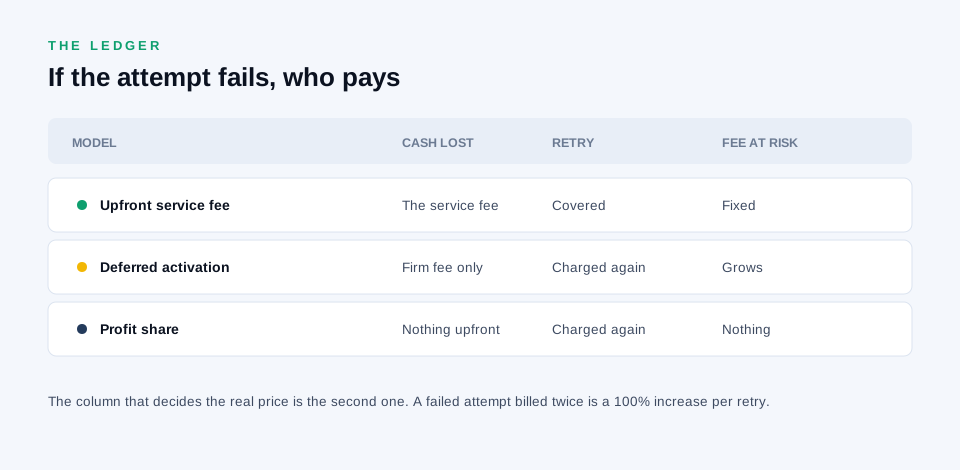
Under an upfront service fee, a failed attempt costs the firm's evaluation fee and nothing else in service terms. The provider absorbs the second attempt. The cash at risk is fixed and known in advance, which is the model's whole appeal: it converts a variable, potentially unbounded cost into a single number.
Under a deferred activation fee, a failed attempt costs the firm's evaluation fee and, if you go again, the firm's fee again. The activation charge never arrives, because you never pass — which feels like a win and is not, because the time is gone and the fee was never the expensive part. The exposure grows with each attempt while the terminal fee stays the same size.
Under a profit share, a failed attempt costs nothing in cash, which is precisely why it is attractive. The cost is deferred rather than avoided, and it lands on the other side: every payout carries a deduction. A trader who passes on the third attempt under a profit-share arrangement has paid three attempts' worth of calendar and will pay a third of every payout afterwards.
There is a fourth cost that appears in none of the columns and is usually the largest: the calendar. An evaluation run at sensible risk takes weeks. Two failed attempts consume a quarter. That quarter cannot be recovered by any refund policy, and it is the reason comparing fees alone misprices the decision. The right unit is fee plus weeks, and the weeks are usually worth more.
The break-even arithmetic
Take a mid-size forex evaluation with a firm fee of $540 and a service fee of $220. The comparison is not between $540 and $760 in the abstract; it is between two expected costs, and the expected cost depends on how many attempts a pass takes.
| Attempts needed | Firm fees, self-traded | Total, self-traded | Total, flat service | Difference |
|---|---|---|---|---|
| 1 | $540 | $540 | $760 | Service is $220 worse |
| 2 | $1,080 | $1,080 | $760 | Service is $320 better |
| 3 | $1,620 | $1,620 | $760 | Service is $860 better |
| 4 | $2,160 | $2,160 | $760 | Service is $1,400 better |
Break-even is exactly one failure. That is a low bar, and it is why the flat model survives commercially despite being the more expensive option for a first-time pass. But the table is doing something slightly dishonest if it stops there, because it treats the number of attempts as a matter of luck rather than of probability.
The correct version multiplies by the chance of each outcome. If a trader's per-attempt success probability is p, the expected number of attempts is 1/p. At p = 0.4, the expected attempt count is 2.5 and the expected firm spend is $1,350 against a flat $760. At p = 0.6, the expected count is 1.67 and the expected spend is $900 against $760 — still in the service's favour, but only just. At p = 0.8 the expected spend falls to $675 and self-trading wins.
So the honest statement of the case is narrower than the industry usually makes it: the flat fee is worth it below roughly a 70% first-attempt success rate, and not above it. A trader who genuinely clears four evaluations in five attempts should self-trade and keep the $220. Almost nobody can demonstrate that, and the ones who can already have funded accounts.
Two further adjustments belong in the arithmetic and rarely appear in it.
Fixed costs do not scale with account size, which changes the ratio. At a $200k account the firm's fee is larger, so the service fee is a smaller proportion of the total. The $220 is 41% of a $540 fee and 19% of a $1,158 fee. The larger the evaluation, the cheaper the flat model is relative to the alternative — the opposite of the intuition that a bigger purchase deserves more caution about add-ons.
The firm's reset charge is not covered by anything. Where a firm bills a reset — a reduced fee to restart an account rather than a full new purchase — that charge sits outside every service fee, including ours. A resets-heavy attempt history therefore erodes the advantage of the flat model without changing its headline. The fee comparison sets the firm side of the ledger out separately for that reason.
Whether paying to pass is permitted at all
This is the question that should come before price, and in most discussions of paying to pass it comes last or not at all. Prop firms almost universally prohibit third-party trading or account management, on the evaluation and on the funded account. A service that accepts the job without reading the terms is not being efficient; it is transferring a risk it does not have to carry onto a client who cannot see it.
The risk is asymmetric in a way that is worth stating plainly. If the evaluation is voided at sign-up, the client has lost a service fee. If it is voided at payout — which is when firms actually investigate, because that is when money leaves — the client has lost the firm's fee, the service fee, and every trading day spent on the account. The provider has lost nothing, because the fee was collected at the start.
There are three possible answers to the terms question, and only one of them is a green light.
Permitted. The terms allow the evaluation to be traded externally. This is uncommon, and it is specific: some firms permit it on the evaluation and prohibit it on the funded account, which means the permission expires at the moment of value.
Prohibited. The terms ban third-party trading or account management. The job should be declined before any payment is taken, and the reason should be given in writing.
Silent. The terms do not address it. Silence is not permission. It means the firm has reserved the question and can answer it at the payout, which is the worst possible time to discover the answer. Silence should be treated as prohibition unless the firm confirms otherwise in writing.
One practical note on how to establish the answer. A support response is worth having, and it costs a single message, but the answer that governs is the one in the terms rather than the one in the chat window. Where the two disagree, the terms win at payout. The rules matrix records which firms state what, and the legitimacy guide takes the same question apart from the buyer's side.
The test that settles it. Ask the provider to confirm in writing, before payment, whether third-party trading is permitted on the evaluation and on the funded account separately. A provider that will not put that sentence in writing has answered the question.
The four ways the money is lost
Payment disputes in this category cluster into four patterns. None of them is exotic, and all four are visible in advance to someone who asks the right questions before paying.
One: the pass is voided at payout. The evaluation was completed in breach of a third-party clause that nobody read. The account is closed when the first withdrawal is reviewed. This is the most expensive failure because it occurs after the work has been done and after both fees have been paid.
Two: the retry is billed. The headline price turns out to be per attempt. Three attempts cost three times the quoted figure, and the quote was never the price. This is the most common failure, and the least discussed, because a provider quoting per attempt is not lying — it simply never volunteered the term.
Three: the calendar has no end. There is no deadline in the agreement, no defined failure condition and no refund trigger. An evaluation that is still "in progress" after four months cannot be shown to have failed, so nothing is owed. This is a contractual failure rather than a trading one, and it is usually visible in the absence of written scope.
Four: the account is not in your name. The evaluation was purchased by the provider, on the provider's payment method, with the provider's identity documents. It passes. It is funded. And it belongs to the provider, because ownership is established at purchase and verified at payout. The client has bought the experience of a funded account rather than the account.
There is a fifth pattern that sits outside the fee entirely and deserves a line of its own: continued management after the handover. A provider that keeps trading the funded account is running a managed account, which most firms prohibit explicitly and which puts the payouts at risk long after the evaluation has been paid for. The service should end at the handover, in writing.
Structuring the payment
The structure of a payment does more to protect a buyer than any warranty on the landing page, because it decides what happens when the two parties disagree about whether the work was done.
Pay for a deliverable, not an outcome. The deliverable is a completed evaluation in an account held in your name, confirmed by the firm itself rather than by a screenshot from the provider. Framing the purchase that way makes the success condition auditable by a third party, which is the only kind of success condition worth having in a dispute.
Get the scope in one document. Six items should appear: what is covered, the retry terms, the failure condition, the refund condition, who owns the account at each stage, and what happens at handover. A provider that cannot produce a single page containing all six is not organised enough to be holding your evaluation.
Prefer a staged payment where one is offered. A deposit with the balance on handover aligns the incentive: the provider is paid in full only when the deliverable exists. Providers that require the whole fee upfront are not necessarily dishonest — the flat model depends on collecting before the work — but the request is worth weighing against the protection.
Keep the purchase in your own name. This is not a preference, it is the mechanism that makes the funded account yours. Buy the evaluation yourself, with your own payment method, and complete identity verification yourself. No service fee is worth an account that verifies to somebody else.
Do not pay on the strength of a screenshot. A screenshot of a passed evaluation is the least verifiable artefact in this industry: reproducible in an afternoon with browser developer tools. A firm's confirmation email, which names the account, is a different class of evidence, and it is the only one worth accepting.
The general principle behind all five is that money should move against something checkable by someone other than the person receiving it. Where that is impossible, the arrangement is a wager between strangers, and it should be priced as one.
Eight questions before you pay
Each question has an answer that should end the conversation, and the failing answers are specific enough to be recognisable in a single reply.
- Is third-party trading permitted on this firm's evaluation, and on its funded account? The wrong answer is yes to the first and silence on the second, or "nobody checks".
- If the attempt fails, is the retry covered or billed? The wrong answer is "we'll talk about it then".
- What is the failure condition, in writing? The wrong answer is a definition that only the provider can apply.
- What is the refund condition? The wrong answer is none, or "case by case".
- Whose name is on the evaluation, and whose payment method buys it? The wrong answer is the provider's, on either count.
- Who completes identity verification? The wrong answer is anyone other than you.
- Does the service end at handover, or continue? The wrong answer is continued management of the funded account.
- What is the total, including the firm's fees and any reset charges? The wrong answer is a service fee quoted without the firm's side of the bill.
Eight questions, one message, and most of the answers are a paragraph of copy that either exists or does not. The exercise takes ten minutes and removes the entire category of disputes described above. It is also a decent filter on the provider: the ones with written answers produce them quickly, and the ones without produce enthusiasm instead.
The deferred-fee alternative
For a trader whose constraint is cash rather than time, the deferred activation model is a genuine alternative to paying a service, and it deserves to be described on its merits rather than as a lesser option.
The structure is straightforward: a small entry fee to start an evaluation, the substantial fee deferred until the profit target is met. A firm offering this is effectively financing the evaluation for the length of the attempt, which is a real service and is priced accordingly — the deferred fee is rarely smaller than the upfront one, and sometimes larger.
What it does not do is remove the work. The evaluation is still traded by you, on your own time, and the fee still lands at the moment you succeed. Compared with a service, the difference is who trades and when the money moves; compared with a full-price evaluation, the difference is only the timing of the same cash.
The two models suit different people and it is worth being blunt about which is which. A trader with capital but limited time, or with a demonstrated record of failing at the final stage, is buying the same thing twice if they self-trade — the service is cheaper in expectation. A trader with time, a workable plan and a cash constraint should take the deferred fee and trade it themselves, because the calendar is the resource they have and the fee is the one they do not.
The mistake is treating the models as competing on price. They compete on which resource gets spent, and the answer depends on which one is scarce.
A worked case
A trader has failed two $100k evaluations at a firm charging $540, has $1,200 available, and is deciding between a third self-traded attempt and a flat fee service.
Option one, self-traded. Two attempts already spent, $1,080 gone. A third attempt costs $540 and leaves $660. If it succeeds, total spend is $1,620. If it fails, total spend is $1,620 with no funded account and $120 remaining — a position from which a fourth attempt is not affordable.
Option two, flat service. The service fee is $220 and the firm fee for one more evaluation is $540, so $760 leaves $440 in reserve for a reset charge. If the service passes first time, total spend is $1,840 across everything, which is $220 more than the self-traded success case and $220 less than the self-traded failure case. If the service fails, the retry is covered and the spend does not move.
What actually differs. The service does not reduce the total if the third attempt works. It removes the branch where the third attempt fails and the fourth is unaffordable. The trader in this position is not buying a cheaper pass; they are buying the elimination of the outcome that ends the project.
That framing is the honest one, and it is also the reason the arithmetic above matters less than the budget position. A trader with $5,000 available can absorb three more attempts and should think about expected cost. A trader with $1,200 is not making an expected-value calculation at all; they are deciding how many branches of the tree they can still reach. The flat fee converts a sequence of unaffordable branches into one known cost, which is a different product from a cheaper one.
For the payout side of the same decision, the profit calculator converts a funded balance into a first-payout figure, and the payout process guide covers what has to be true before that figure is reachable.
Frequently asked about paying to pass
How much does it cost to pay someone to pass a prop firm challenge?
Published rates in October 2026 run from $220 flat to $588 at a $100,000 account, with one provider quoting per client rather than publishing. At $200,000 two of those providers charge $1,158 and $700 while the flat rate stays at $220. The service fee is on top of the firm's own evaluation fee, which is unaffected.
Is paying to pass against the firm's rules?
Almost always, yes. Most firms prohibit third-party trading or account management, and enforcement typically happens at payout rather than at sign-up. A small number permit a third party on the evaluation while prohibiting it on the funded account, which means the permission expires before the money does. Silence in the terms is not permission.
What happens if the attempt fails — do I pay again?
It depends entirely on the retry term, which is usually not on the pricing page. A flat-fee service covers retries while the evaluation is running; a per-attempt provider bills each one in full. Converting both to cost per completed evaluation is the only fair comparison, and it changes the ranking of providers more often than the headline fee does.
Is a profit-share model cheaper than a flat fee?
It is cheaper if the account never pays, and more expensive as soon as it does. A 35% share of a $10,000 payout is $3,500, which is more than a flat fee many times over, and it repeats with every payout. The model is well suited to a trader who cannot pay upfront and poorly suited to one who expects a long payouts history.
Can I buy the evaluation myself and still use a service?
Yes, and you should. Buying the evaluation in your own name with your own payment method is what makes the funded account yours at payout. Completing identity verification yourself is part of the same requirement. A provider that offers to buy the evaluation for you is offering to own your funded account.
How long does a paid pass take?
Weeks, not days, because the firm's minimum trading day counts apply to everyone. A two-phase evaluation typically takes three to five weeks. Any provider quoting a completion in a few days has either found a firm with no day count or has not read the terms, and both of those are worth knowing before paying.
What should be in the written agreement?
Six things: what is covered, the retry terms, the failure condition, the refund condition, who owns the account at each stage, and what happens at handover. A provider that cannot put all six on one page is not in a position to be trusted with an evaluation.
Does the service cover the funded account?
It should not. Continued trading of a funded account is managed account activity, which most firms prohibit, and it puts the payouts at risk after the evaluation has been paid for. The service ends at handover, and the funded plan is written by the account holder before the first trade rather than after the first loss.
Is it cheaper than failing and retrying myself?
From the second attempt onward, yes, and by a wide margin. Break-even is a single failure. Whether that applies to you depends on your genuine first-attempt success rate: the flat fee is worth it below roughly 70%, and above that you should keep the money.
Are screenshots of passed evaluations proof of anything?
Very little. A screenshot is editable in any browser in minutes. The only artefact worth accepting is a confirmation issued by the firm itself that names the account, because that is the one thing a provider cannot produce without having done the work.
What if the firm changes its rules mid-evaluation?
The evaluation is traded to the terms in force when it started, and a material change should be raised immediately. A firm that alters payout conditions retroactively is a risk no service can remove, which is one reason the rules matrix records check dates alongside the figures.
Can I pay in instalments?
Some providers offer a deposit with the balance on handover, which is the arrangement worth asking for because it aligns payment with delivery. A provider that requires the full fee upfront is not necessarily acting in bad faith — the flat model depends on collecting before the work — but the request should be weighed against the protection it gives up.
Where these rules come from
Firm figures on this page are read from the rulebooks below rather than from other comparison sites. Every link was opened and checked on . Firms revise targets and drawdown rules without notice, so confirm the figures on the plan you are buying before paying. How we check firm rules sets out what a checked date means, what we publish when a figure cannot be confirmed, and how corrections are handled.
Find out what your firm actually permits
Send the firm, the challenge type and the account size. We confirm in writing whether third-party trading is permitted on the evaluation and on the funded account — before you pay anything.
Related reading
- How the flat-fee passing model works
- Challenge fees against a passing service
- Is a prop firm passing service legitimate?
- How to vet the providers in this category
- What clients report about passing services
- The same question for futures evaluations
- Which firms state what, and when it was checked
- From funded account to first payout
- Profit and payout calculator
- Recently passed evaluations
Firm names are used for identification only. ElitePropX is an independent evaluation service and is not affiliated with, endorsed by or sponsored by any proprietary trading firm. The service is offered only where a firm's terms permit third-party trading. Published prices are checked against provider pages and may change without notice. A funded account is not a guarantee of income, and trading involves substantial risk of loss.