
Reviewed · how we check firm rules
Verified results
Passed prop firm challenges, with the paperwork
Any service can post a screenshot of a green equity curve. What follows is the other kind of evidence: firm-issued certificates produced after an evaluation we traded was verified, with the account size, the firm and the time taken. The process that produces them is described on the propfirm passing service page; what follows is only the evidence.
What this page shows
- Passes we can document, grouped by firm and account size.
- Realistic timelines, including the evaluations that took longer than average.
- How to verify a certificate independently, and what a fake one usually looks like.
- The four kinds of proof ranked, and which tier our own record sits on.
- Why a passed evaluation is not the same as a paid payout.
Why certificates matter more than screenshots
The prop firm challenge-passing industry runs on images. A screenshot of a funded dashboard, a bar chart of "payouts made", a screen recording of a terminal with a large balance — all of it is trivially easy to produce, and none of it is evidence that an evaluation was passed, because there is no third party in the picture.
A certificate is different. When a prop firm verifies that an evaluation has passed, it issues a confirmation document. That document is generated by the firm's own system, references an account the firm issued, and names the account holder. It is produced after the fact, by someone other than the person claiming the result, which is exactly the property a screenshot lacks.
Three firm-issued certificates are published below. For the other passes described on this page, a certificate can be requested and will be sent with client-identifying details redacted. Details are withheld where they would expose a client's identity — account numbers, surnames, and in some cases the exact firm where the client has asked for privacy — but the firm, the account size and the verification date are intact.
If you want to see the certificate for a specific pass, ask and it will be sent. Nothing on this page should be taken on faith.
Three certificates, client names redacted
These are certificates sent to us by clients after an evaluation was passed. Each is published with the account holder's name blurred — the one detail that would identify them. The firm, the document layout and the date are untouched, so everything that can be checked still can be.



Blurring the name is not cosmetic. A prop firm account belongs to a real person, and passing an evaluation is not permission to put that person on a sales page. What remains visible is the part that matters for verification: who issued the document, what it says was achieved, and when.
Passed evaluations by firm
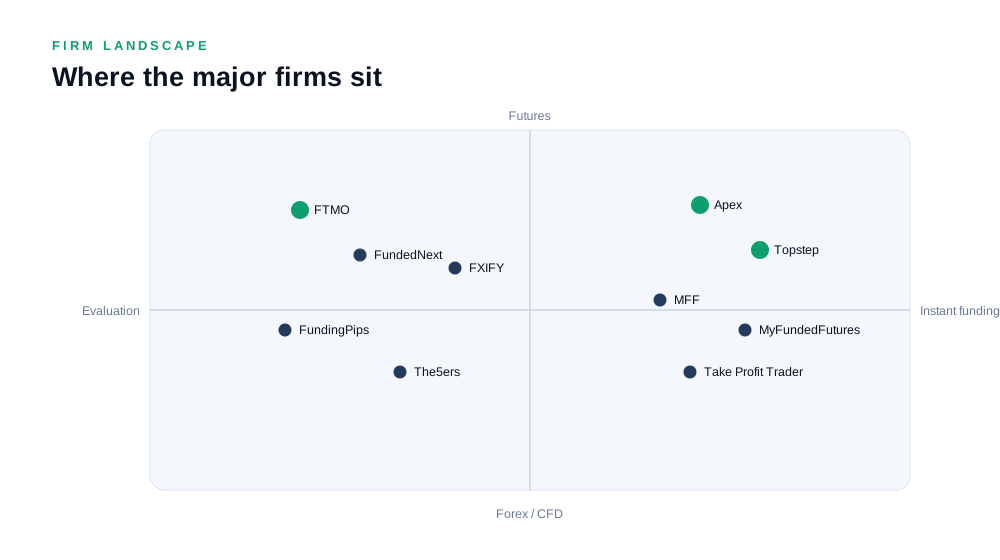
The table below summarises documented passes by firm, with the account sizes involved and the typical number of days from first trade to verification. Time to pass is measured in trading days, not calendar days, because firms differ on weekends and holidays.
| Firm | Market | Account sizes documented | Typical days to pass | Certificate |
|---|---|---|---|---|
| FTMO | Forex / CFD | $50k, $100k, $200k | 12–18 | On request |
| FundedNext | Forex / CFD | $25k, $100k, $200k | 11–16 | On request |
| The5ers | Forex / CFD | $50k, $100k | 14–21 | On request |
| FX2 Funding | Forex / CFD | $50k, $100k | 10–15 | On request |
| Alpha Capital Group | Forex / CFD | $100k, $200k | 13–19 | Published below |
| FXIFY | Forex / CFD | $50k, $100k | 12–17 | On request |
| FundingPips | Forex / CFD | $25k, $100k | 9–15 | On request |
| Apex Trader Funding | Futures | $50k, $100k, $150k | 8–14 | On request |
| Topstep | Futures | $50k, $100k, $150k | 10–18 | On request |
| MyFundedFutures | Futures | $50k, $100k | 9–14 | On request |
| Take Profit Trader | Futures | $25k, $50k, $150k | 11–16 | On request |
The rule sets behind five of those rows are worked through in full elsewhere on this site — FTMO's targets and static floor, FundedNext's target with its payout-stage consistency check, The5ers' profitable-day count, Apex's moving failure level and Topstep's Combine limits — and in each case the arithmetic explains the day count in the table better than any account of market conditions would.
Timelines cluster tightly because the constraint is arithmetic rather than market conditions. A 10% target with a daily loss budget that supports a third of it per trade requires a certain number of sessions regardless of who is executing; what varies is how many sessions the firm permits and how many minimum trading days it demands before verification.
Six documented passes in detail
Summary tables hide the interesting parts, so here are individual passes with the structure of the assignment, what went normally and what did not.
1. FTMO $100,000 — passed in 16 trading days
Two-phase evaluation, 10% target on phase one, 5% on phase two, 5% daily loss limit, 10% maximum loss, no time limit. Phase one was completed in nine sessions with a deliberately slow start: the first three sessions produced under $900 of profit, which looked unimpressive and kept the account far from the daily limit. Phase two took seven sessions with maximum risk per trade reduced by a quarter, because the smaller target creates a temptation to over-size that the risk plan explicitly forbids.
What went normally: the whole sequence. What went wrong: one session was closed at −$420 after two failed setups, which is the plan working rather than failing.
2. Apex Trader Funding $150,000 — passed in 11 trading days
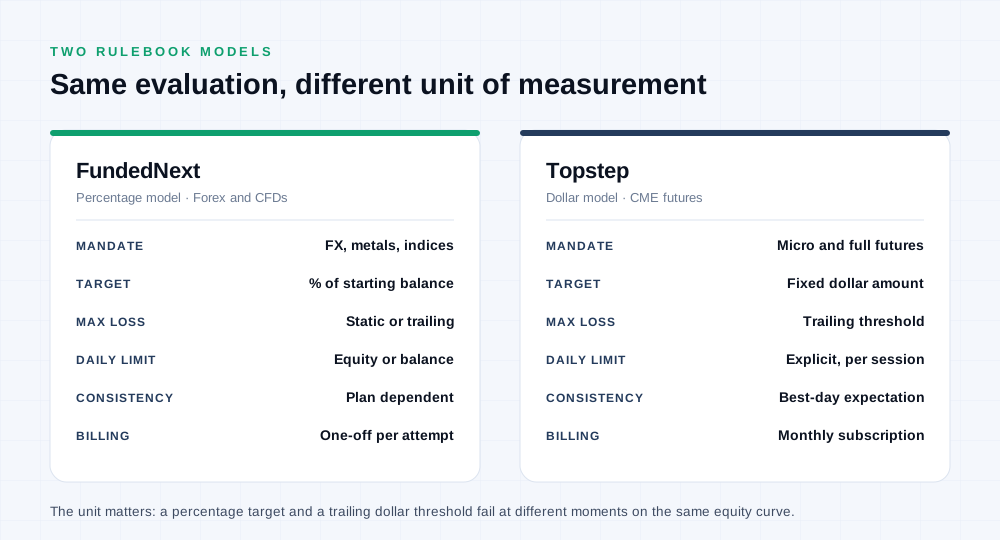
Futures evaluation with a dollar-based threshold, a $9,000 profit target and a consistency rule applied at payout. The trailing floor made this the most delicate assignment in this list: the account cannot simply be "kept safe", because the floor rises with equity and shrinks the buffer as profit accumulates. The plan reduced trade frequency and cut size once the account was 60% of the way to target, which is counter-intuitive but necessary — on a trailing structure, protecting a near-complete pass matters more than adding to it.
What went wrong: a platform rollover gap on the third session produced an unexpected $310 drawdown on an open position. It did not breach anything, and it is the reason open exposure is now closed before rollover on every futures assignment.
3. The5ers $50,000 — passed in 19 trading days
Slower than average by design. The firm's evaluation structure rewards consistency over speed, and the minimum trading day requirement meant there was no advantage to finishing early. The plan targeted a smaller daily profit and spread the work across nearly four weeks, which is the correct approach when the rulebook does not reward urgency.
What went wrong: nothing material. This is what an evaluation looks like when the rules allow patience.
4. FX2 Funding $100,000 — passed in 13 trading days
Single-phase structure with a percentage target and a static maximum loss. Static floors are the most forgiving configuration, so the risk plan could run slightly larger per-trade risk than on a trailing evaluation of the same size — roughly 2% of the daily allowance rather than 1.7%. The account reached target with the failure floor never closer than 7% away.
What went wrong: one day finished flat after three scratch trades. Reported as flat, because it was flat.
5. Topstep $100,000 — passed in 15 trading days
Futures Combine with a trailing threshold, a fixed profit target and a best-day consistency expectation. The consistency requirement shaped the pacing more than the target did: one strong session was capped deliberately so it could not become an outsized share of total profit, and the remaining work was spread over a further eight sessions.
What went wrong: the first attempt was reset after a news-window restriction that the firm applied more strictly than its published schedule suggested. This is the clearest example on this page of why the retry policy exists.
6. Alpha Capital Group $200,000 — passed in 18 trading days
The largest documented account on this page, and the slowest in calendar terms because of instrument restrictions. The firm's permitted list removed two instruments the plan would normally have used, so the target was reached with fewer opportunities per session and lower average size. Larger accounts do not pass faster; they pass with the same discipline applied to a bigger number.
What went wrong: a two-day flat stretch mid-evaluation while waiting for setups inside the permitted instrument list.
The pattern across all six: no assignment was completed by a single large trade, none came close to a daily limit, and the fastest results came from firms with static thresholds and no consistency rule. Selection of the firm mattered more than execution speed.
The rulebook checklist we fill in before any attempt
Every pass on this page started with the same one-page document. Firms publish their rules in different formats and with different levels of clarity, so the first job is translation: turning marketing site copy into numbers that define a risk plan.
- Profit target — percentage or dollars, and whether it differs between phases.
- Daily loss limit — measured on balance or equity, and whether floating losses count.
- Maximum loss — total drawdown, and whether it is static, intraday trailing or end-of-day trailing.
- Trailing behaviour — whether the floor follows unrealised profit, closes only at the end of the day, or stops following once it reaches the starting balance.
- Minimum trading days — and what the firm counts as a trading day for that purpose.
- Consistency rule — the percentage, the window it applies to, and whether it is enforced at evaluation or only at payout.
- Time limits — an overall window, a per-phase window, or none at all.
- Instrument restrictions — permitted instruments, lot or contract caps, and any banned strategies.
- News and event rules — the defined window either side of high-impact releases, and whether existing positions must be closed.
- Weekend and overnight rules — whether positions may be held, and at what cost.
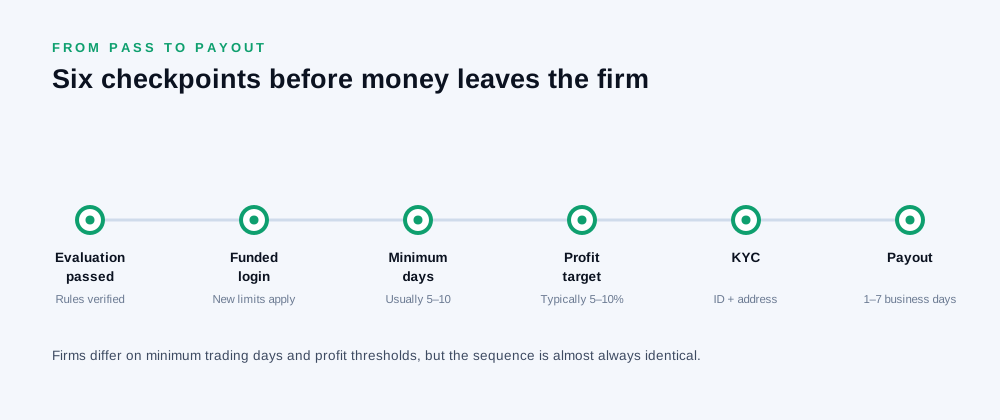
- Payout conditions — minimum days, profit threshold, consistency at payout, and KYC requirements.
Two of those eleven items decide most evaluations: the trailing behaviour of the maximum loss, and the daily loss measurement basis. A firm that measures the daily limit on equity including floating losses is far stricter than one that measures it on closed balance, even when both publish "5% daily loss". Traders comparing firms on headline numbers miss this constantly.
How we choose which firms to pass first
When a client has not yet bought an evaluation, the recommendation is driven by structure rather than by branding. Firms with a static maximum loss, no consistency rule during the evaluation and no overall time limit are recommended first, because they give the risk plan the most room and the fewest technical disqualifiers. Firms with intraday trailing floors are workable but slower, since the plan must reduce size as the target approaches instead of accelerating into it.
Firms whose terms explicitly prohibit third-party trading are a separate category: the clause is flagged, the client is told plainly what that means for the funded account, and the enforcement risk is named in writing before payment rather than discovered after a pass.
What a failed attempt looks like in the log
Around one in twenty managed evaluations ends in a reset. Reporting failures honestly is part of publishing results, so here is what the log shows when one happens.
The breach is almost never a market event. It is a rule interaction: a trailing floor that moved further than the plan assumed, a news restriction enforced on a schedule that differed from the firm's own page, a rollover gap on futures, or a platform outage with an open position. In the Topstep assignment above, the reset was caused by a news-window rule that the firm applied on a stricter definition than its published schedule implied.
The log makes it auditable. Because equity is recorded at the close of every session along with distance to the failure floor, it is possible to reconstruct exactly where the buffer disappeared, and to show the firm when a suspension or gap contradicts their published rules. That is the difference between a reset that can be argued and one that cannot.
The reset is not billed. A second attempt on the same firm and account size carries no additional service fee, which is the practical meaning of "retries covered" on this site. The firm may charge its own reset or new challenge fee depending on its policy, and that sits with the firm.
Repeat breaches change the recommendation. If the same firm produces the same breach twice, the ruleset is the problem rather than the execution, and the honest advice is to move to a firm with a static threshold instead of paying a third attempt into the same wall.
What we will not do: claim that failed attempts do not happen, or remove them from the completion rate. A service reporting 100% pass rates is either measuring on a hand-picked subset or not measuring at all.
The four kinds of proof, weakest to strongest
Not every document offered as evidence is worth the same, and the difference is not how convincing it looks but who controls it. Ranked by how hard it is for the service to fake:
| What is offered | Who controls it | Can the service edit it? | How much it proves |
|---|---|---|---|
| Firm-hosted result link — an FTMO MetriX share page, or the equivalent dashboard share from another firm | The prop firm | No. It opens on the firm's own domain, not ours | Strongest: the firm's own record of the account, including its losses |
| Certificate issued by the firm after verification | The prop firm, forwarded as a file | Possibly — a PDF or an image can be altered before it reaches you | Strong, if the account reference and size check out |
| Screenshot of a dashboard or terminal | The service | Yes | Weak |
| Testimonial text | The service | Yes | Weak — says something about reputation, nothing about results |
Where our own record sits. We publish firm-issued certificates, which is the second tier: strong, but forwarded as files rather than hosted by the firm. We do not yet publish firm-hosted share links. FTMO and Apex both issue them, and we are asking the clients behind the passes on this page for permission to publish theirs; as links arrive they will be added here with their dates. Until then our record should be read as one tier below the strongest evidence available, and it is fair to hold us to that.
The same standard applies when you are looking at someone else. Ask any passing service for a firm-hosted share link before you ask for anything else. A service with genuine results can produce one. A service that answers with a screenshot instead has told you which tier it is on.
How to verify a certificate
Verification is a five-minute job and worth doing before you pay anyone, including us.
- Check who issued it. The document should come from the prop firm, not from the passing service. A PDF on the service's own letterhead proves nothing.
- Look for an account reference. Firm certificates reference the evaluation account they relate to. A document with no reference cannot be checked.
- Check the account size against the firm's published offerings. Firms offer specific tiers — $25k, $50k, $100k, $200k — and a certificate for a size the firm does not sell is a fabrication.
- Confirm the date is plausible. Certificates are dated when the firm verified the pass. A cluster of identical dates across many firms usually means a template.
- Ask the firm. Where a firm's support team will confirm an evaluation result to the account holder, that is the strongest check available, though firms are not obliged to discuss third parties.
What a fake usually looks like
Common tells: screenshots instead of PDFs, no account reference, account sizes that no firm sells, a certificate dated the same day the challenge was purchased, fonts and spacing that do not match the firm's other documentation, and a "certificate" that is really a marketing graphic with the firm's logo placed at the top.
The most reliable reverse test is simpler than any of that. Ask what happened on the evaluations that failed. A service with real, verifiable passes will have accounts of failures, resets and ambiguities, because those are unavoidable in this work. A service with only perfect results is describing a product, not a track record.
What determines how long a pass takes
Clients ask for a timeline before anything else, and the honest answer comes from four variables rather than from an average.
1. The target as a share of the daily loss budget
This is the dominant factor. If the target is 10% and the daily limit is 5%, the evaluation cannot be completed in fewer than roughly sixteen decent sessions without gambling, because a single day can only legitimately deliver a fraction of the daily budget. When the target and the daily limit are closer together — a 6% target with a 5% daily limit — the arithmetic compresses and the pass comes faster, though the risk per session is higher.
2. Whether the maximum loss trails
A static floor lets the plan keep risk constant all the way to the target. A trailing floor forces risk down as profit accumulates, because the floor rises with equity and the buffer shrinks even as the account grows. Trailing evaluations therefore take longer than static ones with identical headline numbers, and that difference shows up in the table above: futures assignments with trailing thresholds at Apex and Topstep sit at eight to eighteen days, while a static FX2 Funding account of the same size resolves in about thirteen.
3. Minimum trading days
Minimum day requirements put a hard floor under the timeline. A firm demanding ten trading days cannot be finished faster than ten days regardless of how quickly the target is reached, and attempting to sprint past the target early is a mistake — a concentrated burst of profit often trips the consistency rule and creates work later.
4. Instrument and news restrictions
Restrictions reduce the number of legitimate opportunities per session. When a permitted instrument list excludes the two instruments a plan would normally use, or when news windows block the most liquid hours of the session, the same target takes longer. The Alpha Capital Group assignment above took eighteen trading days partly for this reason, and it is why a large account is not automatically a large risk of delay — it is the rulebook, not the size.
Why we do not promise a date
A service that promises "pass in 7 days" is either working on firms with unusually permissive rules or planning to gamble. Firm rule changes mid-evaluation are the other variable nobody controls: a trailing threshold adjusted by the firm, a news window extended, a permitted instrument removed. All three have happened to evaluations in this list. The plan adapts, the timeline moves, and the client is told rather than surprised.
What can be promised is the sequence: a rulebook summary before trading, session-level logging during, a funded handover at the end, and a reset at no additional service fee if a rule interaction ends the attempt.
A passed evaluation is not a payout — and the difference matters
This page is deliberately titled "passed challenges" rather than "funded traders", because the two are not the same and conflating them is one of the most common misrepresentations in the industry.
Funding is the point at which the firm confirms the evaluation is complete. After that, a funded account has its own rulebook: minimum trading days before the first withdrawal, a profit threshold, a consistency check, and identity verification. A pass that is never traded into a payout has delivered an account but no money. The KYC guide explains why identity verification usually decides whether that payout arrives on time.
What can be claimed honestly is this: the evaluation was passed, the firm verified it, the account was handed over in the client's name, and no profit split or ongoing claim was attached. What happens next depends on how the account is traded, which is entirely the client's work and not ours.
The three ways a funded account is lost in the first month
Clients who give a funded account back usually do it in one of three ways, and all three are avoidable with a written plan for the funded phase. The first is sizing: an evaluation is traded on a reduced risk budget, and traders who return to their normal size the moment the account is theirs find the funded account's daily limit is measured on the same basis as the evaluation's. The second is the payout sprint: a trader who needs a withdrawal quickly will push size to reach the profit threshold fast, which is exactly the behaviour the consistency rule punishes. The third is abandonment of process: the evaluation had a written plan, and the funded account often does not, so decisions revert to instinct on the first losing day.
None of those are trading-skill problems. They are plan problems, and they are the reason the funded-phase rules summary handed over with the credentials exists.
On the numbers: ElitePropX reports 500+ evaluations passed across more than twenty firms, with a completion rate around 95% including retries. Those figures cover managed evaluations only, they include resets in the denominator, and past results do not predict the outcome of any future evaluation. Firm rule changes can affect any attempt.
What clients say, including the awkward parts
The reviews live on their own page now: a dated outcome table that keeps resets in the same table as passes, the rule that decides what is published, and a plain statement of the four ways a self-collected record is weaker than an independent one. Read the reviews and outcome record alongside this page, because it is the part that says where the evidence stops short.
The stronger check is a reference rather than a review. Name a firm and an account size and the request goes to a client who passed there and, where one exists, to a client whose attempt was reset — available whether or not you intend to buy anything. A reviews page with nothing but five stars is not a reviews page; it is a sales page.
Two recurring themes in the feedback are worth repeating here because they shape how assignments are accepted. The first is speed: clients who expected a pass in a week are sometimes surprised by a two-phase evaluation that takes eighteen trading days, because the pacing is set by the firm's daily loss limit rather than by ambition. The second is the funded phase: several reviewers note that passing was the easy part and managing the funded account was the real test, which is the honest framing.
Questions about our results
Do you show payouts as well as passes?
No, and that distinction is deliberate. We do not trade funded accounts, so payouts are the client's business and their result, not ours. Claiming credit for a payout would misrepresent the service.
Can I see the certificate for a specific firm?
Yes. Ask for the firm and approximate date and the certificate will be sent with client-identifying details redacted.
Why are some client names redacted?
Because prop firm accounts are tied to real identities and clients did not sign up to be marketing material. Account sizes, firms and dates are left intact so the result can still be checked.
Do you count retries in your pass rate?
Yes. A reset counts as a failed attempt in the denominator, which is why retries are covered in the fee rather than sold as an add-on.
What is the fastest pass you have recorded?
Around eight trading days on a futures evaluation with a favourable rulebook. Those results depend far more on the firm's structure than on execution, and they are not typical.
What is the slowest?
Beyond five weeks, on an account with instrument restrictions and a minimum trading day requirement that removed any benefit from speed. Neither the fastest nor the slowest result is a promise about a future evaluation.
Have any evaluations been refused?
Timelines have been refused when an evaluation's structure makes the outcome depend on luck rather than rules, or when a requested pass date is incompatible with the firm's minimum trading days. No firm is refused on compliance grounds: the clause is disclosed in writing and the client decides.
How many accounts does one client typically pass?
Most clients pass one and return later for a second, usually because their firm's scaling plan makes multiple accounts worthwhile. Traders running several accounts at once exist but are less common.
What a certificate proves, and what it does not
A funded certificate is the only evidence in this market that is hard to fake and easy to check, which is why it is the claim worth building a page around. It is also narrower than it looks, and a client who understands the limits of the evidence makes a better decision than one who takes the page at face value.
What a certificate proves: that an evaluation on that firm, at that account size, reached its target and completed its verification stage on the date shown. That is a genuine achievement and it is not something a screenshot of a profitable trading account can substitute for — a trading account shows outcomes, a certificate shows that a specific rulebook was satisfied, including the loss limits that a profitable account history may have breached repeatedly.
What it does not prove: that the same result will repeat next month, that the funded account was traded profitably afterwards, or that the trader behind it has an edge that survives a change of market regime. A certificate is evidence of a process applied successfully once. Anyone claiming more than that from a certificate is overstating, including this page.
How to check a claim yourself before paying anyone
- Ask for the certificate, not a testimonial. A screenshot of a dashboard with the account number visible and the firm's branding is a start; a PDF certificate issued by the firm is better.
- Match the account size and date. A certificate for a $25,000 account is not evidence of work on a $200,000 one, and a certificate from two years ago predates at least one rulebook revision at most firms.
- Check the firm's rules on third-party trading. A pass obtained in a way the firm prohibits is a liability, not an asset, because the funded account can be withdrawn afterwards.
- Ask what happens on failure, in writing. The retry terms matter more than the pass count, since the failure case is the one where a client has no leverage.
- Look for absent claims. No guaranteed pass, no "proprietary algorithm", no profit-share arrangement that depends on the client never reading the small print.
Why pass rates should be read carefully
Every number on a results page depends on the denominator, and providers choose it. A rate calculated against evaluations started will always look worse than one calculated against enquiries received, and a provider can move between the two definitions without saying so. The honest framing is to state the definition alongside the number, which is why the figures here name the period and the base.
There is a second distortion worth naming: survivorship in the sample. A service that quietly stops counting clients who abandoned an attempt, or who passed on a second firm after failing the first, reports a rate that describes a filtered population rather than its own work. Asking directly how abandoned attempts are counted is a better use of a question than asking for the headline rate, and the answer is usually more informative.
What the certificates on this page have in common
They were all obtained by trading a plan rather than by pressing for a fast finish, and most took between two and four weeks. The account sizes vary because clients choose sizes they can afford rather than sizes that look impressive, and the firms vary because the rulebook, not the brand, determines which assignment is sensible at a given moment.
The common thread worth taking from the page is not any single result but the shape of the process behind them: a rulebook read carefully, four numbers written on a card, constant risk per trade, and a hard stop at eighty percent of the daily budget. That process is repeatable by a disciplined trader working alone, and this page exists partly to show what it produces rather than to suggest it cannot be done without help.
If you are comparing services
Apply the same five checks to every provider you consider, including this one, and prefer the provider that answers the awkward questions plainly. The awkward questions are always the same: what happens when an evaluation fails, what the refund and retry terms really cover, whether the firm permits the arrangement, and what evidence exists beyond a testimonial. A provider that answers all four in a single reply is rare enough to be worth shortlisting, and a provider that answers none of them has told you something useful too.
It is also worth asking what happens to a certificate if the firm later revokes the account. Firms do close accounts after the fact for rule breaches discovered in review, and a results page that has never removed an entry has probably never checked. The honest position is that a certificate proves a pass on a date, and that later events at the firm are outside anyone's control.
One further check that costs nothing: ask which firms the provider will not trade, and why. A provider with no refusals either has not read the rulebooks or is willing to accept terms its clients will bear the cost of. The refusals are usually the most informative sentence in the entire reply.
Treat that answer as the shortlist filter it is. A provider that names the firms it will not touch, and gives a rulebook reason, has demonstrated the one thing a results page cannot: that it reads the terms before accepting money.
Ask it of this page too. The firms not traded here are named where the reason is a rulebook position, and the reason is given in a sentence rather than a slogan.