
Funding models · reviewed October 2026
Prop firm instant funding, explained
Instant funding skips the evaluation: you buy a funded account and trade it immediately. It is not a shortcut so much as a different trade-off — a higher purchase price and tighter early withdrawal rules in exchange for removing the assessment phase.
Key takeaways
- There is no evaluation to pass, but the account still carries daily loss limits, drawdown conditions and profit thresholds.
- The purchase price is typically far higher than an evaluation fee, and the first withdrawal is often pushed further out.
- Instant accounts are usually the sensible option for traders whose funded-phase planning is stronger than their evaluation pacing.
- The absence of an evaluation removes screening, not risk — early-stage rules are tighter for exactly that reason.
Contents
What instant funding actually is
A standard prop firm progression has two steps: buy an evaluation, pass it, receive a funded account. Instant funding collapses those into one step. You buy a funded account directly, and from the moment it opens you are trading firm capital under the funded-account rulebook.
What that structure removes is the assessment phase — the profit target and the two-phase structure, along with the daily loss limits being applied in their strictest form. What it does not remove is the risk framework. An instant account still has a maximum loss, and breaching it ends the account exactly as a failed evaluation ends an evaluation. The difference is that there is no retry built into the price and no pass to point to — the account either survives and pays out, or it does not.
It is worth being precise about the word "instant", because it misleads in one specific way. Funding is instant; income is not. Instant accounts usually carry a profit threshold before the first withdrawal and a minimum period, and those conditions are frequently stricter than the equivalent conditions on an account obtained by passing an evaluation. The instant part is the account, not the payout.
The economics of skipping the evaluation
The purchase price of an instant account is typically several times the cost of an evaluation of the same nominal size. That difference is the price of removing the assessment phase, and whether it is good value depends on two probabilities: the chance of failing an evaluation, and the chance of losing an instant account before the first payout.
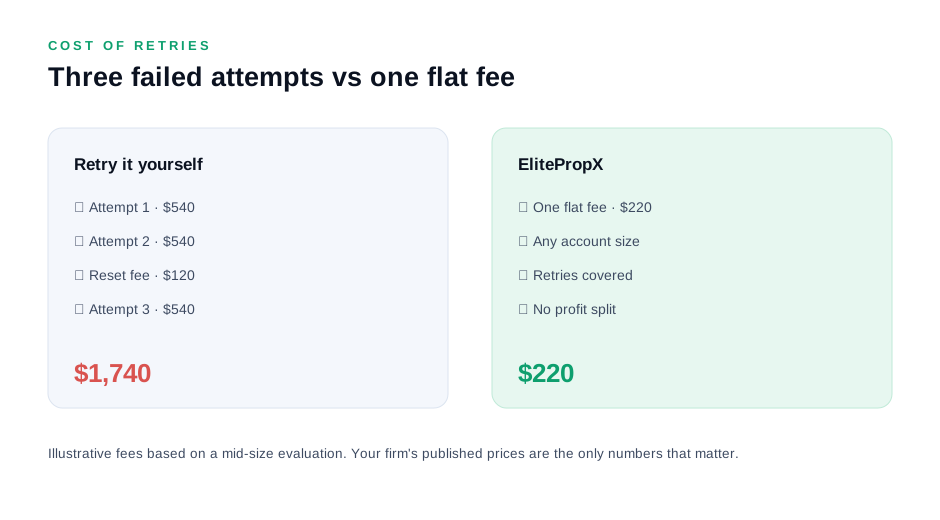
Consider a $100,000 account. An evaluation might cost a few hundred dollars, and an instant account of the same size might cost three to five times that. If the same trader would fail two evaluations before passing — which is a common pattern, and the reason retry policies exist — the total evaluation cost rises toward the instant funding price. At that point the comparison is no longer about price but about time: the evaluation route takes three to six weeks of assessment before a funded account exists, while the instant route produces an account on day one.
The counter-argument is discipline. An evaluation enforces a pace, because a target has to be reached inside a window without breaching a limit. An instant account has no assessment to complete, so the only structure is the one the trader brings. Traders who fail evaluations because they cannot pace themselves often lose instant accounts faster, because nothing external imposes a schedule at all.
The honest summary: instant funding trades money for time. It is a good purchase for a trader with a written funded-account plan, and an expensive one for a trader who is hoping the absence of an evaluation will remove the need for discipline.
The rules an instant account still carries
Because there is no evaluation, the rules that would have applied during one are either removed or relaxed — and new ones are added to compensate.
| Rule | Evaluation account | Instant funding account |
|---|---|---|
| Profit target to receive funding | Required (8–10%) | None |
| Time limit to reach it | Sometimes | Not applicable |
| Daily loss limit | Usually 5%, strictly applied | Present, often relaxed |
| Maximum loss | Static or trailing threshold | Present, usually static |
| First payout threshold | After funding, typically 5–10% | Often higher, or a longer minimum period |
| Consistency at payout | Varies | Commonly applied |
| Purchase price | Low (challenge fee) | High (typically several times the challenge fee) |
Two rows in that table are where traders are most often surprised.
The first is the first-payout threshold. Having paid a premium to skip the evaluation, a trader often assumes the payout is similarly accelerated. Frequently it is the opposite: instant accounts push the first withdrawal further out, sometimes with a higher profit threshold, sometimes with a longer minimum period, and occasionally with a cap on how much can be withdrawn early. The reasoning from the firm's side is straightforward — the account was issued without evidence of the trader's discipline, so the payout conditions carry the screening instead.
The second is the consistency rule. It is often applied at payout on instant accounts even where the firm does not apply it on evaluation accounts, which produces the familiar outcome of a profitable account with a blocked first withdrawal. The arithmetic is the same as everywhere else: total profit must reach at least 3.33× the best day under a 30% rule, as covered in the consistency rule guide.

Evaluation versus instant funding, side by side
Strip out marketing and the two routes differ on four practical dimensions.
| Dimension | Pass an evaluation | Buy instant funding |
|---|---|---|
| Time to funded account | Three to six weeks typically | Immediate on purchase |
| Cost for a $100k account | Low challenge fee per attempt | Several times the challenge fee |
| Evidence of skill required | Yes — a passed evaluation | None |
| First payout conditions | Standard funded terms | Often stricter: higher threshold, longer minimum period |
| Retry on breach | Firm reset policy, sometimes free | New purchase |
| Main failure mode | Daily limit breach during assessment | Losing the account before the first payout |
The row that deserves the most attention is the last one, because it describes two different discipline problems. Evaluation failures cluster around the daily loss limit and a specific behaviour — the recovery trade after a losing morning. Instant-account losses cluster around the absence of structure: without a target to reach, sessions drift, size creeps up, and the maximum loss is reached over a series of unremarkable days rather than in one dramatic session.
That difference suggests a decision rule. If your failure pattern is a single rule breach under pressure, an evaluation is a reasonable purchase — the assessment structure is not what is defeating you, one specific behaviour is. If your failure pattern is drift and inconsistency over weeks, an instant account removes the only structure that was holding the process together, and the purchase is likely to be an expensive lesson.
Who instant funding suits
Three trader profiles tend to get good value from instant funding.
Experienced traders whose edge is already proven. A trader with a verified track record on a personal account does not need an evaluation to know they can perform. Paying a premium to skip three to six weeks of assessment is a rational time purchase, provided the funded-account plan is written before the account is opened.
Traders with capital but limited time. Where the constraint is attention rather than skill, an account that exists immediately and pays out on a predictable schedule fits a busy schedule better than a two-phase assessment that requires daily participation for a month.
Traders who have already proved they can pass evaluations. A trader who has passed two evaluations and lost funded accounts twice has evidence that the assessment is not the bottleneck. Instant funding removes a step that was already being cleared and puts the focus on the phase that actually needed work.
Two profiles do not suit it. The first is a trader who has never traded under hard drawdown conditions, because an instant account is the most expensive possible place to learn what a maximum loss feels like. The second is a trader who wants the evaluation as practice: the assessment phase is genuinely good training for constraint management, and buying past it removes the training along with the cost.
Instant funding and passing services
This is the question the article's title usually produces, and the answer is short: there is nothing to pass on an instant account, so a challenge-passing service has no role in it.
What a passing service offers is the assessment step — the rulebook analysis, the pacing, the discipline to reach a target without breaching a limit. On an instant account, none of that is required, because there is no target and no assessment. Buying instant funding and hiring a passing service would mean paying twice for the same removed step.
The adjacent arrangement that does exist is a service trading the funded account itself for a share of profit. That is a different product, and it should be scrutinised carefully for two reasons: the service then has an interest in payout timing, and the account is being traded by someone other than the person whose name is on it — which is the same third-party-trading question that applies during an evaluation, now applied to an account the firm has already funded.
For traders weighing the two routes with an eye on cost, the honest framing is this: an evaluation plus a flat passing fee is almost always cheaper than an instant account of the same size. The premium on instant funding buys time, not certainty, and the funded-phase conditions on instant accounts are frequently the strictest in the market. Where the goal is a funded account that pays out reliably, passing a forgiving evaluation at a static-drawdown firm remains the cheaper and more predictable route — which is exactly what the firm comparison is designed to help with.
How to plan a funded account you bought rather than passed
The absence of an evaluation is the absence of a plan, so the plan has to be written deliberately before the first trade. Five numbers do most of the work.
- Maximum risk per trade, expressed as a percentage of the account and capped at a third of the daily loss allowance.
- Maximum daily risk, with a hard stop at roughly 80% of the daily limit so that slippage on the closing trade cannot tip the day over.
- Daily profit cap, set at about a third of the eventual payout threshold so the consistency rule is satisfied by construction rather than repaired later.
- Target payout date, calculated backwards from the minimum period and the profit threshold, so the two conditions complete together rather than weeks apart.
- KYC deadline, in the first week of the account rather than at the payout request.
Two further rules close the gaps that instant accounts fall through. The first is a session structure: a defined start, a defined maximum duration and a defined stop, because an account with no assessment to complete has no natural endpoint to a trading day. The second is a weekly review, comparing the week's distribution of profit against the consistency threshold while there is still time to correct it — a check that takes five minutes and prevents a blocked withdrawal.
It is worth stating the alternative plainly. A trader who cannot commit to writing those five numbers is not in a position to benefit from instant funding, because the account has nothing else holding it together. The same trader would be better served by an evaluation, where the rulebook supplies the structure that a purchased account leaves out.
What to check before buying an instant account
Six questions separate a workable instant account from an expensive one.
1. What is the first-payout threshold, in currency? Convert any percentage into dollars before comparing firms, and check whether the threshold resets after each withdrawal.
2. What is the minimum period before the first payout? Some firms define this in trading days with closed trades required, not calendar days.
3. Is a consistency rule applied at payout? And if so, at what percentage, and measured against total profit or against the amount withdrawn.
4. Is the maximum loss static or trailing? On an instant account, a trailing floor is considerably more dangerous than a static one, because there is no assessment period in which to learn how it behaves.
5. Is there a cap on early withdrawals? Some firms limit how much can be taken in the first months or the first few payout cycles.
6. What does the account cost relative to the same size evaluation? If the instant premium exceeds roughly three or four challenge fees, the arithmetic of skipping the assessment becomes difficult to justify for most traders — particularly when a covered-retry passing service sits well below that figure.
When instant funding pays for itself, in numbers
The comparison is arithmetic rather than philosophical, and it can be laid out on one screen. Take a $100,000 account and two routes: an evaluation with a pass rate expectation, and an instant account at a premium price.
| Scenario | Evaluations purchased | Assessment cost | Time to funded account | Total cost |
|---|---|---|---|---|
| Passes first attempt | 1 | One challenge fee | Three to six weeks | Lowest of all options |
| Passes second attempt | 2 | Two challenge fees | Six to ten weeks | Still below the instant premium |
| Passes third attempt | 3 | Three challenge fees | Two to four months | Approaching the instant price |
| Second attempt with a passing service | 1 + service | One fee plus $220 | Three to six weeks | Below the instant premium |
| Instant funding | None | None | Immediate | Several times one challenge fee |
Two conclusions come out of that table. First, the evaluation route only approaches the instant funding price after three or more attempts, and a covered-retry passing service keeps it below that line even when an attempt fails. Second, the instant premium buys time rather than certainty: the account arrives immediately, but the payout conditions attached to it are usually the strictest in the market.
What that means in practice is that instant funding is most defensible when time has a specific cost — a trader who needs a funded account open before a particular period, or whose schedule makes three to six weeks of daily assessment impractical. For everyone else, the arithmetic favours passing an evaluation at a firm with a forgiving structure, and the comparison page exists to identify which firms those are.
A worked example: the first six weeks of an instant account
An instant $100,000 account is purchased, and the funded-phase rules are read on day one rather than in week four: a static maximum loss, a daily loss limit, a 6% first-payout threshold, a ten-trading-day minimum and a 30% consistency rule at payout.
Week one. Risk per trade is set at $500 — a fraction of the daily allowance, deliberately conservative while the account's behaviour is unknown. Daily profit is capped at $700, roughly a fifth of the eventual threshold. The week ends at 1.4% of threshold with a best day of $690. KYC is submitted, and the funded-phase plan is written down with four numbers: risk per trade, daily stop, daily profit cap and target payout date.
Week two. Risk per trade rises to $700 once the plan has held for five sessions without a breach. Progress reaches 3.1% of threshold. A flat Wednesday is logged as flat, and no attempt is made to recover it on Thursday — the daily cap is a ceiling rather than a target to be made up.
Week three. KYC clears. The account passes 5% of threshold on day eleven, and the day count completes on the same day because the pace was planned backwards. The consistency ratio stands at 22% — comfortably inside the 30% rule. The payout is requested immediately.
Weeks four to six. Processing completes inside the firm's window and the first payout arrives. The threshold resets, and the same pace begins again. Because the account was purchased rather than passed, there is no evaluation certificate attached to it — the only record of discipline is the payout history, which is precisely what the firm's scaling conditions are based on.
The example is deliberately unremarkable. The account survived because the plan defined risk before the first trade, and because the payout conditions were read on day one instead of discovered at the first request. That is the entire difference between an instant account that pays out and one that quietly disappears.
Instant funding red flags
Five features of an instant funding offer should prompt caution, and each has a specific reason behind it.
- A very low price for a very large account. Instant capital carries real cost for the firm. An offer far below market usually carries conditions that claw it back — an extreme payout threshold, a long minimum period, or a maximum loss so tight that the account cannot realistically survive.
- No published maximum loss figure. Every funded account has a failure level. If it is not stated clearly before purchase, the account is being sold on the appeal of instant funding rather than on its terms.
- A payout threshold that is not stated in currency. Percentages hide absolute numbers, and the absolute number is what determines how long the funded phase actually lasts.
- No clarity on consistency at payout. Instant accounts commonly apply it, and an ambiguous answer at purchase usually becomes a blocked withdrawal later.
- Marketing built entirely on "instant" and not at all on payout terms. The word describes when the account opens, not when money leaves. An offer that leads with the first and never mentions the second is selling the smaller half of the product.
The sixth flag is the quietest one: an offer that does not say whether the account is static or trailing on its drawdown. That single detail changes how the account must be traded more than any other term, and a firm that omits it from the purchase page is either unaware of the distinction or hoping the buyer is.
The reverse test used elsewhere on this site applies here too: ask what happens to traders who lose the account in the first month. A firm that answers specifically has thought about the funded phase as a product; a firm that answers with a slogan has not, and the trader is the one who finds out which it was.
Frequently asked about instant funding
Is instant funding really instant?
The account is issued immediately on purchase; the payout is not. Instant accounts typically carry a profit threshold and a minimum period before the first withdrawal, and those conditions are often stricter than the equivalent conditions after an evaluation.
Is instant funding easier than an evaluation?
It is easier in the sense that there is no target to reach or assessment to pass in a set window. It is harder in the sense that there is no external structure at all, and the account can be lost through drift rather than through one identifiable mistake.
Why is instant funding more expensive?
Because the firm is issuing funded capital without evidence of the trader's discipline. The premium compensates for that missing screening, and part of the compensation takes the form of stricter early payout conditions rather than purchase price alone.
Do instant accounts have drawdown limits?
Yes. Every instant account has a maximum loss and usually a daily loss limit, and breaching either ends the account. Removing the evaluation removes the target, not the risk framework.
Can I use a passing service on an instant account?
There is nothing to pass, so it would be paying for a step that does not exist. A service that offers to trade the funded account for a share of profit is a different product with a different risk profile, and it should be assessed on those terms.
Which is better for a first prop account?
An evaluation, for almost every trader. It costs far less, the assessment itself builds the constraint discipline the funded phase requires, and a failed attempt provides information that a lost instant account does not.
Do instant accounts scale?
Some firms offer scaling tied to a payout record, usually after several completed withdrawals. Because the account was purchased rather than earned, scaling conditions on instant accounts are frequently more demanding than on evaluation-funded accounts.
What is the biggest mistake with instant funding?
Treating the absence of an evaluation as the absence of constraints. Traders who open an instant account and immediately trade it like a personal account usually lose it before the first payout, and the purchase price makes that outcome considerably more expensive than a failed evaluation would have been.
The true cost of skipping the evaluation
Instant funding products are priced for the convenience of skipping a phase, and the pricing is the least interesting thing about them. What actually changes is the risk structure: an instant account usually pairs a higher fee with a tighter set of payout conditions, because the firm has taken on a trader it has not observed.
The arithmetic is simple and rarely done. A standard evaluation might cost $540 and require 10% of profit before a payout; an instant account might cost $1,200 and require a consistency ratio, a minimum day count and a first-payout profit threshold before anything is paid. The instant product skips three weeks of work and charges roughly double, and the trader who would have passed the evaluation has paid a premium for time they did not need to save.
| Consideration | Standard evaluation | Instant funding |
|---|---|---|
| Fee | Lower | Higher, often double |
| Proof of skill required | Yes — the target is the proof | No |
| Payout conditions | Threshold plus day count | Usually stricter: ratio, days, minimum profit |
| Failure cost | The fee | The larger fee, with no evaluation to learn from |
| Best fit | Anyone with a repeatable process | Experienced traders whose time is genuinely the constraint |
Who instant funding is actually for
It suits a trader who has already passed evaluations, already has a process, and values two or three weeks more than the fee difference. That is a genuinely small group, and it is not the group the marketing addresses. It is a poor fit for a first account, because the evaluation phase is where the routine gets built — the daily budget, the journal, the habit of stopping at the cap — and skipping it removes the cheapest place to learn those habits.
The payout trap to check first
The single most important line in an instant funding offer is the first-payout condition. Some accounts permit a withdrawal only after a profit threshold that is a large fraction of the account, combined with a minimum number of trading days and a consistency ratio. Add those three together and an instant account can require more trading than the evaluation it replaced, with less room for error, because the loss limit applies from day one with no target to aim at.
Read that line before the fee, and read the loss mechanic next. An instant account with an intraday trailing floor and a $3,000 profit threshold is a stricter product than an evaluation with a static drawdown, however it is marketed.
When instant funding is the rational choice
Despite all of the above, there are situations where it is the better decision, and they share a common feature: the trader's constraint is time rather than capital or skill.
Situation one: an existing book needs a second account
A trader already running a funded account who wants a second, independent account for diversification across rulebooks is a reasonable candidate. They have demonstrated the process, they know what a payout cycle feels like, and the marginal value of avoiding a three-week evaluation is real.
Situation two: a firm's evaluation rules are unusually punitive
Occasionally a firm prices its instant product below the expected cost of its own evaluation — usually because the instant account has a low payout ceiling. Where the numbers genuinely favour it, the comparison should be made on expected cost per dollar of payout, not on the headline fee or the headline account size.
Situation three: a time-boxed opportunity
A trader with a known quiet period — a month between contracts, a sabbatical — may rationally pay for immediate access rather than spend that month in an evaluation that expires unused. This is the strongest argument for instant funding and the least used, because it depends on the trader's calendar rather than the product's marketing.
What to check in every instant offer
- First-payout condition. Profit threshold plus days plus consistency, read together rather than separately.
- Drawdown mechanic. Static or trailing, and if trailing, intraday or end-of-day.
- Whether the fee is refundable or credited. Some firms credit part of the fee against the first payout, which changes the arithmetic.
- Whether the account is real or simulated. Almost all are simulated with performance-based payouts; that is normal, and it should be stated.
- Whether third-party trading is permitted. The same rule applies as with evaluations, and enforcement after funding is the expensive case.
One further check costs ninety seconds: compare the instant account's first-payout condition with the evaluation's target. If the instant product requires more profit before the first withdrawal than the evaluation requires to pass, the time saved is an illusion — the trader is doing the evaluation with a larger fee and no reset option.
That comparison is the whole argument in a line, and it explains why these products are rarely priced as straightforwardly as they are advertised. The fee is visible, the payout condition is buried, and the condition is what decides whether the account was worth buying.
A useful habit is to write the two conditions side by side on one line — evaluation target on the left, instant first-payout condition on the right — before reading the price. If the right-hand number is larger, the product has not saved time; it has moved the same work behind a bigger fee and called it access.
The same discipline applies to renewals. Instant accounts are often renewed at a discount when the first attempt fails, and a discounted renewal on a structure that was wrong to begin with is not a saving. The question to ask at renewal is whether anything about the plan has changed, not whether the price has.
The honest test is whether the first attempt failed through a rule breach or through variance. In the first case, a renewal buys nothing until the behaviour changes.