Apex Trader Funding: The Complete Guide (2026)
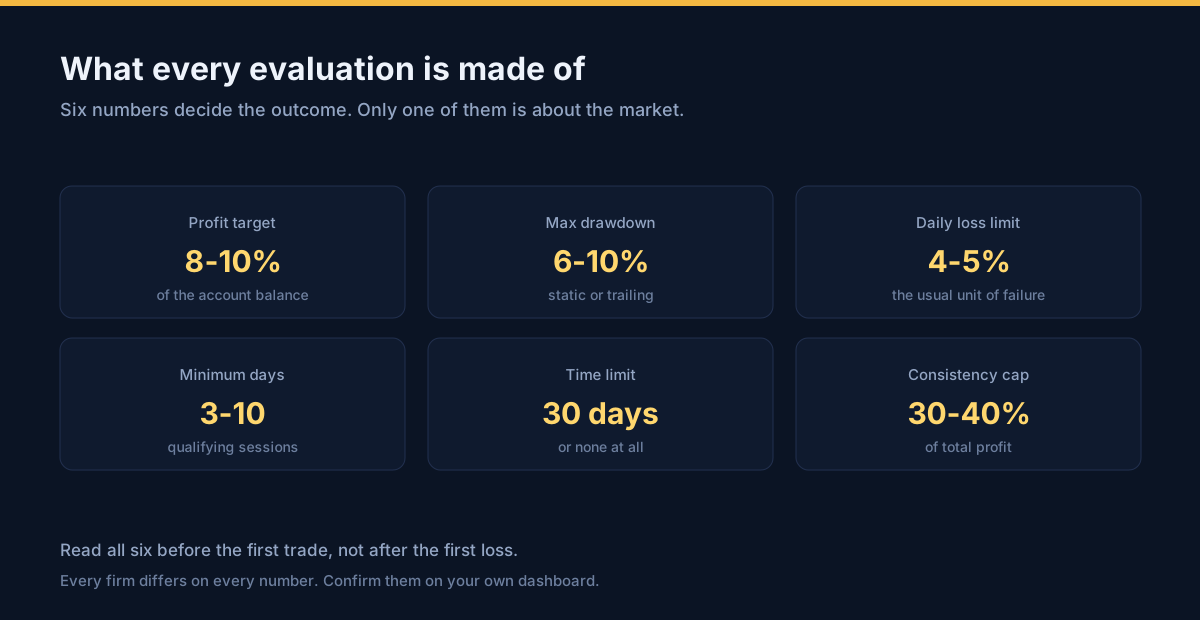
Apex Trader Funding is the most searched futures prop firm in the world, and for good reason: it offers some of the largest account sizes in the industry, a platform-agnostic setup and a payout structure that has matured into something genuinely usable. It is also the firm where the most traders quietly fail, because the trailing drawdown punishes exactly the behaviour that a profitable futures trader is trained to use.
This guide covers Apex end to end: how the evaluation works, how the trailing threshold actually behaves (the part most articles get wrong), the consistency rule that blocks payouts, the payout mechanics, platform choices, and a practical plan for passing — whether you do it yourself or have us do it for a flat fee.
Rules change — always confirm on your dashboard
Apex updates thresholds, day requirements and promotion pricing regularly. Everything below reflects the structure as we understand it at the time of writing. Before you trade, verify the exact numbers inside your Apex account. If you would rather we handle it, see our Apex challenge passing service.
What is Apex Trader Funding?
Apex Trader Funding is a futures-focused proprietary trading firm headquartered in the United States. It funds traders to trade CME futures products — the E-mini and Micro contracts on the S&P 500 (ES and MES), Nasdaq (NQ and MNQ), crude oil (CL and MCL), gold (GC and MGC), and the rest of the CME complex — through third-party platforms rather than its own proprietary software.
The firm's model will be familiar if you have looked at any prop firm. You pay an evaluation or activation fee, trade a simulated account to a profit target without breaching a drawdown limit, and then receive a funded simulated account on which you can request withdrawals of your profits. Apex's specific twist is the trailing drawdown and the breadth of account sizes, which scale all the way up to $300,000 — larger than almost any competitor in futures.
Because Apex funds simulated accounts rather than allocating real capital, the trader's profit is paid out of the firm's revenue pool rather than from a capital allocation. That is standard across the industry and not a red flag in itself; the question that matters to a trader is whether payouts actually arrive, and on that measure Apex has a sustained, well-documented record.
Apex account sizes and what the fee buys
Apex sells a ladder of accounts, and the fee rises with size even though the profit target generally does not scale in the same proportion. That is the first useful insight: the smaller accounts have a materially better target-to-size ratio, and the largest accounts are for traders who want to scale position size rather than because they need a bigger target.
| Account size | Profit target (approx.) | Trailing threshold | Best for |
|---|---|---|---|
| $25,000 | $1,250 – $1,500 | ~$1,250 | First evaluation, low risk |
| $50,000 | $2,500 – $3,000 | ~$2,500 | Most popular starter size |
| $75,000 | $2,750 – $3,500 | ~$2,750 | Mid-size, better $/target |
| $100,000 | $3,000 – $6,000 | ~$3,000 | Serious retail traders |
| $150,000 | $4,500 – $9,000 | ~$4,500 | Traders scaling contracts |
| $250,000 | $6,500+ | ~$6,500 | High-volume traders |
| $300,000 | $7,500+ | ~$7,500 | Maximum size tier |
Two practical notes. First, the profit target at Apex is typically a fixed percentage of the account rather than a percentage that shrinks as size grows, so the ratio stays roughly constant — compare it against firms like Topstep before deciding. Second, Apex frequently runs promotions that reduce the monthly evaluation fee dramatically, so the sticker price is rarely what you actually pay. The evaluation fee goes to Apex; if you use a passing service like ours, that is a separate flat charge.
The trailing drawdown: the rule that decides your outcome
If you read only one section of this guide, read this one. The trailing drawdown is the mechanism that fails the majority of Apex traders, and it is widely misunderstood.
A conventional drawdown is static: your account has a floor set at a fixed distance below your starting balance, and that floor never moves. The trailing drawdown is different. At Apex, the drawdown threshold follows your account's peak upward. As your unrealised profit grows, the floor rises with it, keeping a constant gap between the high-water mark and the floor. The consequence is counter-intuitive: the moment your account moves up, your available buffer shrinks, because the floor has climbed to meet you.
Consider a $50,000 account with a $2,500 trailing threshold. You start with a $2,500 buffer below you. You take a trade that goes $1,000 in profit. The floor now trails to $48,500 — meaning if you give back that $1,000 and fall a further $1,500, you are done. Your buffer is still $2,500 from the peak, but your distance from your starting balance has effectively been reduced to $1,500. Newer traders read "I am up $1,000, so I have $3,500 of room" and they are wrong. They have $2,500 of room from the new peak, not from the start.
The single most common Apex failure
A trader opens a position, it runs in their favour, they leave it on, it reverses, and by the time they exit the trailing floor has climbed above their entry. They have wiped out an account while technically "breaking even" on the trade. Understanding that the floor trails unrealised profit — not just realised profit — is the difference between passing and failing.
There is a relief valve. Once your account reaches a defined profit level, the trailing threshold stops trailing and locks in place. From that point your drawdown floor is fixed, and your cushion grows normally with every winning day. Finding that lock point and reaching it as fast and safely as possible is the core of any Apex passing strategy.
How to trade the trailing drawdown safely
Size to the remaining buffer, not the account size
Your position size should be a function of the distance to the trailing floor, not the nominal account balance. As the floor climbs, size down. This is the opposite of how most traders behave.
Bank profits rather than letting them run to the lock
Take consistent, modest gains and realise them. Realised profit does not put your floor at risk the way a large open winner does when it reverses.
Reach the lock point quickly, then breathe
Once the threshold stops trailing, the account becomes dramatically easier. Treat the pre-lock phase as the whole challenge and the post-lock phase as normal trading.
Avoid news and overnight gaps early
Gap risk can open a position beyond your stop, stepping straight through the trailing floor. Until you are locked, overnight holds are an unnecessary risk.
If you want the full arithmetic behind that discipline — the CME tick table, the position-size formula and a worked $50,000 example showing why only the pre-lock profit is dangerous — read how to pass Apex's trailing drawdown.
The Apex 30% consistency rule for payouts
Passing the evaluation is only half the battle at Apex. To withdraw, your profit has to pass the consistency test. The rule is that no single trading day may account for more than a set percentage of your total profit before a payout — commonly 30% at Apex.
Why the rule exists: Apex, like most firms, is screening for traders who got lucky on one enormous day rather than traders with a repeatable edge. If your entire profit came from a single home-run trade, the firm reasonably questions whether your results will persist. The rule forces your profit to be distributed across multiple days.
Here is the trap. Suppose you make $6,000 on your best day and $4,000 across all other days, for $10,000 total. Your best day is 60% of your profit — well over the 30% cap. You cannot withdraw yet. You must keep trading profitably until the other days make up enough of the total that no single day exceeds the threshold. The counter-intuitive consequence is that making more money on ordinary days is what unlocks your payout, and taking another huge day makes the problem worse.
| Scenario | Best day | Total profit | Best day % | Withdrawable? |
|---|---|---|---|---|
| One lucky spike | $6,000 | $10,000 | 60% | No — keep trading |
| Spike plus grind | $6,000 | $24,000 | 25% | Yes |
| Distributed gains | $1,800 | $9,000 | 20% | Yes |
Our full consistency rule guide walks through the maths in detail, and the same logic applies across most firms. If consistency is the specific thing that has blocked you, that is exactly the problem our service is built to solve.
Payouts, thresholds and the payout ladder
Once your account is in profit and consistent, you request a withdrawal through the Apex dashboard. The key facts to internalise:
- Minimum trading days. Apex requires a minimum number of qualifying trading days before the first payout, currently in the region of eight. You cannot request a payout on day two no matter how large the profit.
- Minimum payout amount. There is a floor on withdrawal size; smaller profits simply accumulate.
- No profit split deductions in the usual sense. Apex pays out a high percentage of profits on funded accounts, and the split improves as you demonstrate consistency across payouts.
- Payout schedule. Requests are processed on a set cadence rather than instantly, so plan cash flow accordingly.
See the dedicated Apex first payout timeline for a day-by-day expectation of the process.
Platforms: Tradovate, Rithmic and TradingView
Apex does not force you onto proprietary software, which is a genuine advantage. You can trade your Apex account through:
- Tradovate — the most popular choice, with a clean browser and desktop interface and solid order handling for futures.
- Rithmic / R|Trader Pro — favoured by traders who want institutional-grade order routing and depth.
- TradingView — allows charting and execution in a familiar environment, useful if you already map levels on TradingView.
The platform matters less than the rules, but Tradovate is the gentlest onboarding for a first evaluation, and our team can trade whichever you prefer.
How to pass an Apex evaluation — a realistic plan
Strip away the noise and passing Apex comes down to surviving the pre-lock trailing phase with enough profit to hit the target. Here is the framework we use.
Map the exact thresholds from your dashboard
Confirm the profit target, the trailing amount, the lock point and the minimum days. Do not rely on a blog post — including this one. The dashboard is authoritative.
Trade micros first
Until you are locked, use the Micro contracts (MES, MNQ, MCL, MGC). Micros let you build profit in small increments without a single loss threatening the trailing floor.
Target 1–2 solid setups per day, then stop
Overtrading is how trailing accounts die. A single good setup, banked, is worth more than five marginal ones that leave open risk.
Reach the lock point, then scale carefully
Once the threshold stops trailing, you can add contracts. Before that point, every extra contract is borrowed risk.
Manage the consistency rule from day one
Do not take a monster day early and then spend weeks diluting it. Spread profit evenly across trading days so the payout rule is satisfied the moment you hit the target.
Common mistakes that fail Apex accounts
- Misreading the trailing floor as static. The most expensive error in futures prop trading.
- Holding through high-impact news. A CPI or FOMC print can gap through any stop and breach the trailing threshold instantly.
- Revenge trading after a small loss. On a trailing account, a small loss has already eroded your buffer; doubling up compounds the injury.
- Ignoring the consistency rule until payout time. Then discovering a single $7,000 day is blocking a $7,000 withdrawal.
- Oversizing with the big contracts too early. ES and NQ move fast; a two-tick adverse move on a full contract can consume hundreds of dollars of buffer.
Should you pass Apex yourself or use a service?
Both are legitimate. If you have the screen time and can follow the trailing-floor discipline, passing Apex yourself is cheap — the evaluation fee is modest and the platform is forgiving. If instead you are a skilled trader who keeps tripping the trailing threshold, or you simply do not have the hours, our Apex challenge passing service takes the evaluation off your hands for a flat $220 with no profit split, and covers retries if we fail a managed account. We explain the honest trade-offs of third-party trading here.
Frequently asked questions
We cover the highest-frequency Apex questions in the FAQ block below, including the trailing drawdown mechanics, the 30% consistency rule, payout day requirements and whether Apex suits beginners. If your question is not answered there, the challenge-passing deep dive and the Apex vs Topstep safety comparison go further.
How does the Apex Trader Funding trailing drawdown work?
What is the Apex 30% consistency rule?
How many trading days until the first Apex payout?
How much does an Apex evaluation cost?
Can I hold trades overnight at Apex?
Is Apex good for beginners?
Have a question before you commit?
Ask us anything about your firm, your account size or whether a passing service suits you. We answer directly on Telegram — no forms, no queues.
Ready to pass your prop firm challenge?
Flat $220 per evaluation — we trade it for you and hand over a funded account. No hidden cuts, no monthly fees. Message us on Telegram and we will answer in minutes.