
Reviewed · how we check firm rules
Questions and answers
Everything traders ask before paying $220
These are the questions that come up in almost every enquiry, answered without marketing language. If your question is not here, send it over — the answer will be added. For the delivery terms behind these answers, the propfirm passing service page has the full account.
Quick answers
- Price: $220 flat per evaluation, any account size, retries covered.
- Profit split: 0% — the funded account and everything it earns belong to you.
- Timeline: around 14 days on average for a two-phase forex evaluation.
- Coverage: 20+ firms including FTMO, FundedNext, The5ers, Apex, Topstep and MyFundedFutures.
- Not included: the firm's own challenge fee, which you pay directly to the firm.
Pricing and payment
How much does ElitePropX charge?
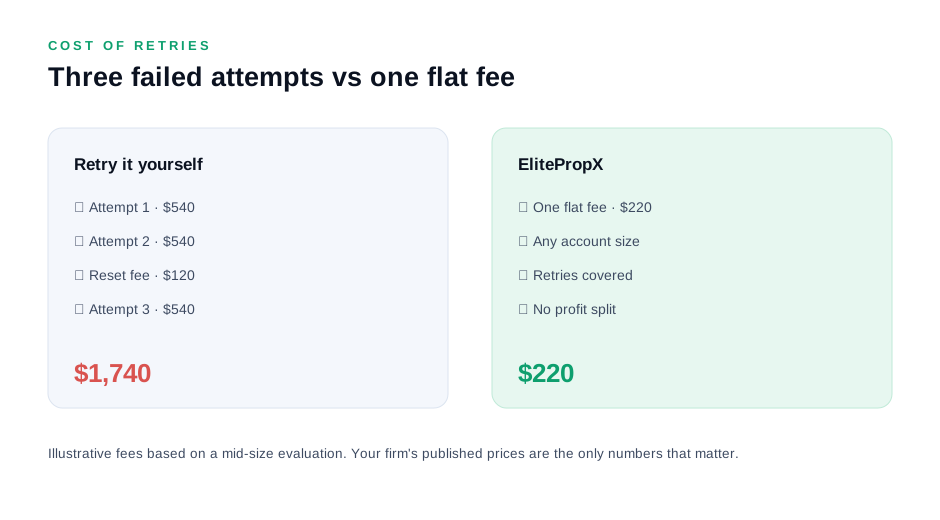
A flat $220 per evaluation. The price does not change with account size, firm or phase structure. There is no monthly subscription, no setup fee, no performance fee and no charge at payout. The propfirm passing service pricing models section compares this against the two alternatives.
Is the prop firm's challenge fee included in the $220?
No. The firm charges its own evaluation fee, and that payment goes to the firm, not to us. You register and pay the firm directly, which keeps the account in your name and keeps KYC attached to you.
Why is the fee the same for a $25,000 and a $300,000 account?
Because the work is nearly identical. The rulebook analysis, the risk planning and the number of sessions required scale with the profit target as a percentage, not with the nominal account value. Charging more for larger accounts would be charging for the size of a number, not for more work.
Do you take a percentage of my payouts?
Never. Once the funded credentials are handed over, the account is yours and 100% of the profit is yours. We do not trade funded accounts under any arrangement and we do not take a share of withdrawals.
Are there hidden upsells?
No premium tier, no "expedited" upgrade, no mandatory add-ons. If an engagement needs something outside the flat fee — which is rare — it is stated in writing before payment rather than discovered later.
When do I pay?
Before the evaluation is traded, once the firm, account size and rules have been confirmed and you have the fee and timeline in writing. Nothing is charged at the moment of enquiry.
What payment methods are accepted?
Invoiced payment methods are confirmed at enquiry and depend on your location. The practical requirement is that the payment is traceable, so both sides have a record of the transaction.
Do you offer refunds?
Retries are included when an attempt breaches a rule, which is the main protection for a rules-based service. Refund terms for a specific engagement are confirmed in writing before payment, and the firm's challenge fee is always outside our control and non-refundable by us.
Is there a free trial?
Yes, in two forms. The free 7-day demo trial uses a broker demo account you open yourself: we trade it for a week and you watch, at no cost and with no card. Separately, a trial challenge — a smaller prop firm evaluation run through the same process — is available for traders who want to see a firm-side pass before committing to a full-size account. Neither carries an obligation to continue.
Can I see the service trade before I pay anything?
Yes. Open a demo with any broker that offers MT4, MT5 or cTrader, send the demo login, and we trade it for seven days under a written plan. You keep the login and can watch whenever you like. A demo cannot reproduce a prop firm's breach rules, so it is evidence of process rather than a guarantee of a pass.
Can I split the fee across multiple accounts?
Each evaluation carries its own $220 fee. Traders running several accounts at once — common on firms with scaling plans — often arrange them sequentially rather than simultaneously, partly so the daily risk budgets do not compete for the same attention.
The process
What exactly happens after I pay?
The firm's rulebook is written into a one-page plan covering target, daily loss limit, maximum loss, drawdown type, minimum trading days, consistency rules and instrument restrictions. A risk plan follows from those numbers: maximum risk per trade, maximum trades per session, and the conditions under which trading stops for the day. Then the evaluation is traded, with progress logged session by session.
How long does it take to pass?
On average around 14 days for a two-phase forex evaluation with no time limit. Futures evaluations with trailing thresholds and minimum trading days typically run two to four weeks. A timeline is agreed before the attempt starts and updated if a firm's rules complicate it.
Can you pass it in a few days?
Only if the firm's rules allow it. Many firms require a minimum number of trading days before verification, and racing to a target inside the daily loss budget usually means gambling rather than executing. If an aggressive timeline conflicts with the rules, the timeline is declined.
How much communication do I get during the evaluation?
Session-by-session logging with four numbers: closing equity, distance from the failure floor, percentage of target completed, and trading days used. You see the log rather than a curated summary, including flat and losing sessions.
Do I need to do anything during the evaluation?
No. The account must remain funded and in good standing, and you should avoid logging in and trading it yourself, which would be an obvious breach of the firm's rules and would confuse the risk plan.
How is the funded account handed over?
The credentials are passed to you directly, along with the funded-phase rules summary — minimum trading days, payout thresholds, consistency checks and KYC requirements — so you know what the first withdrawal requires before you start trading.
Do I need a trading platform installed?
Not for the evaluation, since the trading happens on our side. You will need access to whichever platform your firm uses — MT4, MT5, cTrader, TradingView, Tradovate, NinjaTrader and similar — for the funded phase.
Can I watch the evaluation progress in real time?
The log is the record of progress. Live screen sharing is not part of the standard service, mainly because it invites second-guessing of the plan mid-session, which damages the discipline the plan depends on.
What happens if I change my mind after paying?
If the evaluation has not started, that is straightforward and handled on a case-by-case basis. Once trading has begun the fee reflects work already performed, so cancellations at that stage are governed by the written terms agreed before payment.
Do you trade on my behalf or teach me to trade?
We trade the evaluation. Teaching is not part of the service, and the funded phase is entirely yours. The guides on this site exist because understanding evaluation mechanics is useful to any trader, not because we sell a course.
Firms and account sizes
Which firms do you support?
More than twenty, including FTMO, FundedNext, The5ers, FXIFY, Alpha Capital Group, FundingPips, E8, Apex Trader Funding, Topstep, MyFundedFutures, Take Profit Trader, TradeDay and MFF. Coverage expands as firms launch new evaluation models, and any firm not listed can be checked on request.
Which firms are easiest to pass?
Broadly, firms with static drawdowns, no consistency rule, no time limit and a single-profit-target structure are the most predictable, because fewer rules can technically disqualify a finished attempt. Firms with intraday trailing thresholds and consistency rules at payout are harder, not because the target is larger but because more independent conditions must hold.
What account sizes are available?
From $25,000 to $300,000 depending on the firm. Apex, for example, scales considerably higher than most forex firms, while forex evaluations commonly stop around $200,000 per account with multi-account scaling on top.
Should I choose a forex or a futures evaluation?
It depends on what you plan to trade afterwards. Forex evaluations are usually percentage-based with static or end-of-day trailing drawdowns; futures evaluations are dollar-based with intraday trailing thresholds and consistency rules at payout. If you already trade one market, staying in it makes the funded phase easier.
Do you pass instant funding accounts?
Instant funding accounts skip the evaluation, so there is nothing to pass. What traders usually mean by this question is whether the early payout rules on instant accounts are manageable, which is covered in the instant funding guide.
Can you pass multiple accounts at the same firm?
Yes, and firms with scaling plans actively encourage it. Accounts are typically run sequentially so each one gets a full daily risk budget rather than several accounts sharing the same attention.
What if my firm is not on the list?
Ask. Most firms are workable if their rules are published and their terms do not prohibit third-party trading. Where a firm's evaluation is genuinely unpredictable, or its terms make the arrangement a clear breach, we will say so rather than take the fee.
Do you pass HFT or algorithmic-only evaluations?
Evaluations that restrict latency-sensitive or prohibited algorithmic strategies are handled conservatively and often declined, because the firm's rules around order behaviour are enforced aggressively and the risk of a voided account is high.
Failures and retries
What happens if the evaluation fails?
The attempt is reset on the same firm and account size with no additional service fee. Retries are covered because a per-attempt fee would make failure profitable for us, which is the wrong incentive for a service built on rule discipline.
How often do evaluations fail?
Roughly one in twenty managed evaluations ends in a rule breach and is reset. Failures cluster around firm-specific edge cases — an ambiguous trailing rule, a news restriction applied differently than published, a platform outage during an open position — rather than around strategy.
Do I have to pay the firm's fee again after a failure?
That depends on the firm. Some offer a free reset with a coupon or within a time window; others charge a reset or a full new challenge fee. That cost sits with the firm and is outside our fee.
What counts as a failed attempt?
A breach of any published rule that ends the account: daily loss limit, maximum loss or trailing threshold, consistency requirement, prohibited trading during restricted periods, or an unpermitted instrument. A flat or losing week that stays inside the limits is not a failure.
Can an evaluation be failed by a firm's mistake?
It happens occasionally — a payout or drawdown calculation that contradicts the published rules. In those cases the firm is contacted with the session log, and most firms correct genuine platform errors. The log exists partly for this reason.
Is there a limit on how many retries I get?
Managed evaluations are traded until the account is passed or the client decides to stop. In practice, repeat failures on the same ruleset indicate that the ruleset itself is the problem, and a different firm is recommended instead.

After funding and payouts
Who owns the funded account?
You. The evaluation was registered in your name, KYC is yours, and payouts are paid to you. We hold no claim, no equity and no right to the account.
Do you trade the funded account too?
Never. Running funded accounts for a share of profit would change the nature of the business and remove the trader from an account carrying their name. The handover is final.
When can I request the first payout?
Most firms require a minimum number of trading days — often five to ten — plus a profit threshold, a consistency check and completed KYC. The payout process guide walks through the sequence and the delays that catch traders out.
What profit split does the firm take?
That is between you and the firm, typically 80–90% to the trader, and it is unrelated to our fee because we take nothing from payouts. Your share is what you keep out of the firm's split.
What if the firm changes its rules after funding?
Firms can and do change payout terms, consistency requirements and withdrawal schedules. Once funded, you are subject to their current terms, and disputes are resolved between you and the firm.
Can I trade my own strategy on the funded account?
Yes, entirely. The evaluation is traded on our plan because the plan is built around the firm's constraints; the funded account is yours to run however you choose, including with a strategy we have never seen.
What if I lose the funded account quickly?
That is a real risk and the reason the funded phase deserves its own plan. Funded accounts typically relax the evaluation rules but add consistency requirements at payout, and traders who treat the funded account as a personal balance usually give it back within a month.
Do you help with the funded phase?
Rule mechanics, yes: how the consistency rule is calculated, when a payout can be requested, which behaviours trigger a review. Market direction advice is not offered, and no trading signals are provided at any stage.
Rules, compliance and risk
Is using a passing service allowed by prop firms?
It varies by firm, and this is the most important question on this page. Some firms prohibit third-party trading outright; others restrict account sharing or require the holder to trade personally. Enforcement often arrives after funding rather than during the evaluation. You must read your firm's terms before purchasing, and we will tell you what we know about a specific firm's policy on request. The three tests a buyer can actually run are in is a passing service legit.
What is the worst-case risk for me?
That your firm treats the arrangement as a breach and voids the funded account, meaning the evaluation fee and our fee are both lost. That risk is real, it is the client's to weigh, and no passing service can eliminate it.
Do you hide how the account is traded?
The trading method is described on this site in general terms and the session log shows the outcome. What we do not publish is a step-by-step proprietary entry model, for the same reason no trading operation publishes its exact execution rules.
Is ElitePropX regulated?
ElitePropX is not a broker, fund, investment adviser or regulated financial service — it does not hold client money or provide investment advice, so there is no regulatory licence to hold. It sells an execution service tied to a third party's published rules.
Do you encourage people to break firm rules?
No — the opposite. Every part of the service is built on respecting the firm's published rules with more margin than the rules require, including conservative readings of ambiguous terms. If a firm's policy makes the arrangement prohibited, the clause and the enforcement risk are set out in writing before payment so the client can decide.
What data do you need from me?
The firm name, account size, a contact method, and the login credentials for the evaluation account only. Banking details, ID documents and personal financial information are never required by us — KYC belongs to the firm, and the funded account is paid to you directly.
Is there an age or jurisdiction restriction?
You must be old enough to hold a prop firm account under your firm's terms, and participation depends on the firm accepting traders from your country. Sanctioned jurisdictions are excluded.
Do you use affiliate links or earn commission from firms?
No. Affiliate commissions are common in this space and create a conflict of interest — the recommendation would be driven by referral revenue rather than by which firm is actually easier to pass. Our only revenue is the $220 fee.
Mechanics and logistics
How do I start?
Email support@elitepropx.com or use the contact page with the firm name and account size. You will get the fee, the expected timeline, and any compliance notes about that firm before anything is paid.
What information should I include in my first message?
Firm, account size, phased or single-phase, and whether you already have an active evaluation account. If you have not chosen a firm yet, say what you plan to trade and a shortlist will be suggested.
How quickly do you reply?
Usually within one business day. Complex questions about a firm's terms can take longer, because they are checked against the firm's current published documentation rather than answered from memory.
Do you work with clients in my time zone?
Trading sessions are chosen from the firm's permitted hours rather than from a fixed office schedule, so time zones rarely cause a problem. Communication is asynchronous and works in any zone.
What happens if a firm's platform goes down?
Positions are managed conservatively around known maintenance windows, and open exposure is avoided before scheduled outages. Unscheduled outages are documented and reported to the firm if they affect an open position, since the session log supports that conversation.
Can I ask for a specific firm's rule breakdown before paying?
Yes. Rules differ enough between firms — trailing behaviour, consistency windows, news restrictions, minimum days — that checking the specifics first is normal. The rules matrix covers the main firms in table form.
Where can I read independent reviews?
Traders have posted experiences on public forums including Forex Peace Army, BabyPips and Myfxbook. Our own collection, including reviews that describe failed attempts, is on the client reviews page.
How do I verify that a claimed pass is real?
Ask for the firm-issued certificate, which states the account size and the firm name and is issued after verification rather than by us. The passed challenges page shows what the certificates look like and how to check them.
Choosing a firm when you plan to use a passing service
Not every evaluation is equally suitable for third-party execution, and the differences are structural rather than a matter of opinion. Four criteria matter more than account size or marketing offers.
1. Drawdown type
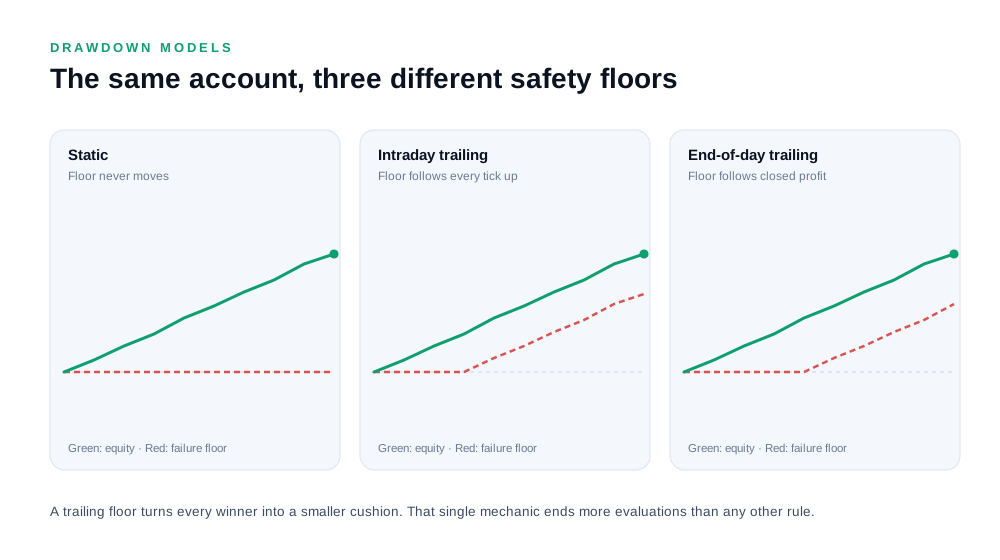
A static maximum loss is the most forgiving structure, because the failure level never moves. An end-of-day trailing drawdown is the next most workable: the floor follows closed profit, so intraday noise does not tighten it. An intraday trailing threshold is the hardest, because every unrealised gain drags the failure level upward and a normal pullback can end the account even while the day's net result is positive. If two firms are otherwise equal, the one with the static floor is the safer assignment.
2. Consistency rules and when they apply
Some firms apply a consistency requirement during the evaluation, some only at payout, and some not at all. A rule that applies at payout is more forgiving, because the distribution of profit can be adjusted by adding additional winning days before requesting a withdrawal. A rule that applies during the evaluation shortens the time you have to fix a lopsided distribution.
3. Time limits and minimum trading days
No time limit is better than a thirty-day window, for an obvious reason: a flat week costs time rather than the account. Minimum trading days cut the other way — they prevent a fast pass from being eligible for funding, which is why the log tracks days used as carefully as it tracks profit.
4. Terms on third-party trading
This is the criterion that decides whether the arrangement is appropriate at all. Firms that explicitly require the account holder to place the trades make a passing service a poor bet regardless of how favourable the evaluation rules look. Checking the current terms — not a review from two years ago — is part of the decision, not an afterthought.
If you would rather not work through that list yourself, send your shortlist and the answers will come back with a recommendation for the sequencing you plan: which firm to pass first, and which to leave until you are funded.
Nine questions to ask any passing service — including this one
The prop firm space has no shortage of operators who disappear after payment. These questions separate the ones with a process from the ones with a landing page.
- Is the fee per attempt or per pass? A per-attempt fee makes failure profitable for the service. Ask what happens on a breach and get the answer in writing.
- Do you take a share of payouts? Any arrangement where the service keeps a percentage of funded profit changes their incentives around payout timing.
- Do you trade the funded account? If yes, the account is effectively running on a profit-share basis and the trader's role shrinks to owning the name on it.
- Can you show firm-issued certificates? Screenshots of an equity curve prove nothing. A certificate issued by the firm after verification is checkable.
- What is your failure rate? A service claiming 100% has either not measured it or is not being straight about it.
- Will you tell me if my firm's terms make this a bad idea? Yes, in writing before payment — the clause, what enforcement has looked like, and who carries the risk.
- How is progress reported? Look for session-level logging with equity, distance from the failure floor and days used, rather than a single message at the end.
- Are you paid by any prop firm? Affiliate commissions are the norm in this space and they bend recommendations toward whoever pays the most.
- What do you need from me? Evaluation credentials only. Any service asking for banking details, broker passwords or identity documents for its own records should be avoided.
Answers to all nine of these, as they apply to ElitePropX, are on the about page — including the parts that are limits rather than selling points.
How to read a prop firm rulebook in fifteen minutes
Most of the questions on this page reduce to one skill: reading a firm's terms and extracting the four numbers that decide whether an evaluation is forgiving or brutal. Once that skill is in place, the answers stop being firm-specific and start being arithmetic.
Minute 1–3: find the loss limits and identify the measurement point
Every rulebook states a daily loss limit and a maximum loss. The question that decides everything is what each is measured against. Daily limits are usually measured on equity including floating positions, which makes them stricter than they appear; maximum loss may be measured from the starting balance, from current balance, or from peak equity on a trailing basis. A 10% maximum loss measured from a static starting balance and a 10% trailing maximum loss are not the same rule with different wording — they are two different challenges, and the trailing version is materially harder near the target.
Minute 4–6: check what resets the trailing figure
Where a maximum loss trails, the next question is when it updates. Intradaily trailing moves with every tick of unrealised profit, which means a position that goes into profit and comes back can raise the failure level without the trader ever banking anything. End-of-day trailing updates once, at the close, on realised balance. The difference is dramatic on a volatile instrument and it is the single most under-read line in the entire document.
| Question to ask | Where the answer usually hides |
|---|---|
| Is the daily limit on equity or balance? | Trading objectives / loss section |
| Does the maximum loss trail, and from what? | Maximum drawdown subsection |
| What counts as a trading day? | Minimum days clause, usually a footnote |
| Is there a consistency rule at payout? | Payout or withdrawal terms |
Minute 7–9: convert the target into trades
Divide the target by your per-trade risk to get the target in R. A 10% target with 1.5% risk is roughly 6.7R; at 3% risk it is 3.3R. That single division tells you how much of the challenge is analysis and how much is patience, and it explains why traders who size aggressively report fast passes and frequent resets in the same breath.
Minute 10–12: read the payout section as though it were the challenge
For most firms the payout terms contain more traps than the evaluation. Minimum trading days, a profit threshold before the first withdrawal, a consistency requirement on the best day, a processing schedule, and sometimes a cap on how much can be withdrawn at once. A trader who passes cleanly and then discovers a 30% consistency rule on a 40% best day has not been funded in any useful sense — they have been given an account they must keep trading before they can be paid.
Minute 13–15: check the prohibitions and the enforcement clause
The last section lists what is banned: third-party trading, account sharing, certain strategies such as high-frequency arbitrage or latency exploitation, sometimes holding through specific news events. The important part is not the list but the enforcement clause — whether breaches are detected during the evaluation or after funding, and whether the remedy is a reset or a forfeit. A prohibition enforced after funding is the most expensive kind, because it arrives when the trader has the most to lose.
What to do when two sections contradict each other
They often do. A marketing page will say "no time limit" while the terms say something narrower, or a headline will describe a static drawdown while a footnote describes a trailing one. The resolution is to ask the firm in writing and keep the reply. Where no reply comes, or the reply is evasive, that is itself the answer: an unclear rulebook becomes a dispute at exactly the moment a trader cannot afford one.
Putting the four numbers on one card
The output of a fifteen-minute read should be a single index card, because a rulebook that lives in memory is a rulebook that gets misremembered on the day it matters. The card carries the daily loss budget in dollars, the current distance to the failure level, the target expressed as a number of R multiples at the chosen per-trade risk, and any constraint that applies at payout rather than during the evaluation. Three of those four numbers change as equity moves, which is why the card is rewritten each morning rather than laminated once.
There is a second use for the card: it makes a rulebook comparison possible without reading two full documents side by side. Two firms whose cards differ in only one line are comparable assignments; two whose cards differ in three are different puzzles, and picking between them on fee alone is picking between difficulties at random. That is the practical reason this site keeps returning to the same four variables — not because they are the only things in a rulebook, but because they are the only things that reliably change an outcome.
The card also settles arguments with yourself. When a session is going badly, the temptation is to renegotiate the plan — a slightly larger position, a slightly wider stop, one more trade to get back to flat. A written number removes the negotiation, because the budget was decided by someone calmer than the person currently looking at the chart.
One warning about the card, since it is a tool rather than a guarantee. Firms revise terms, and a card written three months ago may describe a challenge that no longer exists. The card is dated for that reason, and the date is the first thing to check when a result seems to contradict the rules as remembered. A stale card is worse than no card, because it produces confident errors rather than cautious ones.
One last habit worth adding to the fifteen minutes: keep the firm's reply to your written question. Rules that arrive by email are the only version of a rulebook that cannot be revised later without someone noticing, and the reply costs one message.