
Reviewed · how we check firm rules
About the service
An independent challenge-passing service — and nothing else
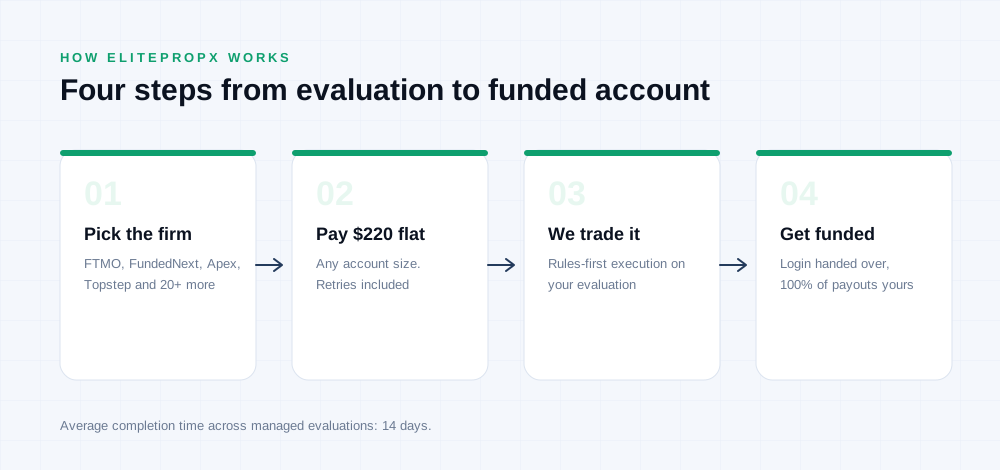
ElitePropX is not a signal group, a fund, a trading educator, a broker affiliate or a copy-trading platform. It does one thing: it takes a prop firm evaluation, trades it against that firm's published rules, and hands over the funded account when the firm confirms the pass. The propfirm passing service page is the full description of that work.
Key takeaway
- Flat $220 per evaluation — the account size never changes the price.
- More than 500 evaluations passed across 20+ firms, with retries covered.
- 0% profit split on funded accounts: the account and everything it makes are yours.
- We do not manage funded accounts, sell signals, or run a subscription.
Why this service exists
A prop firm evaluation is not a test of whether you understand markets. It is a test of whether you can produce a specific return inside a specific set of constraints without ever breaching them. Those are different skills, and the second one is mechanical, repeatable and largely independent of forecasting ability.
That gap is where most traders lose money. Someone who has traded profitably for years on a personal account will often fail three $100,000 evaluations in a row, because the daily loss limit punishes a style that worked fine when the only consequence of a bad day was a smaller personal balance. The frustration is real, and it compounds: after the second failure the sunk cost starts driving decisions, and the third attempt is usually worse than the first.
ElitePropX was built for that specific situation. Instead of trying to convert a discretionary trader into a rule-abiding evaluation machine, we separate the two jobs. The evaluation is a rules problem, so we treat it like one — sized positions, a fixed daily risk budget, a pace that reaches the target over days rather than in one session, and a hard stop when the day's budget is spent. The trader keeps the part that actually requires judgement: running the funded account afterwards with their own strategy.
What we are, precisely
Being precise about this matters more than sounding impressive, because the prop firm space is full of businesses that describe themselves vaguely so a customer can hear whatever they want to hear.
ElitePropX is
- A paid service that trades prop firm evaluations on behalf of the account holder, where the firm's terms permit it.
- A flat-fee business: one price per evaluation, agreed in advance, with retries included.
- An execution operation judged on one metric — whether the evaluation reaches the target without breaching a rule.
- Independent. We are not owned by, partnered with, or paid by any prop firm, and our fee comes from you rather than from a referral commission.
ElitePropX is not
- A fund manager. We do not hold client capital or trade a pool of money.
- A signal service. We do not publish trade calls, run a Discord with entries, or sell alerts.
- A course or mentorship. There is no curriculum, no community tier, no upsell ladder.
- A guarantee. Firms can change rules, and terms compliance is ultimately the account holder's responsibility.
How the operation is structured
The service runs on three documents and one rule.
The rulebook summary is written before the evaluation starts. It lists the firm's target, daily loss limit, maximum loss, drawdown type, minimum trading days, consistency requirement and any instrument or news restrictions. If a firm's rule is ambiguous — and many are — the ambiguity is resolved conservatively, in the direction that protects the account.
The risk plan converts those rules into numbers: maximum risk per trade as a percentage of the daily loss limit, maximum number of trades per session, and the conditions under which trading stops for the day. The plan is deliberately unsophisticated. Its purpose is to survive the sequences that end evaluations, not to maximise return.
The progress log records what happened: equity at the close of each session, distance to the failure floor, percentage of target reached, and days elapsed against the firm's limits. Clients see the log rather than a summary of it, because the log is the only honest way to tell someone that a week was flat.
The rule is simpler than any of that: the firm's rules always beat the market view. An opportunity that looks exceptional is skipped if taking it would put the account within reach of the daily limit. Evaluations are not passed by finding the best trade of the month; they are passed by never letting a bad sequence matter.
A worked example: pacing a $100,000 two-phase evaluation
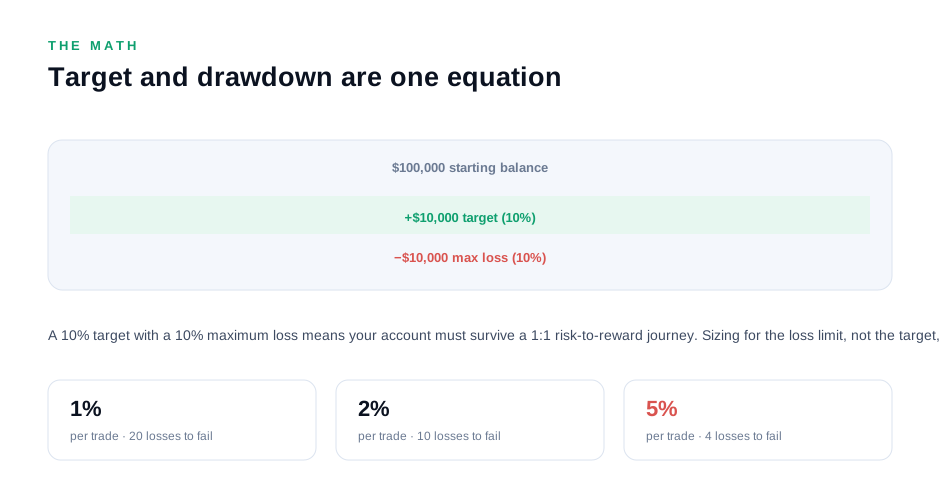
Abstract descriptions of risk discipline are easy to write and hard to apply. A concrete example is more useful, so here is how a standard two-phase forex evaluation — 10% target on phase one, 5% on phase two, 5% daily loss limit, 10% maximum loss — is typically paced when ElitePropX trades it.
Starting conditions
Balance $100,000. Profit target phase one: $10,000. Daily loss limit: $5,000. Maximum loss: $10,000. Minimum trading days: four. No time limit, which is the single most helpful rule in the rulebook, because it means a flat week costs time rather than the account.
The plan sets maximum risk per trade at $1,600 — roughly a third of the daily limit. That number is chosen so that three consecutive losses, which happen regularly to any strategy with a normal win rate, still leave the account intact and the day unfinished by only a fraction of its budget.
Week one: build distance from the floor
The first sessions are about creating separation between equity and the $90,000 failure level. Sessions are short: one or two high-quality setups per day, no chasing, no averaging into losers. A realistic week-one outcome is $2,000 to $3,500 of profit, or a small loss with the daily budget barely touched. Both are acceptable. The purpose of week one is not progress toward the target; it is arriving at week two with a cushion and no rule breach.
Week two: convert the cushion
With a cushion in place, the same risk per trade can produce a larger share of the target, because a losing sequence no longer threatens the maximum loss level. Sessions lengthen slightly and the target is approached in increments. Traders who want to know the arithmetic can check it directly: at $1,600 risk per trade and a 1.8:1 average reward-to-risk, roughly nine winning trades at $2,880 each reach the $10,000 target — a quantity of trades that fits comfortably inside two to three weeks of disciplined execution.
Phase two: smaller target, tighter margins
The second phase usually has a smaller target and the same daily limit, which sounds easier and is not. Complacency is the failure mode here: traders who sprinted phase one with loose sizing discover that a 5% target still has a 10% maximum loss attached, and one oversized attempt can erase both phases of work. The second phase is traded more conservatively than the first, with maximum risk per trade reduced and the profit taken in smaller pieces.
What the progress log looks like
Each session is logged with four numbers: closing equity, distance from the failure floor, percentage of target completed, and trading days used against the firm's minimum. A client reading the log can see immediately whether the evaluation is ahead or behind, and whether the risk budget was respected. There is no interpretation layer between the numbers and the client, which is deliberate — a summary can hide a week, a log cannot.
The point of the example: passing is a pacing problem with a fixed risk budget, not a forecasting contest. Almost every failed evaluation breaches the daily limit or the trailing floor in a single session, and almost every one of those breaches was avoidable by sizing for the downside instead of the target.
Why the fee is flat
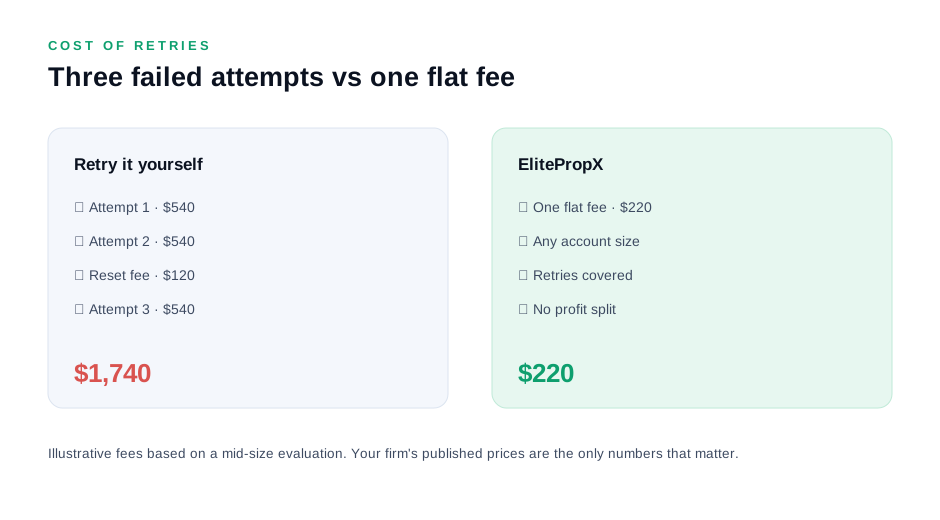
Most service pricing in this space is a percentage of something: a share of the funded account's profit, a subscription that continues for as long as you keep the account, or a fee that scales with the account size being passed. All three create the same problem — the cost of the service grows with the value of the thing you are trying to own.
A flat $220 fee inverts that. A trader passing a $300,000 evaluation pays the same as a trader passing a $25,000 one, which means the larger accounts are dramatically cheaper in percentage terms. That is fine, because the work is nearly identical: the same rulebook analysis, the same risk discipline, the same reporting. The number of zeros on the account does not change how many losing trades the daily limit can absorb in relative terms.
The same reasoning explains the retry policy. If a fee is charged per attempt, a failed evaluation becomes revenue rather than a problem, which is exactly the wrong incentive for a business whose entire value proposition is discipline. Covering retries removes that incentive entirely.
What you pay and what you do not: $220 to ElitePropX covers one evaluation traded to target, with retries if an attempt breaches a rule. The firm's own challenge fee is paid separately and goes to the firm. There is no monthly charge, no profit split and no fee at payout.
How this compares with the alternatives
There are four realistic ways to get a funded prop account, and they are not interchangeable. Each has a cost structure, a failure mode and a type of trader it suits.
| Route | Upfront cost | Ongoing cost | Who it suits |
|---|---|---|---|
| Attempt the evaluation yourself | Firm's challenge fee per attempt | Your time; repeated fees after failure | Traders who already trade under hard rules and want to own the whole process |
| Buy signals or a mentorship | Subscription or course fee | Monthly, indefinitely | Traders who need an edge in the market rather than help with evaluation mechanics |
| Copy-trade another trader's account | Profit split or platform fee | Permanent share of profit | Traders with capital to allocate but no time to trade |
| Use ElitePropX | $220 flat | None — the funded account is yours | Traders who can manage a funded account but struggle with evaluation constraints |
The important distinction is between services that sell an edge and a service that sells execution. A signal group or mentorship addresses the question "what should I trade?" — a question that remains open forever and is never actually answered by a subscription. A passing service addresses a closed, measurable question: did the account reach the target without breaching a rule? When the answer is yes, the engagement is over and the client owns an asset.
Copy-trading arrangements look superficially similar because someone else is pressing the buttons, but the economics are opposite. With copy trading, the trader who provides the account keeps a permanent share of profit, and the account relationship typically continues indefinitely. With ElitePropX, the fee is paid once and the funded account has no ongoing claim attached to it. A trader who later generates $40,000 on a funded account keeps all $40,000; under a typical 20–30% copy-trading split, $8,000 to $12,000 of that would be gone permanently.
When you should not use a passing service
Three situations justify doing the evaluation yourself. First, your firm prohibits third-party trading and enforces the policy — in that case any passing service puts the funded account at risk, and the correct answer is to trade it yourself or choose a different firm. Second, you are deliberately using the evaluation as practice to build evaluation-specific discipline, which many traders do as a form of training. Third, your strategy is already producing consistent results within your firm's constraints; if the constraint set is not the bottleneck, removing it saves nothing.
For everyone else — traders who can trade but keep breaching one rule — the arithmetic usually favours paying once for execution rather than paying repeatedly for attempts.
What "independent" means in practice
Almost every prop firm pays affiliates a commission for sending traders to their evaluation checkout pages. Those commissions are frequently large — a meaningful percentage of the challenge fee — and they create an obvious conflict: the more evaluations a site sends, the more it earns, regardless of whether any of them are passed.
ElitePropX takes no affiliate commission from any firm. That is why this site does not push you toward whichever firm has the best referral programme this month, and why the firm comparison pages rank firms on drawdown structure, payout reliability and evaluation mechanics rather than on the size of an introductory offer.
It also means you should expect recommendations that do not always serve a firm's interests. When a firm's rules make a passing service a poor idea — because third-party trading is explicitly prohibited and enforced — the right answer is to say so, even though it costs a sale. That standard is easier to hold when no one is paying you per referral.
What we publish, and why
The public material on this site is meant to be useful whether or not you ever hire us. Three pieces in particular exist because traders ask for them constantly:
- The prop firm comparison puts every major firm's target, loss limits, drawdown type and payout terms side by side — the information you need before choosing where to spend a challenge fee.
- The rules matrix is the raw version of the same data: exact numbers, no narrative, designed to be checked against a firm's own documentation.
- The guides library covers evaluation mechanics in depth, from the complete challenge-passing guide to firm-specific breakdowns for FTMO and Apex.
Nothing there requires a purchase. Some readers use it to pass their own evaluation without us, which is a perfectly good outcome.
Track record: what the numbers mean
ElitePropX reports more than 500 managed evaluations passed, a completion rate around 95%, coverage of more than twenty firms, and an average time to pass of roughly fourteen days. Four caveats belong next to those figures, because a track record without them is marketing rather than information.
First, the denominator. A completion rate only means something if failures are counted. Ours includes evaluations that breached a rule and were reset under the retry policy — which is why retries are covered rather than billed.
Second, selection. Timelines and account sizes are not homogeneous, and work is scheduled rather than accepted in every shape. Evaluations with rules that make the outcome genuinely unpredictable are flagged in writing before payment so the client can decide with the facts. A pass rate measured on work you accept should always be read that way.
Third, a pass is not a payout. Funding is the end of the evaluation and the beginning of a new rulebook. Firms apply minimum trading days, profit thresholds, consistency checks and identity verification before the first withdrawal. A service that confused the two would be lying about what it controls.
Fourth, past results do not predict yours. Firm rule changes, account sizes, instrument lists and market regimes all vary. The certificates on the passed challenges page are there so you can check the claims against documents issued by the firms themselves rather than screenshots of an equity curve.
How engagements usually end
The typical relationship is short and transactional. A trader arranges an evaluation, it is passed in around two weeks, the funded credentials are handed over, and that is the last we hear from them unless they come back for a second account — which many do, because a firm's scaling plan makes multiple evaluations worthwhile.
A minority of clients want to talk through the funded phase: how to keep the consistency rule satisfied, when to request a payout, how to handle the first withdrawal thresholds. That advice is part of the handover and is not billed separately. It is also not trading advice — we will discuss rules and mechanics, not which way the market is going.
What we flag before accepting an assignment
ElitePropX works with every firm. What changes between firms is disclosure, and the four things below are stated in writing before payment rather than discovered later.
Firms that prohibit third-party trading. FTMO, Apex and most large firms state that the account must be traded by the holder and that credentials may not be shared. We work with those firms when a client instructs it, but the consequence is that a funded account can be voided later, so the clause and the risk are put in writing before any payment. The enforcement risk stays with the account holder, as clause 8 of the terms says.
Evaluation models where the outcome is genuinely random. Some promotional evaluation structures use tight limits and no time limit, which is workable; others use short windows, tight limits and aggressive trailing floors, which compresses the pass into luck. When the rules leave no room for normal variance, the honest answer is that nobody can pass it reliably, including a service that claims to.
Requests to keep trading the funded account. Clients occasionally ask whether the same arrangement can continue after funding, sometimes offering a profit share that looks generous. The answer is always no. Running funded accounts for a cut turns a fixed-fee execution business into a profit-sharing arrangement with payout-timing conflicts, and it takes the account out of the hands of the person whose name is on it.
Impatient timelines that conflict with the rules. "Can this be passed by Friday?" is a fair question and sometimes the answer is yes. When the firm requires a minimum number of trading days, or when a target that large cannot be reached inside the daily loss budget without gambling, the timeline is refused rather than attempted. A rushed evaluation fails and consumes a retry that a correctly paced attempt would not have needed.
Standards we hold ourselves to
- Say what the fee is. One price, stated before the work starts, with the firm's own fee clearly distinguished from ours.
- Say what is not included. Retries, KYC, the funded phase and any compliance consequences of a firm's terms are explained up front rather than discovered later.
- Report the boring weeks. A flat week is reported as a flat week. An operations culture that only communicates winning sessions is a culture that hides the information clients need to judge risk.
- Name the compliance risk. If a firm prohibits third-party trading, the clause and the enforcement risk are put in writing before payment. If an evaluation's rules make the outcome a coin flip, that is said plainly rather than sold as a challenge.
- Never touch the funded account. The handover is the end of our involvement in trading. No managed funded accounts, no performance fees, no exceptions.
Where the risk honestly sits
Two risks belong to the client and should be stated plainly. The first is firm policy: some prop firms prohibit third-party trading, and enforcement can happen after funding rather than during the evaluation, so an account can be voided later even if the evaluation itself was clean. Terms change frequently and nobody can promise what a firm will enforce in six months. The second is the funded phase: an account that is passed and then traded without a plan will be lost, and no service can prevent that.
Everything else — the rulebook reading, the sizing, the pacing, the retries — is what we are paid $220 to get right.
Frequently asked about ElitePropX
Is ElitePropX a trading firm?
No. ElitePropX does not hold client funds, does not run a proprietary trading desk, and does not offer accounts of its own. It trades evaluations issued by third-party prop firms and hands the funded account to the account holder.
Who actually owns the funded account?
The trader who registered for the evaluation. Registration, KYC and payouts are all in their name. ElitePropX has no ownership claim, no profit split and no ability to withdraw funds from the account.
Do you have a refund policy?
Retries are included when an attempt breaches a rule, which is the practical form of protection for a rules-based service. Refund terms for a specific engagement are confirmed in writing before payment, and the firm's own challenge fee is always outside our control.
Can you guarantee the evaluation will pass?
No, and any service that offers a guarantee is misrepresenting how evaluations work. Firm rule changes, platform outages and market gaps can all end an attempt. What can be controlled is sizing, pacing and adherence to the published rules, which is where the completion rate comes from.
Do you trade funded accounts?
Never. The handover is final. Some services offer to run funded accounts for a percentage of profit; that model creates a conflict around payout timing and removes the trader from the account entirely.
How do I verify a claimed pass?
Ask for the certificate. Firms issue confirmation documents when an evaluation is passed, and they include the account size, the firm's name and often a reference number. The passed challenges page shows exactly what to look for.
Is this service available worldwide?
Payment and communication are handled remotely, so coverage is global except where local regulation or a specific firm's jurisdiction rules make participation impractical. Availability for a particular firm and country is confirmed at enquiry.
What is the free trial?
There are two. The free 7-day demo trial is a broker demo account you open yourself, which we trade for a week so you can watch the process at no cost. The trial challenge is a smaller prop firm evaluation traded through the same process, offered so a new client can see the reporting cadence and the handover before paying. Neither carries an obligation to continue.
How an assignment is run internally
Most of what decides a pass happens before the first order and after the last one, so it is worth describing the process in the order it actually happens rather than presenting the outcome as though it were the method.
Stage one: reading the rulebook properly
Every firm publishes terms pages, and most of them contradict themselves somewhere between the marketing page and the schedule of charges. The first task on an assignment is to reconcile those pages into one sheet: what the daily limit is measured on, whether the maximum loss trails or stays static, whether the target is balance or equity based, what the minimum trading days are, and what happens at payout. Where the published terms are genuinely ambiguous, the firm is asked directly and the answer is kept in writing.
This stage is unglamorous and it is where most of the value sits. A trader who misreads one line — for instance treating a trailing maximum loss as static — is not making an analysis error, they are solving a different puzzle than the one they bought.
Stage two: converting the rules into four numbers
The rulebook becomes an index card: daily loss budget in dollars, distance to the failure level, target expressed in R multiples of the per-trade risk, and any consistency constraint that applies at payout rather than during the evaluation. Those four numbers decide position size, session length and pacing. They are recalculated every morning of the assignment, because three of the four change as equity moves.
| What is tracked | Why it matters | How often it changes |
|---|---|---|
| Daily loss budget | Sets the maximum exposure for a session | Daily, from the firm's measurement point |
| Distance to failure level | Determines whether size must shrink | Every time equity makes a new extreme |
| Target in R | Converts a percentage into a trade count | On each change in per-trade risk |
| Payout constraints | Can delay a withdrawal after a clean pass | Only when the rulebook changes |
Stage three: trading the plan, not the chart
The evaluation itself is deliberately boring. A fixed instrument set, a fixed session, constant risk per trade, and a hard stop at eighty percent of the daily budget. Progress is measured in trading days completed and rule violations incurred, not in distance to target — because distance to target is the number that produces the behaviour which fails accounts.
Where a firm permits leverage that would allow a target to be reached in a single session, the correct response is to ignore it. The target is not the constraint; the constraint is surviving a normal losing sequence while reaching it, and that arithmetic does not care how much margin the firm offers.
Stage four: the handover
On a pass, the firm issues the funded account in the client's name. The handover includes the certificate or dashboard evidence, the rulebook as it stood on the day of the pass, and the payout schedule. What it does not include is ongoing discretionary trading on the funded account: the account is the client's, and whether it is traded by them or by another service is a separate decision with its own terms.
What we measure, and what we do not claim
Two numbers appear on this site: challenges passed and pass rate. Both are self-reported and both should be read with that caveat. The pass count is the number of evaluations completed to target or to a funded certificate, and it excludes attempts that were abandoned by the client. The pass rate is calculated against evaluations started in the same period, not against enquiries, which is the more generous denominator and the more misleading one.
What is not claimed is equally important. There is no claim of a proprietary edge, no claim that a pass is guaranteed, and no claim that past results predict the next attempt. Prop firm evaluations are a rules puzzle with a variance component; a service that has solved the rules puzzle still loses to variance sometimes, and the retry clause exists for exactly that reason.
Corrections policy
Firm rulebooks change without notice, and this site carries a lot of numbers that can go stale. Where a figure is found to be wrong — a loss limit, a target, a fee, a payout term — it is corrected on the page and the review date in the header is updated. Where a firm has changed its terms in a way that invalidates an article's central argument, the article is rewritten rather than patched, because a page whose conclusion no longer follows from its evidence is worse than no page at all.
Complaints are handled the same way. A client who believes a fee was misquoted, a timeline misrepresented or a rule misread is asked for the correspondence and the date. Where the complaint is correct, the fee is refunded and the page that caused it is fixed. Where it is not, the reasoning is written out in full — a service that cannot explain its own pricing to an unhappy client has a pricing problem, not a communication problem.
Why the site carries long articles rather than a sales page
A single-page service site has to compress everything into persuasion, which is why so many of them are unreadable. The articles here exist for a different reason: the questions clients ask before buying — how a trailing drawdown actually updates, why a consistency rule blocks a payout after a clean pass, what happens when a firm forbids third-party trading — have long answers, and a client who has read the long answer tends to make a better decision than one who has read a bullet list.
That also sets the editorial standard. Pages are dated and reviewed, firm numbers are attributed to the rulebook rather than to memory, and where a rule varies between account types the variation is described instead of averaged away. None of that makes the content immune to being wrong; it makes being wrong visible, which is the more useful property.
Tell us which firm you want passed
One flat $220 for any prop firm, any account size. Retries covered, no profit split, funded login in your name. We work with any firm; before you pay we tell you in writing what its third-party trading clause says and where the enforcement risk sits.