Prop Firms Without a Consistency Rule
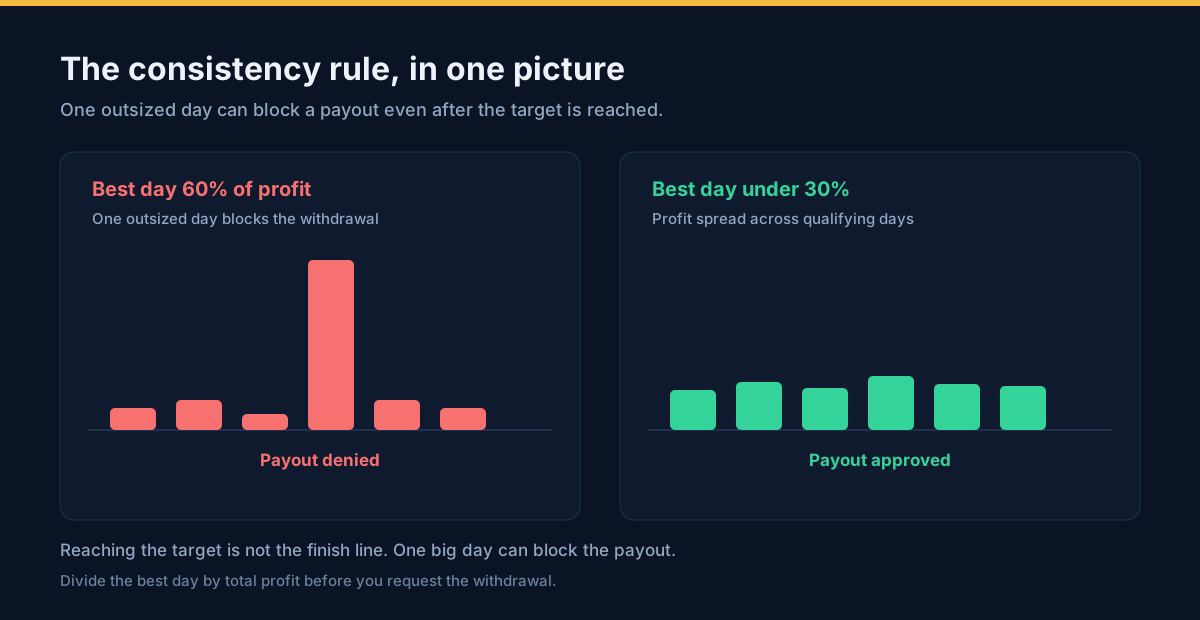
Traders ask for "prop firms without a consistency rule" for a specific reason: they can hit a profit target and still not be able to withdraw, because the rule is measured on the profit being taken out rather than on the pass. It is a real constraint, it is not universal, and the useful answer is less a list of names than an understanding of where the rule lives and how to confirm whether it applies to you.
Verify on your dashboard
Consistency rules are applied per programme and revised. This page deliberately does not name firms as having or lacking the rule, because that is the part that goes stale fastest and the cost of acting on a stale answer is an account. Use the checking method below against your own firm's current documents.
What the rule actually measures
A consistency rule caps the contribution of a single trading day to your total profit. The common form is a percentage — no individual day may account for more than, say, a fifth or a third of the profit you are withdrawing. Some firms express it as a ratio between your best day and your average day instead.
Two features matter more than the number:
- It is usually measured at payout, not at the target. Reaching the profit target can complete an evaluation while the distribution of that profit later fails the payout check.
- It is measured on the profit you are taking out, not on the account's lifetime total. Trading more after the pass dilutes the dominant day's share, which is why some traders resolve a failed check by simply continuing to trade.
| Your trading | Effect on the ratio |
|---|---|
| One very large winning day, many small ones | Fails — the large day dominates |
| Even profit across many sessions | Passes comfortably |
| Large winner, then more profitable days added | Improves as the other days accumulate |
| Large winner, then nothing further | Stays at the worst ratio it will ever have |
Where the rule tends not to appear
Rather than a list of firms, here is where the omission is most likely — and each of these is still something to confirm, not assume:
Instant-funding products
Accounts with no evaluation stage sometimes omit the consistency check entirely, because there is no pass to qualify. They usually substitute tighter drawdown or restricted trading instead.
Multi-phase evaluations with small per-phase targets
Where the target is reached slowly across many sessions by construction, a consistency rule adds little and some firms leave it out.
Firms whose marketing leads on "no consistency rule"
This is a genuine differentiator some firms advertise. Treat the advertisement as a lead, not as evidence — confirm it in the rulebook for the specific programme.
Programmes sold as permissive on news and EAs
Firms that position an account type as flexible on trading style often drop the consistency check as part of the same package. Again, confirm rather than infer.
How to check a firm in five minutes
Search the rulebook for the word itself
Search the current PDF or help-centre article for "consistency". If the word does not appear anywhere, that is meaningful — but check the payout section specifically, because that is where it hides.
Check the payout section, not just the evaluation section
The rule is often documented under "withdrawals" or "payout rules" rather than under the challenge rules. A clean evaluation page does not mean there is no rule.
Confirm for your specific programme
Where a firm sells several account families, the answer can differ between them. Ask about the programme you are buying, not about the firm.
Get it in writing
Ask support directly and keep the reply. If your strategy concentrates profit, this is the clause most likely to cost you a payout, so a written answer is worth the message.
Re-check after any programme change
Firms revise terms. A rulebook you read at purchase is not necessarily the one in force at your first payout request.
If you do have one, trading with it is a choice you make early
The rule is only restrictive if you build the profit distribution badly. It rewards a shape of trading that is generally good practice anyway:
- Take partial exits rather than holding one position for the whole move, so a single trade cannot become a single dominant day.
- Spread the large trades across different sessions instead of taking three at once on a day you feel confident.
- Check the running ratio as you go. Most platforms let you see daily results; comparing your best day to your total is arithmetic you can do at any point rather than only at the end.
- Keep trading after the pass. If the ratio is marginal, additional profitable days improve it. The worst thing to do is request a payout once and stop.
The trade-off nobody mentions
A firm without a consistency rule usually carries something else in its place — a tighter drawdown, a shorter maximum period, or a higher target. Evaluating firms on the presence or absence of one rule is how traders end up on an account that fails on a different one. Compare the package: drawdown type and size, target, time limit, and payout conditions together.
The rule itself, and how the cap is calculated, is covered in more depth in the consistency rule guide.
Frequently asked questions
The FAQ block covers what a consistency rule is, whether all firms have one, when it is checked, how to find firms without one, how to pass with one in place, and whether omitting it makes a firm easier. Related: the consistency rule guide, firms without a time limit and daily drawdown explained.
What is a consistency rule in prop trading?
Do all prop firms have a consistency rule?
When is the consistency rule checked?
How do I find firms without a consistency rule?
How can I pass with a consistency rule in place?
Is a firm without a consistency rule easier to pass?
Have a question before you commit?
Ask us anything about your firm, your account size or whether a passing service suits you. Two ways to reach us, both answered by a person: Telegram @voraspas, or email support@elitepropx.com. No forms, no queues.
Ready to pass your prop firm challenge?
Flat $220 per evaluation — we trade it for you and hand over a funded account. No hidden cuts, no monthly fees. Send your firm and account size on Telegram or by email and we will confirm availability, the current rules and the timeline.