
Reviewed · how we check firm rules
Propfirm passing service
What the flat $220 evaluation plan covers
Propfirm passing service, done for you. We read your firm's rulebook in full, trade the evaluation against it, and hand over the funded login in your name. One flat $220 at any account size — retries covered while the attempt runs, no share of your payouts, and a free seven-day demo before you commit a cent.
Free seven-day test, before you spend anything. Seven days, one demo account, zero cost. You open a demo with whatever broker you already use and pass us the login; we run it on the identical written plan we would run on your evaluation — the same risk per trade, the same daily loss budget, the same hard stop. Every fill and every skipped setup is visible to you while it happens, and the login is yours again at the end of the week. No card is taken and nothing is owed: if a week of watching does not settle it, we part company and that is the end of it.
Firms we pass
- FTMO
- FundedNext
- Apex
- Topstep
- The5ers
- MyFundedFutures
- FXIFY
- Alpha Capital
Third-party trading is prohibited by many firms, and an account breached on that clause can be voided when a payout is requested. We read your firm's position and put it in writing before you pay; the enforcement risk stays with the account holder. What a firm can void at payout review works through that clause in detail. Read the terms.
The offer
One flat fee, and exactly what it buys
Propfirm passing service here means one price for one job. There is no tier structure, no subscription, no performance fee and no charge at payout, and the same $220 applies whether the evaluation is a $10,000 forex challenge or a $300,000 futures account. What the fee buys is execution and rule discipline — the part that decides whether an evaluation survives its own drawdown. What it cannot buy is the firm's own challenge fee, because that money belongs to the firm and is paid by you, directly, in your own name.
Included in the $220
- The full rulebook read — daily loss, maximum loss, trailing versus static, consistency, minimum days, news and weekend restrictions.
- A written sizing plan that keeps the account alive through a normal losing streak.
- The evaluation traded across sessions until the profit target is verified by the firm.
- Retries while the attempt is running, at no additional service fee.
- Immediate notice if an attempt fails, with the failure classified as a drawdown breach or a conduct breach.
- Credentials returned or removed at handover, so the funded account is yours alone.
Not included, and we will not pretend otherwise
- The firm's evaluation fee, which is paid by you to the firm and never routed through us.
- The firm's reset or reactivation charge, where its rules impose one.
- The funded account itself — it is governed by its own payout conditions and traded by you.
- Identity verification, which has to be completed personally by the account holder.
- Any share of your payouts, because we take none.
- A promise of income. The deliverable is a completed evaluation, not a wage.
The line that matters most is the third one. Propfirm passing service solves the evaluation and stops there. The funded stage brings its own gates — a profit threshold, a minimum number of qualifying days, a consistency cap on the largest day, a verification step — and none of them loosen because someone else traded the test. A client who passes and then loses the funded account to a daily limit has lost it for the same reason anyone else would.
How it runs
From your first message to a funded login
The sequence is fixed and describable in advance, which is the point. A provider that cannot state the order of its own process is making it up as it goes, and the place that improvisation costs you is the payout.
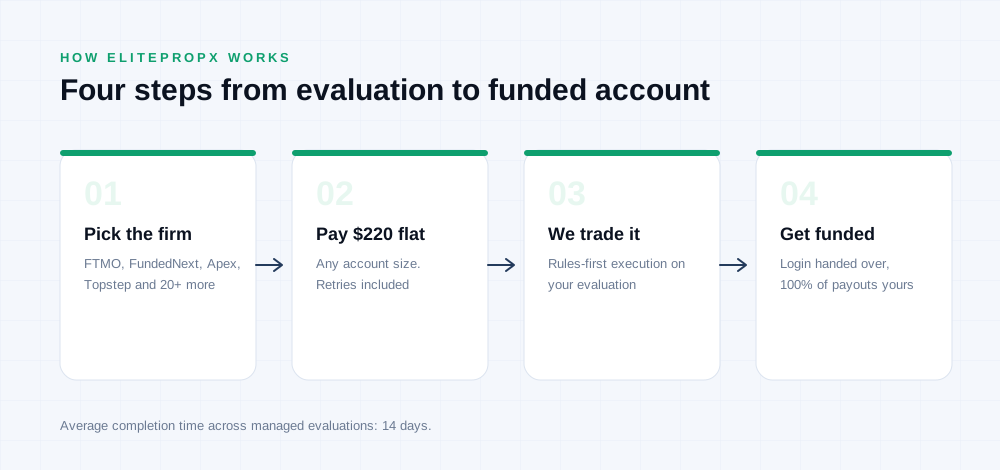
- Terms check. You name the firm and the account size. We read the current terms for third-party trading, on the evaluation and on the funded account, and confirm in writing that the job can proceed. If it cannot, the process stops here at no cost to you.
- Purchase. You buy the evaluation directly from the firm, in your own name, with your own payment method. The evaluation fee is never routed through us — that keeps ownership unambiguous and keeps your identity where the firm expects it.
- Handover. You supply what the firm's platform requires for the account to be traded. The scope of that access is agreed in writing before it is granted, and it is limited to the evaluation account.
- Trading. The evaluation is traded to the firm's target and inside its rules. Progress is reported at agreed checkpoints, and you are told the day an attempt fails rather than at the end of a reporting period.
- Pass and return. The evaluation is completed, credentials are returned or removed, and you take control of the funded account. The pass is documented with the firm's own confirmation, not a screenshot of a dashboard.
Two details in that sequence decide most outcomes. The first is step one: a provider that accepts any firm without reading the terms has not read the terms, which leaves the payout to luck. The second is step five: access should end at handover, and the password changes afterwards regardless. A service that keeps access after the pass is keeping access to a funded account.
Reporting cadence belongs in the product too. An evaluation runs one to three weeks depending on the firm's target and minimum day count, and a provider that goes silent for that stretch leaves you unable to tell a slow pass from a failed one. Weekly checkpoints, plus immediate notice of a breach, is the honest minimum.
Free 7-day test
Seven days, one demo account, nothing to pay
The trial exists because $220 is a real amount to hand a stranger on the strength of a paragraph. It is also the one claim on this page you cannot verify by reading, so the week turns that claim into something you watch happen.
What you send
A demo login from a broker you already use. No live funds, no evaluation fee, no card. Scope is agreed in writing and limited to that one demo account.
What we run
The same written plan an evaluation gets: risk per trade fixed as a share of the daily loss budget, a hard daily stop, a defined number of attempts per session, and a stop when the budget is spent.
What you see
Every entry, every skipped setup, every flat day, as it happens. At the end of the week the login is yours again and the decision is yours.
Use the week to test two things at once. The first is whether those risk numbers look like something you would accept on your own account, because the plan does not change between a demo and a paid evaluation. The second is whether reporting arrives without being chased. A provider that goes quiet for seven days on a free demo will go quiet for three weeks on a live one, and silence is the failure mode that costs the most: you cannot act on a breach you are not told about.
Nothing carries over and nothing is owed. If the week is convincing, the $220 is the next step; if it is not, the trial ends with your login back in your hands and no invoice. Either outcome is a cheaper way to reach a decision than buying an evaluation from a provider you have never seen work. Start the free 7-day demo, or ask a question on Telegram first.
Pricing
One flat $220, priced against the alternative
The industry prices this work in three ways, and the differences matter more than the headline numbers because each model rewards different provider behaviour. Read the table as a description of incentives rather than of prices.
| Model | What you pay | Provider incentive | Main risk |
|---|---|---|---|
| Flat fee (ours) | One fixed price | Pass quickly, absorb retries | Fee priced for the average rulebook |
| Profit share | A percentage of earnings | Keep trading after the pass | Extended exposure, lost account |
| Per attempt | The fee each time | More attempts, more revenue | Structural conflict of interest |
Each model has a cost that is invisible in the quote. A flat fee has to be high enough to cover the failure rate across all clients, so it is priced for the average rulebook rather than for yours — which is why the same $220 covers a gentle static drawdown and a trailing intraday floor. A profit share sounds like alignment until you notice that the provider now has a position in your funded account and a reason to keep trading it. A per-attempt fee is the sharpest conflict of all, because every failure is billable and the provider is paid more when you need more tries.
ElitePropX runs the first model. One flat $220 for any firm and any account size, resets covered while the evaluation is running, and no profit split on the funded account. The consequence is stated openly: the fee is identical whether the account is a $10,000 forex evaluation or a $150,000 futures account, because the work is the same process applied to different numbers. What changes with size is the firm's charge and the payout ceiling, not ours.
Named prices are a different question from pricing models, and they move without notice. Rather than restate a competitor's fee here and let it go stale, this page compares the fee structures and leaves the figures to each provider's own pricing page — which is the only place a price can be confirmed on the day you are asked to pay it.
What the $220 does not include. The firm's own challenge fee, and its reset charge where one applies. Those are paid by you to the firm. The profit calculator models what an account produces once the payout conditions are met, and the cost breakdown puts the two fees side by side.
Doing it yourself
When paying the fee is the cheaper decision
The comparison is not easy versus hard. It is three costs weighed against each other: the fee, the calendar, and the probability of needing a second attempt.
Trading it yourself costs the firm's fee per attempt, plus whatever calendar the evaluation takes. It also costs attention, which is the input most traders under-price — an evaluation traded badly consumes the same weeks as one traded well, and three failed attempts is six weeks that produced nothing. A flat fee converts that into a known number: the firm's fee once, the service fee once, and no service charge for retries while the evaluation runs.
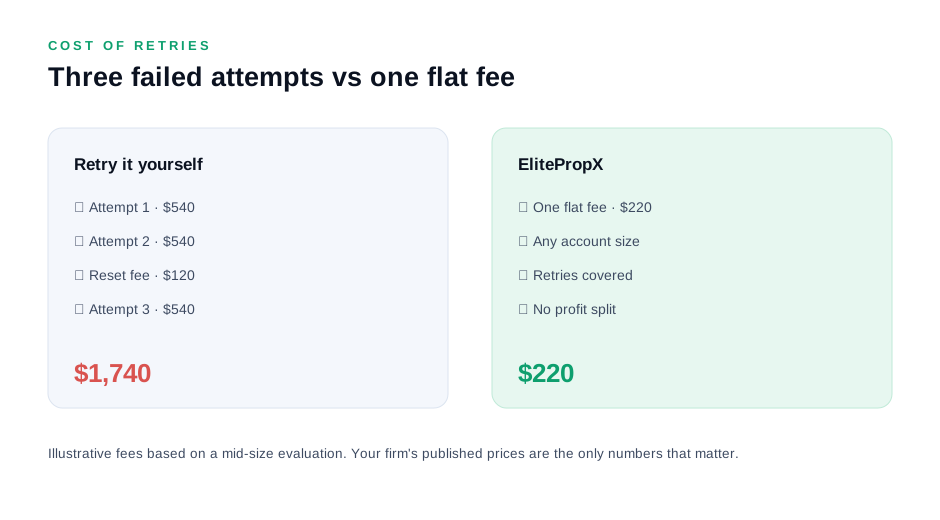
The arithmetic is short enough to do on the page. Take a firm fee of $500, the service fee of $220, and a trader whose own record suggests two attempts. Doing it alone costs about $1,000 over six weeks. Using the service costs $500 plus $220 — $720 — over the same period, with retries covered. The saving is $280 and the calendar is equal. Now take a trader who passes first time: doing it alone costs $500, the service costs $720, and the service is $220 worse. That is the honest case against the model, and it is not small.
| Scenario | Firm fees | Service fee | Total |
|---|---|---|---|
| Pass first attempt, no service | $500 | — | $500 |
| Two attempts, no service | $1,000 | — | $1,000 |
| Pass via service | $500 | $220 | $720 |
| Fail once via service, then pass | $500 plus the firm's reset | $220 | The firm's reset plus $720 |
Break-even is a single failure. If there is any meaningful chance the first attempt fails, the flat fee is priced competitively against the expected cost — and for most traders the chance is meaningful, which is why the market exists at all. What the table cannot price is the value of the calendar and of the attention, which for anyone holding a full-time job is usually the deciding factor.
There is a third option worth naming: buy the evaluation yourself, trade it yourself, and use a passing service only after a failure. That keeps the learning on the first attempt and caps the downside after it, and the flat fee does not change based on how many attempts have already failed. The direct comparison works through the cases where each route wins.
Scope
What a propfirm passing service does
A propfirm passing service takes responsibility for one thing: producing a completed evaluation that meets a firm's profit target without breaching its rules. You buy the evaluation from the firm, supply what the platform requires, and receive a funded account that satisfies the firm's conditions.
The labels are interchangeable and worth settling before the rest of the page, because the market uses them loosely. A prop firm challenge passing service, a challenge pass service, a prop firm passing evaluation, an assessment and a combine all describe the same purchase: someone produces a completed evaluation in your name against your firm's rulebook. The request usually arrives in the first person — pass my challenge, pass my evaluation, have my account passed for me — and the answer is the same each time. What differs between providers is not the name but the three answers underneath it: whether the firm permits third-party trading, what a breached attempt costs, and who holds the account when the work stops.
The deliverable is narrow and worth being precise about. It is not a trading strategy, not a signal service, not a managed account, and not a guarantee of income. It is a completed test. Everything after the pass — the funded account's profit threshold, its consistency rule, its payout schedule, its conduct restrictions — belongs to you and to the firm.
That narrowness is why the model can be priced flat. A provider trading evaluations repeatedly is running a process rather than a view: the target, the drawdown and the daily limit are known in advance, and the work is to reach a fixed objective inside fixed constraints. It is closer to project delivery than to trading advice, which is why a fixed fee is a coherent price and a percentage of future profit is not.
Is it allowed by your firm?
This is the part most providers skip, and it is the part that decides whether a funded account survives.
Proprietary trading firms are not uniform on third-party trading. Some permit it explicitly. Some prohibit it. Some permit it on the evaluation and prohibit it on the funded account, or the reverse. And some are silent, which in practice means the firm can decide at payout time that the account was not traded by the named holder.
The consequence of getting it wrong is asymmetric. A prohibited evaluation that is passed can produce a funded account voided at the first withdrawal, which is worse than a failed evaluation: you have paid the firm, paid the service, and earned nothing. A provider that does not check the terms before accepting the job is transferring that risk to you without saying so.
Our rule: if your firm's terms forbid third-party trading, you are told in writing before payment what the clause says and what enforcement has looked like. There is no version of this where quietly accepting is acceptable, because the loss lands on your funded account rather than on our fee.
Two related points belong here. First, the funded account must be in your name with payouts to you — anything else turns a service into an unauthorised managed account, which most firms prohibit outright. Second, identity verification has to be completed by you, personally; a provider cannot and should not do it on your behalf.
Where the terms are ambiguous, the honest move is to ask the firm in writing before buying the evaluation. A support reply that permits third-party trading on the evaluation is worth having, and worth saving. The rules matrix summarises where the major firms stand, and the scam checklist covers the ones where that question is never answered. The buyer-side counterpart — what makes a propfirm passing service legitimate — sets out the evidence to demand before paying anyone, including us.
The other side
What the fee does not remove
A page that lists only advantages is marketing. Four risks are real, and you should weigh all of them before paying anyone, including us.
Terms risk. The firm may prohibit third-party trading, or may change its terms between the pass and the payout. The first is checkable in advance; the second is not fully, which is why the funded account should be treated as a separate risk from the evaluation.
Provider risk. The fee is paid before the work is done. A provider that disappears, or quietly stops reporting, leaves you with a failed attempt and no recourse unless the payment method is traceable. This is the risk the free demo exists to reduce.
Concentration risk. The provider is trading several evaluations, possibly the same firm, instrument and direction. Firms that treat correlated positions across accounts as one exposure may treat that as a breach, which is another reason the terms check comes first.
Skill risk. A trader who passes by service has not practised the evaluation. The funded account still needs a plan, and the first month of a funded account is not the place to learn one. The complete passing guide covers the plan; it is worth reading even when someone else trades the test.
Expectation risk. The service produces a funded account, not income. A client expecting the fee to convert directly into withdrawals has misunderstood the product, and that misunderstanding is the industry's most common complaint. The honest question is not which provider is cheapest, but which one will tell you in writing when the answer is no.
Questions
Frequently asked about the service
These are the questions that decide the purchase, including the awkward ones. The category advertises the sentence "we pass your prop firm challenge", and the sentence is worth only what sits behind it — permitted or prohibited, retried or billed, yours or ours at the end — which is why several of the answers below are refusals.
What does the $220 actually cover?
One evaluation at any firm and any account size, traded to the firm's target within its rules, with retries covered while the evaluation is running and no profit split on the funded account. The firm's own evaluation and reset fees are separate and are paid by you directly to the firm.
Can I test the service before paying?
Yes, and it is free. Open a demo account with any broker, send the login, and we trade it for seven days under the same written plan used on a paid evaluation. No card, no deposit, no obligation — you keep the login and decide afterwards.
How much does it cost to have a challenge passed for you?
A flat $220 for any firm and any account size, with no profit split on the funded account. On top of that you pay the firm's own evaluation fee, which varies by firm and size and is never routed through the service. A provider charging a percentage of payouts is being paid to keep trading your account after the pass.
Do you pass challenges for any prop firm?
For any firm whose terms permit third-party trading, across forex, CFD and futures evaluations, from $10,000 to $300,000 accounts. Firms that prohibit it are refused before payment rather than after, because a pass on a prohibited evaluation produces a funded account that can be voided at the first payout.
How long does a pass take?
One to three weeks for most rulebooks, sometimes five for a staged evaluation with two targets and two minimum day counts. The driver is the firm's minimum day requirement and profit target rather than trading speed, and any provider quoting a fixed number of days without knowing the day count has not read the rulebook.
What happens if an attempt fails?
You are told the day it happens, the failure is classified as a drawdown breach or a conduct breach, and the attempt is retried at no additional service fee while the evaluation is running. The firm's own reset charge, where one applies, remains your cost.
Who owns the funded account?
You do, always. The evaluation is purchased in your name with your payment method, identity verification is completed personally, and credentials are returned or removed at handover. Anything else is a managed account in disguise and is prohibited by most firms.
Do you take a share of the payouts?
None. You are charged once, at the start, and nothing after it — the funded account, its withdrawals and its record are entirely yours. A provider on a percentage of payouts has a standing reason to stay inside the account after the job is finished, and that is a reason we would rather not have.
Will the service also trade the funded account?
No, and it should not. The funded account has its own profit threshold, qualifying-day requirement and consistency condition, and it has to be traded by its owner under the firm's terms. The service ends at handover, and keeping a provider on the account puts the payout at risk.
Do I have to give you my trading password?
The mechanics depend on the firm's platform, and the scope of any access is agreed in writing before it is granted and limited to the evaluation account. After handover, change the password regardless of how access was provided.
Can you pass my prop firm challenge for me?
Yes, wherever the firm's terms permit it, and the fee is the same whether you hire before the first attempt or after a failure. You buy the evaluation from the firm in your own name with your own payment method, we trade it to the target inside its rules for a flat $220, and the funded login comes back to you. Checkpoints are written for someone reading them after work rather than watching charts, so the arrangement suits a full-time job. What you are buying is a completed test, not a signal, a course or a funded income.
Is a prop firm evaluation the same as a challenge?
In practice, yes. Evaluation, challenge, assessment and combine name the same staged test, and futures firms tend to say combine where forex firms say challenge. Some firms split it into a challenge and a verification, or phase one and phase two; the target and the day count change between those, the job does not. So a search phrased as "can someone get my evaluation passed" is the same request as passing a challenge, and it is answered from the same rulebook. The one label that is genuinely different is instant funding, which starts under live conditions rather than as a test.
Can you get my challenge passed after an attempt has already failed?
Yes, and the fee does not change with the history. Buy the next attempt, or the firm's reset if it offers one, then hand that account over and it is traded under the same plan as a first attempt. This is the order most clients use: try it yourself once, then stop paying for retries. The arithmetic is set out above, and from the second attempt onward the flat fee undercuts a per-attempt arrangement, which is precisely why that model exists.
Do you pass forex and futures evaluations, or only forex?
Both. A forex prop firm challenge and a futures combine go through the identical plan — FTMO, FundedNext, FXIFY, The5ers and Alpha Capital on the forex and CFD side, Apex, Topstep and MyFundedFutures on futures — and all of it is the same flat fee. What changes is the platform the rulebook is read from and the session structure rather than the price, and account size changes nothing at all: a $300,000 forex evaluation costs what a $10,000 futures account costs.
Is a passing service cheaper than doing it myself?
Only if you would have needed more than one attempt. At a $500 firm fee, one attempt costs $500 and a service costs $720, so the service is worse if you pass first time. From the second attempt onward the arithmetic reverses sharply, because retries are covered rather than billed.
Watch a week for free, or start now
Tell us the firm and the account size and we confirm in writing whether third-party trading is permitted before you pay anything. If you would rather see the plan working first, the seven-day demo costs nothing and takes one login.
Related reading
- Start the free 7-day demo
- Recently passed evaluations
- What clients report, including the resets
- Passing services compared
- How a propfirm passing service works, step by step
- The cheapest passing service, and the cheap-evaluation trap
- How to tell a legit propfirm passing service from a scam
- FTMO challenge passing service
- FundedNext passing service
- Which firms permit third-party trading
- The complete guide to passing a prop firm challenge
- From funded account to first payout
- Profit and payout calculator
ElitePropX is an independent evaluation service and is not affiliated with, endorsed by or sponsored by any proprietary trading firm. Services are offered only where a firm's terms permit third-party trading. A funded account is not a guarantee of income, and trading involves substantial risk of loss. Verify the current terms of any firm before purchasing an evaluation.