Lot Size for a $100k Prop Firm Account
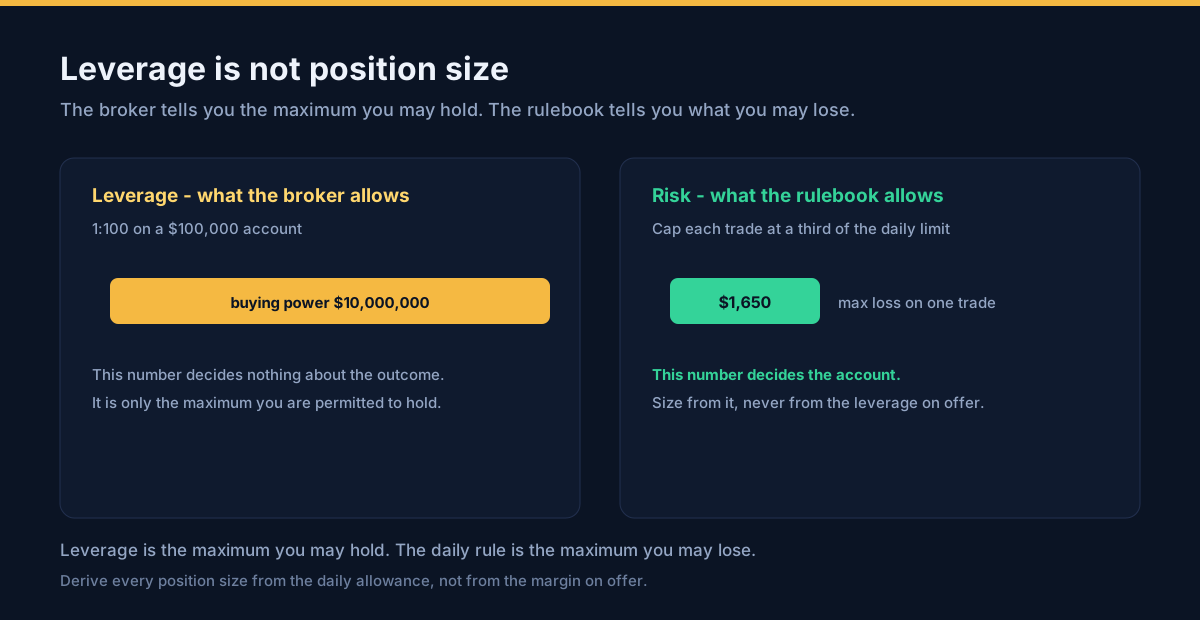
"What lot size should I trade on a $100k account?" is the most common question new prop traders ask, and the most common wrong answer is a fixed number. Position size is not a preference — it is the output of a calculation, and once you know the inputs, the answer is determined. This is the calculation, with worked examples.
The three inputs
Lot size is determined by exactly three numbers, and none of them is the account balance alone.
| Input | Where it comes from | Example ($100k account) |
|---|---|---|
| Risk budget per trade | A third of the daily loss limit | $1,650 |
| Stop distance | The setup's invalidation level, in pips | 40 pips |
| Pip value per lot | Instrument and lot size | $10 per pip per standard lot |
From those three numbers: lot size = risk budget ÷ (stop distance × pip value). For the example above, $1,650 ÷ (40 × $10) = 4.1 standard lots. That is the answer — not because it "feels right", but because it satisfies the constraint.
Where the risk budget comes from
The most common sizing error is taking per-trade risk from the account balance. The correct source is the daily loss limit.
| Account | Daily limit (5%) | Per-trade risk (⅓) | Losses before the limit |
|---|---|---|---|
| $25,000 | $1,250 | $415 | 3 |
| $50,000 | $2,500 | $830 | 3 |
| $100,000 | $5,000 | $1,650 | 3 |
| $200,000 | $10,000 | $3,300 | 3 |
| $400,000 | $20,000 | $6,650 | 3 |
Notice that the per-trade risk scales with the loss limit, which is itself a percentage — so the proportion of the account being risked is identical at every size. A $100k account does not permit more aggressive percentage risk than a $25k one. Traders who size up "because it is a bigger account" have misread the constraint.
The equity trap
The daily loss limit is measured on equity, including floating losses. If you hold two positions each risking $1,650, your live exposure is $3,300 and you are only two losses from a breach rather than three. Sum your open risk, not just your per-trade risk.
Worked examples
| Instrument | Stop | Per-lot risk | Lots for $1,650 risk |
|---|---|---|---|
| EURUSD (standard lot) | 40 pips | ~$400 | ~4.1 lots |
| EURUSD (standard lot) | 20 pips | ~$200 | ~8.2 lots |
| EURUSD (mini lot 0.1) | 40 pips | ~$40 | ~41 mini lots |
| GBPUSD (standard lot) | 30 pips | ~$300 | ~5.5 lots |
| XAUUSD (1 lot) | 200 pips | ~$2,000 | ~0.8 lots |
Two observations. First, the tighter the stop, the larger the permitted lot size — which is precisely why tight stops encourage oversizing and why the calculation, not the platform's maximum, must constrain you. Second, volatile instruments like gold have much larger per-lot values, so the correct size drops sharply.
Futures sizing instead of lots
Futures positions are sized in contracts, and the same principle applies with per-point values.
| Contract | Value per point | Point stop | Risk per contract | Contracts for $1,650 risk |
|---|---|---|---|---|
| ES (E-mini S&P) | $50 | 10 pts | $500 | 3 |
| MES (Micro S&P) | $5 | 10 pts | $50 | 33 |
| NQ (E-mini Nasdaq) | $20 | 20 pts | $400 | 4 |
| MNQ (Micro Nasdaq) | $2 | 20 pts | $40 | 41 |
The micro contracts exist precisely so that risk per trade can be expressed in small increments. On a trailing-drawdown account, that granularity is not a beginner's convenience — it is the mechanism that keeps a single trade from endangering the floor. See our futures firms comparison for why micros matter more at trailing-drawdown firms than anywhere else.
The sizing mistakes that breach accounts
- Using the maximum permitted lot size because the platform allows it. Platform limits are not risk guidance.
- Ignoring floating risk on multiple open positions. Sum your exposure, not just one trade.
- Sizing from the account balance instead of the daily loss limit.
- Widening the stop to permit a bigger position. This inverts the relationship and invalidates the calculation.
- Recomputing size mid-trade. Sizing is decided before entry and is not a variable to adjust under pressure.
The underlying rules and the risk framework are covered in the daily drawdown explainer, the risk management framework and leverage explained.
Frequently asked questions
The FAQ block below covers the right lot size for a $100k account, pip values, using the full daily limit, futures sizing, whether bigger accounts mean bigger proportional lots and why trading smaller is often safer.
What lot size should I trade on a $100,000 prop firm account?
What is the pip value of one standard lot?
Should I use the full daily loss limit on one trade?
How do I size futures positions instead of forex?
Does a bigger account mean proportionally bigger lots?
Is it safer to trade smaller than the calculation allows?
Have a question before you commit?
Ask us anything about your firm, your account size or whether a passing service suits you. We answer directly on Telegram — no forms, no queues.
Ready to pass your prop firm challenge?
Flat $220 per evaluation — we trade it for you and hand over a funded account. No hidden cuts, no monthly fees. Message us on Telegram and we will answer in minutes.