
Firm review · reviewed October 2026
Alpha Capital Group reviewed for 2026: the rulebook, not the marketing
A prop firm review is only useful if it tells you what will fail an account and what will delay a payout. This one works through Alpha Capital Group's evaluation mechanics — the drawdown type, the daily limit, the trading clauses and the funded-stage conditions — then sets out which trader profile the structure suits and which six things to verify in the current terms before paying a fee. Figures are described by mechanism rather than quoted as current, because terms in this industry change faster than any review.
Key takeaways
- The structure is a staged evaluation with a percentage target and a maximum loss, followed by a funded account with its own withdrawal conditions.
- The drawdown mechanism, not the headline percentage, decides how much room the account actually has — read whether it trails or stays fixed before anything else.
- The daily limit is the constraint most attempts touch first, so risk per trade has to be derived from it as well as from the maximum loss.
- Funded-stage conditions — minimum profitable days, consistency, verification — sit between a pass and a payment and are the part reviews usually skip.
- Nothing here is a recommendation. Verify every figure against the firm's own current documentation before paying.
Contents
- What this review is, and what it is not
- The shape of the offer
- Drawdown: the clause that decides everything
- The daily limit and the session budget
- Trading rules that surprise people
- Sizing a plan for this rulebook
- The funded account and payout gating
- Cost to funding, not cost at signup
- Who this structure suits
- Who should look elsewhere
- Six things to verify before paying
- Comparing it against other structures
- A first-month plan
- Frequently asked questions
What this review is, and what it is not
This is a mechanics review. It explains how the evaluation is built, what each clause does to a trading plan, and where the structure is generous or tight relative to alternatives. It is not a ranking, it is not sponsored, and it is not a substitute for the firm's own terms.
The reason for the restraint is straightforward. Prop firm terms change: targets move, drawdown mechanisms are revised, payout schedules are adjusted, and account sizes are added or withdrawn. A review that quotes a specific fee or a specific percentage is accurate for a few months at best, and misleading afterwards — usually at exactly the moment someone is deciding whether to pay. Describing the mechanism instead means the analysis stays useful even when the numbers move.
There is a second reason. The published marketing page and the contract are different documents, and the contract is the one that governs. A review built on the marketing page repeats the marketing. The sections below therefore focus on the clauses a trader can check in the actual terms, and on what each one implies for position size, calendar and payout timing.
Where a figure is described as a mechanism — a staged evaluation, a percentage target, a maximum loss measured from the starting balance — that description is structural and stable. Where a specific number would be needed to trade the account, read it from the firm's current documentation on the day you pay. That is not a hedge; it is the only accurate way to write about this industry.
One disclosure: ElitePropX is an independent challenge-passing service and is not affiliated with Alpha Capital Group or any other proprietary trading firm. Firm names appear for identification only. If the firm’s terms prohibit third-party trading, this service puts that in writing before any payment — and that check is described in the last section, because it is the single most consequential clause in any review like this one.
The shape of the offer
The offer follows the standard architecture of the category: a paid evaluation with one or more stages, each carrying a percentage profit target and governed by a percentage maximum loss, followed by a funded account with a profit split and withdrawal conditions.
| Element | How it is structured | What it does to a plan |
|---|---|---|
| Evaluation type | Staged, with a target per stage | Two smaller targets rather than one large one |
| Target | Percentage of the starting balance | Scale-free: the same plan works at any account size |
| Maximum loss | Percentage, measured from a defined reference | The reference point determines how fast the floor moves |
| Daily limit | Percentage of balance or equity | The binding constraint for most sessions |
| Time limit | Stated per stage | Sets the calendar and therefore the required pace |
| Minimum days | Stated per stage and at payout | Activity requirement, not a profit requirement |
| Funded stage | Profit split with withdrawal conditions | Determines whether a pass becomes income |
Three properties of that architecture are worth absorbing before the detail. Percentage targets mean the challenge is scale-free, so a trader who has passed one stage knows exactly what the next requires in relative terms — only the fee and the payout change. A staged structure means the cost of a late breach is high, because completing stage one and failing stage two usually restarts the sequence. And a stated time limit means the calendar is not the trader's to choose, which changes the pace calculation from a preference into a constraint.
The practical consequence of the third point is underrated. On an evaluation with a deadline, the required weekly return is fixed by arithmetic: target divided by weeks available. That number sets the minimum risk per trade, and the minimum risk per trade has to be checked against the maximum loss and the daily limit. If the required pace does not fit the rules, the evaluation is not passable at a survivable size — which is information worth having before the fee rather than after the second reset.
Drawdown: the clause that decides everything
Every comparison of prop firms begins and ends with the drawdown, and almost every published comparison gets it wrong by quoting the headline percentage without the mechanism attached.
Three mechanisms are in common use. A static maximum loss is fixed at the starting balance and never moves, so profit cannot make the account more fragile. An end-of-day trailing loss resets to the day's closing balance, so intraday spikes are forgiven but completed gains are locked in. An intraday trailing loss follows peak unrealised equity, which means open profit raises the failure point behind the trader and an ordinary retracement can breach from a winning position.
The same percentage produces three different accounts under those three mechanisms. A generous-looking static figure with a large buffer is more forgiving than a smaller trailing figure in almost every strategy that holds winners through pullbacks. Conversely, a static figure with a tight buffer can be harsher than it looks, because the account has no room to absorb an early losing sequence before the plan has produced anything.
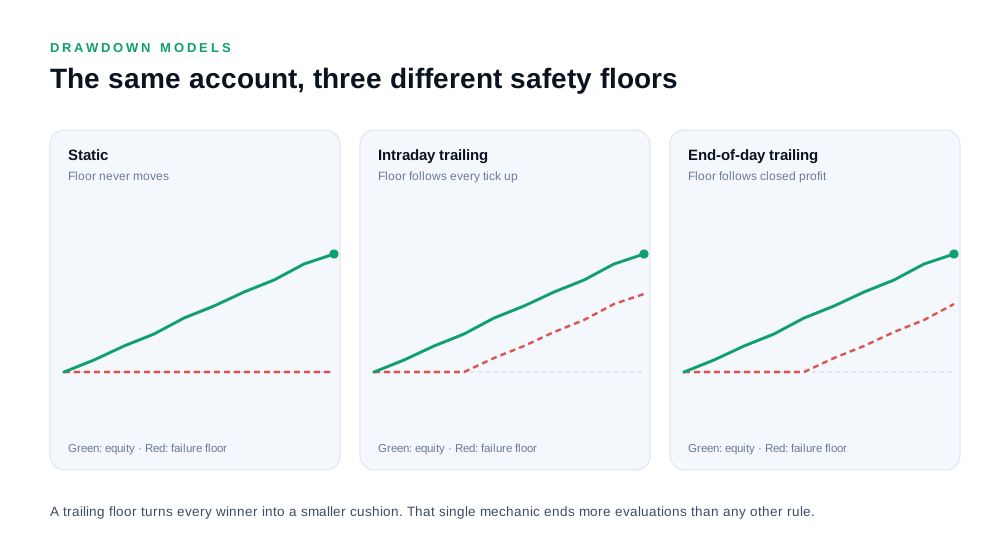
Two further clauses belong to the same paragraph and are frequently missed. The first is whether the threshold is measured on balance or equity — equity includes open positions, which makes the limit tighter in practice for a trader who holds through drawdowns. The second is when the threshold is sampled: continuously, at the end of the trading day, or at the end of the firm's server day. A mechanism described as end-of-day that samples the highest unrealised equity of the session is intraday trailing with extra steps.
For planning purposes, the mechanism should be converted into one number: the distance from the current balance to the floor, in money, right now. That number, not the headline percentage, is what the position size must be built from. It changes daily on a trailing structure and never on a static one, and the difference is the reason a plan calibrated at the start of an evaluation can be oversized by the final third.
The daily limit and the session budget
The daily limit is the constraint that ends the most attempts, because it fires on ordinary variance rather than on a catastrophic error.
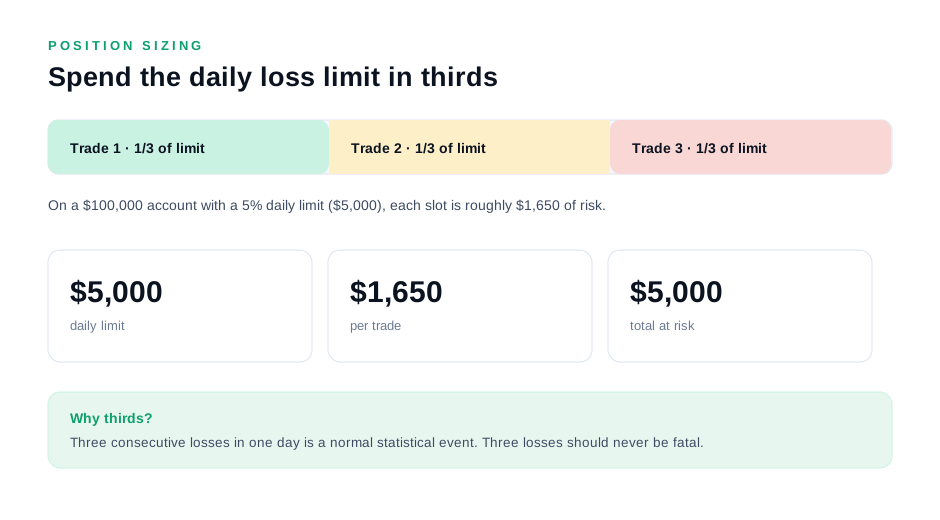
The arithmetic is simple and unforgiving. If risk per trade is a large fraction of the daily limit, two or three consecutive losses close the session. With a win rate in the forties, three consecutive losses are a routine event — they occur several times within a few hundred trades. A plan whose risk line permits only two losses per session is therefore not a conservative plan; it is a plan that will spend a meaningful number of sessions on the sideline after a bad start.
Two derivations follow, and the smaller one governs. Risk per trade from the maximum loss: divide the maximum loss by the number of consecutive losses the plan must survive, typically eight to ten. Risk per trade from the daily limit: divide the daily limit by the number of losses a session should absorb, typically four to six. The second number is usually the smaller, which is why the daily limit and not the maximum loss is the real constraint.
There is a definitional trap that costs traders an attempt. Daily limits are measured from a defined start of day, and that start is the firm's server day, not the trader's local midnight. A trader in one time zone trading the overnight session can unintentionally spread what feels like one day's risk across two server days, or compress two days into one. Either way, the limit behaves differently from the plan's assumption, and the discovery is expensive.
The remedy is to establish the boundary before the first trade and to build the session around it. If the boundary falls mid-session, split the session or shorten it. Then write the daily loss in money, not percentage, at the top of the trading page — the moment of maximum loss is the worst possible time to do arithmetic.
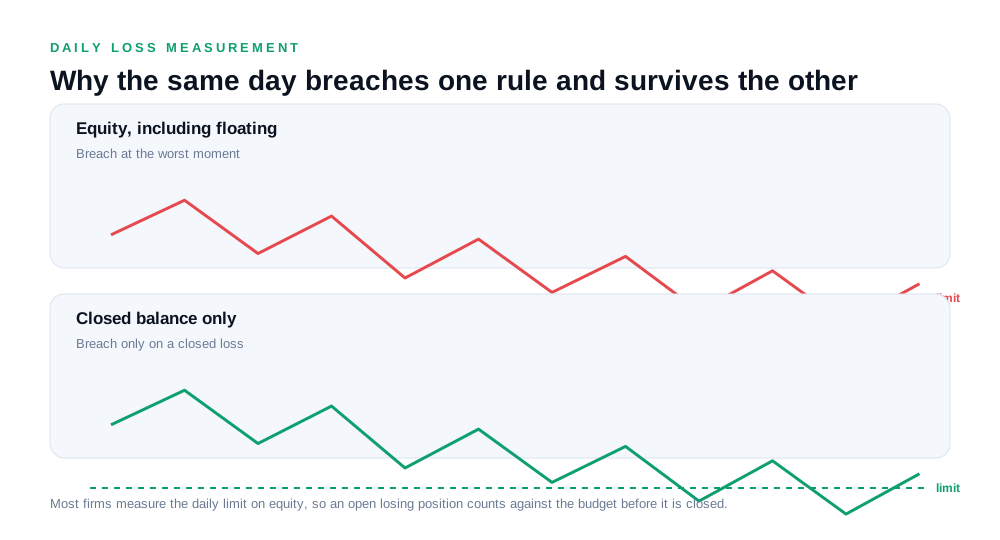
A related clause worth locating: whether an open position that is losing counts against the daily limit as its unrealised loss grows, or only when it is closed. On an equity-based limit it counts continuously, which means a trader can breach without closing a trade. On a balance-based limit the loss is only recognised at exit, which permits a position to be held through a drawdown the plan did not authorise. Neither is necessarily better, but the plan's stop rule has to match the one in force.
Trading rules that surprise people
Beyond the two headline limits, a rulebook contains a set of clauses that are individually reasonable and collectively capable of voiding an otherwise successful attempt.
News restrictions. Many firms restrict opening or closing positions within a window around high-impact releases. The trap is not the restriction itself but the definition: which calendar, which tier of event, and whether the window applies to the trade or to the position. A trader who holds through a release rather than opening during it can breach a clause they believed applied only to entries.
Weekend and overnight holding. Standard accounts frequently restrict holding across the weekend or over specific periods, while swing accounts permit it at a different fee or a different leverage. On a standard account, a position left open on Friday is not merely exposed to gap risk; it may be a rule breach regardless of the result. The weekend holding guide covers the gap arithmetic and the clauses to look for.
Lot and contract caps. A maximum position size is usually stated per instrument or as a total. It is a ceiling, not a target, and it is checked at the moment of the trade rather than at the end of the day. A plan that scales into a position can breach a cap that the initial entry satisfied.
Prohibited strategies. Latency arbitrage, gap trading on stale quotes, and certain forms of copy trading are commonly excluded. The important question is not whether the strategy is named but whether it is described — a clause that prohibits "exploiting platform errors" is broad enough to cover behaviour a trader considers ordinary.
Third-party trading and account management. This is the clause with the largest financial consequence, because a pass produced in breach of it can be voided at the payout request. Crucially, the evaluation terms and the funded terms are separate documents and can answer differently. Where either is ambiguous, the only reliable evidence is a written reply from support, kept on file.
Each of these clauses has the same remedy: read the current terms before the fee, write the restrictions into the risk line as explicit no-go conditions, and where a clause is unclear, ask. A support ticket costs a day; a voided payout costs the evaluation, the pass and the funded account.
Sizing a plan for this rulebook
Sizing on a percentage-based evaluation is arithmetic, and it fits on one line: distance to floor, streak tolerance, dollars per trade, lot size, session cap.
Start from the money, not the percentage. Convert the maximum loss into the current distance between balance and floor, which on a static structure is the same number every day and on a trailing structure is not. Divide by the number of consecutive losses the plan should survive. The result is the maximum dollar loss per trade.
Convert that into position size using the instrument's value per pip or point and the stop distance the strategy requires. If the resulting size is below the platform's minimum, the account is too small for the strategy at that stop distance — a genuine finding, and one that should change the account size rather than the stop.
Then check the daily limit. Multiply the per-trade loss by the number of losses the session should absorb and compare with the daily limit. If the budget exceeds the limit, cut the trade count or the size. If it is far below, the plan is probably too conservative to finish inside the deadline, and the correct adjustment is a tighter stop or a better reward-to-risk ratio rather than a larger position at the same stop.
Keep a quarter of the drawdown untouched. On a static structure the reserve is psychological; on a trailing structure it is arithmetic, because the floor moves and a sequence longer than the design case is exactly what the mechanism punishes. A reserve also gives the trader something to do after a bad week other than stop, which is a behavioural benefit with a financial value.
Recalculate the line every Monday, using the floor as it stands. This single habit prevents the most common late-evaluation breach: a size chosen when the account had room, retained after the room had gone. If the recalculated size is smaller than last week's, trade the smaller size — the plan's job is to finish, not to maintain a position.
The funded account and payout gating
The funded account is a different product with the same name, and the differences are where a pass either becomes income or becomes a story.
The first difference is the drawdown. Funded accounts frequently carry a tighter limit as a percentage, because the firm is now exposed to real payouts rather than to a fee. A plan that ran at a given risk per trade during the evaluation may be twice as aggressive as the funded account permits, which is how newly funded accounts are lost in the first fortnight.
The second difference is that profit only becomes income when it is withdrawn. Unwithdrawn profit sits in the account, contributes to the drawdown calculation, and on a trailing structure raises the floor behind the trader — making the account more fragile rather than less. The disciplined approach is to withdraw on the earliest permitted schedule at a size that leaves room above the floor, rather than accumulating a large balance and hoping to withdraw it later.
The third difference is the payout gate, which typically consists of a minimum number of profitable days, a profit threshold, a consistency check, identity verification, and a payment interval. Each has a failure mode unrelated to trading skill.
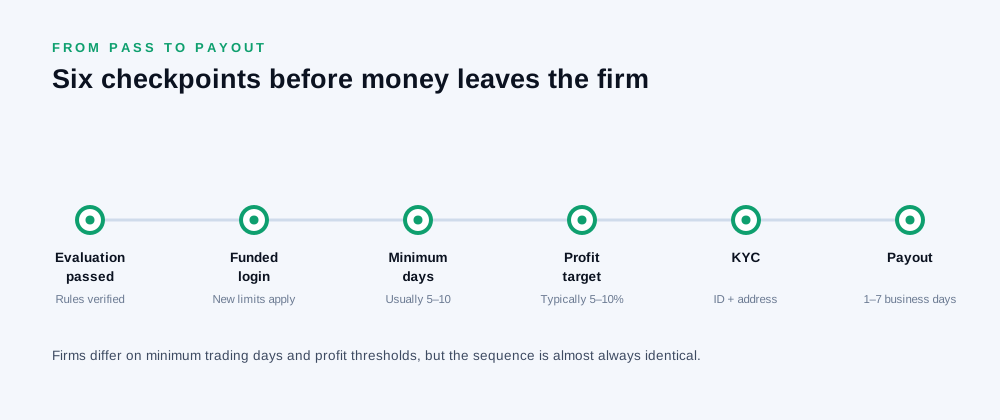
Minimum profitable days are satisfied by activity rather than by profit, and are the most commonly missed condition. A trader who reaches the threshold in six sessions and needs fifteen faces nine sessions of obligation, and the temptation in those nine is to trade for the count. The correct approach is a reduced size, a daily profit cap and an acceptance of flat sessions.
The consistency check is where a good month can become a constrained payout. Applied to the profit being withdrawn, a best-day share of around a third means total profit must reach roughly three times the largest day. A single dominant session therefore constrains the first withdrawal even though it helped reach the evaluation target — the consistency guide covers the arithmetic for the common thresholds.
Verification is administrative and should be completed in the first week of funding rather than at the first request. Documents and payment-method checks are routinely the cause of a delay that has nothing to do with the trading record, and they are the one step in the chain a trader can finish early at no cost.
Cost to funding, not cost at signup
The advertised fee is the least informative number in a prop firm comparison. What matters is the total cost of reaching a funded account, and that number depends on how long the attempt takes.
| Cost line | When it applies | Effect on the decision |
|---|---|---|
| Evaluation fee | Up front, one-off or monthly | A monthly fee makes a slow attempt expensive |
| Reset or retry | Per failed attempt | Determines whether failure is a lesson or a subscription |
| Platform | Monthly | Usually a constant, not a differentiator |
| Market data | Monthly, per feed | Can exceed the evaluation fee over a long attempt |
| Activation | On funding | Converts a cheap pass into a paid one |
| Time | Opportunity cost | Every evaluation week is a week not trading a funded account |
The time line is the one traders omit and the one that often dominates. A three-month evaluation that could have been completed in five weeks does not lose money on fees; it loses seven weeks of funded trading, which is usually the larger figure. That is an argument for a plan efficient enough to finish reasonably and conservative enough to survive, not for a plan that grinds indefinitely.
Retry structure deserves separate attention. A one-off fee with a paid reset is a per-attempt model, and it rewards getting the plan right before the second payment. A monthly subscription with unlimited retries is a different product: it lowers the marginal cost of a failed attempt and raises the cost of a slow one, which changes the optimal strategy toward more attempts and more risk. Neither model is better in itself; a trader whose breach rate is high benefits from the subscription, and a trader whose plan is sound benefits from the one-off.
Finally, price the funded stage. An activation charge on funding, a data subscription that continues, and the profit split together determine the economics of the thing the evaluation is for. A cheap evaluation attached to an expensive funded stage is a cheap entry to an expensive product.
Who this structure suits
A staged, percentage-based evaluation with a deadline suits a specific trader, and being honest about the fit is more useful than a rating out of five.
It suits traders with a defined setup and a measured win rate, because the pace calculation depends on expectation per trade and a trader who has not measured theirs cannot compute it. It suits traders who can trade a fixed number of sessions a week, since the deadline converts the calendar into a requirement. It suits traders who prefer a scale-free plan, where the same percentage risk and the same percentage target apply unchanged at every account size. And it suits traders who want the discipline of a deadline, because the deadline does the work that a self-imposed schedule would otherwise have to do.
It also suits traders who are prepared to read the funded terms before paying, because the evaluation's rules are only half the rulebook and the funded half determines the payout. A trader who treats the evaluation page as the contract is buying a qualification without checking what it qualifies them for.
The structural advantage worth naming is the staged target. Two smaller targets are easier to complete than one large one, because the plan resets its psychology between stages and because the second stage begins with a funded account in view rather than an abstract target. The structural disadvantage is that a late breach costs both stages, which raises the value of reducing risk in the final third — a rule most plans state and few follow.
If a passing service is being considered, the fit question becomes a terms question: whether third-party trading is permitted on the evaluation and on the funded account. That is answered below, and it should be answered before any fee is paid to anyone.
Who should look elsewhere
The same honesty applies in the other direction. Three profiles are usually better served by a different structure.
Traders whose strategy needs to hold winners for weeks. A deadline plus a daily limit is a poor fit for a position that needs a month to work. A swing or static-drawdown structure, or a firm with an explicit swing account, is the better match — the instant funding guide covers the alternative of skipping the evaluation entirely.
Traders who accelerate under a deadline. If the historical pattern is a good first fortnight followed by an oversized final week, a timed evaluation amplifies the flaw rather than correcting it. A no-deadline structure such as the one in the The5ers guide does not fix the behaviour either, but it removes the external trigger, which is a start.
Traders who want futures contracts. Percentage-based forex rules and contract-based futures rules are different products. A trader whose edge is in index futures is better served by a futures evaluation, where the stop is measured in ticks and the daily limit is a dollar figure — the futures firm guide sets out the criteria, and the FundedNext versus Topstep comparison explains the two rulebook models side by side.
A fourth, less obvious group: traders who have not yet measured their own expectation per trade. An evaluation is an expensive way to discover that a strategy is flat after costs. A demonstration account with the same feed and the same order types produces the same information for nothing, and the scam guide explains what a genuine firm will and will not ask for while that measurement is being taken.
Six things to verify before paying
Six checks, each answerable from the firm's own documentation in under an hour. Together they replace every review, including this one.
One: the drawdown mechanism and its sampling. Static, end-of-day trailing or intraday trailing, measured on balance or equity, sampled continuously or at a defined time. Convert the answer into the current distance to the floor in money.
Two: the daily limit and the server day boundary. The percentage, the reference point, and the exact time the trading day starts and ends in the firm's server time zone. Then check how that interacts with the hours you actually trade.
Three: the funded account's drawdown and payout conditions. Not the evaluation's — the funded one. Minimum profitable days, profit threshold, consistency clause and whether it applies at every payout or only the first, verification requirements and the payment interval.
Four: the restricted-behaviour clauses. News windows, weekend and overnight holding, lot caps, prohibited strategies, and the definition of each. Where a definition is broad, ask for a specific example in writing.
Five: the third-party and account-management clause, on both stages. Evaluation terms and funded terms separately, in writing. This is the clause that decides whether a paid pass survives a payout request.
Six: the total cost to funding. Fee, platform, data, activation, and the cost of a reset. Then divide by the realistic number of weeks the plan needs, remembering that a monthly data subscription is a cost per month, not per attempt.
Keep the answers. Terms change, and a trader who has the version they agreed to is in a materially better position than one relying on memory. Where a firm publishes a versioned terms document, save the version in force on the day of purchase.
Comparing it against other structures
Comparisons are only meaningful within a category. The two categories that matter are the rulebook model and the drawdown mechanism, and a firm's position on both explains most of the difference between accounts that feel similar.
On the rulebook model, percentage-based forex rules and dollar-based futures rules are not interchangeable. The first is scale-free and permits fractional position sizes; the second is quantised in contracts and priced in ticks. A plan built for one behaves badly in the other, regardless of the trader's skill. The rules matrix sets the structures side by side and is the fastest way to see where a given firm sits.
On the drawdown mechanism, the ranking from most to least forgiving is usually static, then end-of-day trailing, then intraday trailing — with the caveat that the size of the initial buffer can invert that ranking for a given account. A static floor with a small buffer and a tight daily limit can be harsher than a trailing structure with generous room, which is why the mechanism has to be converted into money before it is compared.
The third axis is the funded stage. Two firms with near-identical evaluations can differ sharply in what a pass is worth, because the funded drawdown, the payout cadence and the consistency conditions are set independently of the evaluation rules. A firm that is generous during the evaluation and strict afterwards has priced the strictness into the payout, and that is where the revenue is.
The 2026 comparison covers the wider market including the firms most often shortlisted alongside this one, and the beginners guide covers the criteria that matter when there is no track record to compare against.
A first-month plan
Assuming the six checks are satisfactory and the fee is paid, the first month divides into four weeks with distinct jobs.
Week one: calibrate at half size. Two trades a session maximum, half the eventual risk, and three measurements per trade: planned risk, realised risk including spread and slippage, and time in the trade. The purpose is to establish whether the cost of execution matches the plan's assumption. Most plans are wrong about this by a meaningful margin, and week one is the cheapest place to find out.
Week two: full size, fixed session cap. If week one's realised risk matched the plan, move to the full size and keep the cap. If it did not, shorten the stop distance rather than increasing the size — slippage is a property of the instrument and the session, not of the account.
Week three: protect the buffer. Ahead, reduce size by a quarter and keep the target in view. Behind, keep the size and move the calendar; the daily limit is not increased to catch up. This is the week where most evaluations are either secured or lost, and it is lost by the same mechanism in both directions: a change in size that was not in the plan.
Week four: decide, do not drift. Review four numbers — trades taken, expectation per trade, worst drawdown so far, distance to target. A plan on pace continues. A plan behind on pace with a healthy expectation extends the calendar. A plan with negative expectation stops, because another fortnight of the same process produces the same result at a higher cost.
Two habits hold the month together. Recalculate the risk line from the current floor every Monday, and never open a position in the final hour of the firm's trading day, where the day-boundary and trailing-floor traps live. If a passing service is doing the work, the same month applies with one addition: a written confirmation that third-party trading is permitted on both stages, kept before the first payment rather than after the pass.
Frequently asked questions
Is Alpha Capital Group a legitimate prop firm?
Legitimacy is not something a review can certify, and it is not the useful question. The useful questions are whether the terms are published clearly, whether the funded-stage conditions are stated before purchase, and whether support answers clause questions in writing. A firm that does all three is one you can evaluate; a firm that does not is one you cannot.
What drawdown mechanism does it use?
Read this from the current terms rather than from any review, and read three details: whether the threshold trails or stays fixed, whether it is measured on balance or equity, and when it is sampled. Convert the answer into the current distance to the floor in money, because that number — not the headline percentage — is what position size must be built from.
Why does the daily limit matter more than the maximum loss?
Because it fires on ordinary variance. If risk per trade is a large fraction of the daily limit, two or three consecutive losses close the session, and runs of that length are routine at a win rate in the forties. Risk per trade should be derived from both limits and the smaller result used.
How much can I risk per trade on the evaluation?
Divide the maximum loss by the number of consecutive losses the plan should survive, typically eight to ten, then check the result against the daily limit divided by the losses a session should absorb. The smaller of the two is the correct number. Keep a quarter of the drawdown untouched as a reserve.
What conditions apply on the funded account?
Usually a minimum number of profitable days, a profit threshold before withdrawal, a consistency check on the profit being withdrawn, identity verification and a payment interval. The funded drawdown is frequently tighter than the evaluation's, so the correct first move after funding is to halve the risk for the first ten sessions.
Can I hold positions over the weekend?
Depends on the account type: standard accounts often restrict it while swing accounts permit it on different terms. Where holding is allowed, price the gap as a multiple of the stop and cut the size accordingly — the weekend holding guide covers the arithmetic.
Is a passing service allowed on this firm?
Only if the terms permit third-party trading, and the evaluation and funded documents answer separately. ElitePropX charges a flat $220 per evaluation at any stage and size, covers retries, takes no profit split, and works with any firm, telling you in writing what that firm’s third-party trading clause says before you pay. Confirm the clause in writing before paying anyone.
Which is better, this or a futures firm?
Neither is better in the abstract; the rulebook has to match the strategy. Percentage rules suit plans with fractional sizing and a percentage edge. Contract rules suit traders whose stop is measured in ticks on an index future. The futures guide sets out the criteria for that side.
How long should the evaluation take?
Derive it from expectation: divide the target by expected value per trade to get the trade count, then divide by planned trades per week. A conservative plan usually lands between fifteen and thirty trading days. If the derived calendar exceeds the firm's deadline, the size is too small to pass within the rules and the account is the wrong purchase.
What is the biggest reason attempts fail?
A risk line that was derived from the maximum loss and never checked against the daily limit, followed by an increase in size in the final third to finish on time. Both are arithmetic failures rather than strategy failures, and both are fixed before the fee rather than during the attempt.
How do I verify the terms before paying?
Six checks: drawdown mechanism and sampling, the daily limit and server day boundary, the funded-stage drawdown and payout conditions, the restricted-behaviour clauses, the third-party clause on both stages, and total cost to funding. Where a definition is broad, ask for a specific written example and keep the reply.
Should I read the funded terms before or after passing?
Before paying the evaluation fee. The funded terms determine whether a pass produces income, and they frequently include a tighter drawdown and a consistency condition that changes how the evaluation should be traded. A trader who reads them first often chooses a different account size.
Where these rules come from
Firm figures on this page are read from the rulebooks below rather than from other comparison sites. Every link was opened and checked on . Firms revise targets and drawdown rules without notice, so confirm the figures on the plan you are buying before paying. How we check firm rules sets out what a checked date means, what we publish when a figure cannot be confirmed, and how corrections are handled.
- Alpha Capital Group — evaluation objectives and payout terms
Want the evaluation traded for you?
One flat $220 for any prop firm, any stage, any account size. Retries covered, no profit split, funded login in your name. If your firm's terms forbid third-party trading, we tell you before you pay.
Related reading
- Recently passed evaluations
- How to pass an FTMO challenge, step by step
- Passing a The5ers challenge
- Best futures prop firms 2026
- Daily drawdown explained
- Consistency rule guide
- Weekend holding rules and gap risk
- Prop firm rules matrix
- Prop firm comparison 2026
Alpha Capital Group is named for identification only. ElitePropX is an independent service and is not affiliated with, endorsed by or sponsored by any proprietary trading firm, and this page is not investment advice. Evaluation structures, drawdown mechanisms and payout terms change; verify every detail against the firm's current documentation before paying. Trading involves substantial risk of loss.