
Reviewed · how we check firm rules
Evaluation service · reviewed October 2026
FundedNext passing service: a flat-fee pass for any account size
FundedNext sells two evaluation shapes, and which one you buy changes both the difficulty and the price of having it traded. This page covers the service for FundedNext specifically: how the two models are chosen, what the terms check involves for each, the plan used to trade the evaluation, the realistic timeline, and what the funded stage looks like once the account is handed back. One flat $220 for any FundedNext program and any account size, retries covered while the evaluation runs, no profit split.
Key takeaways
- FundedNext's two models are not interchangeable for a service pass: the staged model has two smaller targets and a checkpoint, the one-phase model concentrates the whole target into one arc.
- Both models apply a daily limit and a maximum limit, and the balance each is measured from decides how much room exists after a drawdown.
- The terms check happens before payment, and it covers third-party trading on the evaluation and on the funded account separately.
- A FundedNext pass typically takes two to four weeks, driven by the minimum day count rather than by trading speed.
- The service covers the evaluation, not the funded stage: the payout conditions belong to the account holder.
- Flat $220 at any account size, retries covered, no profit split, and the firm's third-party clause is put in writing before you pay.
Contents
Choosing the model before the size
The most consequential decision on a FundedNext purchase is not the account size — it is the model, because the model determines how many targets have to be cleared, how long the account is exposed to the rules, and how much of the evaluation can be lost to a single bad session.
A staged evaluation splits the work into two phases, each with its own target and its own minimum day count. The advantage is a checkpoint: clearing the first phase is a real milestone, and the second phase starts with a reset drawdown and a smaller target. The disadvantage is duration — twice the calendar means roughly twice the number of sessions in which a conduct rule can be broken or a daily limit reached.
A one-phase evaluation asks for the whole target in a single arc. It is shorter, and it is advertised as easier. It is not easier in the way that matters: the target is larger relative to the starting balance, there is no checkpoint, and a single bad session consumes a larger share of the evaluation. Its real advantage is the shortened exposure, which matters for traders whose discipline degrades over a long calendar.
| Question | Staged model | One-phase model |
|---|---|---|
| Number of targets | Two, smaller each | One, larger |
| Calendar | Longer | Shorter |
| Failure tolerance | Higher — a bad week is recoverable across two phases | Lower — the whole evaluation rides on one arc |
| Best fit | Traders who can absorb a losing week | Traders whose discipline shortens over time |
| Service implications | More sessions, more conduct exposure | Fewer sessions, tighter pacing |
For a service pass, the choice has a second layer that a self-trading client does not face: the number of sessions is the number of opportunities to breach a conduct rule, and conduct breaches are the failures that cannot be traded around. That is the reason we generally recommend the staged model even where its total target is higher — more sessions at smaller risk each is easier to keep inside a rulebook than fewer sessions at larger risk each.
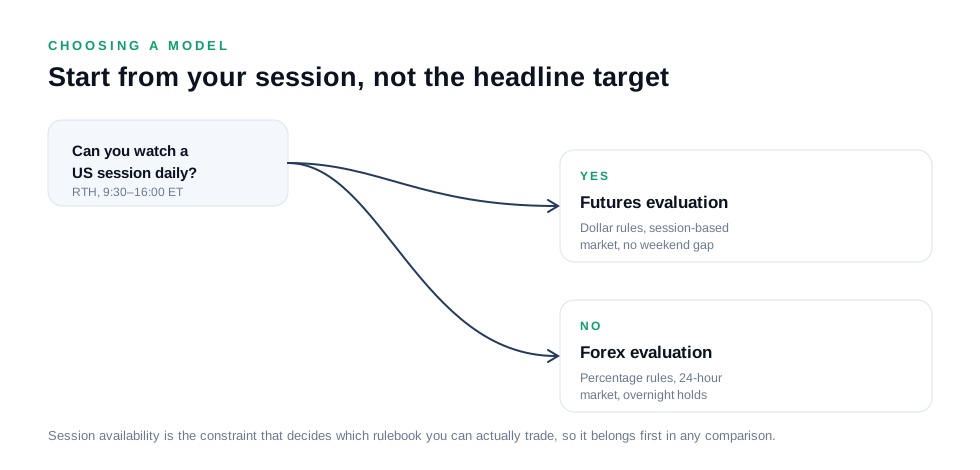
Account size comes second, and the reasoning is the opposite of what most clients expect. The percentage rules are broadly constant across tiers, so a larger account buys a larger payout ceiling and a larger fee, not an easier evaluation. The smallest size that produces a meaningful payout is almost always the right purchase, and the flat fee does not change with size — which removes the incentive a per-attempt provider has to steer clients toward the most expensive tier.
The terms check, per model
Before any payment, we read the current FundedNext terms for the specific program and confirm in writing whether the evaluation can be traded by a third party. This is not a formality; it is the step that decides whether a pass produces a payout or a voided account.
Four things are checked, and they are checked for the evaluation and for the funded account separately, because the two are governed by different clauses.
- Third-party trading on the evaluation. If it is prohibited, the job does not start. There is no version of this where accepting quietly is acceptable, because the loss lands on the funded account rather than on the service fee.
- Third-party trading on the funded account. Some firms permit the evaluation to be traded externally and prohibit it after a pass. That distinction matters because the funded account is the asset.
- Conduct rules. News windows, maximum position size, prohibited strategies, and whether positions may be held overnight or across a weekend. These decide which session windows are usable and therefore how long the pass takes.
- Account ownership requirements. The evaluation must be purchased in the client's name with the client's payment details, and identity verification must be completed by the client. Any arrangement where the provider holds the account is a managed account in disguise and is prohibited by most firms.
The check produces one of three answers: permitted, prohibited, or silent. Permitted means the job proceeds. Prohibited means we say so in writing before payment, and the client decides whether to proceed. Silent is treated as prohibited unless the firm confirms otherwise in writing, because a firm that has not addressed the question can address it at the payout.
What to send us: the program name, the account size and, if you already have it, the firm's support response on third-party trading. The check is free, and it happens before you buy anything.
What the trading plan has to respect
The evaluation is traded to the firm's rules, which means the plan is written from the rulebook rather than from a view on the market. Six constraints shape it.
The daily limit sets risk per trade. Risk is sized at a third of the daily limit at most, so that three consecutive losses leave the session survivable. The session stops at 80% of the budget spent, with the remaining fifth reserved for slippage on the closing trade.
The maximum limit sets the loss count. Total room divided by risk per trade gives the number of losing trades the account can absorb. If that number is under six, either the account is too small for the risk or the risk is too large for the account, and the plan is revised before trading starts.
The target sets the pace. The target is converted to a percentage of the account, divided by the sessions available, and checked against the daily limit. A plan whose required pace consumes more than a fifth of the daily budget is depending on the market rather than on execution, and the schedule is extended instead.
The consistency rule sets the daily profit cap. Where a best-day share applies, the cap is set at a fraction of the total that satisfies it by construction — so the ratio is never computed during the run because it cannot fail.
The minimum day count sets the calendar. Reaching the target early does not finish the evaluation if the day count is short, so the pace is planned backwards from the count. A small closed trade satisfies a qualifying day without adding meaningful risk.
The conduct rules set the clock and the instrument list. Restricted news windows and maximum position sizes are treated as fixed, not as guidelines. A plan that ignores them is a plan that will breach them eventually, and a conduct breach voids the evaluation regardless of profit.
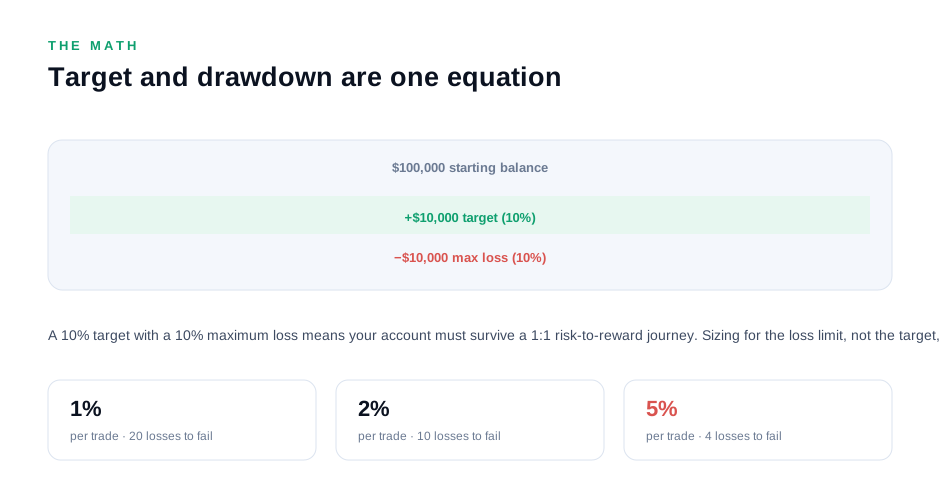
The plan is not exotic and it is not optimised for speed. It is the same shape on every firm: risk sized to the daily limit, pace sized to the calendar, profit capped to satisfy the payout gate, and conduct rules treated as walls. What changes between firms is only the numbers, which is why the service can be priced flat.
Failure handling is part of the plan. If an attempt is lost, the client is told immediately rather than at the end of a reporting period, the failure is classified — drawdown or conduct — and the retry starts under the same rules at no additional service fee. A provider that cannot classify its own failures has not read the rulebook closely enough to trade it.
The timeline, honestly
A FundedNext evaluation is not completed in a week, and any provider promising that has not read the minimum day count. The realistic window is two to four weeks, and the drivers are worth stating precisely so the expectation is set correctly.
The minimum day count is usually the binding constraint, not the target. A plan that trades four sessions a week reaches most targets before it satisfies most day counts. The efficient approach lands both on the same date by pacing deliberately, which is why the plan trades smaller and more often rather than larger and less often.
The daily limit constrains the pace you can take. With risk at a third of the daily budget and a session stop at 80%, a good week produces a modest percentage rather than a large one. That is deliberate: the cost of a slow pass is calendar, and the cost of a fast one is variance.
Conduct windows remove sessions. A restricted release window can eliminate an hour of a session, and on a week with several scheduled releases the usable calendar is meaningfully shorter. The plan works around the windows rather than through them.
Reporting is weekly at minimum. Progress is reported at agreed checkpoints, and a failed attempt is reported the day it happens. Silence during an evaluation is indistinguishable from a failure, which is why the cadence is part of the product rather than a courtesy.
One practical note on the staged model: the handover between phases is a natural checkpoint for the client to see a real confirmation from the firm, and the second phase is traded with the same plan rather than with the first phase's aggression. Traders who carry a fast first phase into the second phase are carrying the wrong lesson: the first phase proved the plan works at that size, not that the size should now increase.
The fee is $220 for any FundedNext program and any account size. The scope is deliberately narrow and stated in full, because a vague scope is the most common source of dispute in this industry.
| Item | Covered | Notes |
|---|---|---|
| The evaluation attempt | Yes | Traded to the firm's target within its rules |
| Retries while the evaluation runs | Yes | No additional service fee |
| Terms check before payment | Yes | Confirmed in writing, free of charge |
| FundedNext's own evaluation and reset fees | No | Paid by the client directly to the firm |
| The funded account after handover | No | Traded by the client under the firm's terms |
| Identity verification | No | Completed personally, as the account holder |
| Profit split | None taken | Payouts belong to the client |
The comparison that matters is against doing it yourself, and it is worth stating the case against the service as plainly as the case for it. At a firm fee of roughly $500, one attempt on your own costs about $500 and a service costs about $720 — so if you pass first time, the service is $220 worse and you also gave up the experience of trading the evaluation. From the second attempt onward the arithmetic reverses, and it reverses sharply, because the service absorbs the retries while your own attempts are billed each time.
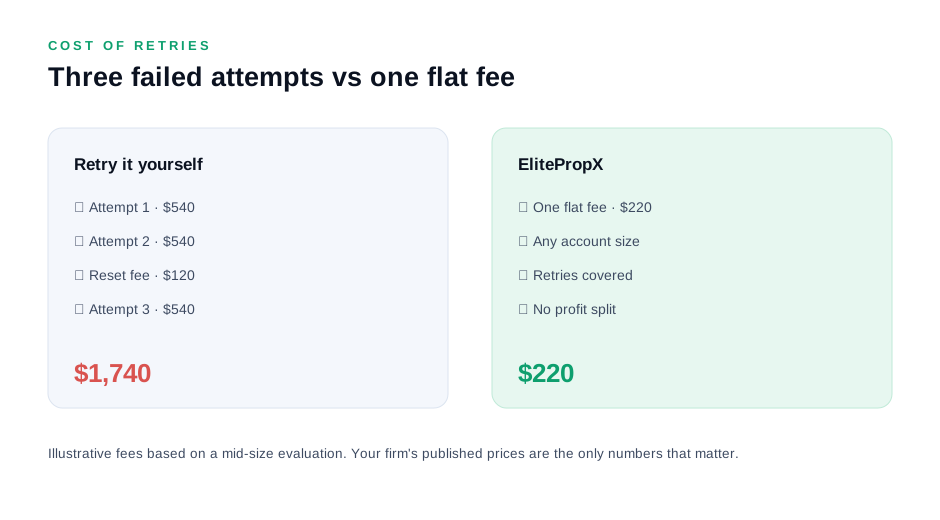
Three costs the fee does not remove are worth naming. The firm's evaluation fee is unaffected. The firm's reset charge, where one is needed, remains the client's cost. And the calendar is not shortened — the minimum day count applies to a service pass exactly as it applies to anyone else, which is why no provider can honestly promise a three-day FundedNext pass.
For the funded stage, the profit calculator models what a given account pays once the payout conditions are met, and the FundedNext challenge guide works the drawdown arithmetic behind the evaluation itself.
At the funded stage
The pass produces a funded account and a change of responsibility. The service covers the evaluation; the funded account belongs to the client and is governed by the firm's payout conditions, which are usually stricter than the evaluation.
Three conditions carry over and three are new. Carried over: the daily limit, the conduct rules, and the requirement to trade within the firm's permitted hours. New: a profit threshold that must be reached before any withdrawal and a minimum number of qualifying days. Some FundedNext plans also apply a consistency share at payout and some do not; the Stellar 2-Step does not apply one at evaluation, and the funded terms for the exact plan decide the rest.
Where a consistency share applies, it is the condition that catches clients who assume the hard part is over. Required total profit equals the largest day divided by the permitted share, so a large single session can multiply the requirement. The remedy is the same as during the evaluation: cap daily profit at a fraction of the threshold and the gate is satisfied by construction.

Four things to do in the first week after handover, in this order. Change the account password regardless of how access was provided. Confirm the account is in your name with your payment details and your identity verification complete. Read the funded terms yourself rather than relying on a summary. And write the funded plan — risk per trade, daily stop, daily profit cap, minimum day count — before the first trade, not after the first loss.
The payout process guide covers the withdrawal sequence and the delays that block first requests. The short version: complete verification early, request the first payout at the earliest permitted date rather than the largest amount available, and treat that first payment as a test of the process rather than as income.
What we will not do
Four refusals define the service as much as the fee does, and each one exists because the alternative transfers risk to the client without saying so.
We will not trade a firm whose terms prohibit third-party trading. Not quietly, not for a higher fee, and not with a disclaimer buried in a chat message. A funded account passed in breach of the terms can be voided at the payout, which turns a paid evaluation into a loss of the firm's fee and the service fee together.
We will not hold the funded account. The account is in the client's name, and access is returned or removed at handover. Continuing to trade someone else's funded account is a managed account in disguise and is prohibited by most firms.
We will not take a profit share. A provider paid a percentage of earnings has a reason to keep trading an account after the job is done, which extends the exposure and can lose the account in pursuit of a larger fee. A flat fee removes that incentive entirely.
Two further practices are worth stating because they are the industry's usual shortcuts. We do not buy evaluations on the client's behalf — the purchase is made in the client's name with the client's payment method, because ownership is the thing that keeps a funded account valid. And we do not ask for identity documents; verification is the account holder's step and cannot be delegated.
Everything above applies to any firm, and the FundedNext-specific part is only the terms check and the rulebook. That is the honest description of the product: a fixed-fee process applied to a ruleset that is read before the fee is taken.
If you are running more than one evaluation
Clients occasionally want several evaluations traded at once, and the answer is usually no — not because it is difficult, but because it changes the risk the client is carrying without changing what they receive.
The first problem is correlation. Two evaluations on the same firm, same instrument, same direction and same session are one position with two sets of fees. Firms that treat correlated positions across accounts as a single exposure may treat that as a breach, and firms that permit multiple accounts usually require them to be traded independently.
The second problem is conduct exposure. Every additional account is another set of news windows, size caps and holding restrictions to stay inside, and a breach on any one of them is a lost evaluation. Two accounts do not double the fee; they multiply the number of ways to fail.
The third problem is sequencing. A funded account produces income and a record. Two failed evaluations produce neither, and a client who funds three accounts in month one has three times the exposure and no payout history to show for it.
The recommendation is sequential, and it is the same advice we give self-trading clients: complete one pass, trade the funded account through two or three payouts, and only then consider a second account. The record from the first is worth more than the head start from the second.
Sizing the purchase to the payout you actually want
Account size is the last decision and the one most often made backwards. Clients usually choose the largest account they can afford, on the assumption that a bigger account is a better account. Under percentage-based rules that is only half true, and the other half costs money.
Because targets and drawdown limits scale with the balance, difficulty per dollar is roughly constant across tiers: a $200,000 account needs a larger dollar target than a $50,000 account and has proportionally more room. What does not scale is the cost of trading. Commissions, spreads and slippage are identical in dollars at every tier, so on a smaller account they consume a larger share of the target. The practical effect is that small accounts are marginally harder to pass at identical discipline — which is worth knowing before buying the cheapest tier in the belief that it is the easiest.
The other factor is the payout ceiling. A funded account's profit threshold and any consistency share are expressed relative to the balance, so a larger account does not pay a larger percentage — it pays a larger amount for the same percentage. That is a real benefit, and it is the only one a larger tier genuinely buys.
Put those two facts together and the correct method is a target-payout calculation rather than a budget calculation. Decide the amount you want a payout cycle to produce, divide by the firm's payout percentage to get the profit the account must generate, then check whether that figure is reachable inside the firm's daily limit at a pace that consumes under a fifth of it per session. If the answer is yes at a small tier, buy the small tier. The extra fee for a larger account buys a bigger ceiling, not a bigger chance.
There is one exception, and it is honest to state: futures and Forex tiers are not always proportional in their fees, and firms sometimes price mid-tier accounts more keenly than the smallest ones. Where the fee curve is non-linear, the cheapest tier is not automatically the best value, and the comparison should be fee per unit of payout ceiling rather than fee alone. The flat service fee does not change with any of this, which removes one variable from a calculation that already has too many.
One further note on sequencing: whichever size is chosen, the first payout is not the place to maximise. A first withdrawal sized modestly is less likely to run into a consistency query and leaves a healthier account behind it, and once the payout process is understood the second cycle is easier to plan than the first. The profit calculator models the payout side of the choice, and the firm comparison sets FundedNext's structures against the rest of the field.
Frequently asked about the FundedNext service
Does the $220 fee depend on the account size?
No. The fee is flat for any FundedNext program and any account size, because the work is the same process applied to different numbers. Sizing affects the payout ceiling and the firm's own fee, not ours.
Which FundedNext model should I buy?
For a service pass, the staged model is usually the better purchase: two smaller targets with a checkpoint, and more sessions at smaller risk each. The one-phase model is shorter but concentrates the whole target into a single arc, which is less tolerant of one bad session.
Will you check the terms before I pay?
Yes, and it is free. Send the program name, the account size and any support response you already have, and we confirm in writing whether third-party trading is permitted on the evaluation and on the funded account. If it is prohibited, we say in writing what that means for the funded account before you have paid anything.
How long does a FundedNext pass take?
Usually two to four weeks. The binding constraint is the minimum day count rather than the target, and restricted news windows remove sessions from the calendar. Any provider promising a few days has not read the day count.
Who owns the funded account?
The client. The evaluation is purchased in the client's name with the client's payment method, identity verification is completed personally, and access is returned or removed at handover. Change the password after handover regardless of how access was provided.
What happens if the evaluation fails?
You are told the day it happens, the failure is classified as a drawdown or a conduct breach, and the attempt is retried at no additional service fee while the evaluation is running. FundedNext's own reset charge, where it applies, remains your cost.
Do you take a cut of the payouts?
No. The funded account and its payouts belong to the client, and no profit share is taken. A provider paid a percentage has an incentive to keep trading the account after the pass, which is a conflict we choose not to have.
Does the service cover the funded account too?
No, and it should not. The funded account is governed by FundedNext's payout conditions — a profit threshold, a minimum day count and a consistency share — and it has to be traded by its owner under the firm's terms. We hand over and the plan continues with you.
Is it cheaper than doing it myself?
Can you trade two FundedNext evaluations at once?
We advise against it. Correlated positions across accounts can be treated as a single exposure, each account adds a full set of conduct rules to stay inside, and a funded account that produces a payout record is worth more than a head start on a second evaluation.
What do you need from me to start?
The program name and account size for the terms check. If the check clears, you buy the evaluation in your own name, then we agree the scope of access in writing and begin. Identity verification stays with you throughout.
What if FundedNext changes its rules mid-evaluation?
A worked FundedNext pass, week by week
An illustration of the pace a compliant pass actually runs at, using a staged model with two phases, a smaller first target and a minimum day count that has to be respected across both phases.
Week one — phase one starts. Four sessions at 1.5% risk per trade against a 5% daily limit, with the session closed at 80% of the budget spent. Two small gains, one flat session, one small loss. Phase one progress around a third of the way to its target, with no day anywhere near the daily limit.
Week two — phase one completes. Three ordinary sessions reach the first target, and the remaining sessions of the week are used to satisfy the balance of the first phase's day count with single small closed trades. Phase one is confirmed by the firm, which is the client's first hard evidence of progress.
Week three — phase two begins. The drawdown resets against the new balance, so the account starts the second phase with a full buffer. The same plan is applied at the same risk, which is the decision most traders get wrong: the first phase proved the plan works at that size, not that the size should rise.
Week four — phase two completes. The second target is reached across four sessions, with the day count satisfied on the same date because the pace was planned backwards from the requirement. The best day across the whole evaluation is a fraction of the total profit, so the consistency share would clear comfortably if it were applied now.
| Week | Phase | Work | Risk per session |
|---|---|---|---|
| One | Phase one | Four ordinary sessions, one small loss | 1.5% of account |
| Two | Phase one | Target reached, day count completed | 1.5%, reduced near target |
| Three | Phase two | Reset, plan re-applied at the same size | 1.5% |
| Four | Phase two | Target and day count land together | 1.5% |
The features worth noticing are the absence of a dramatic week, the deliberate use of small closed trades to satisfy day counts, and the refusal to increase size at the phase boundary. A pass built this way is slower than a pass built on one large session and it is considerably more likely to convert into a payout, because the consistency share is satisfied before it is ever tested.
The contrast is instructive. A trader who reaches the same target in five sessions with one dominant day has completed the evaluation and created a payout problem simultaneously. The consistency guide works that arithmetic through, and the FundedNext challenge guide covers the drawdown mechanics that make the slower plan the safer one.
Check your FundedNext terms first
Send the program and account size and we confirm in writing whether third-party trading is permitted — before you pay anything. If it is not, we say so in writing before you pay.
Related reading
- Passing a FundedNext challenge
- E8 Markets vs FundedNext: which is easier
- FundedNext vs Topstep
- How the flat-fee passing model works
- The 2026 passing service review
- Passing services compared
- From funded account to first payout
- Recently passed evaluations
- Challenge calculator: target, risk and pace
FundedNext is named for identification only. ElitePropX is an independent evaluation service and is not affiliated with, endorsed by or sponsored by FundedNext or any other proprietary trading firm. The service is offered only where a firm's terms permit third-party trading. A funded account is not a guarantee of income, and trading involves substantial risk of loss. Verify current terms before purchasing an evaluation.