
Reviewed · how we check firm rules
Evaluation service · reviewed October 2026
FTMO challenge passing service: two phases, one flat fee
FTMO's evaluation has two phases, a minimum day count on each, and a set of loss rules that have to hold across the whole run. That structure changes how a pass is planned and how long it takes, so this page covers the service for FTMO specifically: which challenge type to buy, what the terms check involves, the pacing plan used across both phases, the realistic calendar, and what the funded stage asks of the account holder afterwards. One flat $220 for any FTMO challenge and any account size, retries covered while the evaluation runs, no profit split.
Key takeaways
- Two phases means two targets and two minimum day counts, so the calendar is the binding constraint rather than the profit target.
- Pace matters more than aggression: a plan that consumes under a fifth of the daily loss limit per session survives ordinary variance across both phases.
- The terms check comes before payment and covers third-party trading on the evaluation and on the funded account separately.
- A realistic pass runs three to five weeks, driven by the day counts and by phase handovers.
- The service covers the evaluation. The funded account keeps its own profit split, minimum trading days and payout cycle, and belongs to the client. On the 2-Step there is no consistency rule; the 1-Step has a 50% rule.
- Flat $220 at any size, retries covered, no profit share, and the firm's third-party clause is put in writing before you pay.
Contents
What the FTMO structure asks of a pass
FTMO's evaluation is a staged structure rather than a single target, and the two-phase shape is the reason a pass takes weeks rather than days. Each phase has its own profit target, each has a minimum number of trading days, and both run against the same pair of loss rules: a maximum loss limit that governs the account and a maximum daily loss limit that governs the session.
Three features of that structure shape every decision.
The day count binds before the target does. A plan traded at a sensible risk per session usually reaches a phase target before it has completed the phase's minimum days. The efficient approach lands both conditions on the same date by deliberately pacing rather than by trading more size.
The daily limit sets risk per trade, not the target. Risk is sized so that three consecutive losses remain survivable inside one session. That produces a slower pass than a trader imagines, and a materially higher completion rate than one built on maximum size.
The phase handover is a checkpoint, not a licence. Clearing phase one proves the plan works at that size. It does not argue for a larger size in phase two, and traders who increase risk at the handover are the population that loses the evaluation from a winning position.
| Constraint | What it governs | Planning consequence |
|---|---|---|
| Phase profit target | Each phase separately | Convert to a percentage and divide by sessions available |
| Daily loss limit | The session | Risk per trade at a third of it; stop at 80% spent |
| Maximum loss limit | The account | Divides total room by risk to give the survivable loss count |
| Minimum day count | Each phase | Pace backwards from the count, not forwards from today |
| Consistency | None on the 2-Step; 50% on the 1-Step | Confirm the product before planning a daily cap |
Two phases, one plan. The plan does not change at the handover. What changes is the account's balance relative to its reset limits, and the correct response is to recompute the numbers rather than to trade them harder.
Which challenge to buy
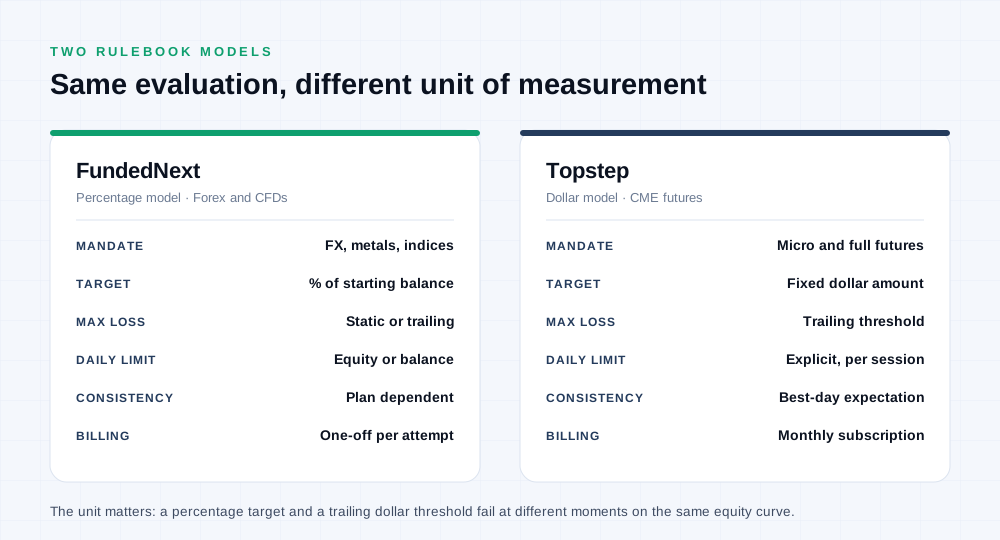
The choice of challenge type matters more than the choice of account size, and both matter less than the rulebook behind them.
Account size first. Percentage rules are broadly constant across tiers, so a larger account buys a larger payout ceiling and a larger fee rather than an easier evaluation. Fixed costs — commissions and spreads — are identical in dollars at every tier, which makes small accounts marginally harder to pass at identical discipline. The smallest tier that produces a meaningful payout is usually the right purchase, and the flat service fee does not change with size, so there is no reason for us to steer a client upward.
Holding policy second. Whether positions may be held overnight or across a weekend changes which strategies are admissible at all. A swing approach on a restricted account breaches without warning; an intraday approach on a permissive account leaves the weekend gap risk unaddressed. Match the policy to the strategy before buying, because it is the one choice that can make an evaluation impossible for a given trader.
Risk profile third. Where a firm offers a stricter and a looser variant of the same evaluation, the looser one usually trades a lower target for a tighter daily limit or the reverse. The useful comparison is not the headline target but the ratio of target to daily limit, which is what decides how much ordinary variance a plan can absorb. A target that is twice the daily limit with a month of calendar available is easier than a target that is four times the daily limit with a fortnight.
One sequencing note that applies to every firm: buy the evaluation in your own name, with your own payment method, and complete identity verification yourself. Ownership is what keeps a funded account valid at payout, and it is the first thing a firm checks when a withdrawal is reviewed.
The terms check
Before payment, we read the current terms for the specific challenge and confirm in writing whether the evaluation can be traded by a third party. That check is free, it happens before anything is bought, and it produces one of three answers.
Permitted. The terms allow the evaluation to be traded externally, and the job proceeds at the flat fee.
Prohibited. We decline and say so before payment. A funded account passed in breach of the terms can be voided at the payout, which is a worse outcome than a failed evaluation, because the client has paid the firm, paid the service and earned nothing.
Silent. Treated as prohibited unless the firm confirms otherwise in writing. A firm that has not addressed the question can address it at the payout, and the risk of that lands on the funded account rather than on the fee.
Three details are checked alongside the main question. Whether third-party trading is permitted on the evaluation and on the funded account separately, since some firms permit the first and prohibit the second. Which conduct rules apply — news windows, maximum position size, prohibited strategies, holding restrictions — because they decide which session windows are usable and therefore how long the pass takes. And what ownership evidence the firm requires, which decides how the account has to be purchased and who completes verification.
Where the terms are ambiguous, the honest move is to ask the firm directly and save the answer. A support response permitting third-party trading on the evaluation is worth having in writing, and it costs one message. Where that message goes unanswered, the answer is no.
The plan across both phases
The evaluation is traded to the firm's rules, so the plan is written from the rulebook rather than from a view on the market. Six numbers define it, and they are recomputed at the phase handover rather than carried over unchanged.
- Risk per trade: a third of the daily loss limit at most, so three consecutive losses leave the session survivable.
- Daily stop: stop opening positions once 80% of the daily budget is realised. The remaining fifth absorbs slippage on the closing trade.
- Daily profit cap: set at a fraction of the phase target to keep the equity curve readable and the calendar inside the minimum-day window. On the 2-Step this is risk management, not a compliance rule.
- Phase pace: the phase target as a percentage of the account, divided by the sessions available in that phase, checked against the daily limit. If the required pace consumes more than a fifth of the daily budget, the phase is running too fast and the plan slows down.
- Day-count plan: the sessions needed to satisfy the minimum days, spread deliberately so that a small closed trade completes a qualifying day without adding meaningful risk.
- Weekly loss pause: a hard stop at two losing sessions in a week. On a staged evaluation the pause costs a few days of calendar and prevents the sequence that closes most accounts — three losses, a size increase, and a fourth.
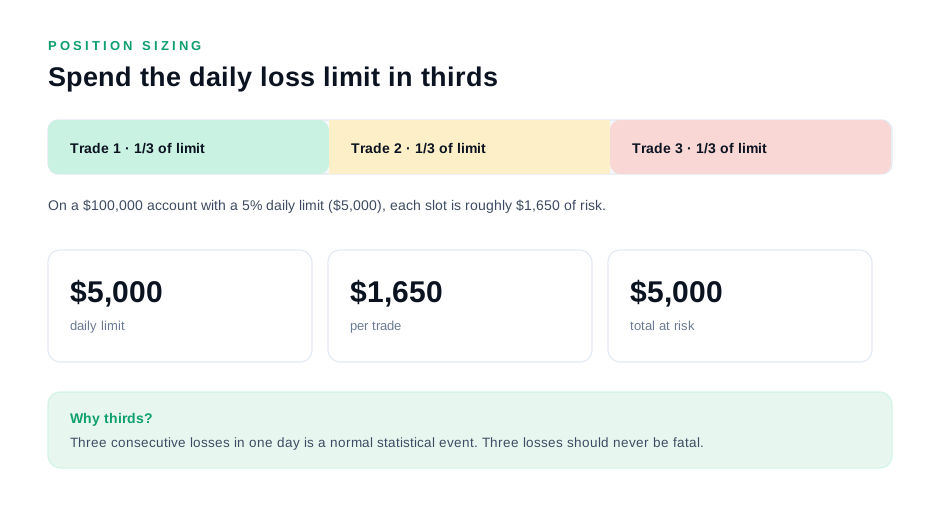
The fifth number is the one clients question most, and it is the one that does the most work. A minimum day count is not a formality; it is a calendar requirement that runs in parallel with the target. A single closed trade that keeps a day green satisfies it. A trader who instead uses those days to press for profit is adding risk to a requirement that needed none, and on a staged evaluation that mistake has to be avoided twice.
At the handover, three numbers are recomputed: the maximum loss floor against the new balance, the daily limit against the new balance if it is expressed as a percentage, and the pace required for the second phase's target. Nothing else changes, and the risk per trade stays where it was. That last point is worth restating because it is the most common self-inflicted failure on a staged evaluation.
The timeline, honestly
A two-phase evaluation is not completed in a few days, and any provider promising that has not read the minimum day counts. The realistic window is three to five weeks, and the drivers are worth stating precisely so that the expectation is set correctly from the start.
Phase one sets the pace and usually takes one to two weeks. At a risk per trade that keeps three losses survivable, a good week produces a modest percentage rather than a large one. Two weeks is typical with four sessions a week, and the phase completes when both the target and the day count are satisfied.
The handover adds days, not hours. Phase two starts against a reset balance with its own target and its own minimum days, so the calendar does not simply continue — it restarts in part. Building that into the estimate is the difference between a plan and a hope.
Conduct windows remove sessions. Restricted releases can eliminate an hour of a session, and a week with several scheduled events has a meaningfully shorter usable calendar. The plan works around the windows rather than through them.
Losing weeks are expected and budgeted. A plan that cannot absorb a two-loss week is not a plan, and the weekly pause means a bad week costs two sessions rather than five. That is calendar spent deliberately to protect the account.
Reporting runs at agreed checkpoints, at minimum weekly, with immediate notice if an attempt fails. Silence during an evaluation is indistinguishable from a failure, which is why the cadence is part of the product rather than a courtesy. Where a phase completes, the client sees the firm's own confirmation rather than a summary from us.
Price, scope and comparison
The fee is $220 for any FTMO challenge and any account size. The scope is narrow and stated in full, because a vague scope is the most common source of dispute in this industry.
| Item | Covered | Notes |
|---|---|---|
| Both evaluation phases | Yes | Traded to each phase target within the firm's rules |
| Retries while the evaluation runs | Yes | No additional service fee |
| Terms check before payment | Yes | Confirmed in writing, free of charge |
| The firm's own evaluation and reset fees | No | Paid by the client directly to the firm |
| The funded account after handover | No | Traded by the client under the firm's terms |
| Identity verification | No | Completed personally, as the account holder |
| Profit share | None taken | Payouts belong to the client |
The comparison that matters is against doing it yourself, and the case against the service deserves stating as plainly as the case for it. At a firm fee of roughly $500, one attempt on your own costs about $500; a service costs about $720. If you pass first time, the service is $220 worse and you also gave up the experience of trading the evaluation. From the second attempt onward the arithmetic reverses sharply, because the service absorbs retries while your own attempts are billed each time.
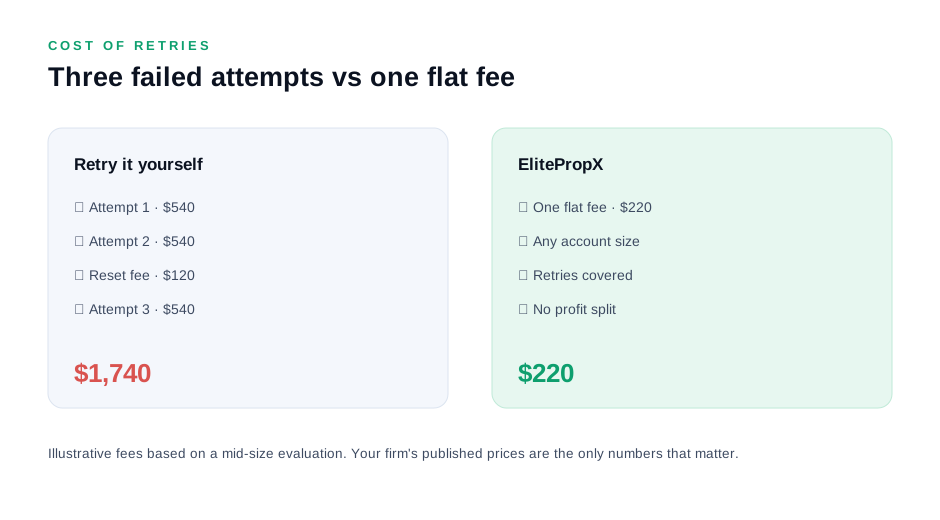
Three costs the fee does not remove are worth naming. The firm's evaluation fee is unaffected. The firm's reset charge, where one applies, remains the client's cost. And the calendar is not shortened: the minimum day counts apply to a service pass exactly as they apply to anyone else, which is why a two-phase evaluation cannot be compressed indefinitely by trading harder.
What the fee does buy is a removal of the reset multiplication and of the attention cost. A trader running two failed attempts has spent four to eight weeks that could have produced a funded account, and that calendar is usually worth more than the fee difference. For the arithmetic on the payout side, the profit calculator models what a funded account produces once its conditions are met.
At the funded stage
The pass produces a funded account, and responsibility transfers with it. The service covers the evaluation; the funded account is governed by the firm's payout conditions, which are usually stricter than the evaluation was.
Three conditions carry over and three are new. Carried over in some form: the maximum loss limit, the conduct rules, and the requirement to trade within permitted hours. New: a profit threshold before any withdrawal, a minimum number of trading days per payout cycle, and the 14-day seasoning period before the first reward. On the 2-Step there is no consistency rule; the 50% consistency rule belongs to the 1-Step and Instant products.
The seasoning window is the condition that catches clients who assume the work is done. The first reward becomes available 14 days after the first trade on the FTMO Account and on demand after that, so a funded account that starts fast still waits. Plan the first request around the window rather than around the profit alone.

Four steps in the first week after handover, in order. Change the account password regardless of how access was provided. Confirm the account is in your name with your payment details and verification complete. Read the funded terms yourself rather than relying on a summary. And write the funded plan — risk per trade, daily stop, daily profit cap, minimum days — before the first trade rather than after the first loss.
The payout process guide covers the withdrawal sequence, the verification steps and the delays that block first requests. The short version: complete verification early, request the first payout on the earliest permitted date rather than at the largest available amount, and treat that first payment as a test of the process rather than as income.
What we will not do
Four refusals define the service as much as the fee does, and each exists because the alternative transfers risk to the client without saying so.
We will not trade a firm whose terms prohibit third-party trading. Not quietly, not for a higher fee. A funded account passed in breach of the terms can be voided at payout, which converts a paid evaluation into the loss of both the firm's fee and the service fee.
We will not hold the funded account. The account is in your name and access is returned or removed at handover. Continuing to trade someone else's funded account is a managed account in disguise and is prohibited by most firms.
We will not promise income. The deliverable is a completed evaluation. The funded account has to be traded by its owner under the firm's terms, and no service can promise a payout it does not control.
We will not take a profit share. A provider paid a percentage of earnings has a reason to keep trading an account after the job is done, which extends the exposure and can lose the account in pursuit of a larger fee.
Two practices are worth stating because they are the industry's usual shortcuts. We do not buy evaluations on the client's behalf; the purchase is made in the client's name with the client's payment method, because ownership is what keeps a funded account valid. And we do not ask for identity documents, because verification is the account holder's step and cannot be delegated to anyone.
Sizing the purchase to the payout you want
Account size is the last decision and the one most often made backwards. Clients choose the biggest account they can afford, on the assumption that a bigger account is a better account. Under percentage rules that is only half true, and the other half costs money.
Targets and loss limits scale with the balance, so difficulty per dollar is roughly constant across tiers. Fixed costs do not scale: spreads, commissions and swaps are identical in dollars at every size, so they consume a larger share of a smaller target. That makes a small account marginally harder to pass at identical discipline — worth knowing before buying the cheapest tier in the belief that it is the easiest.
The benefit a larger tier genuinely buys is the payout ceiling. A payout cycle pays a percentage of the balance, so a bigger account pays a bigger amount for the same performance. That is real, and it is the only advantage.
The correct method is therefore a payout calculation rather than a budget calculation. Decide the amount a payout cycle should produce, divide by the firm's payout split to get the profit the account must generate, then check whether that figure is reachable inside the daily limit at a pace that consumes under a fifth of it per session. If a small tier satisfies the calculation, buy the small tier: the extra fee for a larger account buys a bigger ceiling, not a bigger chance.
One sequencing note to finish. Whichever size is chosen, the first payout is not the place to maximise. A modest first withdrawal is less likely to meet a consistency query, leaves a healthier balance behind it, and makes the second cycle easier to plan than the first. The firm comparison sets FTMO's structures against the rest of the field, and the FTMO challenge guide works through the rule mechanics behind the evaluation.
Frequently asked about the FTMO service
Does the $220 fee depend on the account size?
No. The fee is flat for any FTMO challenge and any account size, because the work is the same process applied to different numbers. Size affects the payout ceiling and the firm's own fee, not ours.
Will you check the terms before I pay?
Yes, and the check is free. Send the challenge type and account size, and we confirm in writing whether third-party trading is permitted on the evaluation and on the funded account. If it is prohibited, we say in writing what that means for the funded account before you have paid anything.
How long does an FTMO pass take?
Usually three to five weeks across both phases. The binding constraint is the minimum day count on each phase rather than the profit target, and restricted news windows remove sessions from the usable calendar.
Do you trade both phases?
Yes. The fee covers phase one and phase two, and the retries that happen while the evaluation is running. The plan is re-based at the handover — the limits are recomputed against the new balance and the risk per trade stays where it was.
Who owns the funded account?
The client. The evaluation is bought in your name with your payment method, identity verification is completed personally, and access is returned or removed at handover. Change the password afterwards regardless of how access was provided.
What happens if an attempt fails?
You are told the day it happens, the failure is classified as a drawdown or a conduct breach, and the attempt is retried at no additional service fee while the evaluation is running. The firm's own reset charge, where one applies, remains your cost.
Do you take a cut of the payout split?
No. The funded account and its payouts belong to the client, and no share is taken. The firm's own profit split applies as normal and is entirely yours.
Does the service cover the funded stage?
No, and it should not. The funded account has its own profit threshold, minimum trading days and payout cycle, and it has to be traded by its owner under the firm's terms. On the 2-Step there is no consistency rule; the 1-Step has a 50% rule. We hand over and the plan continues with you.
Is it cheaper than doing it myself?
If you pass first time, no: your own attempt costs the firm's fee only, and the service adds $220. From the second attempt onward it reverses, because retries are covered rather than billed each time. Break-even is a single failure.
Which challenge type should I buy?
Choose account size by payout ceiling rather than by pass probability, and choose the holding policy by matching it to your strategy — a swing approach on a restricted account breaches without warning. Where two variants exist, compare the ratio of target to daily limit rather than the headline target.
What do you need from me to start?
The challenge type and account size for the terms check. If it clears, you buy the evaluation in your own name, then we agree the scope of access in writing and begin. Identity verification stays with you throughout.
What if FTMO changes its rules mid-evaluation?
The evaluation is traded to the terms in force when it started, and any material change is raised with you immediately. A firm that changes payout conditions retroactively is a risk no service can remove, which is why the reviews on this site look at payout behaviour as well as rulebooks.
A worked FTMO pass, phase by phase
An illustration of the pace a compliant two-phase pass actually runs at, using a plan with risk at 1.5% per trade against a 5% daily loss limit, a session stop at 80% of the budget, and a weekly pause after two losing sessions.
Phase one, week one. Four sessions. Two ordinary gains, one flat session, one small loss. Progress around a third of the way to the phase target with no session anywhere near the daily limit. Two qualifying days.
Phase one, week two. Three sessions complete the target, and the remaining sessions of the week satisfy the balance of the phase's minimum day count with single small closed trades. The phase is confirmed by the firm, and the second phase starts against a reset balance.
Phase two, week three. The same plan, applied at the same risk per trade. Four sessions, one of them a loss of half the planned risk because the setup invalidated early. Progress roughly half the second target, with the day count tracking alongside the profit rather than behind it.
Phase two, week four. Three sessions complete the target, and the day count lands on the same date because the pace was planned backwards from the requirement. Across the whole evaluation the largest day is a modest fraction of the total — a distribution that would clear a consistency rule if one applied, though the 2-Step does not impose one.
| Week | Phase | Work | Session risk |
|---|---|---|---|
| One | Phase one | Four sessions, one small loss | 1.5% of account |
| Two | Phase one | Target reached, day count completed | 1.5%, reduced near target |
| Three | Phase two | Reset, plan re-applied unchanged | 1.5% |
| Four | Phase two | Target and day count land together | 1.5% |
The features worth noticing are the absence of a dramatic week, the deliberate use of small closed trades to satisfy day counts, and the refusal to increase size at the phase handover. A pass built this way is slower than one built on a single large session, and it converts into a payout more reliably because the record is readable and the only remaining gate is the 14-day seasoning window.
The contrast is instructive. A trader who clears both phases quickly on the back of one dominant session has completed the 2-Step, where concentration is not penalised, but the same record would fail the 1-Step product's 50% rule. The consistency guide works that arithmetic through, and the daily drawdown guide covers the limit that decides risk per trade in the first place.
Before you buy the challenge
Five steps, in order, and each one takes minutes. They are the difference between an evaluation that can be passed and one that cannot be, regardless of who trades it.
- Confirm the terms in writing. Ask whether third-party trading is permitted on the evaluation and on the funded account, and save the answer.
- Choose size by payout ceiling. Decide what a payout cycle should produce, then work backwards to the smallest balance that satisfies it.
- Match the holding policy to your strategy. Restricted holding makes some approaches impossible rather than merely harder.
- Have the funded plan written before the pass. Risk per trade, daily stop, daily profit cap, minimum qualifying days. Writing it after the pass is how funded accounts are lost in week one.
- Complete verification early. Identity checks can be finished before the first trade, and doing so removes the most common cause of a delayed first payout.
Four of the five take under an hour in total. The fifth — a plan for the funded account — is the one that decides whether the fee produces income or a screenshot. The service comparison sets out how the flat-fee model compares with the alternatives, and the passed challenges page shows what a completed evaluation looks like.
Check your FTMO terms first
Send the challenge type and account size and we confirm in writing whether third-party trading is permitted — before you pay anything. If it is not, we say so in writing before you pay.
Related reading
- Passing an FTMO challenge
- Having an FTMO challenge passed for you
- How to pass an FTMO challenge, step by step
- FTMO vs The5ers compared
- How the flat-fee passing model works
- The 2026 passing service review
- The consistency rule, worked out
- From funded account to first payout
- Recently passed evaluations
- Profit and payout calculator
FTMO is named for identification only. ElitePropX is an independent evaluation service and is not affiliated with, endorsed by or sponsored by FTMO or any other proprietary trading firm. The service is offered only where a firm's terms permit third-party trading. A funded account is not a guarantee of income, and trading involves substantial risk of loss. Verify current terms before purchasing an evaluation.