
Reviewed · how we check firm rules
Fees and refunds · reviewed October 2026
Do prop firms refund the challenge fee?
Most prop firms do not refund an evaluation fee when an attempt fails, and the ones that do attach conditions that are narrower than the marketing suggests. There is also a second policy — the fee credit — that is routinely confused with a refund and behaves quite differently. This page sets out the four things a "refund" can mean, the exclusions that void most claims, the arithmetic of a refund guarantee against a lower fee, and how to escalate a refusal in an order that preserves your options.
Key takeaways
- Most firms refund nothing on a failed attempt; the fee buys an attempt, not a guaranteed outcome.
- A refund, a fee credit and a free reset are three different policies. Only one returns money.
- Refund conditions almost always exclude conduct breaches — conduct rules void a refund even when the loss was inside limits.
- A refund guarantee raises the headline fee. The question is whether the expected refund is worth the premium, and for most traders it is not.
- A chargeback is a last resort and can cost you the account and future access; use the firm's process first and keep records.
- Consumer-protection rights vary by country and cannot be waived by a terms-of-service clause. Check your local rules rather than assuming.
Contents
- Four things "refund" can mean
- What the policies actually say
- The exclusions that void a claim
- Refund guarantee versus lower fee
- Fee credits and free resets
- Chargebacks: why they are last
- An escalation ladder that works
- Consumer law, in general terms
- What to record before paying
- Refunds and passing services
- Frequently asked questions
The provider side of the same question. A passing service should state its retry policy in writing before payment. Client certificates are on the passed challenges page, the flat fee against four rivals is in the dated propfirm passing service price table, and the reviews page records the attempts that were reset.
Four things "refund" can mean
The word is used loosely across the industry, and the looseness costs traders money because they hear one meaning and sign another. Four distinct policies hide behind it.
A cash refund. The fee is returned to the payment method. This is rare on a failed attempt and occasionally available within a short window after purchase if the account has not been traded. It is the only policy that returns money.
A fee credit. The fee is applied to a future purchase — a reset, a larger account, or a second attempt. No money moves. A credit is worth the face value only if you intend to buy again, and its real value is the fee minus the discount you would have negotiated anyway.
A free reset. The account is reissued at no charge after a failure, usually once and usually within a time limit. This is the most common concession in the industry, and it is genuinely valuable: a reset at no charge is a refund of the next attempt's cost rather than this one's.
A pass guarantee. The firm promises a refund or a free retry if you pass and are not paid, or if the firm changes terms mid-evaluation. This is a different product entirely, and it is the one worth reading most carefully, because a guarantee that triggers only on conditions the firm controls is close to worthless.
| Policy | Money returned | Typical condition | Real value |
|---|---|---|---|
| Cash refund | Yes | Short window, account untraded | Full fee, rarely available |
| Fee credit | No | Applied to a future purchase | Value only if you buy again |
| Free reset | No | One per purchase, time-limited | Full cost of the next attempt |
| Pass guarantee | Sometimes | Firm-side failure to pay | Depends entirely on the trigger |
The practical consequence is that a firm advertising "refundable fee" and a firm advertising "free reset" may be offering the same economic thing, and a firm advertising neither may still return money if you ask within the purchase window. Read the clause, not the badge.
Which prop firms have a refundable challenge fee?
No published list of "refundable" firms stays accurate for a season, because the badge usually describes one of three different products: a cooling-off refund on an account that has not been traded, a fee credit applied to the next challenge, or a free reset after a failure. A firm advertising a refundable fee and a firm advertising a free reset can be selling the same economic thing under different words, and neither necessarily returns money on a failed attempt.
The answer for your own firm takes about five minutes: open the client agreement, search it for "non-refundable", "credit", "reset" and "guarantee", and note which of the four policies above each clause describes. Then read the exclusions below, because a conduct breach voids most refund language even when the account failed well inside its limits.
Two structural details decide the answer more often than the badge does. Subscription-billed futures firms price the attempt monthly, so "refundable" becomes a question about cancellation terms rather than a one-off fee. And firms that publish a pass guarantee usually tie it to the payout rather than the evaluation, so the fee is returned only if a funded account is never paid — not if the challenge itself fails.
Where two firms are close on fee, compare expected total cost across attempts instead of comparing refund badges: pricing a firm and the rules matrix cover the mechanics that decide the number.
What the policies actually say
Across the industry, refund language clusters into a small number of shapes. Knowing the shapes makes a terms page readable in two minutes.
"Fees are non-refundable." The default. The fee buys the attempt; the outcome is the trader's risk. Almost every firm states this somewhere, and it survives the marketing badge because the badge refers to a separate, narrower program.
"Refundable within 24 hours if untraded." A short cooling-off window. It is a genuine consumer-friendly term and it is also easy to lose: logging in and placing a trade usually ends it, and some firms treat any login as use.
"One free reset if the first attempt fails." Common, and usually automatic rather than requested. The reset is often time-limited, and it may not apply if the failure was a conduct breach rather than a drawdown breach.
"Refund if the firm fails to pay after a pass." A pass guarantee. The trigger is firm-side non-payment, which is exactly the scenario a trader actually fears, and the clause is only worth what the firm's dispute process is worth.
"No refunds after a payout has been made." A clause that appears in funded-account terms. It exists because the fee is effectively earned once the firm has paid out, and it is reasonable on its face.
None of these is unusual, and none is inherently unfair. The problem is a marketing page that says "refund guaranteed" while the terms say "non-refundable except as set out in the reset policy". Both statements can be simultaneously true, and only one of them is binding.
The two-minute test: search the terms for the word "refund" and read every hit, including the ones in the funded-account section. A policy that appears only in marketing and not in the terms does not exist.
The exclusions that void a claim
Exclusions, not conditions, are where refund claims die. Five recur across nearly every firm.
Conduct breaches. A failure caused by trading a news window, exceeding a size cap, hedging between accounts, or using prohibited strategies voids a refund even if the account was well inside its drawdown limits. This is the exclusion that surprises traders most, because the loss was not reckless — it was rule-shaped.
Multiple accounts or shared logins. Terms usually prohibit running several accounts in a coordinated way and prohibit sharing access. A breach of either is treated as fraud-adjacent, and refund claims in that category are refused as a matter of policy.
Expired windows. A refund window measured in days after purchase, or a reset window measured in days after failure, is enforced to the day. Traders who discover the failure a fortnight later have usually missed it.
Third-party trading. Where a firm prohibits someone else trading the evaluation, a failure in breach of that rule is not refundable — and a pass in breach of it can be voided, which is a much worse outcome than a lost fee.
Chargeback-first behaviour. Some terms void the account and any pending payout if a payment dispute is opened before the firm's own process is used. That converts a fee dispute into a funded-account loss, which is an expensive way to recover a fee.
The pattern is consistent: a refund is available for outcomes the firm considers ordinary, and unavailable for behaviours it considers a breach of contract. That is a defensible policy. It is also a reason to read the conduct rules before paying, because they are the rules that decide whether the refund exists at all.
Refund guarantee versus lower fee
A refund guarantee has a price, and the price is embedded in a higher fee. Whether it is worth paying is a calculation, not an opinion.
Suppose Firm A charges a lower fee with no refund, and Firm B charges a premium of roughly a third with a full refund on failure. If you fail, B returns the premium. If you pass, B keeps it. So the refund is worth the premium multiplied by the probability of failure — and nothing more. At a 60% failure rate, a premium of a third of the fee is worth about a fifth of the fee in expectation. At a 30% failure rate, it is worth a tenth.
That is a poor trade in most cases, because the same money spent on a more forgiving rulebook has a larger effect on the failure rate than the refund has on the cost of failing. A static drawdown instead of a trailing one, a longer deadline, a lower target percentage — each of those reduces the probability of failure directly, and a lower probability of failure is worth more than a partial rebate after it.
There is an exception worth naming. A refund guarantee is valuable to a trader who is confident of passing and wants protection against firm-side risk — a firm that changes terms mid-evaluation, refuses a payout, or becomes unreachable. That is a different guarantee (the pass guarantee above), and it is worth a premium because the underlying risk is large and not under the trader's control. A refund on a failed attempt protects against a risk the trader controls, and that is the cheaper risk to manage with discipline.
Fee credits and free resets
Credits and resets are the industry's real refund mechanism, and they are more generous than they are usually given credit for.
A free reset is worth the full price of the next attempt. On a 2-attempt path, that is a 50% discount on the total cost of a funded account, which is materially better than a partial cash refund of the first fee. The conditions to check are the count, the window, and whether a conduct breach consumes the reset.
A fee credit is worth the face value only if you were going to buy again at that firm. If the credit is only applicable to a larger account, its value is the difference between the larger account's fee and the credit — which may still be substantial, but is not the number on the badge.
Both mechanisms share a trap: they encourage a second attempt at a firm whose rulebook may be the reason for the first failure. A credit is not a reason to repeat a structure that does not suit you. If the failure came from a trailing drawdown you cannot trade well, a credit at the same firm buys another failure at a discount. The failure recovery guide covers how to decide whether to retry the same firm or change the rulebook.
Chargebacks: why they are last
A chargeback is a dispute raised with the card issuer or payment provider. It exists for fraud and for goods not delivered, and it is the wrong first move for a fee disagreement.
Three reasons. First, terms commonly void the account and any pending payout when a dispute is opened before the firm's own process is used, so a fee dispute can cost a funded account. Second, a chargeback on a digital service that was delivered — an evaluation account that was issued and traded — is frequently decided in the firm's favour, because the service was provided even though the outcome was not. Third, payment processors share dispute history, and a pattern of disputes can affect access to services well beyond one firm.
There is a legitimate case for a chargeback: the firm took payment and never issued an account, or issued an account that did not match the purchased terms, or became unreachable after a pass. Those are delivery failures, and a chargeback is designed for them. The distinction is whether you received the product and disliked the result, or did not receive the product at all.
Before any dispute, assemble the record: the purchase confirmation, the terms as they stood on the purchase date, the account statement showing the failure or the pass, and the support correspondence. A claim with those four documents is a different conversation from a claim without them, in either direction.
An escalation ladder that works
Disputes are resolved in order, and skipping a rung usually costs the higher ones. Here is the order that preserves the most options.
- Check the terms against the claim. Establish which policy applies, whether the window is open, and whether an exclusion is triggered. If an exclusion applies, stop: the claim will fail and the effort is better spent on the next purchase decision.
- Write to support, once, with the record attached. State the policy you are relying on, quote the clause, and ask for a specific outcome. A specific ask produces a specific answer; a general complaint produces a template.
- Escalate to a named contact or a complaints address. Many firms publish one in their terms. A second-level request is treated differently from a first-level ticket, and it creates a dated record.
- Ask for the decision in writing. A written refusal is useful evidence for the next rung and occasionally reverses itself once someone has to put it in a document.
- Use the payment provider's dispute process — only for a delivery failure. As above, this is the right tool for non-delivery or a materially different product, not for a rule outcome you disagree with.
- Use a consumer-protection route where one exists. A regulator, an ombudsman or a small-claims process, depending on the jurisdiction and the amount. These routes are slow and their availability varies enormously by country.
Two practical notes. Keep everything in writing; a phone call that resolves a dispute leaves no record if it later does not. And keep the tone factual — a claim that quotes the clause and states the requested outcome is handled by a different team than an angry message, and the difference in outcome is larger than it should be.
Consumer law, in general terms
Nothing here is legal advice, and the rules differ by country. What can be said generally is that consumer-protection law sits above a firm's terms, and a clause that purports to remove a statutory right does not automatically do so.
In the European Union and the United Kingdom, distance-selling rules give consumers a cancellation right for many online purchases, with an exception for digital content supplied immediately with consent. Whether a trading evaluation falls inside or outside that exception is not obvious, and firms rely on the exception. A consumer who believes the exception does not apply should seek local advice rather than assume either way.
In the United States, there is no general federal cooling-off right for online service purchases; protections come from state law, from card-network chargeback rules, and from whether the firm's representations were deceptive. A misrepresentation — advertising a refund the terms do not provide — is a stronger claim than disliking the rulebook.
Elsewhere, the pattern is usually some combination of a statutory cancellation window, a misleading-advertising rule and a payment-dispute mechanism. The practical implication is the same everywhere: the most useful fact in a dispute is what the firm said at the moment of purchase, which is why the terms should be saved on the purchase date rather than read afterwards.
One general point that is safe to state: if a firm advertises a refund on its marketing page and the terms exclude it, the advertising itself may be the strongest part of the claim. Screenshots taken before purchase matter more than arguments made after.
What to record before paying
Five minutes of record-keeping converts a dispute from an argument into a process. Do it before the first trade, not after the failure.
- Save the terms as a PDF, dated. Terms change, and the version that applies is the one in force when you paid. A saved copy is the difference between quoting a clause and remembering one.
- Screenshot the pricing page and any refund badge. Marketing claims are evidence, and they are edited frequently.
- Record the purchase confirmation and the account number. Obvious, and routinely missing from support tickets.
- Keep the daily statements. If the dispute is about a failure, the statement shows whether the failure was a drawdown breach or a conduct breach, which decides whether a refund clause applies.
- Note the reset and refund windows in a calendar. A window that expires unused is the most common reason a valid claim is lost.
The same discipline applies to choosing a service rather than a firm. A flat-fee provider should state in writing what happens if the evaluation fails, what happens if the firm changes its terms, and whether resets are covered. A provider that answers those three questions in writing is a provider worth using, and the answers are checkable. The service comparison sets out how the models differ, and the 2026 review covers what to verify before paying anyone.
Refunds and passing services
The refund question changes shape when someone else trades the evaluation, and it is worth being precise about how.
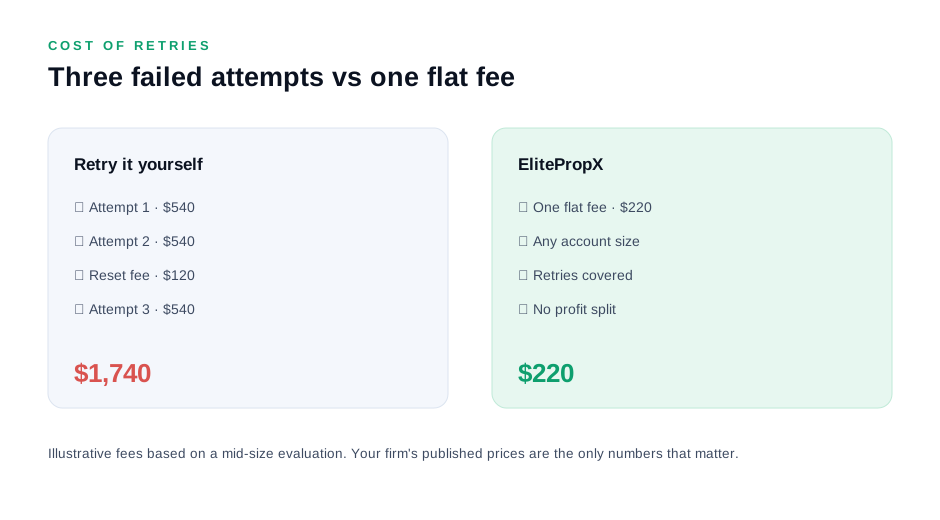
A flat-fee passing service at $220 for any firm and any account size does not refund the firm's evaluation fee — that fee is paid to the firm and is not recoverable by anyone if the attempt fails. What the service changes is the number of attempts: resets are covered while the evaluation is running, so a failed attempt costs the service nothing additional rather than costing a second fee. That is economically similar to a free reset, which is the industry's real refund mechanism.
Three conditions make the arrangement honest, and a provider that does not state all three is not worth using. The firm's terms on third-party trading must be disclosed in writing; where they prohibit it, the service should name the risk of a voided funded account before payment. The funded account must be in the client's name, with payouts to the client. And the firm's own reset charge, where a reset is needed, remains the client's cost — a flat-fee service covers its own work, not the firm's fees.
On the refund question specifically: a service that promises to refund the firm's evaluation fee is promising something it does not control. A service that promises to keep working until the evaluation passes, at no additional fee, is promising something it does control. The second is the arrangement worth having, and it is the one described on the passed challenges page and priced on the home page.
For readers comparing the do-it-yourself path, the arithmetic is in the profit calculator, and the rules matrix sets out which firms' structures suit which strategies before any fee is paid.
Three claims, worked through
Abstract policy is easier to apply with examples. These three cover the outcomes a trader is most likely to face.
Claim one: failed on the drawdown, no conduct breach, first attempt. The refund clause is "fees non-refundable, one free reset on failure". The trader is entitled to the reset, not the fee. The correct request is a reset within the stated window, in writing, quoting the account number and the failure date. If the firm offers a credit instead, its value is the next attempt's price minus the credit — check whether the credit applies to the same account size, because a credit restricted to a larger account is worth less than face value.
Claim two: failed after trading a news window. The loss was inside the drawdown limits, so the trader believes the failure was ordinary. It was not: the conduct rule ends the account independently of profit and loss. The refund clause excludes conduct breaches, and therefore the reset does too. The claim will fail, and the useful response is to read the conduct rules before the next purchase rather than to escalate. This is the single most common refund dispute in the industry, and it is lost before it starts.
Claim three: paid, never received an account. This is a delivery failure, not a rule outcome. The record is the purchase confirmation and the absence of any account credentials. This is the one category where a payment dispute is the right tool, and it is worth opening immediately rather than after a fortnight of support tickets, because card-network windows are short.
| Scenario | Refund due? | Right next step |
|---|---|---|
| Failed on drawdown, first attempt | No — reset applies | Request the reset in writing inside the window |
| Failed on a conduct breach | No | Read the conduct rules before buying again |
| Paid, no account issued | Yes, via delivery dispute | Open a payment dispute with the confirmation |
| Passed, payout refused without cause | Depends on the pass guarantee | Escalate in writing, then local consumer route |
| Purchased, never logged in, inside the window | Usually yes | Request cancellation immediately, before any login |
Notice how much of the outcome is decided by which category the failure falls into, and how little by how the trader feels about it. That is the practical lesson of the whole subject: the refund question is answered at purchase, by the clause you saved and the conduct rules you read, not at failure by the argument you make.
How to need a refund less often
The best refund policy is the one you never invoke. Four habits reduce the probability of a failed attempt more than any refund clause reduces its cost.
Read the conduct rules first, the numbers second. Most disputes are conduct disputes. News windows, size caps, weekend holding and third-party trading are the clauses that void a refund, and they are the clauses least likely to be on the marketing page.
Budget for two attempts in the decision. A trader who has budgeted for one buys the second in a hurry and a bad mood, which is when sizing discipline slips. A trader who has budgeted for two chooses the second attempt deliberately, possibly at a different firm with a structure that suits better.
Choose the structure that matches your equity curve. If your good months are strong and your bad months are shallow, a static floor and unlimited calendar is close to ideal. If you need a deadline to finish anything, buy the deadline. A refund does not fix a mismatch; it discounts the second failure.
Write the numbers down. Risk per trade, daily stop, daily profit cap, weekly pause, minimum day count. Every one of those is a rule that prevents the failure the refund was meant to soften, and a page of numbers costs nothing.
None of that is novel, and all of it is what the firms' own terms are implicitly assuming when they price a refund badge. A trader who plans to fail is buying insurance; a trader who plans to pass is buying a rulebook. The second is cheaper, and the difference is a page of arithmetic rather than a clause in a contract.
Frequently asked about challenge fee refunds
Which prop firms have a refundable challenge fee?
Almost none have an unconditional one. The three shapes worth checking for are a short cooling-off refund on an untraded account, a credit toward a second challenge after a failure, and a free reset — and the last two cost the firm nothing if you never buy again. Verify by searching your firm's client agreement for "non-refundable", "credit" and "reset" rather than trusting the marketing badge, and read the conduct exclusions first, since a breach voids the clause even when the failure was inside the loss limits.
Do prop firms refund the challenge fee if I fail?
Most do not. The fee buys an attempt, not a guaranteed outcome, and the standard clause is that fees are non-refundable. What many firms do offer is a single free reset, which is worth the price of the next attempt rather than a return of this one.
What is the difference between a refund and a reset?
A refund returns money. A reset reissues the account at no charge, so no money moves but the next attempt costs nothing. On a two-attempt path, a free reset is worth roughly half the total cost of reaching a funded account, which is usually more valuable than a partial cash refund.
Can I get a refund if I breach a conduct rule?
Usually not. Conduct breaches — trading a news window, exceeding a size cap, hedging across accounts, sharing a login — void refund clauses even when the account was well inside its drawdown limits. This is the most common refund dispute and the most commonly lost one.
Is a refund guarantee worth the higher fee?
Rarely. The refund is worth the premium multiplied by the probability of failure, so at a 30% failure rate a third-of-a-fee premium returns about a tenth of the fee in expectation. The same money spent on a more forgiving rulebook reduces the failure probability directly, which compounds.
Should I dispute the payment with my card provider?
Only for a delivery failure — no account issued, a materially different product, or an unreachable firm after a pass. For a rule outcome you disagree with, a payment dispute is usually decided in the firm's favour, can void the account and any pending payout, and can affect access to other services.
What if the firm changes its terms after I buy?
You are generally governed by the terms in force when you paid, which is why a dated copy matters. If the change materially affects the evaluation you purchased, escalate in writing and cite the version you agreed to. Some firms publish a pass guarantee that covers exactly this.
Do consumer protection laws override the terms?
Statutory rights sit above a contract in most jurisdictions, but what they cover varies enormously. The EU and UK have distance-selling cancellation rights with an exception for immediately supplied digital content, and the US relies on state law and card-network rules. This is general information, not legal advice — check your local rules or ask a local adviser.
How long do I have to claim a refund or reset?
Windows are short and are enforced to the day — commonly measured in days after purchase for a cancellation and days after failure for a reset. Put both dates in a calendar at purchase; an expired window is the most common reason a valid claim is lost.
What should I keep as evidence?
A dated copy of the terms, a screenshot of the pricing page and any refund badge, the purchase confirmation and account number, the daily statements, and all support correspondence in writing. Those five items turn a dispute into a process.
Do passing services refund the firm's evaluation fee?
No, and a service claiming to is promising something it does not control. The fee is paid to the firm and is not recoverable if the attempt fails. What a flat-fee service can offer is to keep working until the evaluation passes at no additional service fee, which is a promise it can keep.
Does ElitePropX refund its own fee?
The arrangement is a flat $220 per evaluation at any firm and any size, with resets covered while the evaluation is running and no profit split. Because retries are covered rather than charged, the practical outcome of a failed attempt is a reset at no additional service fee rather than a refund claim. It is offered only where the firm's terms permit third-party trading.
What is the most common refund mistake?
Buying on a marketing badge without saving the terms. By the time a claim arises, the pricing page has changed and the version you agreed to is not the version on the site. A dated PDF taken at purchase is the whole defence.
Where these rules come from
Firm figures on this page are read from the rulebooks below rather than from other comparison sites. Every link was opened and checked on . Firms revise targets and drawdown rules without notice, so confirm the figures on the plan you are buying before paying. How we check firm rules sets out what a checked date means, what we publish when a figure cannot be confirmed, and how corrections are handled.
Skip the repeated fee
Related reading
- What to do after a failed challenge
- Prop firm scams to avoid
- Daily drawdown explained
- Consistency rule guide
- Passing services compared
- Passing service reviews
- Profit and payout calculator
- Prop firm rules matrix
- Frequently asked questions
This page is general information, not legal or financial advice. Refund terms vary by firm, by product and by jurisdiction, and they change. Verify the current terms of any firm before paying and keep a dated copy. ElitePropX is an independent service and is not affiliated with, endorsed by or sponsored by any proprietary trading firm. Trading involves substantial risk of loss.