
Reviewed · how we check firm rules
Evaluation service · reviewed November 2026
We pass your Apex Trader Funding evaluation for a flat $220
Apex is the largest futures prop firm and the one whose rulebook is least like the forex evaluations most traders learn on. Dollars instead of percentages, a subscription instead of a one-off fee, and a loss floor that climbs as the account climbs. This page covers the service for Apex specifically: which of the two drawdown models to buy, how a pass is planned around a floor that follows peak equity, how the 50% payout rule shapes the trading even though it applies after the pass, and what the handover looks like. Flat $220, any Apex account size, retries covered while the evaluation is open, no share of the payout.
Key takeaways
- Apex sells two evaluation models — end-of-day drawdown and intraday trailing — and the model changes the plan more than the account size does.
- The intraday floor follows peak unrealised equity, so a winning position that retraces leaves less room than it started with. That is the failure mode to plan against.
- Risk per trade is tapered towards the target rather than increased, because every new equity high drags the floor upward behind it.
- Apex's payout consistency rule is 50% on current accounts: the best day may not exceed half of total profit. The pass is paced to leave a distribution that would clear it.
- The end-of-day model also carries a 30-day access window, which sets the outer edge of an honest schedule.
- Flat $220 at any size, terms confirmed in writing before payment, retries at no extra fee, and the funded account handed back in your name.
Contents
- Apex Trader Funding: end-of-day or intraday, decided first
- Planning an Apex pass around a floor that follows the peak
- The Apex evaluation terms check, before anything is bought
- The numbers the plan is written from
- The Apex 50% payout rule, and why it shapes the pass
- The Apex challenge calendar and the access window
- What the flat fee covers at Apex
- Sizing an Apex account to the payout you want
- The Apex funded account, after the handover
- A worked Apex pass, week by week
- Five ways an Apex attempt ends
- What this service will not do
- Frequently asked questions
Apex Trader Funding: end-of-day or intraday, decided first
Most firms sell one evaluation shape. Apex sells two, and the gap between them is bigger than the gap between Apex and its competitors. Choosing the model is therefore the first decision on any Apex purchase, and it is worth making before the account size is discussed at all.
Apex Trader Funding is a futures prop firm rather than a broker: what is bought is an evaluation account whose dollar target has to be met before any payout is discussed, and the Apex funded account that follows is governed by a separate set of terms.
| Question | End-of-day model | Intraday trailing model |
|---|---|---|
| When the floor moves | Once, on the closing balance | Continuously, against open profit |
| What hurts most | A bad session inside the daily limit | Giving back an open gain |
| Separate daily stop | Yes, a fixed dollar figure | Not on the standard terms |
| Time pressure | A 30-day access window | Open-ended within the plan |
| Suitability | Positions closed before the session ends | Traders who can take profit at a level and stop |
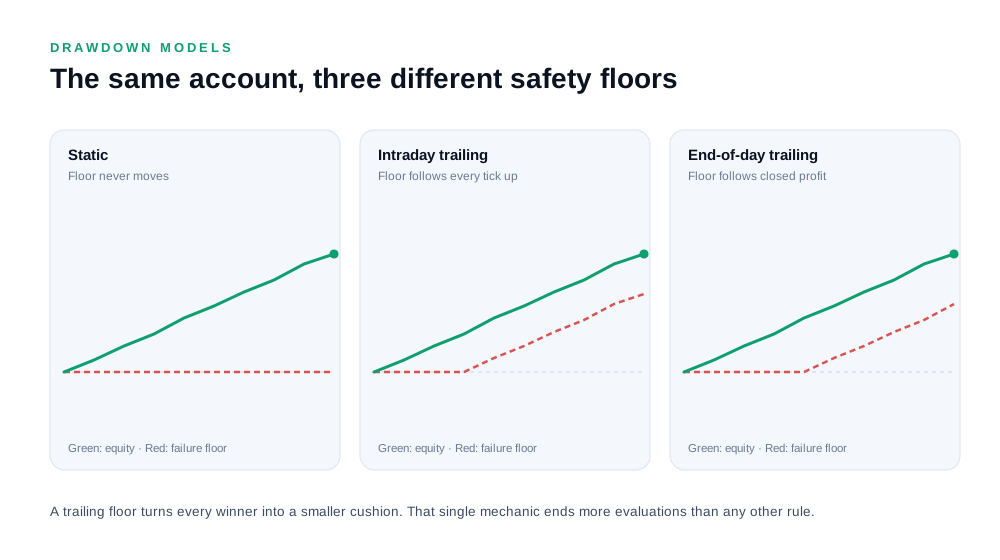
The mechanical difference is where the floor is measured from. On the end-of-day model the floor is recalculated after the close and then held, so nothing that happens inside a session — including a position that runs a long way in the money — moves the failure level until that session is finished. On the intraday model the floor tracks equity in real time, open profit included, which means a position that gains and then gives the gain back has already lifted the failure point and left the account closer to it than it was at the open.
For a service pass this produces a clear preference. The end-of-day model is easier to defend because the plan's worst case is bounded by a fixed daily figure, and because a winning session cannot tighten the floor mid-trade. The intraday model is passable and sometimes cheaper, but it rewards a specific discipline — taking profit at a predetermined level and never letting a winner become a scratch — and it punishes hesitation in a way that no amount of position sizing fixes. Where a client has no strong view, the end-of-day account is the recommendation, and the reasoning is stated rather than assumed.
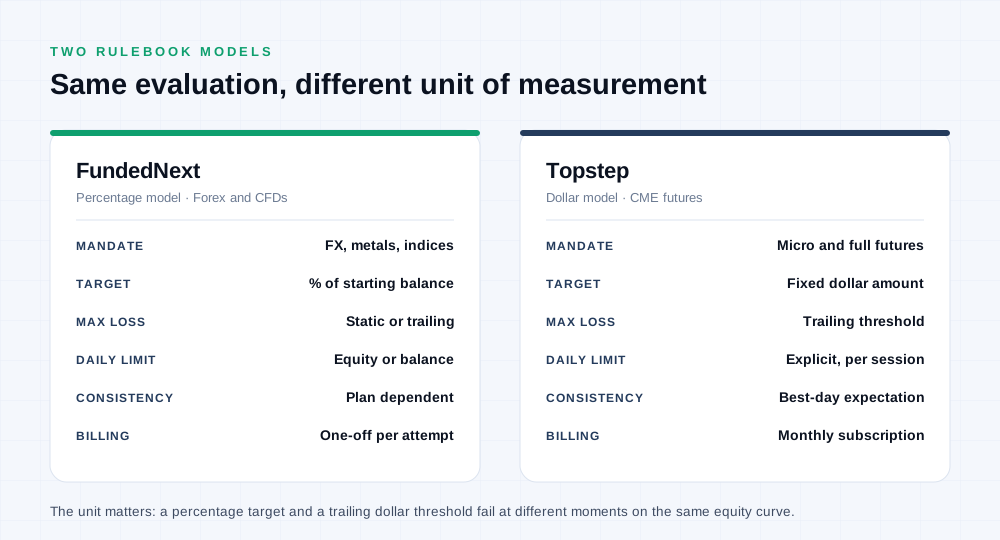
Size is a second-order question after that. Apex runs accounts further up the ladder than almost anyone, to $300,000, and because its targets and thresholds are dollar figures that scale together, a larger account buys a larger payout ceiling rather than an easier evaluation. The account size breakdown works through the ladder, and the 2026 rule set is where the current thresholds belong.
Planning an Apex pass around a floor that follows the peak
On a static evaluation the arithmetic of survival is a subtraction from a constant, and it does not change between the first session and the last. On an Apex trailing account the reference point moves, and every part of the plan has to treat the peak — not the starting balance — as the thing being defended.
The consequence that catches traders is counter-intuitive: progress makes the account more fragile, not less. A $100,000 account whose floor sits $4,000 below the balance has four thousand dollars of room. Earn $3,000 and close the session, and on the intraday model the floor has risen with the equity, so the room is still about $4,000 — but measured from a much higher peak, and a retracement that would once have been survivable is now close to the failure line. Traders who increase size after a good week are doing the opposite of what the structure requires.
The plan therefore tapers. Risk per trade starts at a fraction of the daily budget and steps down as the target approaches, with the final third of the target traded at roughly half the opening size. Two effects follow, and both matter. The chance of giving back the gained room falls, and the distribution of daily profits flattens — which is the second requirement, covered below, because Apex applies a consistency test at payout.
There is one further piece of arithmetic worth doing before the first trade, and it is the one Apex traders skip. Compute the cushion in dollars, divide it by the planned risk per trade, and read the answer as the number of consecutive losses the account can absorb. On a 100k end-of-day account with a $3,000 floor, a $600 risk per trade allows five losses; at $1,000 it allows three. If that number is under six, the plan is too large for the account and the account size or the risk has to change — before the evaluation is bought, not after it is lost. The trailing drawdown arithmetic sets out the same calculation with the intraday case worked through.
The Apex evaluation terms check, before anything is bought
Apex's terms are the ones that decide whether a paid pass is worth having, and they are read before the fee is taken. Three questions are answered in writing, and the answer is given whether or not it is the one the client wants.
Is the evaluation permitted to be traded by someone else? This is the question that ends most conversations, and it is answered from the firm's own document rather than from what a competitor's terms say or what a forum reports. Where the clause is silent, the working assumption is that it is not permitted, because a silent clause is one the firm can interpret at the payout.
Does the permission extend to the funded account? A few firms allow outside trading during the evaluation and prohibit it afterwards, which produces the worst possible outcome: a paid pass that becomes a voided account on the first withdrawal request. The two stages are checked separately for exactly this reason.
What does ownership require? The account has to be bought in the client's name with the client's payment method, and identity verification is completed by the client. Apex's promotional pricing makes buying several accounts tempting, and the temptation is worth resisting for a reason unrelated to cost: multiple correlated accounts traded in the same direction are one position with several invoices, and firms that treat them as a single exposure can call that a breach.
Two conduct details are read at the same time, because they decide which sessions exist rather than how large a position may be. Whether news releases are restricted on the evaluation, and what the position and contract limits are at the size being bought. A plan that ignores a news window does not fail because it was wrong about the market; it fails on a rule, and a rule breach voids the account regardless of profit.
The numbers the plan is written from
The trading itself is unremarkable, which is the point. Five numbers are fixed before the first session and checked weekly, and every one of them is derived from the firm's document rather than from a market view.
- Risk per trade as a fraction of the daily budget — never a round number chosen for comfort. On the intraday model it is sized so that two consecutive losses still leave the floor intact, which is a tighter constraint than the equivalent forex evaluation imposes.
- A session stop at the point where the day's loss has consumed the planned budget. On the end-of-day model this is the firm's own figure; on the intraday model it is self-imposed, because there is no separate daily rule to enforce it.
- A per-session profit ceiling expressed as a share of the remaining target, which is what keeps the finish line from arriving in one session and keeps the payout test satisfiable.
- A taper schedule for risk as the target approaches, written in advance so that it is not a judgement made while a position is open.
- A weekly circuit breaker — two losing sessions end the week. The cost is a few days of calendar; the alternative is the sequence that closes trailing accounts, which is a loss, a size increase to recover it, and a second loss into a floor that has already moved.
Why the taper is not optional on Apex. On a static account, pressing a winner costs nothing structural. On a trailing account it removes the cushion that the rest of the plan depends on. The taper is the single change that separates a plan written for Apex from a plan copied from a forex guide.
The Apex 50% payout rule, and why it shapes the pass
Apex applies a consistency test at the payout stage rather than during the evaluation, and it is stricter than the version most traders have met. On current accounts the best day may not exceed 50% of total profit; legacy accounts still run the older 30% test. The rule is not a pass condition, which is why it is easy to ignore until the withdrawal is reviewed.
The arithmetic is unforgiving in a specific way. If the best day is $6,000, the account needs $12,000 of total profit before the withdrawal qualifies — so a single excellent session does not shorten the road, it lengthens it. A trader who clears a $6,000 target on a $100,000 account with one $5,000 day has passed the evaluation and created a payout problem in the same afternoon, and the remedy is more trading on a funded account with its own limits.
The service handles this by construction rather than by correction: the per-session ceiling keeps any single day small relative to the total, so the ratio is satisfied before it is calculated. A pass that reaches the target over eight to twelve sessions has a distribution that would survive either the 50% or the 30% version. That is a deliberate design choice, not a side effect, because the client inherits the record and the record is what the payout is judged on. The consistency rule guide covers the arithmetic across firms, and the denied payout cases show what the test looks like when it fails.
The Apex challenge calendar and the access window
An Apex pass is a matter of weeks, and the drivers are worth naming precisely rather than quoting a single number that flatters the service.
The firm's minimum-day requirement sets the floor. A dollar target can be reached quickly; an evaluation that requires a number of qualifying sessions cannot. The pace is planned backwards from that requirement so that the target and the day count land on the same date instead of one waiting on the other.
The end-of-day model adds a hard outer edge. The 30-day access window means the plan has to be efficient as well as careful — unlike an open-ended forex evaluation, there is a date after which the account is gone regardless of progress. A plan that spends three weeks waiting for a perfect setup is not conservative on this model; it is a plan that runs out of calendar.
A losing week is budgeted, not unexpected. Two losing sessions trigger the pause, and the pause costs four or five sessions of a thirty-session window. That is the trade being made deliberately: a shorter calendar in exchange for an account that survives to use the rest of it.
Reporting runs weekly at minimum, with the same day notification if an attempt is lost. What the client receives at the end is the firm's own confirmation of the pass, not a summary written by the service — a distinction worth insisting on, because a screenshot of someone else's dashboard is not evidence of anything.
What the flat fee covers at Apex
The fee is $220 for any Apex account size and either drawdown model. What that buys and what it does not is set out in full, because the boundary is where disputes start.
| Item | Included | Detail |
|---|---|---|
| Model recommendation | Yes | End-of-day or intraday, argued from the client's strategy rather than the fee |
| The evaluation attempt | Yes | Traded to the dollar target inside Apex's rules |
| Retries while the evaluation is open | Yes | No further service charge |
| Consistency-safe pacing | Yes | Per-session ceiling set so the 50% payout test is satisfied by design |
| Apex's subscription and reset charges | No | Paid by the client to the firm; Apex bills monthly |
| The funded account | No | Handed over; traded by its owner under Apex's terms |
| Identity verification | No | Completed by the account holder personally |
| Share of payouts | None | The firm's split is entirely the client's |
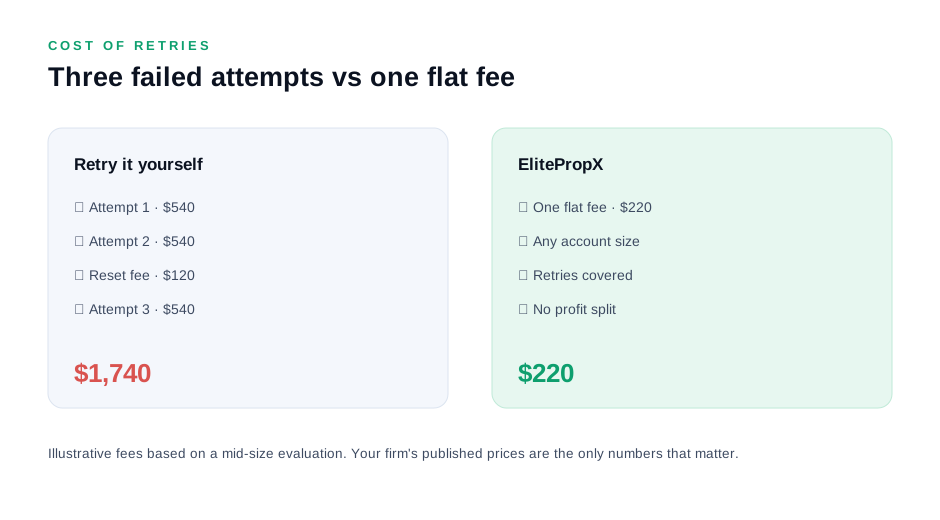
The honest comparison is with doing it yourself, and Apex makes that comparison unusual because its subscription model means the cost of a slow pass keeps accruing. A single month of a 100k account is cheap; three months of a 100k account plus a reset is not, and the difference between those two outcomes is mostly whether the first attempt was planned or improvised.
That is the case for the fee and the case against it in one sentence: if the first attempt succeeds, $220 has bought a service that self-trading did not need. From the second attempt the arithmetic changes, because retries inside the evaluation are covered by the fee while self-trading pays the subscription again. The futures service page covers the contract-level mechanics that apply across Apex, Topstep and the rest, and the payout calculator models what a funded Apex account produces once the 50% test is met.
Sizing an Apex account to the payout you want
Apex runs the widest account ladder in futures, from small evaluation accounts up to a $300,000 ceiling that almost no competitor matches. That range invites a mistake: buying the largest account the budget allows, on the assumption that a bigger balance is a better balance. Under dollar-based rules the opposite is closer to true, and the arithmetic is worth doing before checkout rather than after a failed attempt.
| Account | Target | End-of-day floor | Daily loss limit (EOD) |
|---|---|---|---|
| $50,000 | $3,000 | $2,000 | $1,000 |
| $100,000 | $6,000 | $3,000 | $1,500 |
| $150,000 | $9,000 | $4,000 | $2,000 |
| Up to $300,000 | Scales with size | Scales with size | Scales with size |
Read as a ratio, every tier asks for six to seven and a half per cent of the balance as profit while permitting a floor of four to six per cent. That is a narrower margin than a percentage-based forex evaluation, and it is the reason the taper matters more here than anywhere else: the target is small enough to reach quickly and the floor is close enough to be hit while trying.
Two costs do not scale, and they both penalise the smallest account. Commissions, exchange fees and the spread are charged in dollars per contract, so they consume a larger fraction of a $3,000 target than of a $9,000 one. And the subscription is billed per account per month, so a slow pass on a small account costs proportionally more. A trader choosing between a $50,000 account and a $150,000 account is choosing between a cheaper invoice and a wider margin, not between two versions of the same difficulty.
The method that settles it is a payout calculation rather than a budget calculation. Decide what a payout cycle should produce, divide by the split the firm applies, and read the result as the profit the account has to generate. If the smallest tier that produces that figure can be traded inside the daily limit at a pace the calendar allows, that tier is the purchase. A larger account buys a larger ceiling for the same percentage performance; it does not buy a higher chance of finishing, and it does buy a larger subscription while the attempt is open.
The Apex funded account, after the handover
The pass ends the evaluation and starts a different job. Apex's funded stage carries its own thresholds, its own consistency test at withdrawal and a payout schedule that is not the evaluation's schedule, and none of it is improved by how quickly the pass was completed.
Four steps belong to the first week after handover, in this order. Change the password, whichever way access was provided. Confirm the account is registered in your name with your payment method and verification complete. Read the funded terms rather than a summary of them — the 50% test, the payout cadence and the minimum trading days are the three that decide whether a first withdrawal clears. And write the funded plan before the first trade: risk per trade, session stop, per-session ceiling, and the day the first withdrawal will be requested.
The consistency test is the one that surprises people, because it is calculated on total profit rather than on a single session. A funded account that earns $9,000 with a $5,000 best day fails the current 50% test and has to keep trading to qualify — on an account with its own trailing floor. Planning the first payout around a modest target rather than a maximum one is the simplest way to avoid that trap. The payout process guide covers the sequence and the delays, and the first payout timeline sets out the calendar.
A worked Apex pass, week by week
An illustration of what a compliant Apex pass actually looks like on an end-of-day account, traded at a risk per trade of roughly one sixth of the daily limit, with the session stopped once the day's budget is spent and size reduced through the final third of the target. No week in it is dramatic, which is the point.
Week one. Four sessions on a $100,000 account with a $3,000 floor. Two ordinary gains, one flat session and one small loss leave the account around $1,800 up with the floor still at its starting distance. Two of the four days produced enough to count as qualifying sessions, and no session came near the daily figure.
Week two. The remaining target is reached in three sessions and the balance closes $3,400 higher. On the end-of-day model the floor rises by that amount at the close, so the room available is unchanged in dollars but the failure level is now much closer to the balance. This is the moment most traders add size; the plan does the reverse and halves it.
Week three. Two sessions at half size produce the last of the target and the account is submitted. The week is short because the target was small relative to what the first fortnight produced, and the discipline that made it short was refusing to press a winning account in week two.
| Week | Sessions | What happened | Risk per trade |
|---|---|---|---|
| One | 4 | Two gains, one flat, one small loss; floor unchanged at close | Full plan size |
| Two | 3 | Target reached; floor rises with the closing balance | Full, then halved |
| Three | 2 | Final third completed at reduced size; submitted | Half |
The record that falls out of it is deliberately even. Nine sessions, no day contributing more than a third of the total, and a largest day well inside the 50% payout test. A trader who reached the same target with one $5,000 session would have passed the evaluation and created a withdrawal problem, because the funded account would then need $10,000 of profit before the best day fell below half of it.
Five ways an Apex attempt ends
The failure modes on a dollar-target evaluation with a trailing floor are narrow and repetitive. Five account for almost every attempt that does not finish, and none of them is a market view that turned out wrong.
Giving back a winner. On the intraday model the floor follows open profit, so a position that runs to a good gain and is allowed to retrace has already lifted the failure level. The account can be up on the day and one trade from closing. The remedy is a profit level decided before entry, not after.
Adding size after a good week. The instinct that says the plan is working, so it can be pushed, is the one that converts a rising floor into a failed account. Progress on a trailing structure demands less risk, not more, and the taper exists to make that automatic rather than a judgement call.
Treating the daily limit as the only limit. On the end-of-day model the daily figure caps the session while the floor caps the account, and after a profitable run the floor is the tighter of the two. A plan that computes only the daily budget will over-trade the second half of the evaluation, which is exactly when the cushion is thinnest.
Trading the news window. Restrictions on scheduled releases are a rule rather than a risk preference. A breach voids the evaluation regardless of profit, and it is the only failure on this list that no amount of position sizing prevents.
Running out of access. The end-of-day evaluation carries a 30-day access window. An attempt that spends three weeks waiting for a perfect setup is not being careful on that clock; it is spending the calendar it was given, and the account disappears whether or not a rule was broken.
What this service will not do
Four refusals apply at Apex exactly as they apply everywhere, and each is stated because the alternative hides a risk inside the fee.
No pass on an account whose terms forbid it. If the clause is not there in writing, the job does not start. A voided funded account is a worse outcome than a declined booking, and it is the client who carries it.
No holding of the funded account. Access is returned or removed at handover. Continuing to trade an account after the job is done is a managed account with a different name.
No promise about income. What is sold is a completed evaluation. The funded account pays what the firm's terms and the owner's trading produce, and a service that predicts that number is guessing.
No percentage of the payout. A provider paid from earnings has a reason to keep trading after the handover, which is precisely when the account should be left alone.
Two practical habits follow from the same logic. Evaluations are bought in the client's name, never on the client's behalf, because ownership is what keeps a funded account valid at withdrawal. And identity documents are never requested: verification belongs to the account holder and cannot be delegated to a service, whatever a provider claims.
Frequently asked about the Apex service
Which Apex model should I buy for a service pass?
End-of-day, in most cases. The floor only moves on the closing balance and the account carries a fixed daily stop, which bounds the worst session and keeps a winning trade from tightening the floor mid-position. The intraday model is passable but demands taking profit at a level and never letting a winner turn into a scratch, which is a discipline fewer traders hold under pressure.
Does the $220 change with account size or model?
No. The fee is the same at $25,000 and at $300,000, and the same on either drawdown model. The work is the same process applied to different dollar figures, so a larger account does not cost more.
How long does an Apex pass take?
Weeks rather than days, driven by Apex's minimum qualifying sessions and, on the end-of-day model, by the 30-day access window. A plan paced to reach the target over eight to twelve sessions usually lands inside the window with room for one paused week.
What happens if the evaluation fails?
The client is told the day it happens, with the cause classified as a drawdown event or a rule breach, and the attempt is restarted at no additional service fee while the engagement is open. Apex's own subscription and reset charges remain the client's cost.
Will the pass satisfy Apex's 50% consistency rule?
That is the design. The per-session ceiling keeps any single day small relative to total profit, so a pass spread over eight to twelve sessions produces a distribution that clears 50% — and the older 30% test — without adjustment afterwards.
Can you run several Apex accounts at once?
It is possible and usually a bad idea. Correlated accounts in the same direction are one position with several subscriptions, and the drawdown models make that exposure worse rather than better. Sequential accounts, funded and paid out before the next is bought, produce a record that is worth more than the head start.
Do you buy the evaluation for me?
No. You buy it in your own name with your own payment method and complete verification yourself. That is what makes the funded account yours, and it is the first thing a firm checks when a withdrawal is reviewed.
How much does the Apex Trader Funding challenge cost?
Apex prices an evaluation by account size and bills it as a monthly subscription, so the firm's own checkout carries the current figure and its promotions move it. The $220 here is separate from that charge and does not change with size, which is why the account cost and this fee are quoted as two lines rather than one total.
Is the Apex challenge the same as an Apex prop firm evaluation?
Yes. Apex challenge, Apex evaluation and Apex prop firm account are three names for the same product: a dollar-target evaluation bought at a chosen account size, traded inside a trailing or end-of-day drawdown, and completed before an Apex funded account is issued.
How does the pass affect an Apex payout?
The pass decides when a funded account exists, not what it pays. The payout is judged on the funded record, and the 50% best-day test is calculated on total profit for the cycle — which is why the pass is paced to leave an even distribution rather than a dominant day.
What do you need to start?
The model, the account size and your strategy's holding pattern for the terms check. If the terms clear, you buy the evaluation, we agree access in writing, and the first session is planned before it is traded.
Check your Apex terms first
Send the model and the account size and we confirm in writing whether third-party trading is permitted on the evaluation and on the funded account — before you pay anything.
Related reading
- Apex challenge passing: both drawdown models
- The complete Apex Trader Funding guide
- Apex trailing drawdown, worked out
- Why Apex payouts get denied
- Topstep Combine
- Futures evaluations: contracts and thresholds
- Prop firm rules matrix
- Profit and payout calculator
- Recently passed evaluations
Apex Trader Funding is named for identification only. ElitePropX is an independent evaluation service and is not affiliated with, endorsed by or sponsored by Apex Trader Funding or any other proprietary trading firm. The service is offered only where a firm's terms permit third-party trading. A funded account is not a guarantee of income, and trading involves substantial risk of loss. Verify current terms before purchasing an evaluation.