
Reviewed · how we check firm rules
Evaluation service · reviewed November 2026
We pass your Topstep Combine for a flat $220
Topstep's Combine is the futures evaluation most traders meet first, and it is unusual in one respect that decides how it has to be traded: the daily loss limit is a checkout option rather than a fixed rule, so what the account can absorb depends on what was bought with it. This page covers the service for Topstep specifically — the three limits that interact, which checkout options are worth taking, how the 55% best-day expectation shapes the pacing, and what happens between a passed Combine and a first withdrawal. Flat $220, any Combine size, retries covered while the evaluation runs, no share of the payout.
Key takeaways
- Three constraints run at once: a trailing maximum loss floor, an optional daily loss limit, and a best-day expectation during the Combine itself.
- The daily stop is bought at checkout, not applied automatically. Without it, the trailing floor is the only failure condition and a single session can end the account.
- The best-day limit is 55% of the profit target in the Combine and 40% at payout. Exceeding 55% does not fail the account — it raises the target to best day ÷ 0.55.
- The trailing floor follows the closing balance, so an open winner does not move it, and the floor locks once it reaches the starting balance.
- A disciplined pass typically runs ten to eighteen trading days.
- Flat $220 at any size, terms checked in writing first, retries at no extra fee, and the funded account handed back in your name.
Contents
- What the Topstep Combine actually asks
- The Topstep daily loss limit: the checkout decision
- The Topstep 55% best-day rule and the rising target
- The plan a Topstep Combine pass runs on
- The terms check, before payment
- How long a Topstep Combine takes
- What the flat fee covers at Topstep
- Account tiers and the daily limit you can buy
- From a passed Topstep Combine to first payout
- A worked Topstep pass, session by session
- What a failed Combine actually costs
- Five ways a Combine ends
- What this service will not do
- Frequently asked questions
What the Topstep Combine actually asks
A Combine is a futures evaluation priced and measured in dollars. The account size sets the target and both loss figures, but the shape of the rules is the same at every tier, and the shape is what has to be planned for.
Topstep is a futures prop firm, so the Combine is an evaluation rather than a live brokerage account: the target has to be reached and the rules held before a Topstep funded account exists at all.
| Rule | How it is set | What it means for a pass |
|---|---|---|
| Profit target | A dollar figure fixed by account size | Divide by the sessions planned to get the pace, then compare that with the daily budget |
| Maximum loss | Trails the closing balance and locks at the starting balance | Every profitable close removes room permanently; size has to come down as the target approaches |
| Daily loss limit | Optional at checkout, in dollars by size | If bought, it caps the session and hitting it is not a breach; if not, nothing caps the day |
| Best day | 55% of the target during the Combine, 40% at payout | The largest session must stay small, or the target grows |
| Qualifying days | Set by Topstep's current terms | The calendar is paced backwards from the count, not forwards from today |
The interaction is the part traders misread. A trailing floor and a daily stop are not two versions of the same protection; they fail on different days. Early in an account, with the floor well below the balance, the daily stop is usually the tighter of the two. After a strong run of profitable closes, the floor has climbed towards the balance and becomes the tighter constraint — at which point the daily stop offers less protection than it appears to, because the account can fail before the day's budget is spent.
That is why a pass is planned with both numbers computed each morning and the smaller of the two treated as the day's real limit. A plan that uses only the daily figure is over-trading the second half of the evaluation, which is precisely when most failed attempts are lost. Topstep's own rules and the pacing arithmetic are set out in the Combine rules guide.
The Topstep daily loss limit: the checkout decision
Because the daily loss limit is purchased rather than applied, the checkout page is a risk decision with a price attached, and it is worth treating as one instead of clicking through.
With the daily limit. The worst session is capped, and a session that reaches the cap is not a rule breach — the day simply ends. That converts a single bad afternoon from an account-ending event into a bounded loss, which is the single most useful property a futures rulebook can have for anyone trading to a target on a schedule.
Without it. The trailing floor is the only failure condition, so the account survives a losing session that the floor is not near, and dies on a session that reaches it. The saving is real at checkout and small relative to the evaluation's total cost; the exposure added is not small, because an unplanned session on a futures account can consume a large share of the floor in minutes.
For a service pass the recommendation is to take the daily limit where the size being bought offers it. It is not a claim that the pass cannot be run without one — it is that the plan's worst case is defined rather than open-ended, and a defined worst case is what makes a schedule honest. Where a client has already bought an account without it, the plan self-imposes the same figure, and the difference is that the limit is then a discipline rather than a rule.
Buy the rule, not the discount. Topstep discount codes change the price of a Combine, never the shape of its rules. A cheaper entry with no daily stop is a different risk from a full-price entry with one, and the two should not be compared on price alone.
The Topstep 55% best-day rule and the rising target
Most firms apply consistency at the payout. Topstep applies an expectation during the Combine as well, and the mechanism is unusual enough to state in full: the largest day is compared with the profit target, and if it exceeds 55% of that target, the target is raised to the best day divided by 0.55.
Worked in dollars, a $3,000 target on a $50,000 account sets the line at $1,650. A $2,000 session — a good day by any ordinary measure — pushes the target to $3,636, so the trader who had $1,000 left to earn now has $1,636, and the extra profit has to come from later sessions under a floor that has risen with the gain. The rule does not punish the day directly; it makes the finish line move away.
At payout the test tightens to 40% of total profit, which is the version most traders expect and the one that catches accounts passed quickly. A Combine cleared in six sessions with one dominant day can satisfy the evaluation and still fail the withdrawal test, which leaves the account trading on a funded basis for longer than planned.
Both tests are satisfied the same way, and it is a pacing decision rather than a trading one: cap each session at a fraction of the target, so no single day can approach the line, and spread the work across enough sessions that the total is built evenly. A pass assembled from eight modest days clears 55% and 40% without arithmetic at the end. The consistency guide compares Topstep's version with the payout-stage rules at other firms.
The plan a Topstep Combine pass runs on
The evaluation is traded to the rulebook, so the plan is written from Topstep's document rather than from a market view. Four numbers govern it, and all four are fixed before the first session.
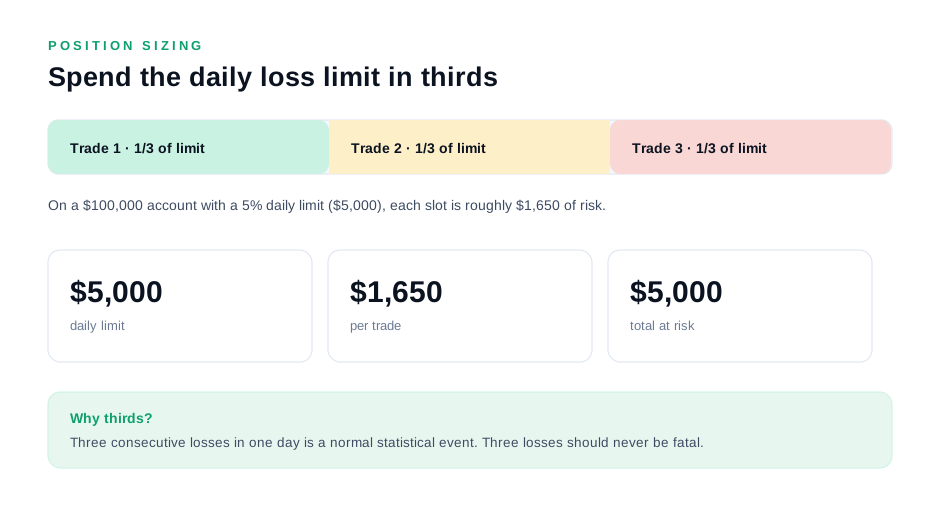
- Risk per trade sized from the smaller of the daily budget and the remaining floor distance, not from the target. On a 100k Combine with a $3,000 floor, $600 of risk means five consecutive losses are survivable; $1,000 means three, and three is not a plan.
- A session stop at the daily figure where one was bought, and at the same figure self-imposed where it was not.
- A per-session profit cap at roughly a fifth of the target, which keeps the best day far below 55% by construction and keeps the finish line from moving.
- A risk taper across the last third of the target, because each profitable close lifts the floor permanently and the room left is smaller than the chart suggests.
Two behavioural rules sit alongside the numbers. No size increase after a winning day, since that is the exact moment the floor has risen and the cushion has thinned. And a pause after two losing sessions, because on a trailing account the cost of a pause is calendar while the cost of pressing is the account.
Failure handling is part of the plan rather than an afterthought. If an attempt is lost, the client hears on the day, the cause is classified as a floor event or a rule breach, and the retry starts under the same discipline at no additional service fee. A provider unable to say which rule ended an account has not read the rulebook closely enough to trade it.
The terms check, before payment
Topstep's terms decide whether a paid pass is worth anything, and they are read before the fee is taken. The answer is given in writing, including when it is no.
Is third-party trading permitted on the Combine? Answered from Topstep's own documentation. Where the clause is silent, the assumption is that it is not permitted, because a silent clause can be interpreted at the payout.
Does it extend to the funded account? Checked separately. A firm can permit outside trading during an evaluation and prohibit it afterwards, which turns a paid pass into a voided account at the first withdrawal.
Who must own the account? The client, with the client's payment method, and with verification completed by the client. Topstep's monthly billing makes it easy to accumulate accounts; ownership is still what keeps a funded account valid.
Two conduct questions are answered at the same time because they decide which sessions exist: whether trading is restricted around scheduled economic releases, and what the position or contract limits are at the size being bought. On a futures account those limits bind quickly, and a breach voids the evaluation regardless of how much profit was on the screen.
How long a Topstep Combine takes: ten to eighteen days
That range is the honest one for a paced Combine, and it comes from three constraints rather than from a marketing number.
The qualifying-day count. A dollar target can be reached in a handful of sessions; an evaluation that requires a set number of qualifying days cannot be finished before them. Pacing backwards from the count is what makes the target and the calendar land together.
The per-session cap. Keeping each day at a fifth of the target deliberately slows the pass. The trade is calendar for consistency, and it is worth making because the same distribution is what clears 40% at payout.
The taper. The last third of the target is traded at reduced size, which adds sessions at the point where the floor is closest. Attempts that fail at 80% of target usually fail there because the size was held constant while the cushion shrank.
Reporting is weekly at minimum and immediate on a failed attempt. At the end, the client receives Topstep's own confirmation of the pass rather than a summary from the service.
What the flat fee covers at Topstep
The fee is $220 for any Combine size and any billing option. The boundary is stated in full, because it is where disputes begin.
| Item | Included | Detail |
|---|---|---|
| Checkout guidance | Yes | Whether to take the daily loss limit at the size being bought, and why |
| The Combine attempt | Yes | Traded to the dollar target within Topstep's published rules |
| Retries while the evaluation is open | Yes | No further service charge |
| Best-day-safe pacing | Yes | Session cap set so 55% during the Combine and 40% at payout are satisfied by design |
| Topstep's own subscription and reset fees | No | Paid by the client to the firm; billed monthly |
| Platform and data charges | No | Whatever the chosen platform and feed cost the account holder |
| The funded account | No | Handed over; traded by its owner under Topstep's terms |
| Share of payouts | None | The firm's split belongs entirely to the client |
Against self-trading, the arithmetic is straightforward. A Combine costs a monthly subscription, so an attempt that takes six weeks costs more than one that takes two, and a reset adds a second subscription without adding a second chance at the same account. The flat fee does not change with how long the pass takes, which is the only structural advantage it has over doing it yourself.
It is also worth saying plainly where the fee loses. A trader who passes a Combine first time at disciplined size has paid $220 for work they could have done, and no honest provider should pretend otherwise. The fee earns its place when the alternative is a second and third subscription, or when the calendar cost of a failed attempt is worth more than the fee. The futures service page covers the contract mechanics common to Topstep and Apex, and the payout calculator models a funded account once its conditions are met.
Account tiers and the daily limit you can buy
Topstep's tiers are separated by dollar figures that scale together, so the difficulty of reaching the target is broadly constant while the size of the payout ceiling changes. What does not scale is the cost of trading: commission per contract is the same at every tier, which makes a small account marginally harder to finish at identical discipline and makes the smallest tier a poor choice for anyone treating it as the easy option.
| Combine | Profit target | Trailing floor | Daily limit available at checkout |
|---|---|---|---|
| $50,000 | $3,000 | $2,000 | $1,000 |
| $100,000 | $6,000 | $3,000 | $2,000 |
| $150,000 | $9,000 | $4,500 | $3,000 |
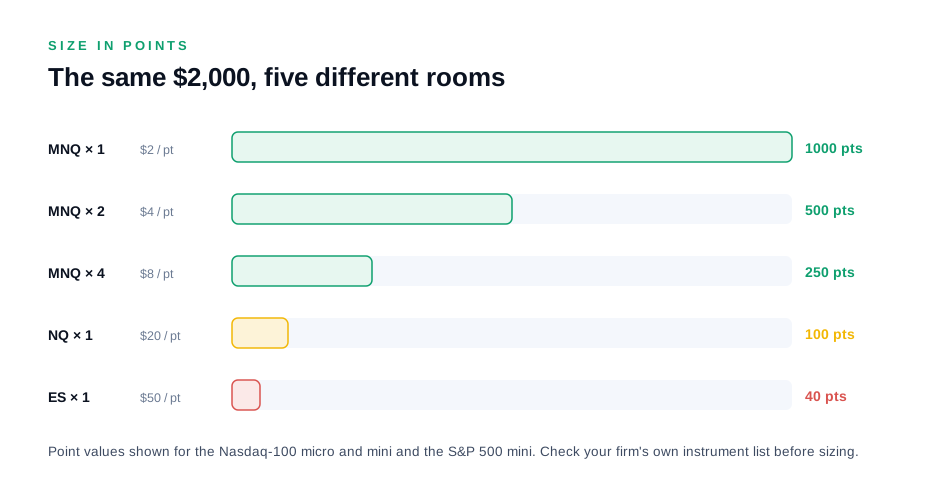
The floor is the figure that decides how many contracts the account can carry. A $3,000 floor on a $100,000 Combine, with risk held at a fifth of it per trade, supports roughly $600 of risk — which on a micro contract with a modest stop is a small handful of contracts, not the twenty the target tempts a trader towards. Working in contracts rather than percentages is the discipline this rulebook demands, because every figure in it is denominated in dollars.
Cost has a second dimension on Topstep that forex evaluations do not: the subscription runs for as long as the Combine is open. A pass finished in three weeks pays one month; an attempt that stalls for nine weeks pays three, and a reset restarts the clock without restarting the account. That is the arithmetic the flat fee is competing with, and it is why a slow, careful pass is not automatically the cheaper choice on this firm.
The payout ceiling is where a larger tier earns its price. A funded account pays a share of what it earns, so a bigger balance produces a bigger cheque for the same percentage performance. That is real, and it is the only advantage a larger Combine buys — the percentage asked for and the percentage at risk both stay roughly constant up the ladder.
From a passed Topstep Combine to first payout
A passed Combine produces a funded account with its own rules, and the 40% payout test is the one that decides when money actually leaves.
Four steps belong to the first week after handover. Change the password. Confirm the account is in your name with your payment method and verification complete. Read the funded terms directly rather than a summary — payout cadence, qualifying days and the best-day test are the three that gate the first request. And write the funded plan before the first trade, with the session cap kept at a level that keeps the largest day under 40% of total profit for the cycle.
The practical consequence is that the first withdrawal should be planned around a modest accumulated profit rather than a maximum one. A funded cycle that produces $4,000 with a $2,500 best day fails the 40% test and needs more trading on an account with a live floor; the same account earning $4,000 across six even sessions withdraws without arithmetic. The denied payout cases show how that test is applied in practice, and the payout process guide covers the withdrawal sequence.
A worked Topstep pass, session by session
What a compliant Combine actually looks like when it is traded to the rules rather than to the target, on a $100,000 account with the daily limit bought at $2,000, risk per trade held near $500 and a per-session ceiling of $1,200. The report is dull on purpose: a pass that reads like a good week is usually a pass that fails the payout test later.
Sessions one to four. Two gains of about $900 each, one small loss of $400 and one scratch. Progress is $1,400 against a $6,000 target, and the floor has moved up by the profitable closes, so the cushion is thinner than the balance suggests. No session came within $800 of the daily figure.
Sessions five to nine. Five sessions produce $2,600, with the best day at $1,100 — inside the 55% line comfortably, because $1,100 is a long way under $3,300. The qualifying-day requirement is being satisfied in parallel rather than afterwards, which is the reason the calendar does not stretch past the target.
Sessions ten to fourteen. The last $2,000 is taken at two thirds of the opening size, spread over four sessions with one loss of $300. The Combine finishes at $6,050 with a largest day of $1,100, which is eighteen per cent of the total — comfortably inside both the 55% evaluation line and the 40% payout line.
| Sessions | Result | Largest day | Risk per trade |
|---|---|---|---|
| 1–4 | +$1,400 | $900 | $500 |
| 5–9 | +$2,600 | $1,100 | $500 |
| 10–14 | +$2,050 | $800 | $330 |
Three features are worth copying. The per-session ceiling never let a single day approach the best-day line, so the target never moved. The qualifying days accumulated alongside the profit instead of being chased at the end. And the taper did its job at the point of maximum danger, when the floor had climbed to within a few thousand dollars of the balance and the account was one undisciplined session from ending.
What a failed Combine actually costs
The case for paying someone else to trade the Combine rests on what a failed attempt costs, so it is worth costing one properly rather than quoting a fee against a subscription. Take a $100,000 Combine bought with the $2,000 daily limit, lost in week five after a session that ran through the floor.
The subscription is not refunded. Five weeks of billing is more than one month, so the attempt has already cost more than a single month's price, and the reset — where one is available — is charged on top of it. Add the platform and data fees, which run whether or not a session is traded, and the true cost of the failed attempt is roughly double the sticker price a buyer compares against.
The calendar is the larger loss. Five weeks of sessions produced no funded account, no payout record and no evidence about whether the plan survives a drawdown. A second attempt starts that clock again from zero, and the months accumulate while the subscription keeps billing. This is the cost that never appears in a price comparison, and it is usually the largest one.
The evaluation is not the funded account. A reset restores the chance to pass; it does not restore the record a funded account would have produced. A trader who spends a quarter on three attempts has spent the same time a funded account could have spent building a payout history at 40% best-day discipline, which is the thing that actually produces income.
| Item | One attempt, self-traded | One attempt, flat fee |
|---|---|---|
| Combine subscription | Billed monthly while open | Billed monthly while open, unchanged |
| Work on the evaluation | Your sessions | $220 once, any size |
| Retry inside the engagement | Second subscription and reset | Covered, no extra fee |
| Calendar at risk | Repeats in full on each attempt | Repeats, but the retry is not billed twice |
That is the honest shape of the trade, and it is also where the fee stops being an advantage: a first-attempt pass costs $220 more than doing it yourself and buys nothing you could not have done. The fee earns its place on the second attempt, and the second attempt is the common case — which is precisely why a plan built around the taper and the per-session ceiling is worth more than a plan built around reaching the target quickly.
Five ways a Combine ends
Futures evaluations fail in a narrow set of ways, and Topstep's rulebook adds one that most traders have never traded under before. None of the five is a market call that turned out wrong.
A dominant day raises the target. Exceeding 55% of the profit target does not fail the account; it moves the finish line to best day divided by 0.55. A $2,500 session against a $3,000 target turns a $500 remainder into $1,545, and the extra has to be earned under a floor that has already risen. This is the failure unique to this firm, and it is invisible to anyone who only checks the profit figure.
Buying the Combine without the daily stop. The trailing floor is then the only failure condition, which means one bad session can end an account that was weeks into a pass. The saving at checkout is small next to the cost of a reset, and the decision is made once rather than argued with later.
Holding size as the floor climbs. Each profitable close lifts the floor permanently and locks it once it reaches the starting balance. A plan that keeps the same contract count from the first session to the last is adding risk at exactly the moment the room is shrinking.
Trading a restricted release. News windows and position caps are rules, not preferences. A breach voids the Combine regardless of how much profit is on the screen, and no sizing choice protects against a rule that was never read.
Stalling into a second subscription. The monthly billing means an attempt that waits for perfect conditions pays for the waiting. Two extra months of a $150,000 Combine can exceed the fee for having the evaluation traded, which reframes patience as a cost rather than a virtue.
What this service will not do
Four refusals define the offer, and each exists because the alternative moves risk onto the client without saying so.
No pass where the terms forbid it. If Topstep's documentation does not permit outside trading, the job is declined in writing before payment.
No trading of the funded account. Access is returned or removed at handover, and the account is then the owner's to trade.
No income promise. The deliverable is a completed Combine. What the funded phase pays depends on the firm's terms and the owner's trading.
No cut of the payout. A fee taken from earnings gives the provider a reason to keep trading an account that should have been left alone.
Two habits follow. The Combine is bought by the client, not by the service, because ownership is what makes the funded account valid. And no identity documents are requested — verification cannot be delegated, whatever a provider advertises.
Frequently asked about the Topstep service
Should I buy the Combine with the daily loss limit?
Yes, at any size where it is offered. It caps the worst session and, because hitting it is not a rule breach, it turns a bad afternoon into a bounded loss rather than a failed account. Where a client already bought without it, the plan imposes the same figure as a discipline.
Does the $220 depend on account size or billing?
No. The fee is the same at every Combine size and whether the account is paid monthly or annually. The process does not change with the dollar figures, so the price does not either.
How long does a Topstep pass take?
Ten to eighteen trading days with disciplined pacing. The floor is the qualifying-day count rather than the target, and the per-session cap that satisfies the 55% rule deliberately slows the pass down.
What happens if the best day goes over 55%?
The account is not failed; the target is raised to the best day divided by 0.55. A $2,000 day against a $3,000 target makes the target $3,636, so the work grows and the floor has already climbed with the gain. The plan avoids this by capping each session at about a fifth of the target.
Can the pass fail at payout instead?
Yes. The payout test is 40% of total profit rather than 55% of the target, so an account passed with one dominant day can still be blocked at withdrawal. Even pacing satisfies both tests, which is why the session cap is part of the service rather than optional advice.
What if an attempt is lost?
The client is told the day it happens, with the cause identified as a floor event or a rule breach, and the retry runs at no additional service fee while the engagement is open. Topstep's own subscription and reset charges stay with the client.
Do you run several Combines at once?
Rarely, and not as a default. Correlated futures accounts are one position with several subscriptions, and a single session can breach more than one floor. Sequential accounts, each funded and withdrawn before the next is bought, are the recommendation.
How much does a Topstep Combine cost?
Topstep bills the Combine monthly, and the figure depends on account size and any discount running at the time, so the checkout is the only place to read it. This fee is charged once at $220 whatever the size and sits outside Topstep's own subscription.
Is the Topstep Combine the same as a Topstep evaluation?
Yes — Combine is Topstep's name for its evaluation. Traders also search for Topstep prop firm account and Topstep evaluation, and all three describe the same purchase: a dollar-target account that has to be passed inside the trailing floor before funding.
Which Topstep evaluation should a service pass trade?
The Combine, at a size where the optional daily loss limit can be bought at checkout. Choosing the smaller size with the daily stop is a better decision than the larger size without it, because the stop is what defines the worst session the plan has to survive.
What do you need from me to start?
The Combine size, whether the daily limit was included, and your holding pattern for the terms check. If the terms clear, you buy the account, we agree access in writing, and the plan is set before the first session.
Check your Topstep terms first
Send the Combine size and we confirm in writing whether third-party trading is permitted on the evaluation and on the funded account — before you pay anything.
Related reading
- Topstep Combine rules and how to pass them
- Topstep Express versus the Combine
- Topstep's minimum trading days
- Why Topstep payouts get denied
- Apex Trader Funding evaluation pass
- Futures evaluations: contracts and thresholds
- Prop firm rules matrix
- Profit and payout calculator
- Recently passed evaluations
Topstep is named for identification only. ElitePropX is an independent evaluation service and is not affiliated with, endorsed by or sponsored by Topstep or any other proprietary trading firm. The service is offered only where a firm's terms permit third-party trading. A funded account is not a guarantee of income, and trading involves substantial risk of loss. Verify current terms before purchasing an evaluation.