
Expert advisor · $570 one-time · no recurring fee
Prop firm passing EA: test it free, then decide
This is the expert advisor we use ourselves to pass prop firm challenges. It is built for one job — reach the profit target inside the firm's loss limits, in days rather than weeks — and it does that on autopilot once it is attached to a chart. You do not have to take that on trust: open a demo with a broker you already use, let the EA trade it to the same target under the same rules, watch every trade, and only then decide whether to buy the licence for $570. One payment, no subscription, no profit split.
Key takeaways
- Tested free on a demo account before you pay anything. No card, no deposit, no obligation.
- You open the demo at a broker you trust, send the login, and the EA trades it to the challenge target without breaching the rules the plan is written around.
- You keep the login, so you watch positions, equity and history live rather than waiting for a summary.
- After the test you buy the $570 one-time licence or walk away and owe nothing.
- One payment, no recurring fee, no profit split, no charge per challenge or per attempt.
- It runs on MT4 and MT5, so the automation clause on your firm has to be checked first — and that check is free.
Contents
- What the prop firm passing EA is
- The free test, step by step
- What the test proves
- How it trades an evaluation
- The four rules it manages
- Firms, platforms and the permission check
- How fast a pass actually is
- Price: $570 once, nothing recurring
- Set-up, VPS and install
- After the pass
- Risks and honest limits
- Frequently asked questions
What the prop firm passing EA is
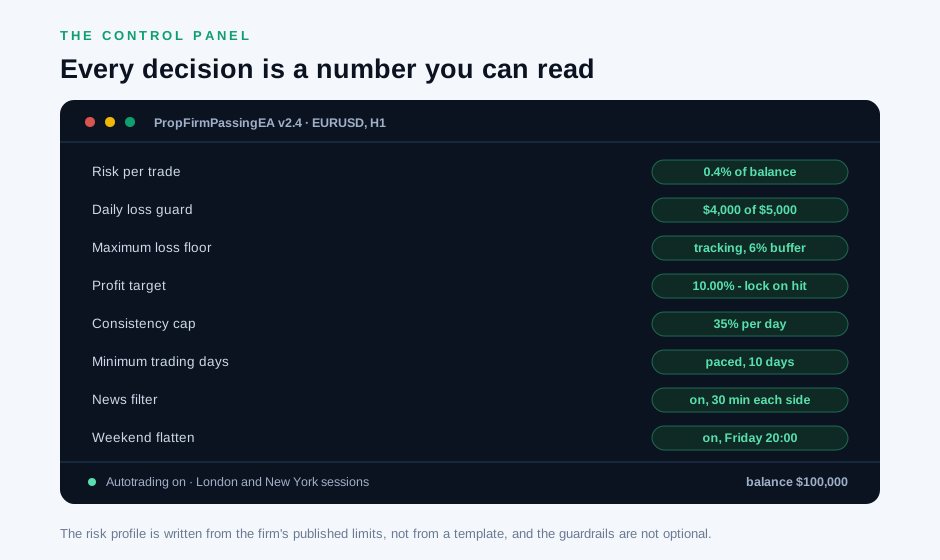
An expert advisor is a program that runs inside MetaTrader and places, manages and closes trades on a chart without anyone clicking. Most EAs sold online are general-purpose: a trend follower, a grid, a scalper. This one is not. It is a prop firm passing EA, written around the constraints a challenge imposes, and its only objective is to move an evaluation from its starting balance to its profit target while staying inside the daily loss limit, the maximum loss limit, the minimum trading days and any consistency rule.
The difference is not marketing. A general EA optimises for profit per unit of time and treats a drawdown as an inconvenience. A passing EA treats a drawdown as the thing that ends the product. It will stop trading for a day, trade smaller near the target, and take ordinary small wins instead of the one big position a general strategy would prefer — because the evaluation does not pay for the biggest day, it pays for a finished attempt.
In practice it is one file attached to one chart. It reads the licence, detects the account size, applies a risk profile sized from that balance and works through its session windows. There is no signal group to follow and no screen to watch; it can run on a VPS overnight.
- Balance-aware sizing. Risk per trade comes from the account's daily loss limit, not from a fixed lot size, so a $25,000 demo and a $200,000 evaluation run the same logic at different numbers.
- A hard daily stop. When the session's loss budget is spent, the EA stops opening trades until the next session. It does not "recover" the day.
- A target lock. Once the target is reached, trading stops and the account sits still — the phase where self-managed attempts most often give the pass back.
- Day-count pacing. Where a firm needs a minimum number of trading days, activity is spread across the calendar instead of sprinting to target in three sessions.
- Consistency awareness. Where a firm caps any single day's share of profit, daily profit is capped so the record clears at payout, not only at the target.
- News and weekend handling. Positions are avoided around restricted releases and flattened before the weekend where the terms require it.
What it is not: a guarantee, a funded account, or a substitute for checking whether your firm permits automation at all.
The free test, step by step
This is the whole reason the page exists. Nobody should buy trading software on the strength of a sales page — ours included. So the EA is proved on a demo account first, at no cost, before a dollar changes hands. It is not a screenshot pack or a backtest: it is a forward test on a demo opened today, at a broker you choose, traded by the same EA you would be buying, until it reaches the target under the rules a real challenge applies.
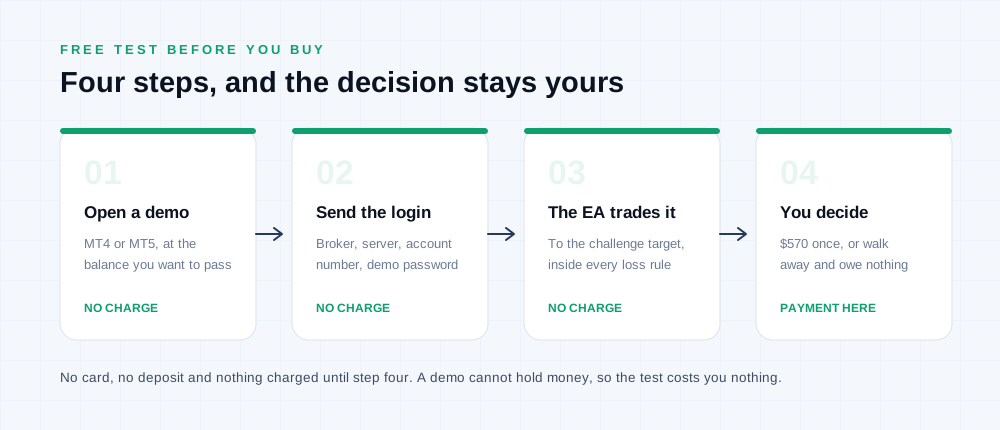
Step one: open a demo with a good broker
"Good" means three practical things, and none of them involve affiliate commission — there is no referral link on this page.
- The broker offers MT4 or MT5. The EA runs inside MetaTrader, so the demo has to be a MetaTrader demo. Nearly every forex and CFD broker provides one in about two minutes.
- The balance matches the account size you want to pass. A $100,000 demo is the right test for a $100,000 challenge. A $10,000 demo traded at 0.01 lots tells you almost nothing, because the sizing arithmetic is different.
- Spreads and commissions are realistic. A demo with institutional spreads no live account gets will flatter any EA. Use a broker whose conditions resemble the prop firm's feed, or at least one you already trade.
Futures traders should say so up front. Most prop-firm futures accounts run on Tradovate, Rithmic or NinjaTrader rather than MetaTrader, so the test is set up differently — usually a NinjaTrader demo or a simulated evaluation on the same feed.
Step two: send the demo login
Broker name, server, demo account number and password. That is the whole list. The account holds no money and cannot, so the credential carries no financial risk. No card, ID or bank statement is requested. Send it on Telegram at @voraspas and you get a confirmation the same day with the plan attached: the risk profile, the target, the daily loss budget and roughly how many sessions it should take — written for your balance, not copied from another client.
Step three: the EA trades the demo to the target
The EA is attached, the profile loads, and it starts working under the same rule set a challenge would impose:
- A daily loss budget derived from the balance, with a hard stop when it is spent.
- A maximum loss floor that is never approached by design rather than by luck.
- The same target percentage your firm uses — typically 8% to 10% on a two-phase forex challenge, or the dollar equivalent on a futures plan.
- Session windows that respect news restrictions and any weekend-flatten rule.
- Consistency pacing, so no single day carries a disproportionate share of the profit.
You keep the login throughout, so you can open the terminal at any hour and see the positions, equity, closed history and running drawdown yourself. Nothing is hidden behind a screenshot or reported only after the fact.
Step four: you decide
When the demo reaches the target, or the test period ends, you get a written summary: every trade, the risk taken on each, where the plan allowed a loss, the worst daily and maximum drawdown, and how the same sequence would read against a specific firm's rulebook.
Then you choose. Buy the licence for $570, ask for another test week, or stop and owe nothing. There is no auto-renewal, no card on file and no follow-up sequence that keeps charging you.
How long the free test runs. Long enough to include a losing session, a news release and at least one decision by the EA to do nothing, because those three situations are where a passing EA either follows its rules or improvises. That is one to two weeks on a demo — the same window in which a real challenge is usually finished.
What to send, and what never to send
- Send: broker, server, demo account number, demo password and the balance it was opened with.
- Never send for the test: live credentials, a funded login, card details, ID or bank statements. None are needed, and a provider who asks before a demo has told you something useful.
- Change the demo password at the end, or ask for written confirmation that access has stopped. Either is fine.
What the test proves, and what it cannot
A free test is only worth something if both sides are clear about what it measures. A demo is a genuine forward test of the EA's behaviour; it is not a prop firm evaluation.
What you can judge
- Whether it reaches the target in the sessions it claimed, on a live forward feed.
- How it sizes — constant risk derived from the balance, or drifting with confidence.
- How it behaves on a losing day, including whether the daily stop is respected.
- Whether the drawdown is boring. A passing EA should produce a dull curve. Excitement is a defect.
- Whether the reporting agrees with the history you can read yourself.
What it cannot prove
- That your firm's feed matches. Prop firm spreads and slippage differ from a broker demo.
- That your firm permits automation. That is a terms question, answered by the clause, not by performance.
- The funded phase. Passing and keeping an account are different jobs, and the demo tests neither payout rules nor consistency at withdrawal.
- Future results. Two weeks is a sample of process, not a forecast.
Use the demo as a filter. If the fortnight looks like a rule set being executed, buying the licence is a reasonable next step. If trades look improvised or the answers to your questions are vague, the test has done its job by costing you a fortnight instead of $570.
How it trades an evaluation
There is no secret indicator, and any vendor who says otherwise is selling a story. What makes a passing EA work is the order of decisions: rules first, risk budget second, market view last and least important.
1. It reads the balance and derives the budget
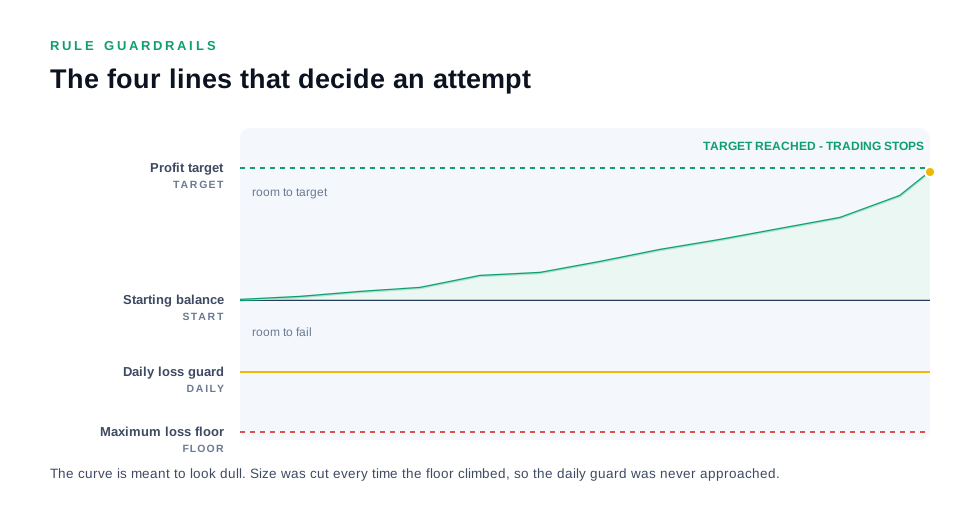
On attach, the EA computes the daily loss budget from the firm's limit. On a $100,000 account with a 5% daily limit that is $5,000, and risk per trade is a fraction of it — a third at most — so three consecutive losses leave the session survivable. Nothing else in the program may override that number. This is what separates a passing EA from a merely profitable one: a strategy can be profitable on average and still fail a challenge, because the challenge does not average.
2. It waits for its session windows
It trades only inside defined hours, chosen for liquidity. Outside them it does nothing, which is most of the day. Restricted releases are excluded, and where the terms require flat positions over the weekend it closes before the cutoff rather than hoping the gap goes its way. Every hour not traded is an hour in which the budget cannot be spent.
3. It opens small, defined-risk positions
Each entry carries a stop from the moment it is placed, sized so a full stop equals the planned risk. No averaging down, no adding to a loser, no grid and no martingale — the four techniques that produce spectacular screenshots and dead evaluations. Position count is capped too, because three correlated positions on one currency complex is one position with three times the risk.
4. It paces towards the target
The target becomes a daily pace using the sessions available and the firm's minimum day count. If the required pace would eat too much of the daily budget, the EA extends the calendar instead of increasing size. A pass that takes twelve days is worth infinitely more than one that reaches 90% of target and breaches a daily limit on the last session.
5. It locks the target and stops
The moment the target is met, trading stops. This is not caution for its own sake: a large share of failed attempts are accounts that passed the target and kept trading while waiting for verification, giving back enough to breach a rule the evaluation had already satisfied.
6. It respects the consistency rule where one applies
Firms that cap any one day's share of total profit create a failure that happens after the target — the account passes and the payout is withheld. The EA caps daily profit during the build and continues working ordinary days until the distribution clears the threshold. Where no consistency rule applies, this module simply does not bind, which is why the firm has to be named before the profile is loaded.
The four rules it manages for you
Across every firm we deploy on, the same four rules end attempts. The EA does not make them disappear; it makes them mechanical, which is the difference between knowing a rule and obeying it at 3 a.m. on a losing day.
| Rule | How it usually fails | What the EA does instead |
|---|---|---|
| Daily loss limit | One oversized position, or losses recovered with double size | Risk fixed at a fraction of the budget; trading stops when it is spent |
| Maximum loss / trailing floor | A floor that follows equity upward and is hit after a good week | Size recalculated against the floor as it moves, keeping set distance |
| Consistency rule | One huge day that passes the target and fails the payout check | Daily profit capped during the build, extra ordinary days added |
| Minimum trading days | A three-day sprint, then a wait for eligibility | Activity spread so target and day count land together |
The trailing floor. A firm whose maximum loss follows peak equity is not measuring your balance, it is measuring your best day. Every dollar of profit raises the line beneath you, so risking the same percentage after a strong week risks more in absolute terms against a closer floor. That is how traders blow up from a winning position. The EA recomputes the distance on every trade and shrinks size as the floor climbs.
The consistency rule. This one is invisible until payout. An account can reach a 10% target with a single 7% day, get verified, get funded, and then have the first withdrawal refused because that day is 70% of the profit. The deliverable is not a passed evaluation — it is a pass that still works when you ask for the money.
Firms, platforms and the permission check
Platforms. MT4 and MT5 cover most forex and CFD prop firms: FTMO, FundedNext, The5ers, FXIFY, FundingPips, Alpha Capital and their competitors. The EA ships for both. If your firm only offers cTrader, DXtrade or Match-Trader with no MetaTrader, the EA cannot run there, and that is the end of the conversation rather than something to work around.
Futures firms. Apex, Topstep and MyFundedFutures run on Tradovate, Rithmic, NinjaTrader and TradingView. The same rule logic is applied through a NinjaTrader strategy build where the firm and platform support automated execution. Ask before assuming your plan is covered.
The permission check. This matters more than any performance number, and it is free. Before the EA goes on a paid evaluation we read the automation clause on your specific plan and tell you which of three things is true:
- Permitted. The plan allows automated execution and does not prohibit the strategy type. The EA runs at the price on this page with nothing extra to pay.
- Permitted with conditions. Some plans allow EAs but restrict high-frequency behaviour, require disclosure, or disable automation above a certain size. The EA is configured inside the condition or the size is changed — never the clause.
- Prohibited. We say so in writing and do not sell you the licence for that firm. A funded account can be voided at payout for something the evaluation never tested.
The distinction the market gets wrong is between "EAs allowed" and "this strategy allowed". Many firms permit automation and prohibit behaviour some EAs produce — hundreds of orders a minute to harvest a spread, latency games, hedging across accounts. This EA trades a handful of defined-risk setups a session, which sits inside the permission at every firm that permits automation at all. That is a claim to verify against your clause, not a licence to skip it.
Read this before paying. Some firms prohibit automated trading outright, and enforcement usually surfaces at the payout rather than at the pass. We would rather lose the $570 than sell a licence that gets your funded account closed.
How fast a pass actually is
On a two-phase forex challenge with percentage targets, the binding constraint is almost never the profit target — it is the calendar. A phase that requires four trading days cannot be completed in two, however much the account earns. The EA is configured so the target and the day count land on the same date, which puts the realistic first-attempt window at eight to fourteen days on most plans, and shorter where there is no minimum day requirement.
Single-phase and instant-funding products move faster because there is less calendar to satisfy. Futures plans with dollar targets can be quicker still, though their trailing thresholds punish acceleration, so the EA paces them rather than rushing them.
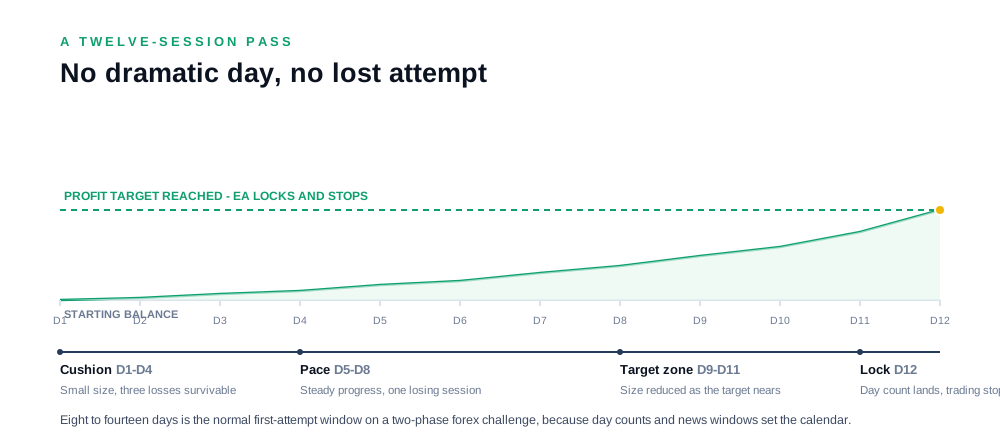
Three things genuinely slow a pass down. Minimum trading days cannot be compressed: if the plan needs ten, the pass takes at least ten. Restricted news windows shorten the usable calendar in a week with several releases, and the EA sits out rather than trading through. A losing week triggers a pause that costs sessions and protects the account — days, not the attempt.
Price: $570 once, nothing recurring
The licence is $570, paid once. No monthly fee, no annual renewal, no subscription, no profit split and no charge per challenge or per attempt. You pay for the software and keep it, and how many evaluations you run with it next year is your business rather than a billing event.
| Item | Included | Notes |
|---|---|---|
| EA licence, MT4 or MT5 build | Yes | One payment of $570, no renewal |
| Free demo test before purchase | Yes | No card, no deposit, no obligation |
| Risk profile for your firm and size | Yes | Configured from the firm's published limits |
| Automation-permission check | Yes | Answered in writing before you pay |
| Install and setup guidance | Yes | Chart attach, VPS, server, common errors |
| Re-use across your own evaluations | Yes | Run your next challenge at no extra cost |
| The firm's challenge or reset fee | No | Paid by you directly to the firm |
| Funded account management | No | The funded account is yours to trade |
| Profit share | None taken | What the account earns is yours |
One licence covers one trader on one live evaluation at a time, with unlimited demo use. Running several accounts at once is a separate arrangement — ask, because firms have their own rules about copy trading and duplicated positions.
How $570 compares with the alternatives
| Route | What you pay | Attempts covered | Who trades |
|---|---|---|---|
| Trade it yourself, unaided | Firm fee per attempt | One each, billed again on reset | You |
| Done-for-you passing service | $220 flat per evaluation | Retries covered on managed attempts | ElitePropX |
| Prop firm passing EA | $570 once | Unlimited on your own accounts | The EA, on your machine |
The comparison that matters most is with our own done-for-you service, because it would be strange to pretend otherwise. At $220 that is cheaper for a single evaluation and the work is taken off your hands entirely. The EA costs more once and then nothing again: your next challenge, the firm you try next quarter, an account you reset — all at no extra fee. Break-even against the service is the third evaluation.
The other difference is control. With the service, someone else trades your account and you accept that, along with the terms question it raises. With the EA you press the button yourself, in your own terminal, which is a simpler position to defend if a firm ever asks who placed the trades — and you learn the rule mechanics instead of watching them happen.
Against doing it unaided the arithmetic is uncomfortable but obvious. Two failed attempts at a mid-size challenge fee usually cost more than $570 before any service fee is considered, and they cost weeks. The licence does not make an attempt certain; it removes the possibility that the failure was a decision made at 2 a.m. by a tired human rather than by a rule set.
Set-up, VPS and install
The technical side is small, but it has to be right, because an EA that stops running mid-session is worse than no EA at all.
- A MetaTrader terminal on Windows. The EA attaches to a single chart and needs no templates or indicators.
- AutoTrading enabled. The toolbar button must be green and "Allow automated trading" ticked in the options. This one setting causes most "it is not trading" messages.
- A VPS. It keeps the terminal running when your laptop sleeps or the connection drops. Any low-latency Windows VPS near the broker's server works, costs a few dollars a month, and prevents a gap in the equity curve.
- The right account. The EA goes on the evaluation account, not the demo, with the profile written for that firm and balance.
- A log you keep. Export the trade history at the end of each session. If a firm ever questions an account, the record is the answer.
Installation takes about fifteen minutes. Support covers the attach, the settings and the common errors; it does not cover changing the strategy.
After the pass: the funded phase
A pass is not the finish line. The funded account has its own rules — a profit threshold, minimum trading days per payout cycle, a consistency check and verification — and three things change the moment the EA stops:
- Change the password. You hold the funded account alone, which is both safer and more defensible.
- Re-read the funded terms. Evaluation rules and payout rules are different documents, and the differences are where first payouts get refused.
- Decide whether to keep using the EA at a smaller risk profile. Many clients do; some trade manually once the pressure is gone. What is not legitimate is trading the funded account with no written plan.
For the mechanics, the payout process guide covers the withdrawal sequence and the delays that block first requests, and what to do after passing covers the first week.
Risks and honest limits
This page has made strong claims about the EA, and they are meant. It is also software, and software that trades carries risk no sales page should blur.
- A pass is not a payout. Firms can change rules or refuse a withdrawal for reasons unrelated to how the account was traded.
- Firm permission is yours to confirm. We tell you what the clause says, but the account is in your name and the consequences land there.
- Market conditions change. The daily stop and the floor limit damage; they do not eliminate it.
- Execution differs between servers. Expect small differences in fills, and size for them.
- The licence is software, not a service. The done-for-you route includes retries and a human watching the account. The EA includes neither, which is why it is priced once rather than per evaluation.
- No income promise. Any vendor who guarantees what a funded account will earn is describing a scenario rather than a product.
None of that is a reason to avoid the EA. It is the reason the free test exists.
Frequently asked questions
Can I really test the EA free before buying?
Yes. You open a demo at a broker you already use, send the login, and the EA trades it to the challenge target under the same rules a paid evaluation applies. You watch live, get a written summary, and only then decide. No card is taken for the test and there is no obligation.
How much does the prop firm passing EA cost?
$570, paid once. No monthly subscription, no annual renewal, no profit split and no charge per challenge. You can run it on your next evaluation at no additional cost.
What do I need for the free test?
A demo on MT4 or MT5 with a balance close to the size you want to pass, plus the broker name, server, demo account number and password. Nothing else — no card, no ID, no deposit.
How long does the test take?
Usually one to two weeks, long enough to include a losing session, a restricted news event and at least one decision by the EA to stand aside. If you want a longer window, ask and it runs on.
Does a good demo week mean I will pass my challenge?
No. It means the EA executed its rule set on a forward feed. A real evaluation adds firm-specific spreads, minimum day counts and verification. The test is evidence of behaviour, not a forecast.
Which firms and platforms does it run on?
MT4 and MT5, covering most forex and CFD prop firms including FTMO, FundedNext, The5ers, FXIFY, FundingPips and Alpha Capital. Futures firms such as Apex or Topstep use different platforms, so ask before assuming your plan is covered.
Do prop firms allow EAs?
Most permit automation with conduct limits; a minority prohibit or restrict it, sometimes only above a certain account size. The permission check is free: send the firm and plan and you get an answer in writing before you pay for the licence.
How fast can it pass a challenge?
Usually eight to fourteen days on a two-phase forex challenge, shorter where there is no minimum day requirement. The calendar is the binding constraint, and news windows or a losing week can add sessions.
Is this different from your $220 passing service?
Yes. The $220 service is done-for-you: we trade the evaluation and cover retries. The $570 EA is software you run yourself, with unlimited re-use. The service is cheaper for one evaluation; the EA is cheaper from the third onwards.
Does it need a VPS?
It runs without one, but a VPS is strongly recommended. A terminal that sleeps or loses its connection stops trading, and a gap in the equity curve mid-evaluation is exactly the problem the EA is meant to remove.
What happens if the evaluation fails?
The EA stops when the daily or maximum loss rule is hit. Unlike the done-for-you service, a failed evaluation is not covered by a retry — the licence is software, not a managed service. You can redeploy on the firm's reset at no additional licence cost, and the firm's reset fee is theirs.
Can I use it on more than one account?
One licence covers one trader on one live evaluation at a time, with unlimited demo use. Running several accounts at once is a separate arrangement — ask first, since firms also restrict copy trading across accounts.
Can I change the settings myself?
You can see every input, and the profile for your firm and balance is documented. Raising risk is the fastest way to turn a passing EA into a failing one, so the profile is deliberately conservative and support explains each number rather than removing the guardrails.
How do I start?
Message @voraspas with your broker, platform (MT4 or MT5), demo balance and the firm you intend to trade. You will get the risk profile, the test plan, and an answer on your firm's automation clause before anything is paid.
Start with the demo, not the receipt
The order of events is deliberate: demo first, decision second, payment third. Open a demo at a broker you trust, at the size you actually intend to pass, and send the login. You will see the EA work through the same constraint set your challenge imposes — daily budget, floor, day count and consistency cap — before you are asked for anything.
If the two weeks convince you, the licence is $570 once and it is yours for every evaluation after that. If they do not, say so and the conversation ends there.
Test the EA free, then decide
Demo account, live forward test, written summary, no card. The $570 licence only comes after you have seen it trade.
Related reading
- Do prop firms allow expert advisors?
- Passing an FTMO challenge with an EA
- The free 7-day demo trial for the manual service
- The done-for-you passing service, and what it costs
- How the daily loss limit actually works
- The consistency rule, worked out
- Minimum trading days and why they set the calendar
- Prop firm rules matrix
- Recently passed evaluations
- Profit and payout calculator
The prop firm passing EA is trading software, not a managed service and not financial advice. Automation is offered only where a firm's terms permit it, and permission must be confirmed for your specific plan before deployment. Trading involves substantial risk of loss, a passed evaluation is not a guarantee of a funded payout, and past performance does not indicate future results. ElitePropX is an independent service and is not affiliated with, endorsed by or sponsored by any proprietary trading firm named on this page.