Prop Firm Passing Service Cost: What You Actually Pay
Most traders comparing passing services compare the wrong number. The sticker fee is the smallest part of the total cost — the profit split, the retry economics and the firm's own evaluation fee matter far more. This page breaks down what a prop firm passing service genuinely costs, and how to compare providers on total value rather than headline price.
The three price points in the market
Every passing service prices in one of three ways, and the differences swamp the headline numbers.
| Model | Sticker price | What you actually pay |
|---|---|---|
| Flat fee | $100–$500 | The fee. That is the whole cost. |
| Fee + split | "From $99" | $99 + 20–50% of every payout, indefinitely |
| Subscription | $100–$250/month | Accumulates monthly whether you pass or not |
Why the split is the expensive option
Run the numbers on a $100,000 account. Suppose it eventually generates $10,000 of withdrawals across the year — modest, but realistic for a trader finding their feet.
| Provider | Upfront | Ongoing | Total paid |
|---|---|---|---|
| Flat fee (ours: $220) | $220 | $0 | $220 |
| Fee $99 + 30% split | $99 | $3,000 | $3,099 |
| Subscription $150/month × 12 | — | $1,800 | $1,800 |
The cheap-looking offer is fourteen times more expensive than the flat fee. This is not a trick of presentation — it is the single most important cost insight in the category. A profit split turns a one-time service into a permanent tax on your trading, and the tax grows as you succeed.
Ask this one question
"What do you take after I'm funded?" If the answer is a percentage, that percentage is the real price — not the number on the pricing page.
The cost everyone forgets: failed attempts
When traders compare a service fee against "doing it myself", they usually compare it against one evaluation fee. That is the wrong comparison. What matters is the number of attempts you expect to buy before one succeeds.
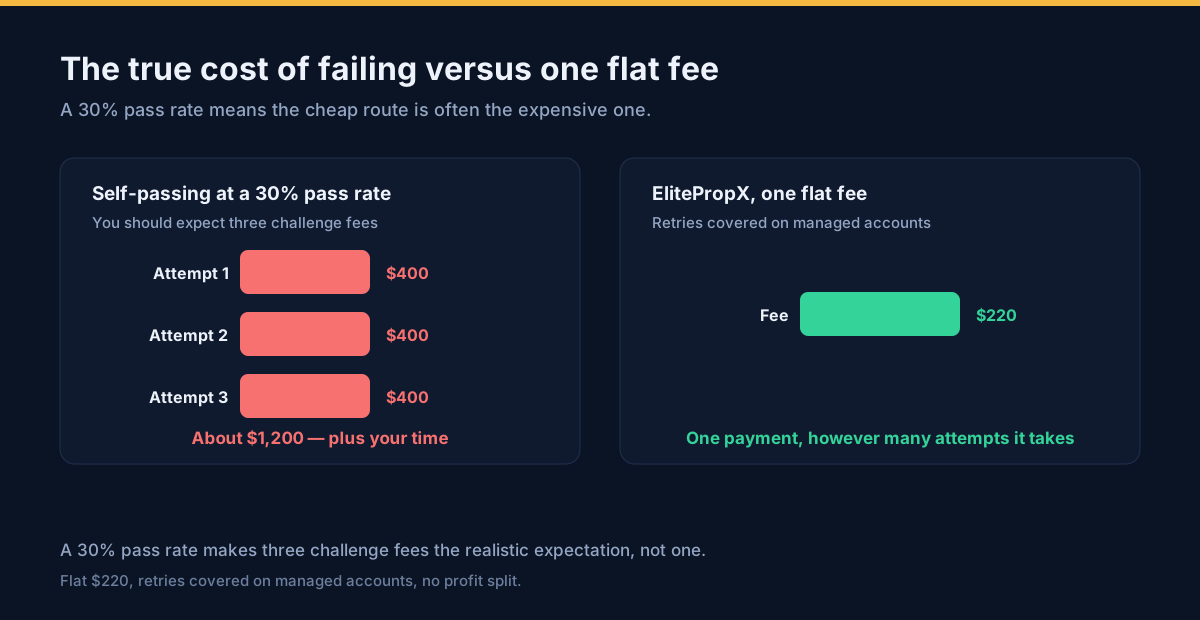
Take a $400 forex challenge with a realistic 30% pass rate. On average you will buy about 3.3 evaluations before passing — roughly $1,330 in evaluation fees alone, plus weeks of your time. Now compare:
| Route | Evaluation fees | Service fee | Expected total |
|---|---|---|---|
| Self-traded at 30% pass rate | ~$1,330 (3.3 attempts) | $0 | ~$1,330 |
| Self-traded at 90% pass rate | ~$445 (1.1 attempts) | $0 | ~$445 |
| Flat-fee service | ~$400 (one evaluation) | $220 | ~$620 |
This is why "is the service worth it?" has no single answer. If your personal pass rate is high, self-passing is clearly cheapest. If it is low — because the daily limit or a trailing drawdown keeps beating you — the flat fee is not a luxury, it is a discount on a cost you are already paying. Our profit calculator lets you run your own numbers.
The complete cost breakdown
A full accounting of getting funded looks like this:
The prop firm's evaluation fee
$50–$600 depending on firm, account size and promotions. Paid to the firm, not the service. This cost exists on every route.
The passing service fee
$100–$500 flat, or a smaller number attached to a profit split. This is the only cost that varies between providers.
Retry fees
$0 if the provider covers retries, potentially several hundred if they do not and you fail.
Profit split
$0 with a flat-fee provider. Thousands per year with a split provider. The largest line item by far when it applies.
Opportunity cost of time
Weeks of screen time on a self-traded challenge, or the fee to avoid it. Hard to price, but rarely zero.
Why account size should not change the fee
Some services price by account size — $150 for a $25k evaluation, $600 for a $200k one. The justification is thin. Passing a large evaluation requires the same understanding of the same rulebook; only the position-sizing arithmetic changes, and that is a calculation, not additional work. Pricing by size is pricing by your ability to pay.
Our view is that the fee should be flat, and ours is: $220 regardless of whether you are passing a $10,000 account or a $400,000 one. That is a deliberate choice, and it is worth comparing against any quote you receive elsewhere.
Ten-year view: which model is cheapest
Most traders look at the first month. Look at a decade instead. A trader running a few evaluations a year, funded on $100k accounts, withdrawing steadily:
- Flat fee: a few hundred per evaluation. No ongoing cost. Total over ten years: a few thousand.
- Profit split: a percentage of every withdrawal, every year, forever. Total over ten years: often tens of thousands.
The gap is not marginal. It is the difference between a service you bought and a partner you accidentally acquired.
Frequently asked questions
The FAQ block below covers typical pricing, why some services look cheap, hidden costs, whether self-passing is cheaper and whether the fee should scale with account size. For the wider category see what a prop firm passing service is and the cheapest options.
How much should a prop firm passing service cost?
Why do some passing services look so cheap?
Is it cheaper to pass the challenge myself?
Are there hidden costs with passing services?
Does the fee change with account size?
What is the most cost-effective way to get funded?
Have a question before you commit?
Ask us anything about your firm, your account size or whether a passing service suits you. We answer directly on Telegram — no forms, no queues.
Ready to pass your prop firm challenge?
Flat $220 per evaluation — we trade it for you and hand over a funded account. No hidden cuts, no monthly fees. Message us on Telegram and we will answer in minutes.