
Reviewed · how we check firm rules
Evaluation service · reviewed November 2026
We pass your Vest Markets evaluation for a flat $220
We pass Vest Markets evaluations for a flat $220 at any account size, and hand the funded account back to you. Vest lets you configure the target, the daily limit and the profit split before you buy, which makes the purchase decision more consequential than at a firm with fixed tiers — and its drawdown is static, so profit never reduces your room to fail. This page covers the three paths, which configuration a service pass should choose, the reset clock, the honest arithmetic of a fee against accounts this small, and the terms check that happens before payment.
Key takeaways
- Vest sells three routes: a one-step evaluation with a configurable target, a two-step evaluation, and an instant funded account with no evaluation at all.
- The drawdown is a static 6% of starting capital, so it never trails and profit cannot tighten it.
- The daily loss limit is chosen at purchase — 3%, 4% or none — and resets at 20:00 New York time.
- There is no time limit, no minimum trading day count and no consistency rule, and news, scalping, overnight and weekend holding are all permitted.
- Vest accounts are small by comparison with futures firms — the funded ceiling is $50,000 — so the fee is a larger share of the economics and the sizing has to be chosen carefully.
- Flat $220 at any size, retries covered while the evaluation runs, no profit split, and the third-party clause confirmed in writing first.
Contents
- Three routes, one of which can be passed
- Configuring the account before you buy
- The static 6% floor
- The daily limit and the 20:00 reset
- The plan a Vest pass runs on
- The honest arithmetic of a small account
- The terms check, before anything is bought
- What the flat fee covers
- A worked pass, week by week
- What a failed attempt costs
- The two-step route, and when it wins
- Which tier to buy, and why the smallest is a trap
- Claims, splits and the 24-hour clock
- A losing week, worked through
- Six checks before you buy
- How a Vest account differs from a futures firm
- Four ways a Vest attempt ends
- Frequently asked questions
Three routes, one of which can be passed
Vest Markets is a trading platform that added a prop programme, so its evaluation sits alongside ordinary account products. The programme offers a one-step evaluation, a two-step evaluation and an instant account that is funded from purchase.
Only the first two involve a pass. The instant route has no target to hit, so a passing service has nothing to sell you on it — and anyone offering to pass an instant account is describing something else, usually a managed account, which is the arrangement most firms prohibit outright.
| Route | Assessment | Target | Service relevance |
|---|---|---|---|
| One-step | Single phase | 10% or 20%, chosen at purchase | Yes |
| Two-step | Two phases | 10% then 5% | Yes |
| Instant | None | None to pass | No — nothing to pass |
Between the two passable routes the choice is the same one that appears at every firm: a single phase concentrates the target and shortens the exposure, while two phases split the work and add a checkpoint. On a static floor the single phase is usually the better purchase for a service pass, because the floor does not tighten and the shorter calendar means fewer sessions in which a conduct rule can be broken.
Configuring the account before you buy
Vest lets the buyer set several parameters at checkout rather than selling fixed tiers: the profit target on the one-step route, the daily loss percentage, and the profit split. That configurability is the most distinctive thing about the programme and the easiest thing to get wrong.
A higher target lowers the purchase price and raises the difficulty. A lower target raises the price and makes the pass easier. A larger daily limit allows bigger positions and a faster attempt; no daily limit at all removes the intraday brake entirely. The split choice trades a higher percentage of future profits against a higher upfront price.
For a service pass the configuration should be chosen for survivability rather than for price. Our default is the lower of the two targets, a daily limit of 3% rather than none, and the base split — because a pass that fails is worth nothing at any discount, and a daily brake is the cheapest insurance against a single bad session on an account this small.
Why not the higher target: it saves money at checkout and costs money at the retry. On a static floor the difficulty is concentrated in the first week, and a 20% target on a small account means the buffer is being asked to carry twice the pace it was sized for.
The static 6% floor
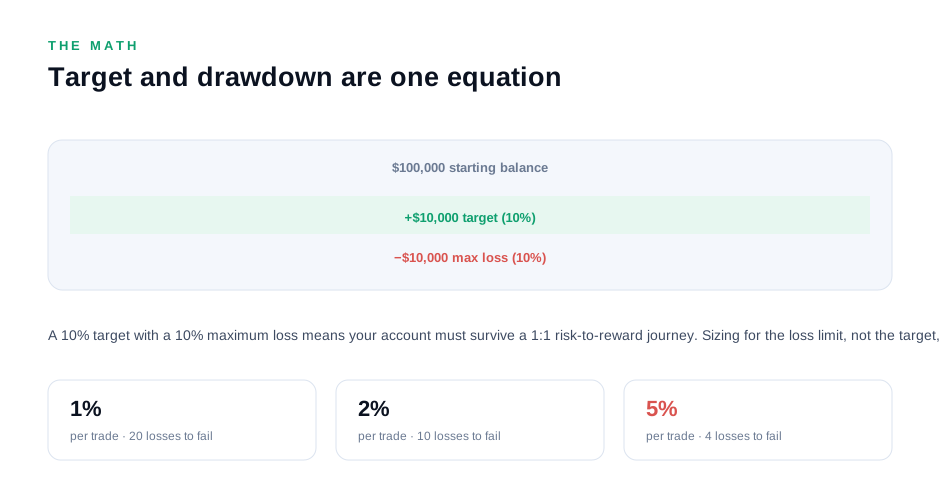
The maximum loss is 6% of starting capital and it is static: the failure level is fixed and profit does not move it. On a $10,000 account the floor is $9,400 for the entire evaluation, whether the balance is $9,500 or $12,000.
Static floors are the easiest rulebook in this market to trade, because the room to fail never shrinks. A trailing floor forces the position unit down through the attempt; a static floor lets it stay constant, and the losing sequence the account can absorb in week four is the same as in week one.
| Account | Static floor at 6% | Room at the start | Room after 10% profit |
|---|---|---|---|
| $5,000 | $4,700 | $300 | $300 |
| $10,000 | $9,400 | $600 | $600 |
| $50,000 | $47,000 | $3,000 | $3,000 |
The trade-off is that the dollar buffer is small in absolute terms, and on the smaller accounts it is very small: $300 on a $5,000 evaluation. At that size the position sizing has to be built from a risk unit of a few dollars, which is possible with fractional sizing and impossible with a fixed one-contract position. The plan refuses accounts where the minimum tradable position exceeds a fifth of the buffer, which rules out the smallest tiers on most instruments.
The daily limit and the 20:00 reset
The daily loss limit is chosen at purchase — 3%, 4% or none — and it resets at 20:00 New York time rather than at a market open. That reset time is worth noting because it splits the New York session: a position held into the evening is measured against a new day's allowance rather than the one it was opened under.
On a $10,000 account a 3% limit is $300 a day against a $600 total buffer, which means two full daily losses exhaust the evaluation. That ratio is the reason the plan trades at a third of the daily limit per trade and stops the session at 80% of it: at that sizing the account absorbs six losing trades, which is a normal bad week rather than a failed attempt.
Choosing no daily limit is permitted and we advise against it on accounts under $25,000. Without a daily brake, a single session can consume the whole static buffer, and the buffer does not grow back. The limit is not a constraint on the strategy; it is the thing that keeps one bad morning from ending a three-week attempt.
The plan a Vest pass runs on
Five constraints write the plan.
The static floor sets risk per trade. Risk is a tenth of the buffer at most, so ten consecutive losses leave the account alive. On a $600 buffer that is $60 of risk per trade, and on a $300 buffer it is $30, which is why the smallest accounts require fractional position sizing.
The daily limit sets the session. Risk is a third of the daily allowance at most, and the session closes at 80% of it. On the 3% configuration that is $100 of risk per trade on a $10,000 account and a $240 session stop.
The target sets the pace. Target divided by sessions gives a daily rate, checked against the daily budget. A pace that needs more than a fifth of the allowance is a pace that depends on the market, so the schedule is extended rather than the size raised.
The no-time-limit rule sets the calendar, not the plan. There is no deadline to race, which removes the main reason traders oversize. The plan uses that freedom: it trades fewer, cleaner sessions rather than filling the week.
The conduct rules are permissive. News, scalping, overnight and weekend holding are all permitted, so the plan is limited by risk rather than by the clock. That is unusual and it makes the account easier to trade than a firm that forbids overnight exposure — but it also means the plan has to impose the discipline the rules do not.
Failure handling is part of the plan: a lost attempt is reported the day it happens, classified as a floor breach or a conduct breach, and retried at no additional service fee while the evaluation is open.
The honest arithmetic of a small account
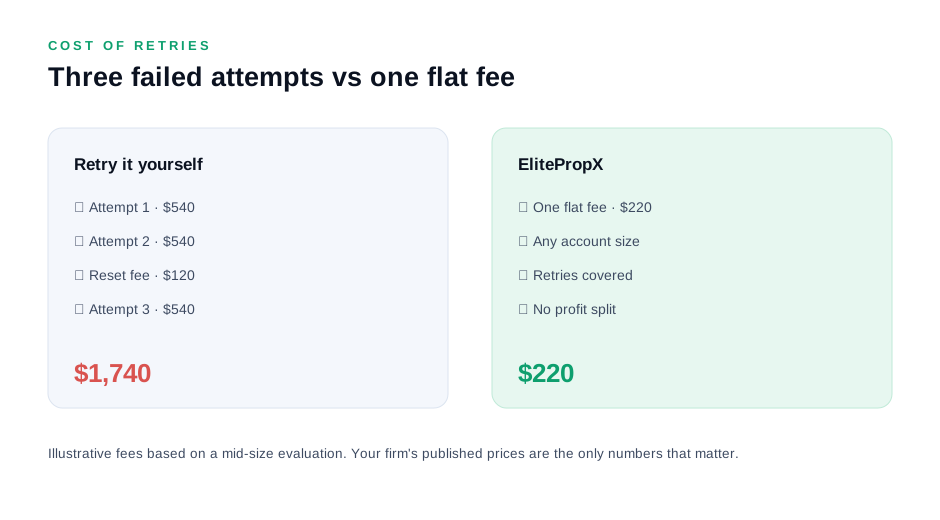
Vest's accounts are small. The funded ceiling is $50,000 and evaluations start far below that, which creates a problem a $220 flat fee cannot hide: on a $500 account the service costs nearly half the account, and no amount of skill makes that a sensible purchase.
The fee only works when the payout ceiling justifies it. A $10,000 account paying out a few hundred dollars a cycle can absorb a $220 fee across two or three cycles; a $1,000 account cannot, because the fee is a fifth of the capital and the payout is smaller than the fee. Our floor for taking a Vest job is $10,000, and we say so before quoting rather than after.
The second piece of arithmetic is the split. Vest's split is configurable within a range, and a higher split costs more upfront. For a first evaluation the base split is the right purchase: the difference in payout share is small relative to the chance of needing a second attempt, and the retry is covered by the flat fee rather than by the split.
Third, the accounts are simulated, and Verst's own terms say so for every programme including instant funding. That does not make the payout less real — payouts are programme compensation — but it does mean the account is a rules exercise rather than a trading desk, which is exactly what a service pass is built for.
The terms check, before anything is bought
Before payment we read Vest's current terms for the specific route and confirm in writing whether the evaluation may be traded by a third party. The check is free, and on a platform-run programme it is worth doing carefully rather than assuming the answer from the marketing pages.
- Third-party trading on the evaluation. If it is prohibited, the job does not start, and the refusal is given in writing before any money moves.
- Third-party trading on the funded account. The funding stage is governed separately at most firms, and Vest's terms describe compensation rather than a share of live profits.
- Conduct rules. Permitted instruments, position limits and the reset clock decide which sessions are usable.
- Ownership requirements. The account is bought in the client's name with the client's payment details, and identity verification is completed by the client.
Silent is treated as prohibited unless the firm confirms otherwise in writing.
What the flat fee covers
The fee is $220 for any Vest evaluation at any size from $10,000 upward.
| Item | Covered | Notes |
|---|---|---|
| The evaluation attempt | Yes | Traded to the configured target inside the rules |
| Retries while the evaluation runs | Yes | No additional service fee |
| Terms check before payment | Yes | Confirmed in writing, free |
| Vest's own evaluation fee | No | Paid by the client; refundable only in narrow cases |
| The funded account after handover | No | Traded by the client under the programme terms |
| Identity verification | No | Completed personally, as the account holder |
| Profit split | None taken | Payouts belong to the client |
A worked pass, week by week
An illustration on a $10,000 one-step account with a 10% target, a 6% static drawdown and a 3% daily limit, traded at $100 of risk per session against a $300 daily allowance.
Week one — establish the unit. Four sessions at $100 of risk, two green and one red. The account closes near $10,350. The floor is still $9,400, so the buffer is $950 and the room above the start is $350.
Week two — hold the unit. Three green sessions take the balance to about $10,850. Because the floor is static, the unit stays at $100 rather than falling; the only limit on size is the daily allowance, which is unchanged.
Week three — finish. The last $150 of target is taken in one session, and the evaluation closes with the best day at roughly a quarter of total profit.
| Week | Balance at start | Floor | Unit | Work |
|---|---|---|---|---|
| One | $10,000 | $9,400 | $100 | Four sessions, two green |
| Two | $10,350 | $9,400 | $100 | Three green sessions |
| Three | $10,850 | $9,400 | $100 | One session to the target |
What is worth noticing is that the unit never changes, because the floor never moves. On a trailing evaluation the same pass would have cut size twice. Neither is better in the abstract; the static floor rewards a consistent unit and punishes only the very first week, when the buffer is at its narrowest.
What a failed attempt costs
The service fee is spent and covers the retry; the cost of a failure is Vest's evaluation fee plus the calendar.
The evaluation fee is refundable only narrowly. Vest's policy allows a refund in limited circumstances, typically where no trade was placed, so a failed attempt is normally a lost fee rather than a credit.
The calendar restarts, but there is no deadline. Because Vest imposes no time limit, a restart costs time rather than a subscription period, which makes a slow attempt genuinely cheap and a fast failure genuinely expensive.
| What ends the attempt | How it happens | What the restart costs |
|---|---|---|
| Static floor | Balance through the fixed 6% level | Evaluation fee again, calendar from zero |
| Daily limit | One session through 3% or 4% | The day, and a new allowance at 20:00 New York |
| Conduct breach | Prohibited practice or a terms violation | The account, and a funded account can be questioned later |
The two-step route, and when it wins
Vest's two-step evaluation splits the work into a 10% first target and a 5% second, for 15% in total against the 10% or 20% available on the one-step route. On paper that looks like more work for the same account, and on a static floor the extra phase has one real advantage: a checkpoint.
The checkpoint matters because of what happens after a good first phase. On a one-step evaluation the target is a single number, and an account that is 8% of the way to a 10% target has 2% left with the same buffer it started with. On a two-step, finishing the first phase converts progress into a completed stage — the client sees the firm confirm it, and the second phase begins under its own parameters.
Before buying it, one question decides the arithmetic: whether the second phase's drawdown is measured from the new balance or from the original starting capital. If the floor resets with the balance, the second phase is a fresh 6% on a larger account and the total attempt is genuinely easier per dollar. If the floor stays at the original level, the second phase inherits the profit as cushion, and the 15% total is harder than a flat 15% would suggest.
The plan asks that question during the terms check and prices the two routes accordingly. Where the reset applies, the two-step is the better purchase for a client who wants a checkpoint; where it does not, the one-step at the lower target is the better buy, because it asks for less total profit against the same floor.
Which tier to buy, and why the smallest is a trap
Vest's evaluation sizes run from a few hundred dollars up to a funded ceiling of $50,000, and the fee is flat at $220 whichever you pick. That combination produces a decision most traders get backwards.
| Evaluation size | Static buffer at 6% | Fee as a share of the account | Our view |
|---|---|---|---|
| $500 | $30 | 44% | Not offered — the buffer cannot hold a position |
| $5,000 | $300 | 4.4% | Only with fractional sizing |
| $10,000 | $600 | 2.2% | The floor we take work at |
| $25,000 | $1,500 | 0.9% | Best balance of fee and buffer |
| $50,000 | $3,000 | 0.4% | Best value, if the budget allows |
On a $500 evaluation the static buffer is $30. No futures or CFD position of any consequence fits inside $30 of risk, so the account cannot be traded to a 10% target by anyone, and the $220 fee is almost the whole purchase. That is not a cheap way to test the service; it is a way to lose the fee and learn nothing.
The tier that makes sense is the largest one the budget can carry, because the fee is fixed and the payout ceiling scales with the balance. A $25,000 evaluation pays out several times what a $10,000 one does for the same $220, and its buffer of $1,500 supports a normal risk unit without fractional sizing. The smallest sensible purchase is $10,000, and the honest recommendation for most clients is $25,000.
Claims, splits and the 24-hour clock
Vest is a crypto-native platform, and the payout mechanics follow from that rather than from the futures-firm template. Profit is claimed to the platform's primary account, claims are processed within roughly a day, and moving funds off the platform is a separate withdrawal to an external wallet.
The profit split is configurable within a range and set at purchase, so a higher share of future payouts costs more upfront. The base split is the right purchase for a first evaluation: the difference in share is small next to the chance of needing a second attempt, and the retry is covered by the flat service fee rather than by the split.
Collateral is held in USDC and every account runs on cross margin, which means the whole balance backs every open position. That is a meaningful difference from a futures account with per-product margin: a losing position on one instrument draws on the same collateral as a winning one elsewhere, so the plan does not treat the account as several independent books.
Two disclosures are worth repeating because they are easy to skim past. Vest's own terms describe all programme accounts, including instant funding, as simulated, with payouts as programme compensation rather than a distribution of live trading profits. And refunds are narrow — typically limited to cases where no trade was placed — so a failed attempt is normally a spent fee.
A losing week, worked through
Anyone can describe a pass. The test of a plan is what happens in the week that goes wrong, so here is one on a $10,000 one-step account with a 10% target, a $600 static buffer and a 3% daily limit of $300.
| Session | Risk taken | Result | Balance | Room to the $9,400 floor |
|---|---|---|---|---|
| Monday | $100 across two trades | Both stopped | $9,800 | $400 |
| Tuesday | $80, size cut after the losses | One win, one scratch | $9,920 | $520 |
| Wednesday | $80 | One loss only | $9,840 | $440 |
| Thursday | $60, second cut | No setup, no trade | $9,840 | $440 |
| Friday | $60 | Two wins | $9,990 | $590 |
The week lost $10 and, more importantly, it kept the account. The plan cut the unit twice — from $100 to $80 after Monday, then to $60 after Wednesday — because the buffer had fallen to $440 and $400 respectively, and the risk rule is a tenth of the buffer rather than a tenth of the starting account.
That is the whole difference between a surviving week and a failed attempt. A trader who held $100 through all five sessions would have risked $500 across the week against a $600 buffer, and a single additional loss on Thursday would have taken the account to $9,440 — $40 from liquidation. The unit cut is not caution; it is the only mechanism that keeps the number of losses available constant as the buffer shrinks.
There is a second lesson in the table. Wednesday's loss was taken and the session closed, even though the daily limit of $300 had not been reached and there was room for another trade. On an account where the buffer is 6% and the daily limit is 3%, two full days of loss exhaust the evaluation, so a session that has already lost a third of its allowance is finished by policy rather than by the rulebook.
Six checks before you buy
Because so much of a Vest account is configured at purchase, the checks happen earlier than at a fixed-tier firm. Six of them decide whether the purchase is worth making at all.
- The third-party clause. Confirm in writing whether the evaluation and the funded stage each permit external trading. This is the check that decides whether a pass is worth anything.
- The target setting. The lower of the two offered targets, unless the higher one is the only configuration that fits the budget. A higher target is a lower price and a harder attempt.
- The daily limit setting. 3% rather than 4%, and never none, on accounts below $25,000. The limit is the only brake on a session.
- The split. The base split for a first evaluation. Paying more upfront for a higher share is a bet on the account surviving long enough to use it.
- The refund window. Vest's refunds are narrow and generally tied to placing no trade, so the purchase should be treated as final before the first order goes in.
- The simulation disclosure. The terms describe every programme account as simulated and payouts as programme compensation. That is normal for the industry and it belongs in the decision rather than in the small print.
If the first check fails, the other five do not matter. If it passes, the remaining five are arithmetic, and the arithmetic points at the largest tier the budget can carry with the lower target and a 3% daily limit.
How a Vest account differs from a futures firm
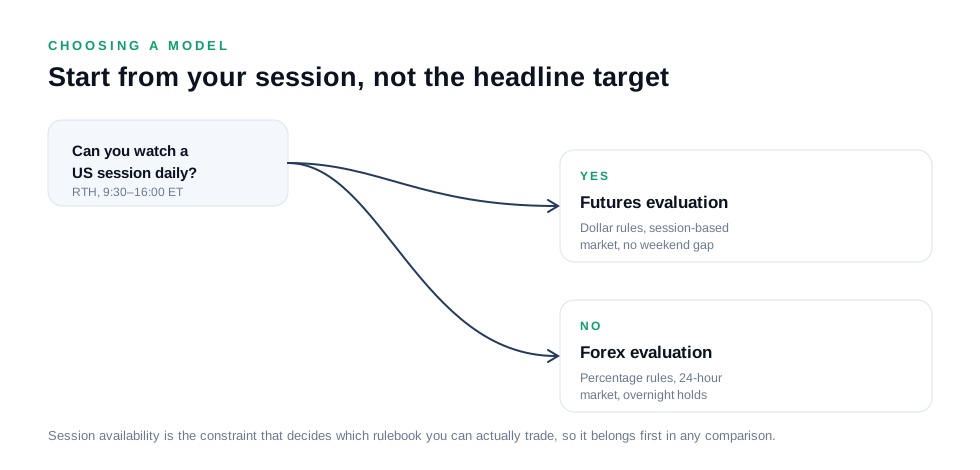
Most evaluation services are built around futures firms with fixed tiers, and a Vest account breaks four of the assumptions that model rests on. The differences are not marketing; each one changes how the attempt is planned.
| Dimension | Typical futures firm | Vest Markets |
|---|---|---|
| Target | Fixed per tier, published | Chosen at checkout, 10% or 20% |
| Daily limit | Fixed, or none at all | 3%, 4% or none, chosen at checkout |
| Drawdown | Often trailing | Static 6% of starting capital |
| Split | Fixed, usually 80–90% | Configurable within a range |
| Settlement | Bank transfer or card rails | USDC on the platform, claims in about a day |
| Ceiling | Up to $150,000 or $400,000 | $50,000 |
| Conduct | News often restricted | News, scalping and overnight all permitted |
The static floor is the biggest planning difference. A trailing floor forces the position unit down as profit accrues; a static floor lets the unit stay constant from the first session to the last. The plan on Vest therefore sets one risk unit and only cuts it when the buffer shrinks, never merely because the balance rose.
The ceiling is the second. At $50,000 the account cannot produce the payout a $150,000 futures account produces on the same percentage, so the fee per dollar of ceiling is higher. That is not a defect in the product, but it does mean a client comparing a $220 Vest service pass against a $220 Tradeify pass is not comparing like with like: the futures account has three times the payout ceiling.
The settlement rail is the third. Claims settle to the platform and withdrawals leave as USDC, which is fast and cheap if the client already holds crypto and a nuisance if they do not. The plan accounts for it at payout rather than at purchase: the client is told before the first claim what the withdrawal route involves.
Conduct is the fourth, and it cuts both ways. News, scalping, overnight and weekend holding are all allowed, which removes the timetable constraints that shape a futures pass. It also removes the rules that stop many traders from overtrading, so the discipline has to come from the plan rather than from the rulebook.
Four ways a Vest attempt ends
Choosing no daily limit to save money. The daily loss setting is a purchase decision, and removing it saves a little on the quote while removing the only intraday brake. On a $600 buffer a single session with no limit can end the evaluation in the first hour.
Sizing to the target rather than the buffer. A 10% target on $10,000 is $1,000 of profit, and a trader who sizes for that number is risking several times the $600 of room available. The target is what has to be earned; the buffer is what may be lost, and only the second one sizes a position.
Buying the smallest tier to test the water. At $500 the buffer is $30 and the fee is nearly half the account. There is no version of that purchase where the service has room to demonstrate anything.
Treating the 20:00 reset as a market close. The trading day turns over in the New York evening, not at a session bell. An overnight position carried past that point is measured against a fresh allowance, and a trader who assumes the old day is still running can misjudge how much room remains.
Frequently asked about the Vest evaluation
Does the $220 fee change with account size?
No, the fee is flat — but we only take Vest jobs from $10,000 upward, because below that the fee is too large a share of the account to be worth paying. That floor is stated before quoting rather than after.
Which target should I configure?
The lower of the two. A higher target lowers the purchase price and doubles the required pace, and on a static floor the difficulty lands in the first week when the buffer is narrowest. A failed attempt costs more than the discount saves.
Should I choose no daily loss limit?
No, on accounts under $25,000. The daily limit is the only brake on a single bad session, and the static buffer does not grow back. Choose 3% rather than 4% on the smaller sizes.
Is the drawdown trailing?
No. It is a static 6% of starting capital, fixed for the whole evaluation. Profit raises the balance but never the failure level, which is why the risk unit can stay constant through the attempt.
When does the trading day reset?
At 20:00 New York time, not at a market open. A position carried into the evening is measured against the next day's allowance, which matters for overnight holds even though they are permitted.
Can you trade the instant funded account?
No. It has no evaluation to pass, so there is nothing for a passing service to do. Any offer to "pass" an instant account is describing a managed account, which the terms do not permit.
Do you check the terms before I pay?
Yes, and it is free. Send the route, the configuration and any support reply you have, and we confirm in writing whether third-party trading is permitted on the evaluation and after funding.
What happens if the evaluation fails?
You are told the day it happens, the failure is classified, and the attempt is retried at no additional service fee while the evaluation is open. Vest's own fee remains your cost and is refundable only in narrow cases.
What do you need from me to begin?
The route and configuration for the terms check, plus any support reply you already hold. Once it clears you buy the account in your own name, the access scope is agreed in writing, and the first session follows it.
Check your Vest terms first
Send the route and account size and we confirm in writing whether third-party trading is permitted — before you pay anything. If it is not, we say so in writing before you pay.
Related reading
- Upcomers evaluation
- Phidias evaluation
- Tradeify evaluation
- FundedNext evaluation
- How the flat-fee model works
- Daily drawdown explained
- Recently passed evaluations
- Challenge calculator: target, risk and pace
Vest Markets is named for identification only. ElitePropX is an independent evaluation service and is not affiliated with, endorsed by or sponsored by Vest or any other proprietary trading firm. The service is offered only where a firm's terms permit third-party trading. A funded account is not a guarantee of income, and trading involves substantial risk of loss. Verify current terms before purchasing an evaluation.